


 Unable to repay its debt, Sri Lanka gave China a controlling equity stake and a 99-year lease for Hambantota port, which it handed over in December 2017. The economic rationale for Hambantota is weak, given existing capacity and expansion plans at Colombo port, fueling concerns that it could become a Chinese naval facility. Recipient countries should link infrastructure projects to broader development strategies that assess projects within larger networks and monitor overall debt levels. The international community should expand alternatives to Chinese infrastructure financing but cannot and should not support all proposed projects.
 7 April 2018
Game of Loans: How China Bought Hambantota
Unable to repay its debt, Sri Lanka gave China a controlling equity stake and a 99-year lease for Hambantota port, which it handed over in December 2017. The economic rationale for Hambantota is weak, given existing capacity and expansion plans at Colombo port, fueling concerns that it could become a Chinese naval facility. Recipient countries should link infrastructure projects to broader development strategies that assess projects within larger networks and monitor overall debt levels. The international community should expand alternatives to Chinese infrastructure financing but cannot and should not support all proposed projects. India-Iran Cooperation at Chabahar Port: Choppy Waters

India’s efforts to help develop Iran’s Chabahar Port reflect Indian ambitions as a driver of infrastructure development and improved regional connectivity, particularly with Afghanistan. Chabahar Port is meant to serve as an essential node to a multi-modal transportation network for the movement of goods and passengers between Iran, Afghanistan, and India. During the final phase of its development, the port is expected to be capable of handling 20 million tons of trade annually. Only 72 kilometers from the Chinese-backed, Pakistani port of Gwadar , the project is seen as a strategic play to limit the influence China seeks to gain and wield through its Belt and Road Initiative. Chabahar also allows the bypassing of a Pakistani bottleneck in terms of India-Afghanistan connectivity.
Long Before Cambridge Analytica, There Was KGB
by Aravindan Neelakandan
 Today, there is a massive outrage against the alleged misappropriation of big data from a social networking site by Cambridge Analytica and political parties seeking the services of such transnational big data crunchers to manipulate the electorate. However, decades before Cambridge Analytica, Soviet intelligence agency, the KGB (Komitet Gosudarstvennoy Bezopasnosti translated in English as Committee for State Security), had a free run in India.
Today, there is a massive outrage against the alleged misappropriation of big data from a social networking site by Cambridge Analytica and political parties seeking the services of such transnational big data crunchers to manipulate the electorate. However, decades before Cambridge Analytica, Soviet intelligence agency, the KGB (Komitet Gosudarstvennoy Bezopasnosti translated in English as Committee for State Security), had a free run in India.An Indian Marshall Plan to thwart China’s Asia ambitions?
By RAVI KANT
The world is facing a complex international scenario with the threat of conflict on the Korean peninsula, a possible global trade war and growing tension in the Middle East. Economic interdependence, mutual distrust and unreliable security guarantees encourage ostensible allies to hedge against one another to protect their interests. The big question is the rise of China both economically and militarily and its growing assertiveness in the South China Sea, South Asia, Eurasia and Africa. China is clearly undermining regional security by engaging in coercive activity in the South China Sea and challenging the International Tribunal ruling https://goo.gl/nMNozT. South China Sea sovereignty and the huge rise in China’s military budget are deeply troubling concerns for Asian countries. It’s clear that China is seeking global domination.
Foreign Policy Think Tanks in India: New Actors, Divergent Profiles
 Seemingly paradoxically, over the past few years, India has seen a greater centralisation of foreign policy decision-making and the simultaneous rise of new foreign policy think tanks. Traditionally marginalised, India’s foreign policy think tank sector has gained in visibility and vibrancy due to new demand in the wake of India’s expanding international stakes.
Foreign policy think tanks created in India after 2009 are more active and visible in the public sphere than their predecessors. This is partly because they have more funding and increased access to information due to a more supportive government and a more open Ministry of External Affairs (MEA).
How to fix competition in a market owned by Google, Facebook, Amazon and other digital platforms
Anupam Manur
 Almost every digital major out there – from Google to Amazon, Ola to Swiggy – plays both platform and player to expand their reach and market. This itself is not anti-competitive but it becomes unfair practice when the platform takes benefit of data of others on the platform to its benefit. India does not have an adequate legal framework to deal with this yet but it can explore different options even if it means moving from textbook regulation.
 Inside the Minds of Afghanistan’s Commandos
By Franz J. Marty
 Just before nightfall, a group of Afghan commandos approaches the high mud walls of a Taliban-held village behind Farahrud Bazaar in the western province of Farah. The alleys between the walls that enclose the houses yawn empty, but the appearance is deceptive. Two commandos place explosives on the back wall of one compound – the gate in the front might be mined and is not a safe way in. “Explosion, explosion, explosion,” a commando calls through the dusk; a bang follows. The cloud of dust settles, revealing a hole in the wall.
Kyaukpyu: Connecting China to the Indian Ocean
 Chinese state-owned firms have reached agreements with Myanmar to construct a $7.3 billion deep-water port and $2.7 billion industrial area in a special economic zone at Kyaukpyu along the coast of the Bay of Bengal. The strategic town is the terminus of a $1.5 billion oil pipeline and parallel natural gas pipeline running to Kunming in China’s Yunnan Province. Despite fears that the project could eventually be used for Chinese military access, political and legal restrictions in Myanmar make this unlikely. The project is aimed mainly at helping China avoid the vulnerable Strait of Malacca and aid the development of its southwestern hinterland.
 CHINA SAYS U.S. WANTS WORLD FOR ITSELF AND THAT'S WHY IT CAN'T ACCEPT BEIJING'S ROLE IN AFRICA
BY TOM O'CONNOR
China has defended its expanding role in Africa after lawmakers in Washington announced they would open an investigation into Beijing's push for economic and military influence in a number of countries there. House Intelligence Committee Chairman Devin Nunes, a GOP representative from California, said on Fox News's Sunday Morning Futures with Maria Bartiromo that China was "a big problem" and that he and fellow Republican lawmakers were "running an investigation on many aspects of China," including allegations of intellectual property theft, currency manipulation and its "military footprint" in Africa. The following day, the Chinese Foreign Ministry denied charges of malpractice and called for cooperation rather than competition with the U.S.
The looming threat of Chinese imperialism
 North Korean dictator Kim Jong Un recently announced a surprise visit to China, where he was welcomed with considerable warmth and vaguely promised that his country would de-nuclearize at some point. It's a small sign of how the center of world politics is shifting away from the United States and towards Asia. Coincidentally, on that same day Amnesty International released a reporton a Chinese mining operation that almost certainly worsened a flash flood that wrecked a small, poor village in Mozambique in 2015. The company Haiyu had been mining titanium, zircon, and ilmenite in the area, and dumping the tailings onto the local wetlands — thus reducing the capacity to absorb heavy rains.
China’s new surveillance state puts Facebook’s privacy problems in the shade
By John Pomfret
 When a woman walked to work this month in the bustling Southern Chinese metropolis of Shenzhen, she, like many millions of other Chinese, jaywalked, cutting across a side street to avoid a detour of hundreds of yards to a crosswalk. What happened next, as documented by the woman, a writer calling herself Mao Yan, was an illustration of a brave new world being born in China. Two traffic policemen approached the woman and told her that she had violated the traffic regulations of the People’s Republic of China.
 Commentary: How Beijing is winning in the South China Sea
Peter Apps
Earlier this month, the USS Carl Vinson became the first American aircraft carrier to visitVietnam since the Vietnam War ended in 1975. Coming alongside the news that a record 23 nations from Southeast Asia and beyond would be joining biennial naval exercises in the eastern Indian Ocean, it was a potent reminder of just how eager the nations surrounding the South China Sea are to embrace powerful allies to fend off a rising China.A sailor walks among aircraft aboard the USS Carl Vinson after it docked in Danang, Vietnam. March 5, 2018. REUTERS/Kham
The Catholic Church and China: Where Religion and Geopolitics Meet
 The Roman Catholic Church has been at odds with the state in China since the imperial period, reflecting the broader dynamic of politics trumping religion in the country. Religious movements in China succeed best when they can show they are not a threat to centralized control, as with Buddhism. But the Vatican's fortunes may change as it approaches a possible compromise with Beijing, causing repercussions for Christianity in China as well as for Taiwan.
How China’s grand strategy for the Mekong impacts the river, and the countries downstream.
By Tom Fawthrop
 The Mekong has long cast a mystical spell over adventurers, wildlife experts, and scientists enchanted by its spectacular rapids and waterfalls, along with its endangered dolphins, giant manta rays, and Siamese crocodiles. The river’s biodiversity is second only to the Amazon. In recent years, however, this great international river – which flows through six countries – has increasingly grabbed the attention of engineers, technocrats, and energy consultants on a very different kind of mission: to exploit its roaring currents in pursuit of hydropower.
Fewer Checks, More Balancing: How Xi Jinping’s Consolidation of Power Changes the Risk of War
 The recent consolidation of power by Chinese President XI Jinping has sparked a wave of concern in the West. For several decades, prominent commentators and policymakers have argued that China’s economic expansion would plant the seeds for political liberalization. As the argument went, a more representative and prosperous China would then become a member, of rather than seek to overthrow, the rules-based global order. Other observers, however, never lost sight of the authoritarian nature of the Chinese regime.
 50 years after the Battle of Karameh, Jordan faces new uncertainty
 Fifty years ago, an armed confrontation between Israel, Jordan, and Palestinian guerrillas created a new phase of Middle East diplomacy and conflicts. What does the battle’s legacy tell us about Jordan and its place in the troubled region today? In March 1968, a battle largely forgotten in the Western annals of Middle East conflicts was waged along the Israeli-Jordanian border. The fifteen hour engagement east of the Jordan River between the Israeli Defense Forces (IDF), the Palestinian Liberation Organization (PLO), and the Jordanian Armed Forces, was something of a draw, with all sides heralding a victory.
The Battle of Karameh’s mixed legacy
How Iran Used the Hezbollah Model to Dominate Iraq and Syria
By Ranj Alaaldin
 DOHA, Qatar — Global anxiety that the United States will take military action against Iran has increased now that President Trump has appointed John Bolton as his national security adviser. Mr. Bolton has long promoted regime change in Iran, argued for bombing Iran and a more assertive American policy against Iranian expansionism in the Middle East. But the United States cannot effectively confront Tehran and its proxies until it appreciates Iran’s role in state building in Middle Eastern countries decimated by conflict.
Why Central Banks Could Mint Their Own Digital Currency
From the Marshall Islands to Russia, it seems everyone's on board with the year's hottest trend: digital currency. Following the boom and (partial) bust of various private cryptocurrencies over the last six months, several central banks are now seriously considering introducing their own national digital currencies in the near future. These currencies won't just be bit players in a field dominated by the likes of bitcoin; instead, the central banks' entry into the crypto game could have a significant effect on individual customers, commercial lenders and the international monetary system itself.
Mattis: Russia Has Chosen To Be a "Strategic Competitor"
Dave Majumdar
 The United States places the blame on Russia for the breakdown in relations between NATO and Moscow. In the view of U.S. Defense Secretary Jim Mattis, Russia chose to be strategic competitor to the United States and NATO. “The NATO alliance tried to create a partnership—so, there's a Russia-NATO partnership council,” Mattis told reporters on March 27. “There is a mechanism to keep us working together. And I think a number of us with my color hair can remember Russian marines in North Carolina working with U.S. Marines as we prepared for possible deployments together on U.N. peacekeeping missions—humanitarian relief.”
Was the Arab Spring a black-swan event?
Elena Ianchovichina
To the Lebanese-American author Nassim Taleb almost all major discoveries and historical events are “black swans.” These very rare, extremely impactful events initially come as a surprise, but once they occur, they are often inappropriately rationalized with the benefit of hindsight. For Taleb, historical events such as World War I and September 11 are some examples of black swans. In his view, these outliers explain almost everything that followed as they changed the course of history.
Judy Asks: Does Europe Have a Russia Policy?
JUDY DEMPSEY
Federiga BindiSenior fellow at the School of Advanced International Studies at Johns Hopkins University, Jean Monnet chair at the University of Rome Tor Vergata, and D. German distinguished visiting char at Appalachian State University No and yes. Ever since the end of World War II, European countries have been squeezed between the West (the United States) and the East (the Soviet Union, then Russia). Any foreign policy decision had to take into consideration—at least to some extent—either or both of these countries’ preferences. For Central and Eastern Europeans, the Soviet Union pretty much dictated any foreign (and domestic) policy decision. For Western Europe, the picture was more nuanced. Countries like Germany and Italy tried to find a difficult balance between Atlantic obligations and Eastern reality.
Patriot Missiles Are Made in America and Fail Everywhere
BY JEFFREY LEWIS
 The evidence is in: the missile defense system that the United States and its allies rely on is a lemon. On March 25, Houthi forces in Yemen fired seven missiles at Riyadh. Saudi Arabia confirmed the launches and asserted that it successfully intercepted all seven. This wasn’t true. It’s not just that falling debris in Riyadh killed at least one person and sent two more to the hospital. There’s no evidence that Saudi Arabia intercepted any missiles at all. And that raises uncomfortable questions not just about the Saudis, but about the United States, which seems to have sold them — and its own public — a lemon of a missile defense system.
Why the U.S. Government Is No Longer Capable of Ensuring National Security
Russell W. Glenn Ian M. Sullivan
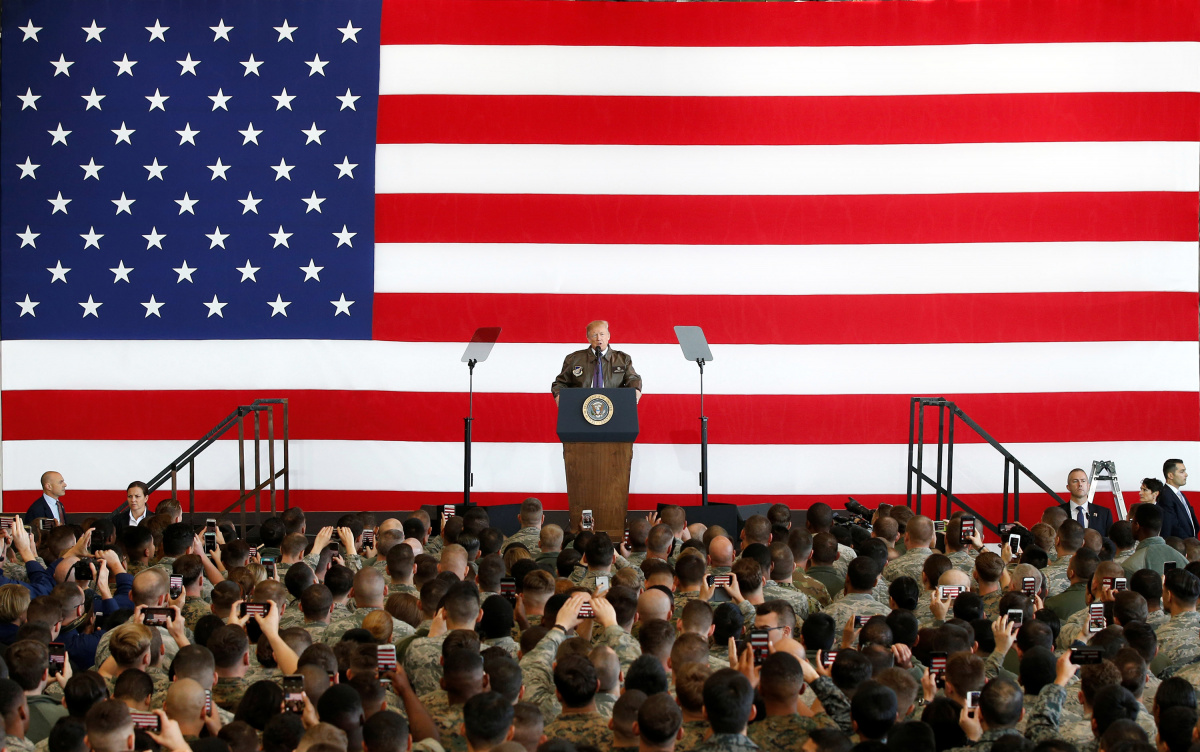 The U.S. government as currently structured and regulated is unable to guarantee the security of its country. This is true both in terms of wars involving combat with a peer or near-peer competitor and what we will here call “conditional-peer” threats, those able (A) to challenge or exceed U.S. capabilities, (B) in one or more functional or geographical arenas, but (C) not across all or most such spheres.
What the Hell Is Happening in Gaza?
By Chas Danner
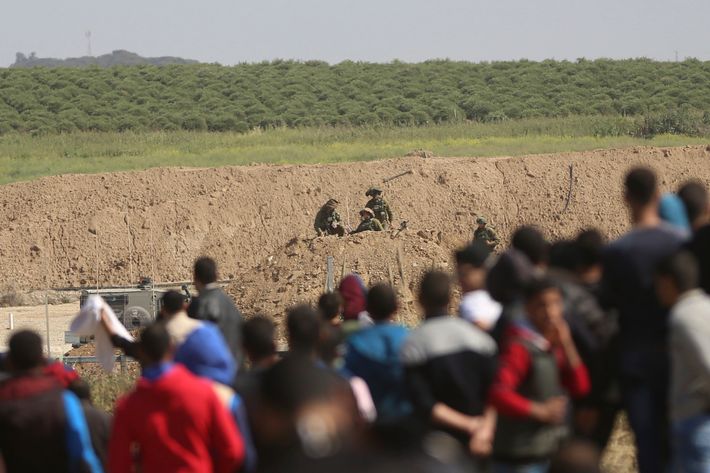 At least 15 Palestinians are dead and hundreds more injured after Israeli troops fired on demonstrators taking part in a large-scale border protest in Gaza on Friday. It was the deadliest day for the Israeli-Palestinian conflict since the last Israeli war in Gaza in 2014, and the violence could escalate dramatically in the coming days and weeks.Some 30,000 Gazans amassed along their side of the border on Friday for the first day of the “Great March of Return,” a heavily promoted six-week protest over Palestinians’ inability to return to their ancestral homes in what is now Israel. Most of the attendees protested peacefully at encampments hundreds of meters from the border, which is well protected by armed Israeli forces. But large crowds of mostly young men inevitably ventured closer, resulting in clashes. Those demonstrators mostly hurled rocks, but some threw Molotov cocktails and rolled burning tires at the border fence. The IDF forces fired back, using tear gas as well as bullets.
The FSB: A Formidable Player in Russia’s Information Security Domain
By: Sergey Sukhankin
The long-running legal conflict between the Federal Security Service (FSB) and Telegram Messenger Limited, a cloud-based instant messaging service created by Pavel Durov, finally seemed to come to an end on March 20. That day, the Federal Service for Supervision of Communications, Information Technology and Mass Media (Roskomnadzor) demanded that Telegram provide the FSB with fully de-coded information pertaining to private correspondence of the messenger’s clients (Rosbalt, March 20). Specifically, all information (including all the codes and specific instructions) pertaining to incoming, outgoing and/or processed electronic messages must be handed over to the FSB within 30 days. If Telegram fails to comply by this deadline, Russian Internet service providers (ISP) will be charged with blocking online access to the instant messenger. This decision followed provisions engrained in Article 10.1 of the Federal Law “On Information, Information Technologies and Protection of Information,” adopted in 2006 (Consultant.ru, July 27, 2006).
If We Want To Get To Real Time AI, We’ve Got To Build Another iPhone Industry. Five Times Over.
 InOctober 2016, Tesla announced a significant change to its Advanced Driver Assistance System package. This is the combination of sensors and computer power that will enable Tesla to fulfill Elon Musk’s promise to drive “all the way from a parking lot in California to a parking lot in New York with no controls touched in the entire journey” by the end of 2017. Amongst the many changes to the sensor package was a switch in the systems’ brains. Previously powered by a processor from Mobileye (recently acquired by Intel) the package now sports a Nvidia Drive PX 2. Why?
How to Modernize Data Processing, Exploitation and Dissemination Methods
 As the amount of data collected increases, it is critical that modern tools are used to streamline the time-consuming collecting and tagging tasks associated with Processing, Exploitation and Dissemination (PED). Government and military organizations today have more data than they know what to do with. Terabytes of data are collected each day from various types of equipment all over the world. This multitude of resources has made examining and integrating disparate data types from different sources — particularly video — in a timely and cost-effective manner a significant challenge. As the ways in which we collect data have evolved, so do the methods we use to analyze it.
Everything you need to know about a new EU data law that could shake up big US tech
Arjun Kharpal
The General Data Protection Regulation (GDPR) will come into force on May 25. It will affect companies located in the European Union but also those that have operations and customers there too. The key principle of GDPR is giving consumers control of their data. There are fines of up to 4 percent of total global turnover if rules in the GDPR are breached. You may have heard of the General Data Protection Regulation (GDPR). But most likely you haven't because it sounds boring, but it's really important and CNBC has a guide to help you understand it.
The Theft or Abuse of Your Personal Information by Governments, Facebook and Others Is Now the New Norm. What Lessons Have We Learned?
Paul R. Pillar
The sudden attention to the exploitation, including for political purposes, of information on millions of Facebook users in ways that ought to make those users uncomfortable—and to how Facebook does not seem to have cared about such abuses—has been tardy and myopic even though the attention is fully justified. It took the story about Cambridge Analytica’s mining of Facebook data to get that attention, even though the probability of such unwelcome exploitation of personal information has existed since the dawn of social media.
Triggering the New Forever War, in Cyberspace
 The United States is in the midst of the most resounding policy shift on cyber conflict, one with profound implications for national security and the future of the internet. The just-released U.S. Cyber Command “vision” accurately diagnoses the current state of cyber conflict and outlines an appropriate new operational model for the command: since cyber forces are in “persistent engagement” with one another, U.S. Cyber Command must dive into the fight, actively contesting adversaries farther forward and with more agility and operational partnerships.
United States Cyber Command’s New Vision: What It Entails and Why It Matters
By Richard J. Harknett
The United States Cyber Command (USCYBERCOM) has released effectively a new command strategy (formally called a “Command Vision,” although it addresses ends, ways and means), anchored on the recognition that the cyberspace domain has changed in fundamental ways since the Command was established in 2009. Drawing on its experience over the past eight years, the Command offers a new approach that aligns with the strategic realities within which it must successfully operate. The “Achieve and Maintain Cyberspace Superiority: A Command Vision for US Cyber Command” marks a significant evolution in cyber operations and strategic thinking, portending an opportunity to bring about greater security and stability to the interconnected global digital environment.
NSC Readies Major Overhaul in US Arms Exports
By PAUL MCLEARY
 Call it, Sell American. The Trump administration’s National Security Council is readying a slew of proposals to cut bureaucratic red tape and reduce the long timelines normally involved in international arms sales. The plan, dubbed the Arms Transfer Initiative, picks up on work started under the Obama administration, while adding a Trumpian element to the proposal that is described by administration officials as both promoting his America First philosophywhile ensuring that allies are better able to provide for their own security.
7 Big Pentagon Numbers in the $1.3 Trillion Spending Deal
By Michael Rainey
 The Department of Defense is one of the biggest winners in the $1.3 trillion omnibus spending bill working its way through Congress, with the Pentagon receiving $700 billion for the current fiscal year, a $61 billion increase from 2017. House Speaker Paul Ryan emphasized the Pentagon funding Thursday, calling the spending package “the Trump-Jim Mattis budget,” a reference to the secretary of defense. The base Pentagon budget for fiscal year 2018 is $590 billion, with an additional $65 billion for the defense component of the Overseas Contingency Operations fund and the remainder appropriated to defense-related activities in other federal agencies. The total is $80 billion higher than the funding levels defined by the 2011 Budget Control Act, which lawmakers agreed to bust through this year and next. Some critics have charged that the spending caps imposed by the Budget Control Act have resulted in serious maintenance problems for the military.
‘The Art of War’: As relevant now as when it was written
by Peter Harris

The Art of War has rightly become one of the world’s most influential books on military strategy. Written well over two thousand years ago in China, but not translated into English until the beginning of the twentieth century, it is now studied in military academies around the globe. Indeed, its relevance has been reconfirmed in the twenty-first century. For Sun Tzu, and for any strategist, of course, the best strategy is the one that delivers victory without fighting. “Troops that bring the enemy to heel without fighting at all - that is ideal,” he advised. Those who soldiered during the Cold War - or any war, for that matter - can certainly attest to the wisdom of Sun Tzu’s observation; however, those who remained in uniform beyond 9/11 would caution that, unfortunately, it is not always possible to prevail against one’s enemies without resort to arms.
US Army’s Futures Command sets groundwork for battlefield transformation
By: Jen Judson
In his keynote address to the AUSA Global Force Symposium, Army Secretary Mark Esper explains why the service considers modernization to be so important. It’s the beginning of a new era in Army acquisition in which soldiers might not have to wait 10 years or longer to see a new weapon or capability in the field, but instead could get modern, new systems in their hands within just a few short years. That’s at least what service leaders tasked to come up with new road maps for the Army’s top modernization priorities are thinking is possible. The newly vigorous pace is fueled by the frustration created by years of painful acquisition blunders, sluggish bureaucratic processes and wasted dollars, all on top of the fact that near-peer adversaries like Russia haven’t waited to develop weapons systems that would create serious dilemmas for the U.S. Army and its Middle East-tuned equipment if it had to face off in a conflict.
Subscribe to:
Posts (Atom)