The Profession of Arms: A Guide for Young Army Officers
It takes courage, especially for a young officer, to check a man met on the road for not saluting properly or for slovenly appearance, but, every time he does, it adds to his stock of moral courage, and whatever the soldier may say, he has respect for the officer who does pull him up.
Read Document →The Dragon's Teeth: Assessing China's Military Modernization
PLA has focused on modernising its capabilities across all warfare domains to achieve these goals. This includes land, air, and maritime operations, nuclear, space, counter-space, electronic warfare and cyberspace operations, aiming to become a fully integrated joint force.
Read Document →Transforming the PLA: A Decade of reorganisation from SSF to ISF
PRC has engaged in a sustained and broad effort to transform the PLA from an infantry-heavy, low-technology, ground forces-centric military into a high-technology, networked force with an increasing emphasis on joint operations and naval and air power projection.
Read Document →Eyes without Borders: Exploring the World of Open Source Intelligence (OSINT) in the Digital Age
Open Source Intelligence (OSINT) is gaining prominence with the rise of social media, the digital society and the vast growth of publicly and commercially available information (PAI and CAI).
Read Document →
The PLA’s Developing Cyber Warfare Capabilities and India's Options
Informationised warfare blurs the lines between peacetime and wartime. A nation in the information age cannot wait for the hostilities to break out to collect intelligence, carryout influence operations, develop antisatellite systems or design computer software weapons.
Read Document →
Galwan and After
Why did China did this when he is under tremendous pressure in all fronts, is this China's salami slice tactics being progressed rigorously, what will be new Rules of Engagement, what will be escalatory control mechanism, who has taken this decision, will there be some pressure put by China in India's North-East through insurgency.
Read Document →
India’s Joint Doctrine for Cyberspace Operations: A Critical Review
Chief of Defence Staff (CDS) General Anil Chauhan and Secretary, Department of Military Affairs, formally released declassified versions of the Joint Doctrines for Cyberspace Operations during the Chiefs of Staff Committee meeting in New Delhi.
Read Document →
Know your Enemy General(now Field Marshal) Syed Aseem Munir
Gen SA Munir's position in the hierarchy of Pakistan was not very comfortable. The state of economy, insurgency in Pakhtoonistan and Balochistan, attack on the Jaffar Express, constant protests by supporters of Imran Khan's supporters inside and outside of parliament.
Read Document →
Decoding Operation SINDOOR: Key Aspects and Implications
Precision strikes were carried out on nine sites—four in Pakistan and five in PoK—linked to anti-India terrorist groups such as the LeT, JeM and the Hizbul Mujahideen. The targeted sites included Muridke (LeT headquarters) and Bahawalpur (JeM headquarters).
Read Document →
Chinese Cyber Exploitation in India's Power Grid - Is There a linkage to Mumbai Power Outage?
The New York Times (NYT), based on analysis by a U.S. based private intelligence firm Recorded Future, reported that a Chinese entity penetrated India’s power grid at multiple load dispatch points. Chinese malware intruded into the control systems that manage electric supply across India, along with a high-voltage transmission substation and a coal-fired power plant
Read Document →23 September 2019
Afghan president sees his chance after collapse of U.S.-Taliban talks
Al Qaeda Is Ready to Attack You Again
Al Qaeda-linked Nusra Front fighters carry weapons on the back of pick-up trucks in Arsal, eastern Bekaa Valley, Lebanon, December 1, 2015Abu Dhabi dispatch: The great Sino-US decoupling
The most knowing delegates at this year’s World Energy Congress continued to worry about the US-Chinese trade war.Taiwan’s Defense Strategy Doesn’t Make Military Sense
Taiwan is approaching an ominous deadline. For decades, the leaders of the Chinese Communist Party have declared that China’s “great national rejuvenation” must be accomplished by the year 2049. National rejuvenation, the party insists, includes a Taiwan governed by the same powers and principles that now reign across the Taiwan Strait. Beijing would prefer to accomplish this through the free assent of the Taiwanese people. If they do not give it, party leadership has made clear that it is willing to decide the matter with military force.Are Hong Kong’s Protests Dying Down?
Good afternoon, and welcome to Foreign Policy’s China Brief. The highlights this week: What the ongoing protests mean for Hong Kong’s future, questions loom over Chinese influence in Australia, and the government releases shaky figures for Chinese industry.China and the world: Inside the dynamics of a changing relationship
Why the Hong Kong economy remains resilient amid unrest
Analyzing Toxic “Fake News”: Are Key Concepts Promulgated by Master Propagandists of the Past Still in Practice Today?
This Is the Moment That Decides the Future of the Middle East
Since the end of World War II, three core interests have shaped U.S. Middle East policy: ensuring the free flow of energy resources from the region, helping to maintain Israeli security, and making sure no state or group of states can challenge American power in a way that would put the other two interests at risk. In other words, aside from the strategic, historical, moral, and political reasons for the “special” U.S.-Israel relationship, oil is the reason why the United States is in the Middle East at all.The Attack on the Saudi Oil Facilities: A New Level of Iranian Audacity
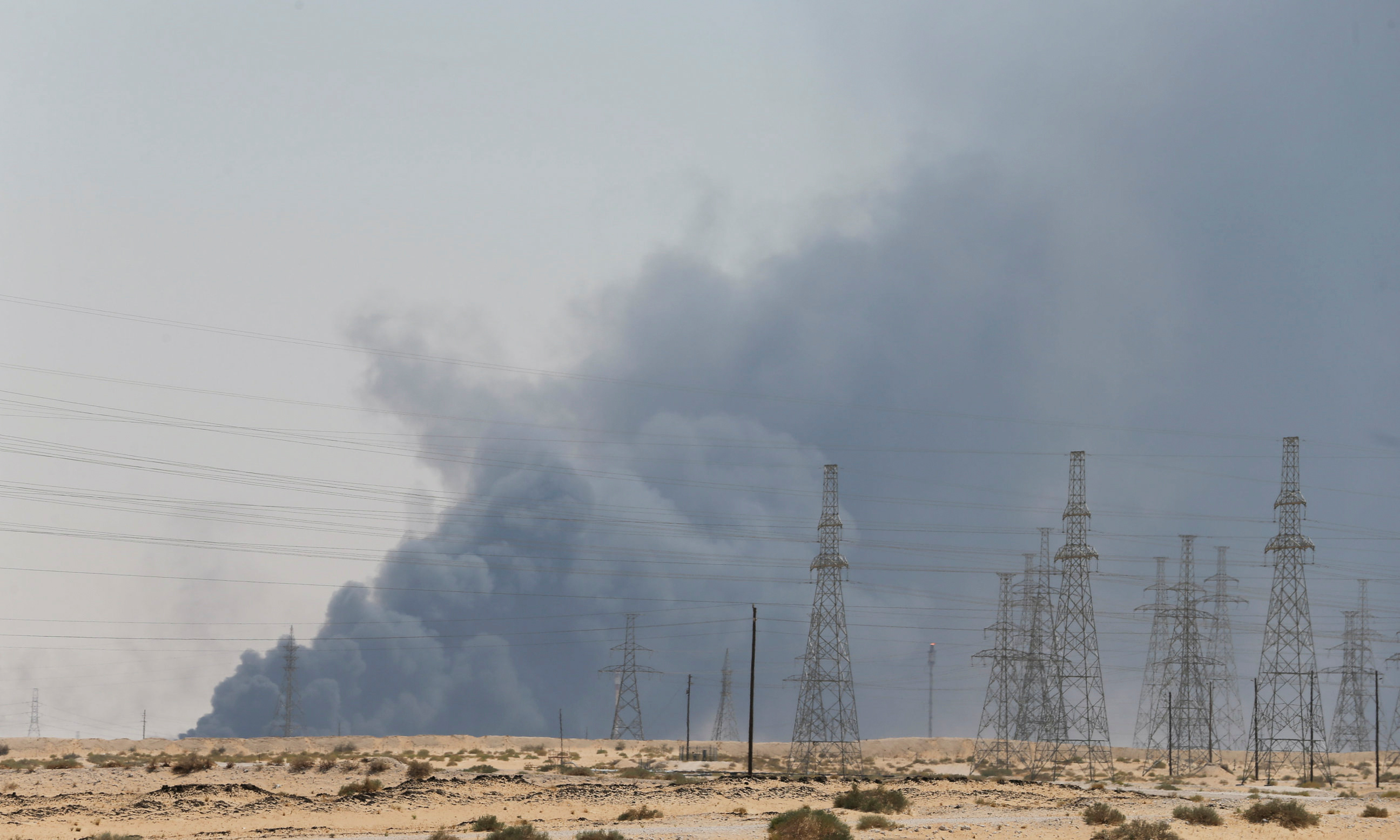
The September 14 attack on the oil facilities in Saudi Arabia - including Abqaiq, which is considered the largest of its kind in the world - is the most serious kinetic attack on oil facilities in the Gulf since the 1991 Gulf War, in terms of damage and economic significance. This incident goes far beyond the bounds of the war in Yemen, particularly if it is proven beyond any doubt that the attack was launched from Iranian territory. Under these circumstances, it is evident that even if Iran is not interested in a broad deterioration vis-ร -vis the United States, it is prepared to take new and more daring risks, based in part on the assessment that President Trump, as well as the Saudis and other Gulf states, is not interested in severe escalation. The reactions from both the Saudis and the US will be determined by several converging interests, some of which are contradictory. On the one hand, Riyadh and Washington have an interest in punishing and deterring Iran. On the other hand, they are not interested in running the risk of dragging the entire region into an all-out war, particularly after Saudi vulnerability has been brought into sharper relief. One way or another, it is likely that pressure on both leaderships to respond will grow. From Israel’s standpoint, given its continued attacks in Syria and Iraq, and notwithstanding the difference in the nature of the theaters, Iran’s moves in Saudi Arabia carry an indirect yet clear message about its advanced military capabilities, even from outside Iranian territory. They are also a possible signal in the event of a military deterioration between Israel and Hezbollah in Lebanon.US says attack on Saudi oil site was an Iranian ‘act of war’
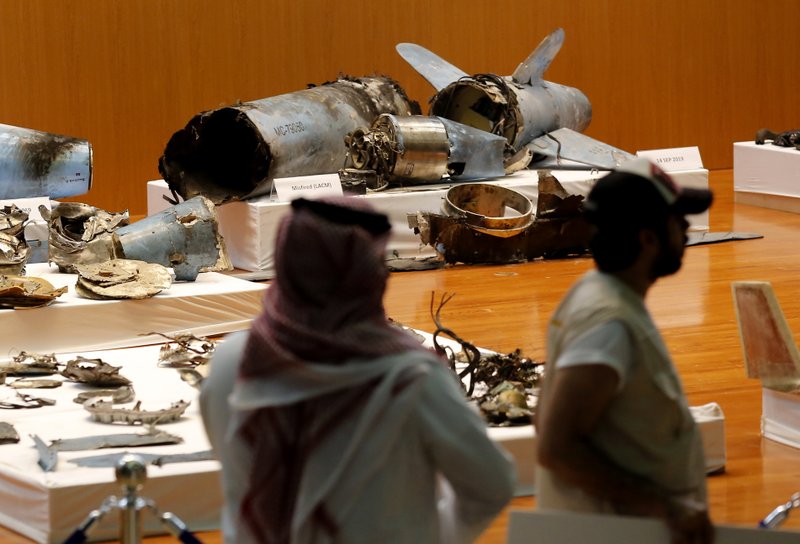
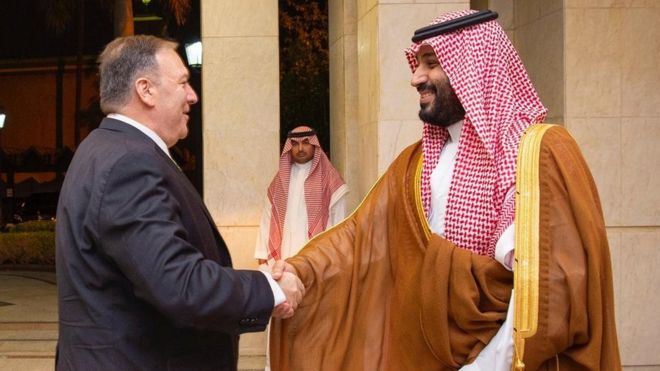
RIYADH, Saudi Arabia (AP) — U.S. Secretary of State Mike Pompeo on Wednesday called the attack on Saudi Arabia’s oil installations an “act of war” against the kingdom by Iran, as the Saudis displayed missile and drone wreckage and cited other evidence they said shows the raid was “unquestionably sponsored by Iran.”Why would Iran raise the stakes by attacking Saudi Arabia?
Saudi Arabia says it has evidence showing Iran sponsored Saturday's drone and missile attacks on two of its oil facilities, and called on the international community to take action. The question is whether there could be a war.Attacks on Saudi Arabia Spell Bad News for the U.S. Military
Asthe security situation in the Persian Gulf continues to deteriorate in the aftermath of Sunday’s cruise missile attacks on Saudi oil facilities, the Trump administration finds itself in an increasingly dire situation — and its apparently dysfunctional relationship with both Iran and Saudi Arabia appears to be to blame.Saudi Oil Infrastructure Offers a Target-Rich Environment for Iran
Iran has recently focused on building up its missile capabilities, putting Saudi Arabia's critical infrastructure within its reach.Putin Is Trolling the United States in the Persian Gulf
Think what you will about Russian President Vladimir Putin, but the man does have a wry sense of humor. Trolling has become one of his trademarks. If Saudi Arabia wants to protect itself, he hinted on Sept. 16, it should make a wise decision and follow Iran and Turkey, who bought Russian air-defense systems. Russia’s S-300 and S-400, he continued “are capable of defending any kind of infrastructure in Saudi Arabia from any kind of attack.” Flanked by Turkish President Recep Tayyip Erdogan and Iranian President Hassan Rouhani at a joint press conference in Ankara, Turkey, following a round of talks on Syria, Putin was poking at another friend of his, Saudi Crown Prince Mohammed bin Salman. “What should the Saudis buy,” Rouhani asked, laughing, “S-300 or S-400?” Putin’s retort was quick: “Let them choose.”Western COIN: The Rise of “Soft” Counterinsurgency Doctrine
The Return of Fiscal Policy
The Economic Consequences of Automation
Competition Without Catastrophe
The United States is in the midst of the most consequential rethinking of its foreign policy since the end of the Cold War. Although Washington remains bitterly divided on most issues, there is a growing consensus that the era of engagement with China has come to an unceremonious close. The debate now is over what comes next.The American Working Man Still Isn’t Working
The United States is in the midst of its longest-ever economic recovery. It has been a slow climb out of the depths of the 2008–9 financial crisis, but the upward trend is now in its 11th year. American workers have seen 107 consecutive months of job growth, more than double the previous record, and the unemployment rate will soon reach its lowest level in over 50 years. However, there is one important economic indicator that still hasn’t rebounded to pre-crisis levels: the employment rate among prime-age men—that is, men between the ages of 25 and 54.Interview – Costas Constantinou
Costas M. Constantinou is Professor of International Relations at the University of Cyprus, with cross-cutting interests in diplomacy, conflict, international political theory, and legal and normative aspects of international relations. His research uses conceptual and autoethnographic approaches to understand methods of engaging alterity and modes of living, relating and cohabiting. Besides Cyprus, he has conducted fieldwork in India, Nepal, Lebanon, Israel, Turkey and Kenya. His publications include States of Political Discourse: Words, Regimes, Seditions and On the Way to Diplomacy.The future of Asia: Asian flows and networks are defining the next phase of globalization
Air Force creates new information warfare organization, revamps Cyber Command teams
In Countering a Creative Security Threat, Anticipation Is Key
Because criminals, militants, spies and the like are ever resourceful, security personnel must overcome some of their traditional inflexibility in addressing threats to their companies.How Cyber Command can limit the reach of ISIS
The U.S. military’s digital team tasked with targeting ISIS is now focused on providing agencies intelligence that will help identify specific individuals and that will limit the group’s financing.Considering the Whole Ecosystem in Regulating Terrorist Content and Hate Online
The last few years have seen a range of proposals to counter terrorist and extremist content online. From the European Commission’s Code of Conduct on Countering Illegal Hate Speech Online in 2016 and its 2018 proposed Regulation for preventing the dissemination of terrorist content online, to the introduction of the German Network Enforcement Act (NetzDG) in 2017, with a similar French law likely to be implemented soon, and the UK’s Online Harms White Paper in 2019, a range of strategies have been advanced. One recurrent idea is a requirement for faster removals, supported by large fines in the event of non-compliance, and the UK’s Online Harms White Paper proposed the creation of a new independent regulatory body.Self-Help in Cyberspace: A Path Forward
Recent years have seen sustained calls to “unleash” the private sector to more assertively combat cyber threats. The argument has gained some sympathy in Congress, where Rep. Tom Graves (R-Ga.) recently reintroduced the Active Cyber Defense Certainty Act (ACDCA). As Bobby Chesney summarizes, the act, if passed, would amend the Computer Fraud and Abuse Act (CFAA) to allow private entities, under certain conditions, to engage in defensive measures that intrude into attackers’ networks for purposes of attributing, disrupting or monitoring malicious activity.Intel, Ethics, and Emerging Tech: Q&A with Cortney Weinbaum
Cortney Weinbaum studies intelligence and cyber policy as a senior management scientist at RAND. Her research has helped the intelligence community improve its data collection and analysis and identify emerging technologies and their impact on operations. She began her career as an intelligence officer, designing advanced sensors for intelligence gathering. She is the recipient of a General Electric Fellowship and Grant for Women in Physics & Computer Science and a Defense Intelligence Agency Humanitarian Award. Weinbaum serves on the board of directors of Carrie Simon House, a charity that provides transitional housing, life skills, and support and mentoring to young, homeless mothers in the Washington, D.C., area.
/arc-anglerfish-arc2-prod-mco.s3.amazonaws.com/public/OYXBYZGXURFC5PYNW4IYGU57HE.jpg)