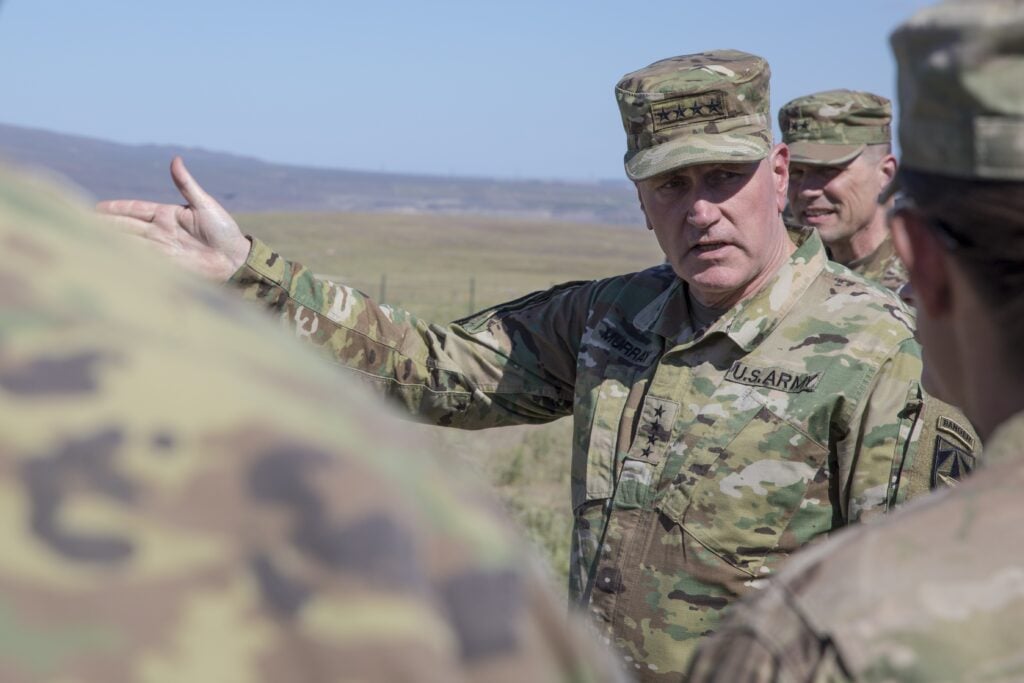
The Profession of Arms: A Guide for Young Army Officers
It takes courage, especially for a young officer, to check a man met on the road for not saluting properly or for slovenly appearance, but, every time he does, it adds to his stock of moral courage, and whatever the soldier may say, he has respect for the officer who does pull him up.
Read Document →The Dragon's Teeth: Assessing China's Military Modernization
PLA has focused on modernising its capabilities across all warfare domains to achieve these goals. This includes land, air, and maritime operations, nuclear, space, counter-space, electronic warfare and cyberspace operations, aiming to become a fully integrated joint force.
Read Document →Transforming the PLA: A Decade of reorganisation from SSF to ISF
PRC has engaged in a sustained and broad effort to transform the PLA from an infantry-heavy, low-technology, ground forces-centric military into a high-technology, networked force with an increasing emphasis on joint operations and naval and air power projection.
Read Document →Eyes without Borders: Exploring the World of Open Source Intelligence (OSINT) in the Digital Age
Open Source Intelligence (OSINT) is gaining prominence with the rise of social media, the digital society and the vast growth of publicly and commercially available information (PAI and CAI).
Read Document →
The PLA’s Developing Cyber Warfare Capabilities and India's Options
Informationised warfare blurs the lines between peacetime and wartime. A nation in the information age cannot wait for the hostilities to break out to collect intelligence, carryout influence operations, develop antisatellite systems or design computer software weapons.
Read Document →
Galwan and After
Why did China did this when he is under tremendous pressure in all fronts, is this China's salami slice tactics being progressed rigorously, what will be new Rules of Engagement, what will be escalatory control mechanism, who has taken this decision, will there be some pressure put by China in India's North-East through insurgency.
Read Document →
India’s Joint Doctrine for Cyberspace Operations: A Critical Review
Chief of Defence Staff (CDS) General Anil Chauhan and Secretary, Department of Military Affairs, formally released declassified versions of the Joint Doctrines for Cyberspace Operations during the Chiefs of Staff Committee meeting in New Delhi.
Read Document →
Know your Enemy General(now Field Marshal) Syed Aseem Munir
Gen SA Munir's position in the hierarchy of Pakistan was not very comfortable. The state of economy, insurgency in Pakhtoonistan and Balochistan, attack on the Jaffar Express, constant protests by supporters of Imran Khan's supporters inside and outside of parliament.
Read Document →
Decoding Operation SINDOOR: Key Aspects and Implications
Precision strikes were carried out on nine sites—four in Pakistan and five in PoK—linked to anti-India terrorist groups such as the LeT, JeM and the Hizbul Mujahideen. The targeted sites included Muridke (LeT headquarters) and Bahawalpur (JeM headquarters).
Read Document →
Chinese Cyber Exploitation in India's Power Grid - Is There a linkage to Mumbai Power Outage?
The New York Times (NYT), based on analysis by a U.S. based private intelligence firm Recorded Future, reported that a Chinese entity penetrated India’s power grid at multiple load dispatch points. Chinese malware intruded into the control systems that manage electric supply across India, along with a high-voltage transmission substation and a coal-fired power plant
Read Document →30 April 2021
To Friends in the United States: Facilitate Global Vaccine Manufacturing
Afghan Ambassador: ‘The Ball Is in the Taliban’s Court’

The Original Sin of the War in Afghanistan

China's Soft Power in Europe: Falling on Hard Times
Over 500 U.S. Scientists Under Investigation for Being Compromised by China
Can Iraq play the role of a bridge in the Gulf?
Nation States, Cyberconflict and the Web of Profit

John Kerry’s Biggest Mission

Global Migration Is Not Abating. Neither Is the Backlash Against It

Why Is Most Oil Found In Deserts And The Arctic?
Why the US Military Is Leading the Charge on 5G
By now, many of us are already experiencing the tip of the iceberg when it comes to 5G technology. Even my personal smartphone occasionally flashes up the 5G symbol when I’m streaming something or using a web application. Unfortunately for me, I don’t see too much of a difference between 4G and 5G networking, but again, most of us only get to see the tiniest bit of what 5G can offer.After Deby’s Death, Chad—and the Region—Brace for the Worst

The Singular Chancellor
Biden’s Everything Doctrine
It is now time to focus on multilateral order
Defending democracies from disinformation and cyber-enabled foreign interference

Transformative Technology, Transformative Governance: A New Blog Series on the Future

HP Study: Nation-State Cyber Attacks Double Between 2017 and 2020 as World Edges Toward Open Cyber Warfar
Privacy Tip #281 – Preparing for Cyber Warfare: A Survival List
The Five C’s of Biden’s Foreign Policy

Artificial Intelligence, Lawyers And Laws Of War

29 April 2021
The Problem With India’s Economic Diplomacy in South Asia

A Preview of Post-Withdrawal Problems in Afghanistan

Japan says Chinese military likely behind cyberattacks

China’s Creative Challenge—and the Threat to America
Open-source analysis of Iran’s missile and UAV capabilities and proliferation
STRATCOM Head Tells Hill He’s ‘Confident’ In NC3 Cybersecurity

These countries are leading the transition to sustainable energy
The Fostering Effective Energy Transition 2021 report highlights global progress in tackling greenhouse gas emissions from energy generation.Sustainable transport can’t just depend on batteries. Here’s why

No Server Left Behind: The Justice Department’s Novel Law Enforcement Operation to Protect Victims
The U.S. Department of Justice announced on April 13 that it undertook a law enforcement operation in the preceding days to remove malware from hundreds of victim systems in the United States. A state-sponsored group referred to as HAFNIUM (as attributed by Microsoft and reporters, but not yet the U.S. government) compromised the systems in question using recently discovered zero-day vulnerabilities in Microsoft Exchange Server—an on-premises software used by tens of thousands of entities to provide corporate email services. Using a search and seizure warrant, the FBI accessed the malware left by hackers on servers located in the United States and issued a command to copy and subsequently delete the malware from those servers. The Justice Department operation contributed to disrupting what security experts (including on Lawfare) have referred to as a reckless and indiscriminate hacking campaign against tens of thousands of victims.Current International Law Is Not an Adequate Regime for Cyberspace
States increasingly agree that international law, specifically the U.N. Charter and rules of customary international law (CIL) derived from the charter’s principles, applies to cyberspace. Yet both are a poor fit for cyber activities. The charter reflects a bias toward what has been termed the conventional strategic environment, and CIL has evolved in the shadow of both the conventional and nuclear environments. In these environments, states threaten international stability by seeking strategic gains through either coercion or brute force. The cyber strategic environment differs in that threats to stability derive from exploitation—that is, states unilaterally using code to take advantage of others’ cyber vulnerabilities for the purpose of realizing strategic gains.Why Is Joe Biden Risking War With Russia Over Ukraine?