Pages

22 January 2026

Revolution in Iran : Now and Then

Lawrence Freedman

On 16 January 1979, exactly 47 years ago, Mohammed Reza Pahlavi, Shah of Iran, left his country, never to return. His departure had been urged by the man left in charge of the government, Shapour Bakhtiar, a moderate opposition politician, who was hoping to stabilise the country with serious reforms. 

It was all too late, insufficient to dampen the revolutionary fervour that had overtaken the country. At the start of February the Ayatollah Khomeini, the 78-year-old cleric who had become the acknowledged leader of the revolution, flew into Teheran from Paris and took control. The next month the Iranian people were asked to decide whether they wanted to live in a monarchy or an Islamic republic. They overwhelmingly chose the latter.
A New Rift in the Gulf, and Only the Gulf Can Solve It

Michael Ratney

For two countries now at each other’s throats, Saudi Arabia and the United Arab Emirates (UAE) have an awful lot in common. They share the ambition and resources to remake the Middle East as an engine of economic opportunity and to serve as global hubs for artificial intelligence, shipping and aviation, tourism, finance, and much more. 

They both long to turn the page on the region’s history of extremism and instability, and focus instead on commerce, social development, and economic diversification. They are both working to wean their economies away from dependence on oil, investing in renewable energy and their own human capital. They both want a strong security partnership with the United States to help defend against their ultimate threats, namely Iran and jihadi terrorists including al Qaida and ISIS. And they both think Israel should ultimately be an integral part of their region, even while their timelines and conditions for advancing that relationship differ sharply.

Iran protests abate after deadly crackdown, Trump says Tehran calls off mass hangings

Parisa Hafezi and Nayera Abdallah

"I greatly respect the fact that all scheduled hangings, which were to take place yesterday (Over 800 of them), have been cancelled by the leadership of Iran. Thank you!" he posted on social media. Iran has not publicly announced plans for such executions or said it had cancelled them.

The protests erupted on December 28 over economic hardship and swelled into widespread demonstrations calling for the end of clerical rule, culminating in mass violence at the end of last week. According to opposition groups and an Iranian official, more than 2,000 people were killed in the worst domestic unrest since Iran's 1979 Islamic Revolution.

Iran and the Limits of American Power

Andrew P. Miller

Over two weeks into wide-scale protests against the Islamic Republic regime in Iran, the death toll and number of arrests are rapidly mounting. Iranian human rights organizations place the number of dead at 2,500, while other sources suggest it may exceed 10,000. Needless to say, the Iranian people have displayed remarkable bravery in challenging an authoritarian government that still retains immense repressive power. And by emboldening Iranians to turn out by repeatedly raising the prospect of U.S. military intervention to defend Iranian demonstrators, U.S. President Donald Trump is implicated as well in the outcome of the protests.

There are, however, major question marks regarding the potential efficacy of U.S. military action in protecting demonstrators. Unfortunately, one of the few judgments that can be made with some confidence is that foreign military intervention is unlikely to produce a consolidated democracy of any kind, let alone one favorable to the interests of the intervening power. If, as should be the case, the U.S. objective is to support the Iranian people in transitioning to democratic governance, success may hinge on what Trump chooses not to do. Although the United States can and should help, how it does so will determine whether its influence proves beneficial or detrimental to the Iranian people—in whose hands Iran’s fate ultimately must lie.

PODCAST: Rob Thelen on the US Army IWar Initiative

Rob Thelen 

“The Cognitive Crucible is a forum that presents different perspectives and emerging thought leadership related to the information environment. The opinions expressed by guests are their own, and do not necessarily reflect the views of or endorsement by the Information Professionals Association.

During this episode, COL Rob Thelan discusses the US Army’s Information Warfare (IWAR) Branch. IWAR aims to integrate the IO (Information Operations) and PSYOP (Psychological Operations) communities into a unified, conventional force branch. Other topics include: U.S. lagging behind adversaries like China and Russia in IO funding and the need to break down “stovepiping” within the U.S. information operations community; the State Department’s Global Engagement Center and filling the void with respect to mis/dis-information; and military public affairs evolution.”

Iran’s protests: the regional and international responses

Sascha Bruchmann and Martin ‘Sammy’ Sampson

The prospect of a deal between the United States and Iran, if the regime survives, hinges on several factors. The US course of action in the coming days or weeks, notably whether it embarks on military intervention or favours diplomatic engagement instead, may be decisive in determining Iran’s appetite for negotiations with Washington. Despite a lacklustre response to US strikes on its nuclear facilities in June 2025, Iran has held on to its refusal to negotiate with Washington over its conventional capabilities. 

Given the failure of its air defences during the Twelve-Day War with Israel and the decimation of its network of armed non-state actors in Lebanon and Gaza, missiles are the last remaining pillar of Iran’s deterrence strategy. As a result, Iran has embarked on a sustained effort to reconstitute its missile forces and production infrastructure following the damage they sustained during the war with Israel.

The Costs and Global Trade-Offs of U.S. Military Action Against Venezuela

Mark F. Cancian and Chris H. Park

As the U.S. force surge into the Caribbean continues into its sixth month, the question arises: How much does this campaign cost? A rough answer is $31 million per day. Of this, $28 million was already in the budget, but about $3 million is unbudgeted. The Department of Defense (DOD) will need to cover this by cutting other programs, using money from the reconciliation bill, or persuading the White House to ask Congress for more money. The major cost is the strategic trade-off: Forces in the Caribbean limit assets available for other hotspots, such as the Middle East or the Indo-Pacific. That is, however, a trade-off the administration has said it is willing to make.

The Fiscal Costs

The FY 2026 budget includes funds to operate the ships and aircraft deployed to the Caribbean and to pay the service members who operate them. The table below shows the authors’ estimate for those forces fully engaged in operations. Beyond these, many forces and capabilities have been used intermittently, like bombers, satellites, and cyber.

An “America First” Tech Stack Cannot Be America Alone

Stephan Lang

In the coming weeks, the Trump administration will send important signals on the future of international collaboration in building trusted information and communications technology (ICT) infrastructure around the world. With the December 13 deadline for comments on the Commerce Department’s request for information on the administration’s American AI Exports Program now passed, it will soon be time to announce how the federal government will structure the program to promote a U.S. AI stack. In that announcement, it will be critical to show that the United States is committed to working across the entire tech stack with like-minded partners and allies, bringing real resources to promote a shared approach to technology that strengthens democracy and supports basic human rights.

Europe Threatens War over Greenland—Then Buys More Missiles from America

Brandon J. Weichert

French Army General Nicolas Richoux wants the United States to know that if it dares to take Greenland, then the French—and Europeans—“must fight the Americans.” He’s not the only senior European military or political figure who has been advocating hostility toward the United States—a strange prospect, given that the United States is the key backer of all European security.

Europe Just Can’t Take on America in a Fight

Indeed, prominent Europeans have been making empty threats at the Americans for weeks, as fears grow that the United States is readying to annex Greenland irrespective of what the government of Denmark wants. Should that happen, European states believe that it would basically end NATO—which, incidentally, is an outcome that Trump would hardly mind. Of course, many have been asking how much of Brussels’ chest-thumping and caterwauling about the neo-imperialism of the United States is just for show. After all, the Europeans collectively lack an impressive military.

What Just Happened in Venezuela? And What Comes Next?


On January 3, the United States carried out an operation that captured Venezuelan leader Nicolas Maduro and his wife Cilia Flores. Maduro and Flores were brought to the United States to stand trial on drug trafficking charges. In a subsequent press conference, President Trump declared that the United States would take charge of Venezuela, expecting that the de facto vice president of the country, Delcy Rodriguez, would work with the United States. 

However, many questions remain unanswered. What is the future of Venezuela? Is there a chance for a transition to democracy? Will the United States be able to work with a protégé of Maduro to help govern Venezuela? And what does political instability mean for the Venezuelan oil sector and global energy security? Join CSIS experts as they address these questions and more.

Why Trump’s Venezuela Adventurism is a Strategic Disaster

Alexander Langlois

“Only time will tell,” mused U.S. President Donald Trump when asked how long Washington would run Venezuela and manage its oil during a New York Times interview in the Oval Office on January 7. That statement came just days after the shock U.S. assault on Caracas that resulted in the kidnapping of Venezuelan dictator Nicolás Maduro to the United States. The act marks yet another unrestrained and ill-devised act of extraterritorial overreach ordered by the Trump administration.

The buildup to the operation that captured the leader in Venezuela was equally illogical as it was illegal. For months, Washington attempted to build a case against Maduro and his government, tying him and other senior leaders to supposed gangs and cartels – later walking this back – as well as drug smuggling in the Caribbean. Military operations targeted supposed drug boats and oil tankers in international waters, slowly manufacturing consent within the U.S. public for the eventual special forces raid in Venezuela.

The UK’s Free Speech Act is a Paper Tiger — And America is Next

Samiksha Bhattacharjee

For years, the threat to free speech on American campuses was an inside job — a crisis defined by rows of administrators better suited to a daycare than a university, and crowds of activist students holding up placards, eager to police “wrongthink” and silence dissent.

But as 2025 became a record-breaking year for campus censorship in the USA, a new player has emerged: the state.

With the federal government beginning to fight fire with fire (using funding freezes and visa revocations to ensure ideological enforcement), many reformers have come to believe that the only way to save the “marketplace of ideas” is through top-down government intervention.

Exposing Our Enemies’ Weaknesses—and Our Own

Mike Watson

The nationwide protests roiling Iran demonstrate the tremendous courage of the Iranian people, who brave hailstorms of bullets to call for a new and better government. They also reveal how the sweeping changes wrought by the information revolution create grave vulnerabilities for America’s adversaries. But the United States can only take advantage if it stops making its own share of mistakes.

The uprisings in Iran are the most dramatic, but far from the only, evidence that America’s enemies have severe domestic problems. There is plenty of discontent in China too: The China Dissent Monitor has found 14,000 protests occurred in China since June 2022.

Africa’s Mineral Makeover

Charlie Campbell

The journey from tawny earth to copper wire begins with an explosion. Or 2,697 explosions, to be precise. At the 1,100-acre main pit of Kansanshi copper mine in northern Zambia, a lattice of six-inch blast holes punctuates the ribboned moonscape. At 3 p.m., the ground erupts in an echelon pattern, sending plumes of dust skyward.

Cue the arrival of the world’s largest electric dump trucks, which haul away the rubble to be ground to a fine powder. The ore is then concentrated via chemical flotation and finally transformed into 99.5% pure copper anode on site in Africa’s biggest smelter, where the liquid metal emerges amid an emerald glow. “The green color shows it’s pure copper,” says Edmund Mokolo, a smelter engineer for First Quantum Minerals (FQM), which runs Kansanshi.

How Venezuela Becomes a Quagmire Washington Is Repeating Mistakes It Made in Iraq

Meghan L. O’Sullivan

Venezuela is not Iraq. But much as the legacy of U.S. President George W. Bush became tied to Iraq’s fate, President Donald Trump’s legacy now depends in some measure on how events unfold in Venezuela. There are, of course, key differences between Washington’s 2003 invasion of Iraq and the operation against Venezuelan President Nicolás Maduro: most obviously, Bush pursued the ouster of Iraqi President Saddam Hussein with an invading force of more than 150,000 American troops. He acted after the UN passed 16 resolutions condemning Saddam’s activities, Washington assembled a coalition of 49 supporting countries, and Congress authorized the use of force. By contrast, Trump’s “Operation Absolute Resolve” to extract Maduro was a surprise to everyone, including Congress, and involved some 200 Americans over the course of two and a half hours.

The Iranian Regime Could Fall But a U.S. Strike Would Prop It Up

Jamsheed K. Choksy and Carol E. B. Choksy

Many thousands of Iranians are again risking their lives to protest their authoritarian, theocratic regime. And as it has done during previous protests, the regime is responding by cutting off the country’s Internet access, unleashing violence on its citizens, and blaming foreign scapegoats. The protests’ death toll is rising: Iran Human Rights, a Norway-based nongovernmental organization, estimates that over 600 demonstrators have been killed nationwide since late December.

Perhaps emboldened by his recent ouster of Nicolás Maduro, the Venezuelan leader, U.S. President Donald Trump has repeatedly vowed to launch military strikes if Tehran continues to repress protest. The United States “will start shooting too,” he warned on January 6, if Iranian protesters keep getting killed. Tehran’s heavily armed troops and militias have brutally suppressed previous demonstrations, and there is a genuine need to prevent a larger massacre. Moreover, the Islamic Republic appears more fragile than ever after last June’s 12-day war. The regime seems incapable of addressing the root causes of the economic crisis that has driven its people to the streets; protests have spread from Tehran to every corner of the country, revealing Iranians’ widespread lack of faith that their current leaders can set the country on a better course.

A World Without Rules The Consequences of Trump’s Assault on International Law

Oona A. Hathaway and Scott J. Shapiro

From the beginning of his presidency, Donald Trump has threatened to destabilize the international legal order. Early in his second term, he claimed he would “take back” the Panama Canal, make Canada the 51st U.S. state, acquire Greenland, and “own” Gaza. Foreign policy experts shook their heads, reluctant to take Trump seriously. After all, his declarations seemed erratic and poorly thought out. Yet even speaking the words did damage. As we argued in Foreign Affairs last summer, Trump’s threats reflected a troubling lack of commitment to the legal structure the United States and its allies created 80 years ago. The norm against the use of force, embodied in the UN Charter, was already under strain. But Trump’s open disregard of this prohibition threatened to trigger its collapse.

That was before the United States invaded Venezuela and kidnapped its president, Nicolás Maduro, on January 3. The military operation, undertaken without UN Security Council authorization, without congressional authorization, without a claim of self-defense, and without even a plausible legal rationale, represents the most harmful attack yet on the rules-based order. It is not just the existing international legal system that is in jeopardy now. At risk is the survival of any rules at all—and with them any constraints on the exercise of state power.

The Trouble With Regime Change What History Teaches About When and How to Pursue It

Richard Haass

For at least a decade, the conventional wisdom has been that direct attempts at regime change by the United States have ended in disaster. And for good reason. In Afghanistan, the very same Taliban that was dislodged in 2001 returned to power in 2021 after two decades of futile U.S. efforts. In Iraq, U.S. forces succeeded in permanently ending Saddam Hussein’s regime, but in no way was the result commensurate with the human, economic, strategic, and political costs. Then, in Libya, a U.S.-led NATO intervention intended to prevent the dictator Muammar al-Qaddafi from carrying out a massacre that may or may not have materialized wound up leading to his execution and the collapse of his regime. But there was no follow-up, and the regime’s demise produced chaos and what can best be described as a failed state.

This dismal recent track record lends a surprising, even head-spinning quality to the sudden revival of talk about regime change. And the longer history of such U.S. policies and operations sheds even more light on the promise and risks they involve. At the same time, it offers some lessons. What is clear is that regime change is easier to call for than to bring about. To lack a plan for what happens after a regime’s ouster is to court disaster. Finally, and perhaps most important, Washington must distinguish between regime change as a phenomenon that requires a reaction, and regime change as a deliberate policy meant to bring about a particular outcome.

Synthetic Biology for Biomanufacturing and Predictable Engineering


Technology advances in biotechnology and biomanufacturing—from pharmaceutical production to biohazard monitoring—are essential for maintaining U.S. global leadership as well as supporting U.S. economic and national security interests. Breakthroughs in the biological sciences drive innovation across critical fields from medicine, health, and agriculture, to defense, energy, and manufacturing.

In July 2025, the National Academies convened a workshop to examine scientific progress in the area of synthetic biology and explore opportunities for enhanced collaboration across sectors. Workshop participants also discussed recent recommendations provided by the by the National Security Commission on Emerging Biotechnology’s report on Charting the Future of Biotechnology, how the recommendations can be implemented, and future directions for the field.

Technology has become the best weapon for anticipating and responding to hybrid warfare


In a world marked by uncertainty, where geopolitical conflicts, climate emergencies and new forms of threat are intertwined, security has become an essential value for governments, businesses and citizens. The war in Ukraine, tensions in the Middle East and the proliferation of cyberattacks and disinformation have highlighted the need for advanced technologies capable of anticipating hybrid risks and threats and protecting critical infrastructure, such as airports, industrial plants and energy facilities.

Beyond war scenarios and so-called hybrid warfare, risk can also be perceived in the daily lives of citizens: from the management of natural emergencies to large-scale events. In all these contexts, it is crucial to ensure the safety of people and both physical and digital assets. Technology is now an indispensable ally in responding to these challenges, which is why Indra Group has launched IndraMind. This is the first Spanish technological initiative to develop sovereign artificial intelligence in a cyber-resilient environment and at the comprehensive service of protection, enabling risks to be anticipated, responses to be coordinated and potential damage to be mitigated as much as possible in both the civil and military spheres.

Honey, I shrunk the data centres: Is small the new big?

Zoe Kleinman

One day the mighty data centre could be toppled into obsolescence by the humble smartphone, said Perplexity CEO Aravind Srinivas on a recent podcast. Speaking to host Prakhar Gupta, the AI chief argued that people will eventually use powerful, personalised AI tools that will be able to run on the hardware already inside their devices.

This will be instead of the AI relying on transmitting data to and from enormous data centres, and using remote computers to function, as is generally the case now. Apple's AI system, Apple Intelligence, already runs some features on specialised chips inside the firm's latest range of products. The tech giant says this means that its AI tools can operate more quickly, and also keep private data more secure.

Battery Statecraft: Green Tech Minerals are a Military Asset

Tye Graham

On the edge of a small German town, a Chinese-owned battery plant turns stacks of graphite-coated anodes and lithium-rich cathodes into cells bound for European electric vehicles (EVs) (Xinhua, July 23, 2025). The Chinese-processed lithium, graphite, and other inputs are powering the EV industry while also powering the motors, guidance electronics, and energy stores for future missiles, radars, and unmanned systems. In 2023, exports from the People’s Republic of China (PRC) of “new three” (新三样) products (EVs, lithium-ion batteries, and solar cells) passed $150 billion, up nearly 30 percent year on year. 

Chinese factories produced roughly 70 percent of global output of lithium-ion batteries (Xinhua, January 12, 2024; U.S. International Trade Commission, June 2024). The PRC maintains not only pricing power in civilian markets but also a growing edge in the power systems, logistics backbone, and coercive leverage that underpin its next generation of military strength (PLA Daily, August 23, 2024; Sina Finance, October 10, 2025).

Cyber Leaders Series: How Can Ukraine Win the Cyber War? A Conversation with Dr. Greg Rattray

Emily Harding

What is it like to simultaneously fight a cyber war and a shooting war? How does Russia fight in the cyber domain, and how was Ukraine so resilient? What lessons can the United States and allies learn from that resilience?

Please join Emily Harding on Tuesday, November 18, from 2:30 to 3:00 pm ET for a virtual conversation with Dr. Greg Rattray, Partner and Co-Founder of Next Peak and Executive Director of the Cyber Defense Assistance Collaborative (CDAC), a volunteer-led group of cyber experts providing defense assistance to Ukraine.

Kremlin Adapting Western Chips for Military AI

Leonid Sokolov

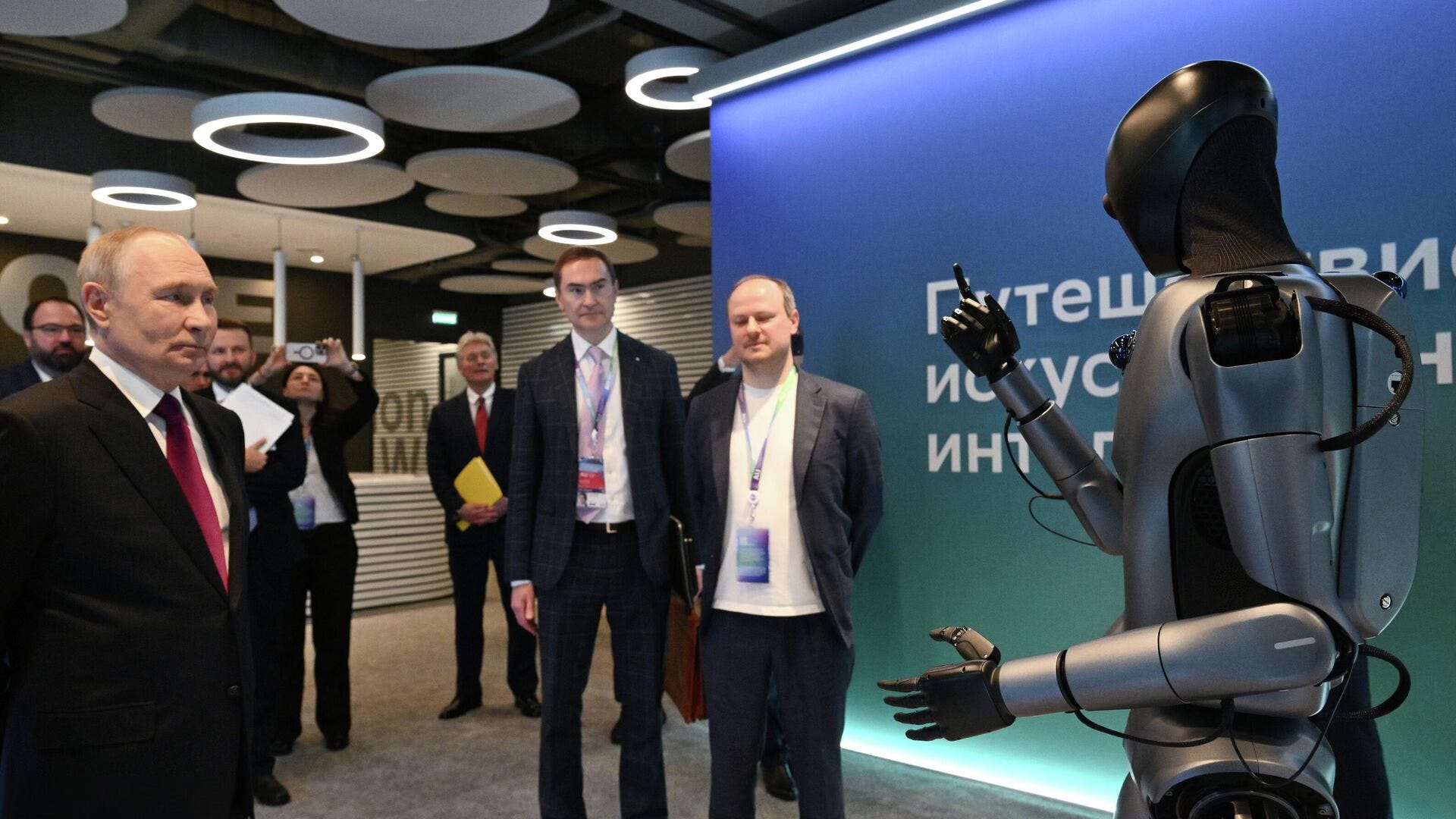
Russian President Vladimir Putin provided new guidance on Russia’s direction in artificial intelligence (AI) at the November 2025 “Journey to the World of AI” conference in Moscow (President of Russia, November 19, 2025). The event highlighted Russia’s militaristic pivot in technology policy. 

The state-owned banking giant Sberbank—whose technocratic-minded chairman, German Gref, has positioned himself as Russia’s corporate AI champion—hosted the conference. Putin said that “critical dependence on foreign AI systems is unacceptable,” framing artificial intelligence as a matter of “state, technological, and value-based sovereignty” (President of Russia, November 19, 2025). To enforce this, he ordered the creation of a central headquarters to direct the AI industry.


Making AI work for you: How think tanks can optimise their communications for generative search

Andrea Cabrera, Kshipra Ajrekar

The way we search for information is undergoing one of its most significant transformations to date, a shift we will undoubtedly continue discussing in the years to come. We are entering the era of generative or conversational search, where users engage in a natural, dialogue-like interaction with an AI system that responds with complete, contextualised answers rather than a list of hyperlinks. This experience feels increasingly human, highly personalised, and remarkably efficient.

It is precisely this seamless, conversational quality that is accelerating the widespread adoption of AI-powered search. The current boom has prompted intense competition among major technology companies, each racing to offer the most capable AI solutions. The numbers speak for themselves: according to OpenAI CEO Sam Altman, ChatGPT reached 800 million weekly active users as of October 2025, while Google Gemini reports around 450 million monthly active users, according to CNBC. For many people, turning to an AI search tool is already becoming a first choice, thanks to its ability to synthesise information instantly and significantly reduce the time spent navigating traditional search engines.