


By Robert Farley
How did the United States go about planning for Phase IV of the Pacific War?
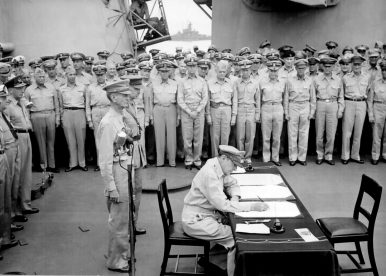 Of course, Phase IV of U.S. World War II planning never existed, at least by that term. However, after the invasion of Iraq the term became short-hand for post-war reconstruction, or for failure to plan for post-war reconstruction. In contrast to the situation with Iraq, U.S. analysts began planning for the reconstruction and reintegration of Japan from even before the war began. As detailed by Dayna Barnes in Architects of Occupation (reviewed here by a group of scholars), the planning process included the State Department, the military, and the 1940s version of the think tank community. Although fraught with tension and difficulty, the process managed to restore Japan’s place in the international community while also largely demilitarizing its society.
The temptation for a punitive approach to Japan ran high in the United States. Both sides of the Pacific War fought brutally, and memories of Pearl Harbor and Bataan remained fresh in U.S. minds. Moreover, Americans often used exterminationist rhetoric in reference to Japan, a tendency that helped frame U.S. strategic bombing policies against Japanese cities, as well as the atomic attacks on Hiroshima and Nagasaki.
For his part, President Franklin Roosevelt left very little indication regarding his thinking for the future of Japan, a political tactic that left the U.S. government adrift in this and other areas after his death. Barnes suggests that Roosevelt might have pursued a more punitive policy toward Japan, and that his passing empowered the planning process at the State Department. Given Roosevelt’s lack of public or private comment, the evidence on this is necessarily thin.
Much depended on an assessment of the sources of Japanese militarism. Analyses by Americans and others offered a range of explanations for Japan’s imperial turn, from institutional problems with Japanese democracy (an analysis not dissimilar from that of Weimar Germany) to cultural or economic reasons for the rise of militarism. The necessary implication of such thinking was that domestic reform, of some sort, would change Japan’s international behavior. This informed the thinking of the reconstruction, although policy eventually took a relatively conservative turn with respect to social reform.
The actual reconstruction of Japan of course diverged from pre-surrender planning. The structure of Japanese society, somewhat opaque before the war, became considerably more clear to scholars and practitioners. The War Department, which had relatively little influence over planning during the war, took on a much greater role in the actual occupation. The international situation also changed; a perception developed in the United States that healthy diplomatic and economic relations with the rest of the world would work to limit Japanese militarism, just as concern grew over the political trajectory in China.
Still, while plans are useless, planning is indispensable. The story that Barnes presents offers a tale of a nascent foreign policy establishment, including government, academia, and the crucial linkage of Washington D.C. think tanks. Subject matter expertise, directed by policy and weathered by practical constraint, helped to develop a plan to turn a militaristic, imperial power into one of the pillars of the global economy, and of global society. The reconstruction of Japan was a success, even if it didn’t offer a template that the United States was willing to follow.
The views expressed here are his personal views and do not necessarily reflect those of the Department of Defense, the U.S. Army, the Army War College, or any other department or agency of the U.S. government.
No comments:
Post a Comment