Like peoples in simplest caves from the beginning and high-technological cities and nations today, Gaza constructs underground infrastructure to evade undercover all-INT full-spectrum attack exhibited in the first pristine safely-bunkered military industrial media photo.
The Profession of Arms: A Guide for Young Army Officers
It takes courage, especially for a young officer, to check a man met on the road for not saluting properly or for slovenly appearance, but, every time he does, it adds to his stock of moral courage, and whatever the soldier may say, he has respect for the officer who does pull him up.
Read Document →The Dragon's Teeth: Assessing China's Military Modernization
PLA has focused on modernising its capabilities across all warfare domains to achieve these goals. This includes land, air, and maritime operations, nuclear, space, counter-space, electronic warfare and cyberspace operations, aiming to become a fully integrated joint force.
Read Document →Transforming the PLA: A Decade of reorganisation from SSF to ISF
PRC has engaged in a sustained and broad effort to transform the PLA from an infantry-heavy, low-technology, ground forces-centric military into a high-technology, networked force with an increasing emphasis on joint operations and naval and air power projection.
Read Document →Eyes without Borders: Exploring the World of Open Source Intelligence (OSINT) in the Digital Age
Open Source Intelligence (OSINT) is gaining prominence with the rise of social media, the digital society and the vast growth of publicly and commercially available information (PAI and CAI).
Read Document →
The PLA’s Developing Cyber Warfare Capabilities and India's Options
Informationised warfare blurs the lines between peacetime and wartime. A nation in the information age cannot wait for the hostilities to break out to collect intelligence, carryout influence operations, develop antisatellite systems or design computer software weapons.
Read Document →
Galwan and After
Why did China did this when he is under tremendous pressure in all fronts, is this China's salami slice tactics being progressed rigorously, what will be new Rules of Engagement, what will be escalatory control mechanism, who has taken this decision, will there be some pressure put by China in India's North-East through insurgency.
Read Document →
India’s Joint Doctrine for Cyberspace Operations: A Critical Review
Chief of Defence Staff (CDS) General Anil Chauhan and Secretary, Department of Military Affairs, formally released declassified versions of the Joint Doctrines for Cyberspace Operations during the Chiefs of Staff Committee meeting in New Delhi.
Read Document →
Know your Enemy General(now Field Marshal) Syed Aseem Munir
Gen SA Munir's position in the hierarchy of Pakistan was not very comfortable. The state of economy, insurgency in Pakhtoonistan and Balochistan, attack on the Jaffar Express, constant protests by supporters of Imran Khan's supporters inside and outside of parliament.
Read Document →
Decoding Operation SINDOOR: Key Aspects and Implications
Precision strikes were carried out on nine sites—four in Pakistan and five in PoK—linked to anti-India terrorist groups such as the LeT, JeM and the Hizbul Mujahideen. The targeted sites included Muridke (LeT headquarters) and Bahawalpur (JeM headquarters).
Read Document →
Chinese Cyber Exploitation in India's Power Grid - Is There a linkage to Mumbai Power Outage?
The New York Times (NYT), based on analysis by a U.S. based private intelligence firm Recorded Future, reported that a Chinese entity penetrated India’s power grid at multiple load dispatch points. Chinese malware intruded into the control systems that manage electric supply across India, along with a high-voltage transmission substation and a coal-fired power plant
Read Document →20 July 2014
Gaza Underground Infrastructure Photos
Like peoples in simplest caves from the beginning and high-technological cities and nations today, Gaza constructs underground infrastructure to evade undercover all-INT full-spectrum attack exhibited in the first pristine safely-bunkered military industrial media photo.
KARGIL WAR 15 YEARS ON Defences stronger, but concerns persist
Many urgent lessons were learnt from the war, but some were forgotten just as quickly. The enthusiastic start to revamp the security and defence apparatus has not been able to keep pace.
by Dinesh Kumar
The last 15 years since the Kargil War ended have been eventful and rapid paced. Barely a year-and-a-half after the intrusions in Kargil were vacated, terrorists conducted a gruesome broad daylight attack on Parliament in December 2001. With evidence pointing to Pakistan, India mobilised its armed forces on the border with its western neighbour. This was the country’s largest military mobilisation since the 1971 Indo-Pak war. On two occasions during the 10-month mobilisation named Operation Parakram, India came close to attacking Pakistan twice. Eventually, in October 2002, India withdrew its forces from the border without it serving much purpose. Pakistan had called India’s bluff. But the mobilisation once again exposed the Army’s lack of preparedness and other deficiencies to fight a war and led to it subsequently adopting the Cold Start Doctrine, a posture once employed by NATO forces during the Cold War.
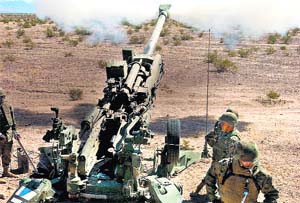
The purchase of US gun M777 (above) was missed because BAE Systems stopped its production even as never-ending Indian negotiations with the US government went on. India has not bought an artillery gun for the last 30 years.
Terror attacks
Yet two years later, in November 2003, India and Pakistan reached an agreement to cease fire along the J&K border. But ‘peace’ on the LoC did not translate into peace within the country. A series of bomb blasts, some of them suspected to be sponsored by Pakistan’s ISI, rocked several Indian cities over the years that followed. The most horrific of course was the terror attack carried out by Pakistani terrorists in Mumbai in November 2008. Once again India was under pressure to teach Pakistan a lesson. Quite characteristically Pakistan has been economical in cooperating with India in bringing the Pakistan-based master planners to justice.
While terror attacks have been fewer since, over the last year-and-a-half not only has the Pakistan Army been randomly violating the cease fire agreement along the LoC and the international border in J&K, but it has also been engaging in barbaric acts such as beheading Indian soldiers.
China, which for many years maintained a quiet profile along the disputed Line of Actual Control (LAC) that divides J&K and Chinese-occupied Aksai Chin, has meantime been engaging in infiltration and aggressive patrolling across the LAC. On occasions, deft diplomacy has helped defuse difficult situations but has not put a halt to China’s ground and aerial intrusions. All in all, India’s internal and external security situation remains far from satisfactory. At the best of times what has been prevailing is negative peace.
GROUND ZERO A war fought and won with an arm tied
Raj Chengappa
The war may have officially come to a close on July 26, 1999, but when I went a week later to Kargil the artillery guns were still booming on both sides. As I drove to nearby Dras, the Indian artillery let loose a fusillade of shells to a distant target on the other side of the Line of Control and the sound reverberated across the high mountains like the roll of thunder. The razor sharp and craggy peaks, many of them snow-tipped, provided a deceptively tranquil backdrop to the bloody battle that had been fought both on the heights and in the steep gorges and narrow valleys.
The Bofors guns were also used for sharp-shooting targets, an unconventional trick.
That night as I slept in the bunkers I heard the whistling of Pakistani shells landing not far from our shelters and I did feel fear. Colonel SVE David, Deputy Commander of 56 Brigade that was guarding the heights, though walked around the zone nonchalantly. He told me philosophically: “The splinter that is going to hit you has your name already engraved on it.” The war had already taken a heavy toll with over 500 Indian soldiers killed and another 1,300 wounded, some maimed for life. It was a hard fought victory and David knew that chance and luck also made the difference between the quick and the dead.
There were awe-inspiring tales of bravery as our soldiers repelled the Pakistani intruders on the heights. There were also plenty of clever and unconventional thinking, particularly while retaking Tiger Hill and Tololing, two of the many peaks that had become household names. The Bofors guns had been deployed in full in the valleys and despite the taint over their purchase had performed exceedingly well, providing India with an edge. Apart from lobbing shells to pulverise targets behind enemy lines, the guns were also used in the unusual role of sharp-shooting to dislodge Pakistani soldiers who had occupied the heights and were raining fire at the Indian infantry below.
Brigadier Lakhwinder ‘Lucky’ Singh, commanding the artillery brigade at Dras, showed me just how effective the Bofors guns could be. He asked me to choose any point on one of the surrounding hills that was being used for target practice. I chose a clump of bush through the binoculars. He then turned around to his gunner and told him to fix the coordinates and fire at it. The next thing I saw was the bush take a leap in the air – such was the deadly accuracy with which the guns were being fired with.
Pipeline to Pakistan may revive stalled mega projects
Atul AnejaMahim Pratap Singh
India’s decision to pipe natural gas and other petroleum products to Pakistan is being seen as a first step that could lead to the revival of two stalled mega undertakings involving Islamabad — the Iran-Pakistan-India (IPI) pipeline and the Turkmenistan-Afghanistan-Pakistan-India (TAPI) project.
“We are attempting a pilot project with Pakistan. If it succeeds, and there is a genuine demonstration of goodwill from Pakistan on all fronts, including security, it could lead to the reconsideration of stalled mega projects such as IPI and the TAPI pipeline,” highly placed sources said.
The sources observed that a new gas pipeline and a products pipeline to Pakistan from India was the brainchild of the Manmohan Singh government. The Modi administration has been willing to carry forward the proposal.
Instability in Pakistan’s Baluchistan, through which the proposed IPI would pass, coupled with the policy of the United States so far to seek Iran’s political and economic isolation, have impeded the project. But analysts say that the IPI could revive, should a breakthrough be achieved in the ongoing nuclear talks between Iran and the six global powers — U.S., Russia, China, France, Britain and Germany. “There is already a softening of stance towards Iran among international oil majors. A political deal, if it materialises, would cement Tehran’s possible reintegration in the global economy and raise its regional standing in West Asia,” the sources said.
Pakistan has responded positively to the Indian proposal for gas and product pipelines to the country.
“I can assure you both sides are working overtime to hasten the process,” Pakistan High Commissioner Abdul Basit said in a conversation with The Hindu on Friday. He stressed that Pakistan Prime Minister Nawaz Sharif — a guest during Prime Minister Narendra Modi’s inaugural — had stated his intention to import 500 megawatts of power from India.Optimistic
GAZA DEBATE MUST PROVE ISRAEL NOT FRIENDLESS
Those who imagine that the scheduled debate in Parliament on the hostilities in Gaza stemmed from a heartfelt desire of concerned MPs to avert a ‘humanitarian tragedy’ are either being wilfully naรฏve or plain disingenuous. Under the guise of tear-jerking speeches the debating chambers will echo a narrow, sectarian rhetoric aimed at a purely domestic audience.
It is time to stop skirting the real issue. The 2014 general election was a turning point in more than one way. Apart from the fact that an avowed non-Congress party secured a clear majority, the election verdict indicated the limits of ‘secular’ scare-mongering. The results clearly suggested that no group or community can exercise a permanent veto over which party and which leader has the right to run a government at the Centre. The victory of the BJP-led NDA exposed the popular impatience with a spurious secularism based on manipulating the fears and vulnerabilities of India’s Muslim citizens.
For both the so-called secular parties and the custodians of ghetto politics, the clear mandate for Narendra Modi and the BJP was a monumental setback. The orchestrated furore over India’s alleged insensitivity to what a senior Trinamool Congress MP bizarrely described as Israel’s “genocide” against the Palestinian people is the first serious attempt to get over the post-election demoralisation and reclaim lost ground. It is a calculated attempt to inform the Modi dispensation that while it may have a functioning majority, their veto is still intact.
For understandable reasons the Modi government may be anxious to minimise the confrontation with the opposition, particularly in the Rajya Sabha where it does not have a working majority. However, this is no reason for the government to be unmindful of the political-ideological challenge that has been thrown by parties that are unable to break out of the mould of sectarian politics.
What is interesting is that the challenge is brazen and with little attempt to conceal its real nature. The Israeli retaliation to the 1,200 or so rocket attacks on its citizens was not against some benign, if helpless, Palestinian dispensation. It was directed at an administration controlled by Hamas, an organisation that has consistently shunned all peace initiatives and is committed to the destruction of the state of Israel. Inspired by the Muslim Brotherhood of Egypt, the Hamas is a radical Islamist body that invokes revulsion in other parts of West Asia and is both feared and despised by the more legitimate Palestinian Authority operating from the West Bank. Hamas does not merely threaten the security of Israel, it has the potential to destabilise the neighbouring Arab states of the region. To convey any sense of sympathy with its political goals and war aims is reprehensible. Even by the dubious standards of the selective ‘morality’ of the Israel-haters, Hamas is beyond the pale. India must not be seen to have any truck with it.
A BRICS-Centered World Order?
Pakistan and China: A Precarious Friendship?
China is the Major Threat to Asian Security and Stability
Hamas and the New Round of Fighting in Gaza: Both Sides are Escalating to Nowhere
http://csis.org/publication/hamas-and-new-round-fighting-gaza-both-sides-are-escalating-nowhere
By Anthony H. Cordesman
JUL 17, 2014
The key question in any war – in starting it and throughout the conflict – is how will this war end? Ever since 1967, the answer in the case of Israeli-Palestinian conflicts, has been by pausing and then resuming in a different form with the same result. In the case of the fighting in Gaza, changes in tactics and technology have simply escalated to nowhere. The best outcome has been an unstable ceasefire. The worst has been violence too low in intensity to be labeled another round of conflict.
The initial cause in 2006, 2012, and now in 2014, has been a new attempt by Hamas to change the strategic facts on the ground – increasingly relying on rockets and missiles rather than irregular warfare in the form of ground or naval attacks on Israel. In each case, Israel’s decisive military edge has left Hamas (and the more extreme Palestinian Islamic Jihad) weaker than before, killed and wounded far more Palestinians than Israelis, prolonged the economic isolation that has crippled Gaza and reduced living standards and social mobility, and failed to have any meaningful political impact that benefited Hamas in making even limited strategic gains.
Each round has also been costly and futile to Israel. Israel’s casualties have been far lower, but all too real if it attempted to fight on the ground. The cost of air and ground operations has steadily risen, and so has the cost of the security measures in peacetime that deter and contain Hamas and other threats in the Gaza. Hamas has recovered its ability to pose a threat and slowly developed a capability to use rockets, missiles and mortars to strike into Israeli territory – although without any meaningful strategic benefits to Hamas – or Gaza’s population.
The latest round of fighting can be measured in different ways – which some media reduce to levels approaching the statistics in a sporting event: comparative killed and wounded, and displaced form or lost their homes. Numbers of Hamas rockets and missiles launched, and numbers that were intercepted or had no result. Numbers of Israeli sorties flown, numbers that hit a military target, numbers that hit a Hamas-related home, numbers that produced collateral damage, and numbers that produced civilian casualties. Direct and indirect military and economic costs to each side.
The Sunni-Shia Divide
ISIL and the Lesser Evil of Bashar al-Assad
How does the devil’s gambit work? The goal is to make the opposition appear even more threatening than the regime. If you’re a despot like Assad, this is no easy feat. For one thing, Damascus has an appalling human-rights record, and a list of allies that reads like the Axis of Evil, 2014 edition, including Iran and Hezbollah.