India’s plans for “development” on the Andaman and Nicobar Islands are threatening the survival of the archipelago’s already endangered indigenous populations. One of the projects that has been approved for implementation in the archipelago is a railway line linking Port Blair, the capital of the island chain, with Diglipur, the largest town on North Andaman Island. The 240-kilometer-long railway line will cut through a protected forest reserve where the native Jarawa live. This would increase the exposure of the Jarawa to outsiders – mainly non-tribal settlers and tourists – and impact their culture, health, and way of life, even their survival as a group.The Profession of Arms: A Guide for Young Army Officers
It takes courage, especially for a young officer, to check a man met on the road for not saluting properly or for slovenly appearance, but, every time he does, it adds to his stock of moral courage, and whatever the soldier may say, he has respect for the officer who does pull him up.
Read Document →The Dragon's Teeth: Assessing China's Military Modernization
PLA has focused on modernising its capabilities across all warfare domains to achieve these goals. This includes land, air, and maritime operations, nuclear, space, counter-space, electronic warfare and cyberspace operations, aiming to become a fully integrated joint force.
Read Document →Transforming the PLA: A Decade of reorganisation from SSF to ISF
PRC has engaged in a sustained and broad effort to transform the PLA from an infantry-heavy, low-technology, ground forces-centric military into a high-technology, networked force with an increasing emphasis on joint operations and naval and air power projection.
Read Document →Eyes without Borders: Exploring the World of Open Source Intelligence (OSINT) in the Digital Age
Open Source Intelligence (OSINT) is gaining prominence with the rise of social media, the digital society and the vast growth of publicly and commercially available information (PAI and CAI).
Read Document →
The PLA’s Developing Cyber Warfare Capabilities and India's Options
Informationised warfare blurs the lines between peacetime and wartime. A nation in the information age cannot wait for the hostilities to break out to collect intelligence, carryout influence operations, develop antisatellite systems or design computer software weapons.
Read Document →
Galwan and After
Why did China did this when he is under tremendous pressure in all fronts, is this China's salami slice tactics being progressed rigorously, what will be new Rules of Engagement, what will be escalatory control mechanism, who has taken this decision, will there be some pressure put by China in India's North-East through insurgency.
Read Document →
India’s Joint Doctrine for Cyberspace Operations: A Critical Review
Chief of Defence Staff (CDS) General Anil Chauhan and Secretary, Department of Military Affairs, formally released declassified versions of the Joint Doctrines for Cyberspace Operations during the Chiefs of Staff Committee meeting in New Delhi.
Read Document →
Know your Enemy General(now Field Marshal) Syed Aseem Munir
Gen SA Munir's position in the hierarchy of Pakistan was not very comfortable. The state of economy, insurgency in Pakhtoonistan and Balochistan, attack on the Jaffar Express, constant protests by supporters of Imran Khan's supporters inside and outside of parliament.
Read Document →
Decoding Operation SINDOOR: Key Aspects and Implications
Precision strikes were carried out on nine sites—four in Pakistan and five in PoK—linked to anti-India terrorist groups such as the LeT, JeM and the Hizbul Mujahideen. The targeted sites included Muridke (LeT headquarters) and Bahawalpur (JeM headquarters).
Read Document →
Chinese Cyber Exploitation in India's Power Grid - Is There a linkage to Mumbai Power Outage?
The New York Times (NYT), based on analysis by a U.S. based private intelligence firm Recorded Future, reported that a Chinese entity penetrated India’s power grid at multiple load dispatch points. Chinese malware intruded into the control systems that manage electric supply across India, along with a high-voltage transmission substation and a coal-fired power plant
Read Document →7 December 2017
Andaman and Nicobar: Vital Islands, Vanishing Tribes
India’s plans for “development” on the Andaman and Nicobar Islands are threatening the survival of the archipelago’s already endangered indigenous populations. One of the projects that has been approved for implementation in the archipelago is a railway line linking Port Blair, the capital of the island chain, with Diglipur, the largest town on North Andaman Island. The 240-kilometer-long railway line will cut through a protected forest reserve where the native Jarawa live. This would increase the exposure of the Jarawa to outsiders – mainly non-tribal settlers and tourists – and impact their culture, health, and way of life, even their survival as a group.Digital China: Powering the economy to global competitiveness
New Geopolitics in the Middle East?
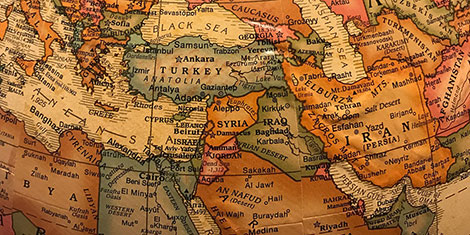
The possible creation of a new geopolitical reality in the Middle East may have snuck under the radar this holiday weekend. The continuing spectacle of the investigations into Russia’s possible involvement in the 2016 Election and the continued naming and shaming of corporate leaders and politicians involved in sexual harassment (as well as Thanksgiving), may have overshadowed the summit in Sochi between the Presidents of Russia, Turkey, and Iran, shortly after Syrian President Bashar al-Assad visited President Putin in the same city (and thanked him for “saving Syria”).What is Sufism?
OPEC: Oil Production Deal Still Has Gas in the Tank, For Now
The Story of How South Africa Voluntarily Gave Up Its Nuclear Weapons
IDF-LINKED THINK TANK ADMITS ISRAEL, ISIS ARE ALLIES IN CONFRONTING IRAN IN SYRIA
What We Really Know About North Korea’s Nuclear Weapons
Go After North Korea’s Money!
Redouble Our Whole Of Government Efforts To Fix Perfect Storm Of Strategy Goobledygook!
Mark Cancian is a former Office of Management and Budget official. Unlike many of that ilk, he sometimes exhibits the ability to write a sentence in clear and simple English. As he and his son, Matthew, looked out across the national security landscape, they saw it pocked with large lumps of nearly meaningless verbiage. In advance of the release of the Trump Administration’s first National Security Strategy, they penned an article modestly titled: It’s Time to Retire These Meaningless Policy Phrases. We like our headline much more, but you get the point. Perhaps this will lead to an exit strategy for this wicked problem. Read on! The Editor.The Surveillance Operative Lurking In The Living Room
North Korea’s Military Capabilities, In Review
The United States and its Asian allies regard North Korea as a grave security threat. It has one of the world’s largest conventional military forces, which, combined with its escalating missile and nuclear tests and aggressive rhetoric, has aroused concern worldwide. But world powers have been ineffective in slowing its path to acquire nuclear weapons. The North’s leader, Kim Jong-un, sees the nuclear program as the means to sustain his regime. While it remains among the poorest countries in the world, North Korea spends nearly a quarter of its GDP on its military, according to U.S. State Department estimates. Its brinkmanship will continue to test regional and international partnerships aimed at preserving stability and security.Mind the Millennial Training Gap
As the need for new analysts continues to grow, the intelligence community is looking to add millennials, the largest generation in the U.S. work force. These young people—born between about 1980 and 2000—bring a new perspective, but teaching them the necessary skills for analysis must be done differently than it was in even the recent past. Their attitudes and thought processes are vastly different from their predecessors, requiring a new approach to intelligence training and education to make the best use of their abundant skills.Use What’s Known to Get to the Unknowns
Securing Cyber in the Sky Layered cybersecurity needed to protect aviation ecosystem
When the WannaCry ransomware warning popped up on the arrival-and-departure signs of Germany's national rail system, experts in aviation security took notice. While the now-infamous attack did not affect travel, it did show how easily malicious code can infiltrate mass transit systems. And with thousands of attacks on aviation systems every month, Raytheon, a company with expertise in both cybersecurity and air traffic management, is taking steps to mitigate cyber attacks in the skies.As AI and Cyber Race Ahead, the State Department Is Falling Behind
There has been considerable interest in the direction of Secretary of State Rex Tillerson’s ongoing “reimagining” of the State Department, but for all the conversations about the future of American diplomacy, what has been underaddressed is how our oldest Cabinet agency is preparing to deal with the new, but foreseeable, diplomatic challenges presented by emerging technology.FIFTH GENERATION WARFARE AND OTHER MYTHS: CLARIFYING MUDDLED THINKING IN OUR CURRENT DEFENSE DEBATES
When you are talking about the command and control of forces that could potentially destroy human society as we know it, you owe it to the rest of humanity to be very precise with your terms and concepts – matters of such extreme importance require the greatest degree of conceptual due diligence that we can collectively muster. But the reality is that much of the debate over future force structure, command and control, and strategy writ large is littered with unexplored assumptions and muddled thinking, often cloaked in buzzwords that members of an organization become obligated to use once their leadership has adopted and promulgated them as guidance. We will always need “bumper stickers” to spread new ideas, but as we do that, we must be very careful which ones we use, and be very aware of their inherent limitations, before they are used to justify dangerous courses of action built on conceptual foundations of sand.