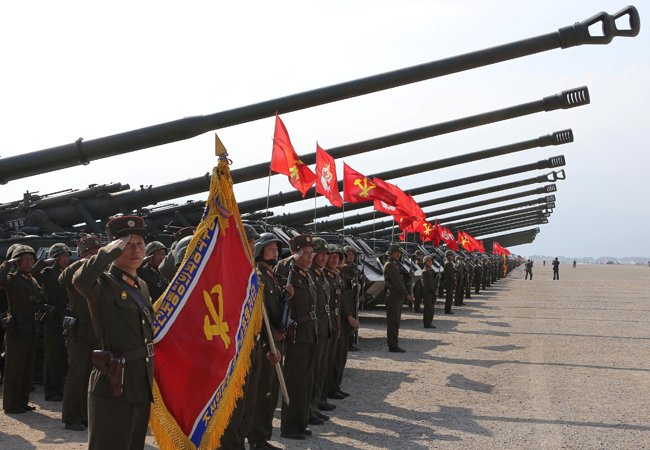
The Profession of Arms: A Guide for Young Army Officers
It takes courage, especially for a young officer, to check a man met on the road for not saluting properly or for slovenly appearance, but, every time he does, it adds to his stock of moral courage, and whatever the soldier may say, he has respect for the officer who does pull him up.
Read Document →The Dragon's Teeth: Assessing China's Military Modernization
PLA has focused on modernising its capabilities across all warfare domains to achieve these goals. This includes land, air, and maritime operations, nuclear, space, counter-space, electronic warfare and cyberspace operations, aiming to become a fully integrated joint force.
Read Document →Transforming the PLA: A Decade of reorganisation from SSF to ISF
PRC has engaged in a sustained and broad effort to transform the PLA from an infantry-heavy, low-technology, ground forces-centric military into a high-technology, networked force with an increasing emphasis on joint operations and naval and air power projection.
Read Document →Eyes without Borders: Exploring the World of Open Source Intelligence (OSINT) in the Digital Age
Open Source Intelligence (OSINT) is gaining prominence with the rise of social media, the digital society and the vast growth of publicly and commercially available information (PAI and CAI).
Read Document →
The PLA’s Developing Cyber Warfare Capabilities and India's Options
Informationised warfare blurs the lines between peacetime and wartime. A nation in the information age cannot wait for the hostilities to break out to collect intelligence, carryout influence operations, develop antisatellite systems or design computer software weapons.
Read Document →
Galwan and After
Why did China did this when he is under tremendous pressure in all fronts, is this China's salami slice tactics being progressed rigorously, what will be new Rules of Engagement, what will be escalatory control mechanism, who has taken this decision, will there be some pressure put by China in India's North-East through insurgency.
Read Document →
India’s Joint Doctrine for Cyberspace Operations: A Critical Review
Chief of Defence Staff (CDS) General Anil Chauhan and Secretary, Department of Military Affairs, formally released declassified versions of the Joint Doctrines for Cyberspace Operations during the Chiefs of Staff Committee meeting in New Delhi.
Read Document →
Know your Enemy General(now Field Marshal) Syed Aseem Munir
Gen SA Munir's position in the hierarchy of Pakistan was not very comfortable. The state of economy, insurgency in Pakhtoonistan and Balochistan, attack on the Jaffar Express, constant protests by supporters of Imran Khan's supporters inside and outside of parliament.
Read Document →
Decoding Operation SINDOOR: Key Aspects and Implications
Precision strikes were carried out on nine sites—four in Pakistan and five in PoK—linked to anti-India terrorist groups such as the LeT, JeM and the Hizbul Mujahideen. The targeted sites included Muridke (LeT headquarters) and Bahawalpur (JeM headquarters).
Read Document →
Chinese Cyber Exploitation in India's Power Grid - Is There a linkage to Mumbai Power Outage?
The New York Times (NYT), based on analysis by a U.S. based private intelligence firm Recorded Future, reported that a Chinese entity penetrated India’s power grid at multiple load dispatch points. Chinese malware intruded into the control systems that manage electric supply across India, along with a high-voltage transmission substation and a coal-fired power plant
Read Document →8 May 2017
Pakistan: Army Kills 50 Afghan Forces in Border Fight
*** Why Russia Can't Quit Syria
It can be difficult to separate the important from unimportant on any given day. Reflections mean to do exactly that — by thinking about what happened today, we can consider what might happen tomorrow.*** China's Navy Takes a Bow

** Time to stop letting Pakistan call the shots
** Project on Nuclear Issues A Collection of Papers from the 2016 Nuclear Scholars Initiative and PONI Conference Series
A NITI Aayog Model For Education: Why Campuses Should Welcome Research With Open Arms
NITI Aayog’s recommendations must be implemented honestly, and without fear or favour, to generate leadership in science.India Needs More Aircraft Carriers But Not At The Cost Of Key Strike Elements
There is no doubt that India, which is poised to become a great power, requires more aircraft carriers.Contested Waters: Subnational Scale Water Conflict in Pakistan
Afghanistan: The Future of the National Unity Government
Think the RCEP is about free trade? Think again
Monks with guns
China’s military tech is becoming less of a joke and more of a threat
China’s first nuclear submarine was a joke. Launched in the 1970s and now an exhibit in a museum, it was loud, couldn’t fire missiles while submerged, and exposed its crew to high levels of radiation.Can China Replace the West?
North Korea’s failed missile launch on Saturday
North Korea’s failed missile launch on Saturday marks its fourth straight test that has ended in failure, prompting some to question whether the U.S. is secretly behind these recent flops. The frequency of these failed attempts — this is the second in two consecutive weeks — along with other accompanying circumstances, lends weight to the possibility that the U.S. is covertly interfering with North Korea’s missile program through cyber attacks.Does China Now Regret Having Defended, Nourished North Korea?
The China–North Korea Relationship,
RUSSIAN INTELLIGENCE CHIEF SAYS EASING OF INFO WAR WITH WEST NOT IN SIGHT, BATTLE FOR MINDS TO INTENSIFY
Russian Military Braces for Possible Follow-Up Attacks by US in Syria and Beyond
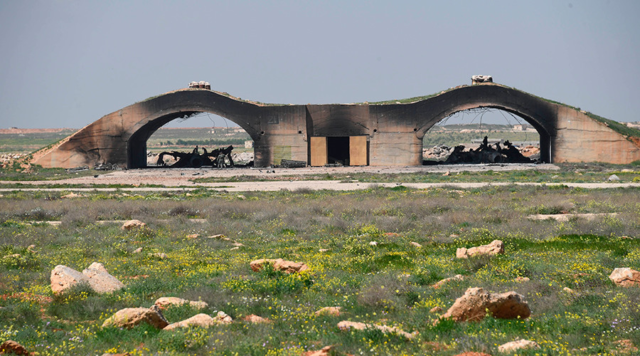
Russian state propaganda has definitively changed its portrayal of United States President Donald Trump after the April 7 Tomahawk cruise missile strike on the Syrian airbase of Shayrat (Homs province). The forces loyal to Syrian President Bashar al-Assad (the Syrian Arab Army—SAA) had allegedly used this base to launch chemical weapons attacks, on April 4, against a rebel-held area of Khan Sheikhoun (Idlib province). According to a poll published this week by the Kremlin-controlled pollster VtSIOM, 82 percent of Russians believe Washington’s attack on the Shayrat airbase was “unjust” and a “US provocation designed to destabilize the situation.” According to VtSIOM general director Valery Fedorov, only 6 percent of Russians believe the US attacked Shayrat to punish the al-Assad regime for allegedly using chemical weapons. The rest believe it was an act of illegal aggression and a provocation designed to harm Russia and its allies. The Russian public supports its country’s continued military involvement in Syria (53 percent), though this support is not overly high despite a continuous pro-war message broadcast by state TV propaganda. VtSIOM data reveals that 34 percent want Russian forces to withdraw from Syria. According to Fedorov, the Tomahawk attack has dramatically diminished the previously positive image of President Trump in Russia (Wciom.ru, April 20). The latest VtSIOM poll concludes that Trump’s popularity among Russians has decreased from 38 to 13 percent; 39 percent of Russians see him today in a negative light, compared to 7 percent a month ago (RIA Novosti, April 17).RBI’s Viral Acharya Proposes Five Ways To Resolve India’s Bad Loan Problem
The problem of bad loans (also known as NPAs, or non-performing assets) continues to be a drag on the Indian economy. Private investment is not taking off and both the Reserve Bank Of India (RBI) and the government need to move fast in resolving the mess created by Indian banks’ stressed assets sooner rather than later.1 Minute of All-Out Exercise May Have Benefits of 45 Minutes of Moderate Exertion
For many of us, the most pressing question about exercise is: How little can I get away with? The answer, according to a sophisticated new study of interval training, may be very, very little. In this new experiment, in fact, 60 seconds of strenuous exertion proved to be as successful at improving health and fitness as three-quarters of an hour of moderate exercise.HOW THE IED WON: DISPELLING THE MYTH OF TACTICAL SUCCESS AND INNOVATION
The U.S. military seems to have settled on the narrative that it won every tactical engagement in the wars in Iraq and Afghanistan. In this view, failures of strategy and the challenges of nation-building proved the undoing of coalition counter-insurgency efforts in each conflict. Even the most critical accounts of U.S. military performance in the wars, like Lt Gen. (ret.) Bolger’s Why We Lost, emphasize American “tactical excellence” in the campaigns. Such a conclusion, however, seems to equate tactics with firefights and ignores the U.S. military’s failure to meet its objectives to counter the enemy’s weapon of choice — the improvised explosive device (IED).88 Lt. Gen. John Kelly, who lost son to war, says U.S. largely unaware of sacrifice
WASHINGTON — Before he addressed the crowd that had assembled in the St. Louis Hyatt Regency ballroom last November, Lt. Gen. John F. Kelly had one request. “Please don’t mention my son,” he asked the Marine Corps officer introducing him.