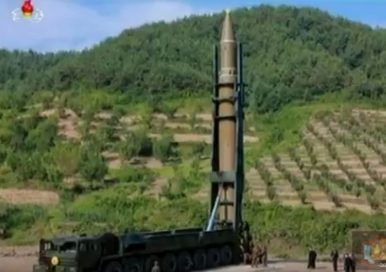
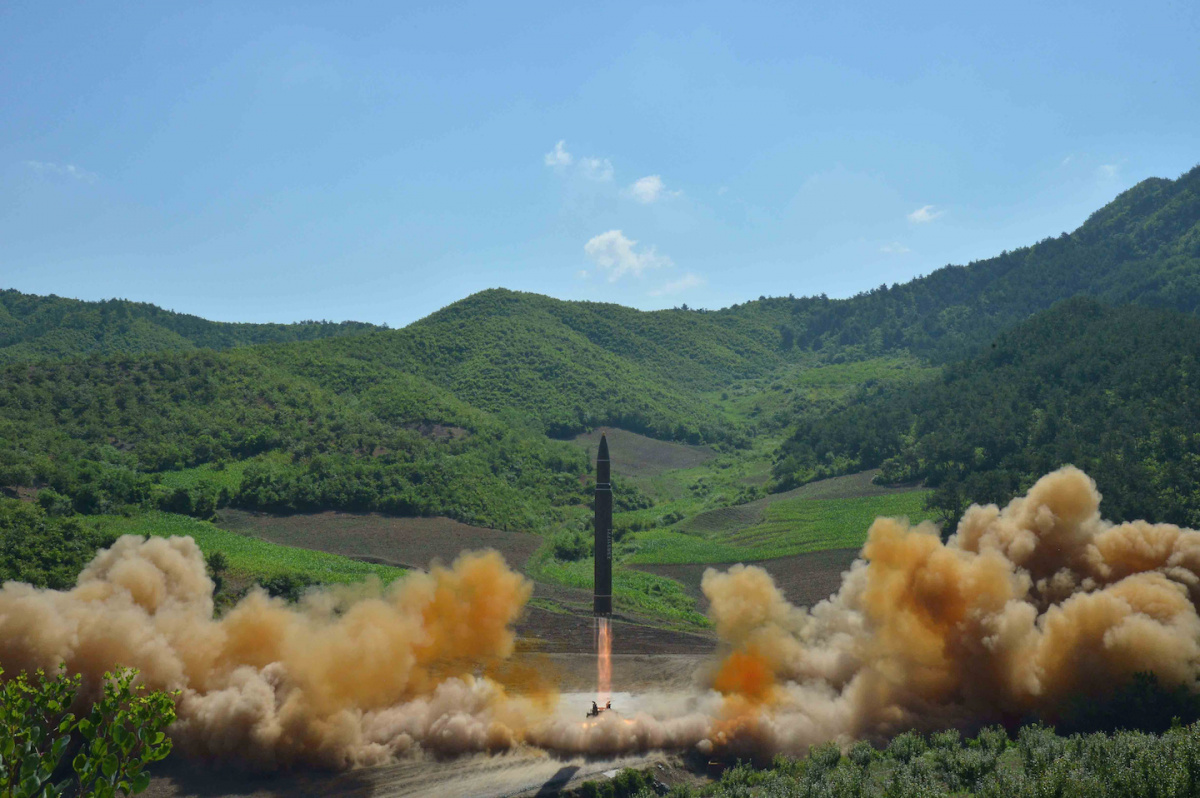
At 9:10 a.m. local time on July 4, North Korea launched a new ballistic missile, the Hwasong-14, from the Panghyon Airport in North Pyongan Province. The Hwasong-14 was tested at a lofted, or steep, trajectory. This flight path maximizes the altitude of the missile and reduces its distance traveled in order to avoid overflying neighboring regions and countries such as Japan. Pyongyang further claimed that the Hwasong-14 missile was an Intercontinental Ballistic Missile — a statement that is thus far backed up by the available flight data.The Profession of Arms: A Guide for Young Army Officers
It takes courage, especially for a young officer, to check a man met on the road for not saluting properly or for slovenly appearance, but, every time he does, it adds to his stock of moral courage, and whatever the soldier may say, he has respect for the officer who does pull him up.
Read Document →The Dragon's Teeth: Assessing China's Military Modernization
PLA has focused on modernising its capabilities across all warfare domains to achieve these goals. This includes land, air, and maritime operations, nuclear, space, counter-space, electronic warfare and cyberspace operations, aiming to become a fully integrated joint force.
Read Document →Transforming the PLA: A Decade of reorganisation from SSF to ISF
PRC has engaged in a sustained and broad effort to transform the PLA from an infantry-heavy, low-technology, ground forces-centric military into a high-technology, networked force with an increasing emphasis on joint operations and naval and air power projection.
Read Document →Eyes without Borders: Exploring the World of Open Source Intelligence (OSINT) in the Digital Age
Open Source Intelligence (OSINT) is gaining prominence with the rise of social media, the digital society and the vast growth of publicly and commercially available information (PAI and CAI).
Read Document →
The PLA’s Developing Cyber Warfare Capabilities and India's Options
Informationised warfare blurs the lines between peacetime and wartime. A nation in the information age cannot wait for the hostilities to break out to collect intelligence, carryout influence operations, develop antisatellite systems or design computer software weapons.
Read Document →
Galwan and After
Why did China did this when he is under tremendous pressure in all fronts, is this China's salami slice tactics being progressed rigorously, what will be new Rules of Engagement, what will be escalatory control mechanism, who has taken this decision, will there be some pressure put by China in India's North-East through insurgency.
Read Document →
India’s Joint Doctrine for Cyberspace Operations: A Critical Review
Chief of Defence Staff (CDS) General Anil Chauhan and Secretary, Department of Military Affairs, formally released declassified versions of the Joint Doctrines for Cyberspace Operations during the Chiefs of Staff Committee meeting in New Delhi.
Read Document →
Know your Enemy General(now Field Marshal) Syed Aseem Munir
Gen SA Munir's position in the hierarchy of Pakistan was not very comfortable. The state of economy, insurgency in Pakhtoonistan and Balochistan, attack on the Jaffar Express, constant protests by supporters of Imran Khan's supporters inside and outside of parliament.
Read Document →
Decoding Operation SINDOOR: Key Aspects and Implications
Precision strikes were carried out on nine sites—four in Pakistan and five in PoK—linked to anti-India terrorist groups such as the LeT, JeM and the Hizbul Mujahideen. The targeted sites included Muridke (LeT headquarters) and Bahawalpur (JeM headquarters).
Read Document →
Chinese Cyber Exploitation in India's Power Grid - Is There a linkage to Mumbai Power Outage?
The New York Times (NYT), based on analysis by a U.S. based private intelligence firm Recorded Future, reported that a Chinese entity penetrated India’s power grid at multiple load dispatch points. Chinese malware intruded into the control systems that manage electric supply across India, along with a high-voltage transmission substation and a coal-fired power plant
Read Document →8 July 2017
*** North Korea Successfully Tests Its First ICBM
At 9:10 a.m. local time on July 4, North Korea launched a new ballistic missile, the Hwasong-14, from the Panghyon Airport in North Pyongan Province. The Hwasong-14 was tested at a lofted, or steep, trajectory. This flight path maximizes the altitude of the missile and reduces its distance traveled in order to avoid overflying neighboring regions and countries such as Japan. Pyongyang further claimed that the Hwasong-14 missile was an Intercontinental Ballistic Missile — a statement that is thus far backed up by the available flight data.** China Tries to Buy Time From Foreign Investors
** Drawing From The Past, Putin Plans His Future
How India Should Respond to China’s Belt and Road
Pakistan Enhances Range of Controversial ‘Tactical’ Nuclear Weapon
ISLAMBABAD —Pakistan’s military announced Wednesday that it has successfully undertaken a series of flight tests of its battlefield nuclear-capable NASR missile this week, enhancing the rocket’s flight maneuverability and extending its range to 70 kilometers from 60.The ISI and Kulbhushan Jadhav's Second “Confession”
Ideology in the Afghan Taliban: A new AAN report
Kherqa-ye Sharif (the shrine of the Holy Cloak) in Kandahar. The cloak belonged to the Prophet Muhammad and was displayed to a crowd by Mullah Omar when he was declared amir ul-mumenin in the spring of 1996.A Year of Bangladesh's War on Terror
China’s Unabated Cartographic Aggression
What ISIL really thinks about the future
In a conversation I had with a fellow university student in Damascus in 2000, he made curious remark. "Ana mubayie," he said. The sentence, which translates into “I owe a pledge of fealty”, was a reference to a supposed secret oath he made to Mullah Omar, then the emir of the Taliban in Afghanistan. In a secular country like Syria, the lack of context for young students meant nobody made much of it beyond observing its oddity.Russia Military Power report reveals what US is really worried about
Russia and China Have a Common Line on Resolving the North Korean Problem
North Korea's ICBM Test Isn't a Game Changer
Russia Deploys a Potent Weapon in Syria: The Profit Motive
MOSCOW — The Kremlin is bringing a new weapon to the fight against the Islamic State militant group in Syria, using market-based incentives tied to oil and mining rights to reward private security contractors who secure territory from the extremists, Russian news outlets have reported.Police seize servers of Ukrainian software firm after cyber attack
Ukraine says it foiled 2nd cyberattack after police raid
Why It's Time for the Carrier Battle Group
New US Drone Project Could Change Asian Warfare Forever
Counter-Terrorism Strategic Communications: Back to the Future, Lessons from Past and Present
Today’s Terror Threat Poses Array of New Challenges
Global War on Terrorism: How Does the United States Military Counter and Combat the Worldwide Spread of Islamic Extremism?
Vulnerability Assessment Method Pocket Guide
Multi-Domain Battle
STRATEGIC OUTPOST AT 50 (COLUMNS): SOME REFLECTIONS
This is the 50th time that our “Strategic Outpost” column has appeared at War on the Rocks. When we published our first piece on January 27, 2015, we had no idea how long our column would last or how it would be received. On this notable occasion, we’ve chosen to share some reflections about these past two and a half years for readers who may have joined us along the way.Layers of bureaucracy block Army from technological advancement, say experts
ARLINGTON, Va. — Excess bureaucracy is holding the U.S. Army back from efficiency and technological development, experts and defense leaders said at an Association of the U.S. Army forum on Thursday.Cyber Flag exclusive: What goes into validating a cyber team?
Staying humble is key to staying safe, says Israel’s cyber chief
srael’s cyber chief Eviatar Matania was not too concerned about the cyber attack that infiltrated computer systems in Israeli hospitals last week.