Pakistan Has All the Leverage Over Trump
-- Maj Gen P K Mallick, VSM (Retd)
Over the last several decades, U.S aid to Pakistan has fluctuated depending on Washington’s regional objectives. For example, during the 1965 Indo-Pakistan War, the U.S. decreased its aid to Pakistan, only sending $26 million to the country. Alternatively, during the 1980s, the U.S. significantly increased its assistance to Islamabad to upwards of $5 billion as Pakistan helped funnel weapons and funds to anti-Soviet rebel fighters in Afghanistan.Between 2002-2017, the U.S. provided more than $33 billion in total aid to Pakistan.
For breakdown of US Aid to Pakistan read http://strategicstudyindia.blogspot.in/2018/01/a-breakdown-of-us-aid-to-pakistan.html.
Bill Milam, former U.S. Ambassador to Pakistan said :
“The U.S. started withholding our goodies from Pakistan in 1965, when President Lyndon Johnson cut off most of our military assistance to Pakistan when it attacked India. We cut off most assistance, both military and aid, when President George H. W. Bush could no longer certify, as required by the 1985 Pressler Amendment, that Pakistan did not possess a nuclear device. And when those sticks didn’t work, we tried to use a huge assistance package as an irresistible carrot to get Pakistan to conform completely to our way of thinking in the fight against terrorism, including in Afghanistan. The results are clear – none of it worked. Pakistan marches to its own beat.”
The U.S. has turned to Pakistan for vital cooperation in rooting out militant groups, such as the Taliban and the Haqqani network, that regularly orchestrate violence in neighboring Afghanistan. At the same time, however, the U.S. has repeatedly accused Pakistan of harboring these groups to promote their own regional interests.
During the late 1970s and 1980s, Washington used Pakistan’s Inter-Services Intelligence agency (ISI) as a conduit to funnel arms and money to rebel groups fighting the Soviet Union’s invasion of Afghanistan. Following the Soviet Union’s withdrawal, however, the ISI helped support the Taliban’s rise to power in Afghanistan during the 1990s. Today, it is widely believed that the ISI continues to protect and assist the Taliban, the Haqqani network and Lashkar-e-Taiba (LeT), all designated as terrorists by the U.S. government, as part of its strategy to keep Afghanistan on unstable footing and advance its ambitions in the disputed Kashmir region bordering India and Pakistan.
Pakistan has assisted with U.S. efforts to dismantle al-Qaida. Pakistani intelligence facilitated the 2003 apprehension of Khaled Sheikh Mohammed, the mastermind of the 9/11 attacks, and has provided information that helped target other key figures by CIA drone strike. Yet questions still linger about whether the Pakistani government knew of Osama bin Laden’s whereabouts after the al Qaida leader’s compound was raided in close proximity to a Pakistani military facility in May 2011.
The Pakistani government has permitted the CIA and U.S. military to use bases inside Pakistan for drones and even launch drone strikes in Pakistani territory. In 2017, at least eight such strikes were conducted, which resulted in the deaths of several Taliban militants. However, many in the U.S. still accuse the Pakistani government of harboring leaders of the Taliban and the Haqqani network, although Pakistani officials have repeatedly rejected such accusations.
After rescuing an American-Canadian family from the Haqqani network in October, the Pakistani military captured one of the organization’s members but reportedly refused to grant the U.S. access to the man. The Haqqani network is still believed to be holding at least two other Americans hostage.
Anthony Cordesman, Arleigh A. Burke Chair in Strategy, CSIS said :
“The practical issues affecting any hardline approach towards Pakistan are (a) what can the U.S. actually do that will matter enough to really change Pakistani behavior, and (b) what will happen if the Pakistanis respond by limiting U.S. access to Pakistan’s airspace, ports and land routes; giving more freedom of action and support to the Taliban and other threats to Afghanistan; and/or titling even more towards China.”
It is unlikely that Trump’s decision to withhold aid from Pakistan in and of itself will lead Pakistan to amend its approach, as Islamabad boasts a track record of withstanding such maneuvers. However, by implementing a multifaceted strategy that extends beyond U.S. fiscal leverage to include a greater alignment of the two countries’ core interests, the Trump administration may begin to chip away at the barriers preventing enhanced and honest cooperation.
Dan Markey, Academic Director of the Global Policy Program, Johns Hopkins SAIS said :
“There are a couple of things that are missing from the Trump Administration’s approach right now. One is evidence of a commitment by the administration to just how far it is willing to push. The Pakistanis are pretty skilled at girding themselves for irritations from the U.S. and aid cutoffs or slowdowns. They can weather all of that. The question is, do we have other pressure tactics that we’re actually willing to use – things like denying them access to international financial institutions and resources that go well beyond U.S. assistance. Just how mean are we willing to get? On the other side, just how committed are we to the fight in Afghanistan in ways that would get Pakistan, over time, to see that its interest is [in] aligning itself with what our strategy is? That is, if they began to believe that the most likely solution in Afghanistan was one in which the Afghan Taliban were either brought to the table and brought into a political process or ultimately defeated, then they would probably be more inclined to get behind that effort themselves and support it. But for the time being, and for as long as I can remember, I think they’ve suspected that the U.S. would leave with a job half-finished and would leave the problem in their lap. Given those assumptions, the idea that they would turn [against] some of their militant allies like the Afghan Taliban and that Haqqani network, seems less compelling. So that’s where we’re stuck.”
C. Christine Fair is assistant professor in the Peace and Security Studies Program in Georgetown University's Edmund A. Walsh School of Foreign Service. She is author most recently of "Why the Pakistan Army Is Here to Stay: Prospects for Civilian Governance" in International Affairs.
She is the foremost Pakistan specialist from USA. Recently she has published a paper "
Pakistan Has All the Leverage Over Trump" in Foreign Policy.
For me it is the finest paper on US - Pakistan relation in recent time. It is a must read for all who are interested in Pakistan. I like it when she writes : Logistics will beat strategy every time.
The paper is reproduce below.
The president can tweet all the threats he wants, but Pakistan’s leaders aren’t worried.
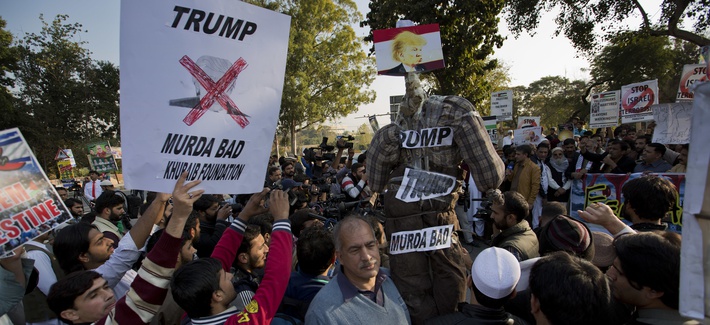
Pakistan responded as it has in the past for being called out for its mendacity and perfidy: It rallied its trolls; it summoned the U.S. ambassador in Islamabad for a démarche; and, in all forums possible, it denied the allegations of nefarious deeds with all of the sincerity and credibility of the wholesome human resources manager of the Chicken Ranch.
Even as the tweet continued to titillate Trump enthusiasts in India and at home, however, the responsible members of Trump’s government were strategizing how to roll it back. Later that same day, a White House National Security Council spokesperson explained what, specifically, to expect: “The United States does not plan to spend the $255 million in FY 2016 foreign military financing for Pakistan at this time.” This is not the sweeping cutoff that Trump implied in his braggadocios tweet.
In fact, there is little that is, or ever will be, new in Trump’s Pakistan policy.
That’s true for two simple reasons: the logistics of staying the course in Afghanistan and the night terrors triggered by imagining how terrifying Pakistan could be without American money.
Obama did the same thing, too, and nothing changed
Trump is not the first U.S. president to express distaste for Pakistan’s actions. In August 2007, then-presidential candidate Barack Obama threatened to undertake unilateral military strikes against the terrorists harbored by Pakistan. Obama, upon being president, took the fight to Pakistan with his zealous use of airstrikes by remotely piloted aerial vehicles. Moreover, in March 2009, when Obama announced his so-called Afghanistan-Pakistan strategy, he specifically identified the latter as a terrorist safe haven. You know, eventually those snakes are going to turn on whoever has them in the backyard.” And it was Obama who ordered U.S. Navy SEALs to unilaterally attack a compound near Pakistan’s famed military academy in which Osama bin Laden had been residing in plain sight for numerous years.
The Obama administration also withheld funds from Pakistan for several years. It did so because the U.S. Congress passed legislation that authorized $1 billion in coalition support funds (CSF) but rendered $300 million hostage to Pakistan taking decisive action against the Haqqani Network and in later years against the Lashkar-e-Taiba. This money could only be paid if the administration certified that Pakistan had complied with the requirements. On several occasions, it demurred to do so.
It is also worth noting that Trump’s tweet only reinforced what the New York Times reported on Dec. 29, that the Trump administration was going to withhold — wait for it — $255 million in foreign military financing (FMF). FMF funds enable partner countries to buy “U.S. defense articles, services, and training” and are provided either as a nonrepayable grant or on a loan basis. This is hardly a sweeping punishment that will persuade Pakistan to begin acting against terrorism. Historically, FMF funds have not been the mainstay of the American dole to Pakistan. Out of the more than $33 billion given to Pakistan since fiscal year 2002, FMF has accounted for less than $4 billion. The most lucrative payouts have been through the CSF program, which totals more than $14.5 billion.
America’s preferred roads to Afghanistan go through Pakistan
Why is it that the United States continues to make huge payouts to Pakistan even though it is widely recognized that the country continues to fund the very organizations — such as the Haqqani Network, the Taliban, and groups like the LeT — that are killing U.S. troops and allies in Afghanistan? Why can’t the United States simply take its checkbook and let China take over paying Pakistan’s bills as Pakistan continually threatens will happen should the United States walk away from this abusive relationship for good? There are several important reasons, none of which are easily ignored.
First, Pakistan has the fastest growing nuclear program in the world, which includes efforts to develop so-called tactical nuclear weapons (I prefer to call them “battlefield nuclear weapons,” as even the smallest nuclear bomb will have strategic effects if used). Given Pakistan’s well-known reputation for black market nuclear trafficking, well-publicized reports of moving its warheads around in unescorted soft-skin vehicles (such as ordinary vans), and a petting zoo of every kind of domestic, regional, and transnational Islamist terrorist organization thriving under its protection, America and its allies are rightly concerned that any instability in Pakistan may result in terrorists getting their hands on Pakistan’s nuclear technology, fissile material, or a nuclear device. This is Washington’s worst nightmare. Ironically, Pakistan has invested in both its nuclear and terrorist arsenals on Washington’s time and dime. Yet, even as the continued payments to Pakistan intensify the country’s nuclear coercion, American officials in virtually all branches of government fear that a complete breakoff in aid will hasten the worst-case outcome.
Second and related to the first, the United States worries about Pakistan’s solvency. If it really wanted to bring Pakistan’s to its terrorism-loving knees, it would let the International Monetary Fund (IMF) cut the country off when it reneges on its own commitment to financial reform. Soon, international contributors to the IMF will essentially be subsidizing Pakistan’s exorbitant loan repayments to the Chinese. This alone should be adequate reasoning to let the IMF cut Pakistan off. However, this is unlikely to happen. Pakistan has essentially developed its bargaining power by threatening its own demise.
With any economic collapse of Pakistan, Washington again fears that the specter of a nuclear-armed terrorist group rising up from Pakistan will materialize.
Finally, the United States has placed itself in an unwinnable position in the Afghan war. One can argue that the United States lost the war in Afghanistan when it went to war with Pakistan, one of the states most committed to undermining U.S. efforts there. Whereas the United States wants a stable Afghan government that can resist its predatory neighbors and keep Islamist militants out of the government and prevent these militants from using Afghanistan as a sanctuary to train, recruit, and plan terrorist attacks in the region and beyond, this is precisely the Afghanistan that Pakistan wants. The only way Washington could have had any hope of avoiding the situation in which it finds itself is if then-President Bush had capitalized on the opening with Iran that President Mohammad Khatami offered.
In 2001, Iran was incredibly supportive of the American effort in Afghanistan. U.S. Ambassador James Dobbins, who was present at the talks in Germany that led to the Bonn Agreement, has attested to Iran’s productive role in trying to secure a democratic future for Afghanistan. The United States instead spurned Iran and even labeled it a founding member of the Axis of Evil. The Bush administration was clueless about Pakistan’s interests and had believed that then-President Pervez Musharraf was sincere in offering his country’s help in defeating its own proxies in Afghanistan. We know now that this was a preposterous assumption. Yet the die had been cast. The United States became singularly reliant on using Pakistan’s air and land corridors to move supplies for the war effort. Its efforts to cultivate a so-called northern distribution route failed to materialize.
Over the years, I have offered reminders that Americans could work with Indian contractors to move goods from Chabahar to Afghanistan, thus providing an opportunity to further consolidate the two countries’ fast-growing ties with India. This would require using Iran’s port in Chabahar, which the Indians have helped to develop along with the road and rail lines connecting it to Afghanistan.
But most Americans recoil at the suggestion of cooperating with Iran, arguing that Tehran is a potential nuclear-proliferating sponsor of terrorism. Needless to say, Pakistan is an actual nuclear-proliferating sponsor of terrorism. Moreover, Pakistan is actually more dangerous than Iran: Tehran’s terrorist proxies are regional menaces rather than the international, hydra-headed scourges cultivated by Islamabad.
Under the Obama administration, the United States made unprecedented progress in thawing relations with Iran with the Joint Comprehensive Plan of Action (JCPOA), also known as the Iran nuclear deal, which opened up at least the possibility of exploring the idea of moving supplies from the port in Chabahar. In fact, India just completed its first shipment of 1.1 million tons of wheat to Afghanistan that traveled through Chabahar. However, Trump has made it clear that he prefers to scrap the JCPOA entirely.
Without an alternative port, the United States will have no choice but to continue working with Pakistan if it wants to remain engaged in Afghanistan, as Trump intends to do. (The proposed troop surge is now complete with about 14,000 U.S. troops in the country.) While Trump can tweet whatever he wants about Pakistan or Iran, the professionals on his staff know the truth: U.S. policy in Afghanistan requires a port with road or rail access to Afghanistan. This administration — like each one before — has cast its lot with Pakistan. And this administration will confront the same failures as its predecessors. Logistics will beat strategy every time.








/arc-anglerfish-arc2-prod-mco.s3.amazonaws.com/public/ALLXTCDL5NCDDH4GI7ZZTBO4S4.jpg)

/arc-anglerfish-arc2-prod-mco.s3.amazonaws.com/public/K6EPMWFDORC6FHFFLYSHHZ3XRI.net2414f7d86cb74b5eb01f4763b111a254635979665113267457)