The Profession of Arms: A Guide for Young Army Officers
It takes courage, especially for a young officer, to check a man met on the road for not saluting properly or for slovenly appearance, but, every time he does, it adds to his stock of moral courage, and whatever the soldier may say, he has respect for the officer who does pull him up.
Read Document →The Dragon's Teeth: Assessing China's Military Modernization
PLA has focused on modernising its capabilities across all warfare domains to achieve these goals. This includes land, air, and maritime operations, nuclear, space, counter-space, electronic warfare and cyberspace operations, aiming to become a fully integrated joint force.
Read Document →Transforming the PLA: A Decade of reorganisation from SSF to ISF
PRC has engaged in a sustained and broad effort to transform the PLA from an infantry-heavy, low-technology, ground forces-centric military into a high-technology, networked force with an increasing emphasis on joint operations and naval and air power projection.
Read Document →Eyes without Borders: Exploring the World of Open Source Intelligence (OSINT) in the Digital Age
Open Source Intelligence (OSINT) is gaining prominence with the rise of social media, the digital society and the vast growth of publicly and commercially available information (PAI and CAI).
Read Document →
The PLA’s Developing Cyber Warfare Capabilities and India's Options
Informationised warfare blurs the lines between peacetime and wartime. A nation in the information age cannot wait for the hostilities to break out to collect intelligence, carryout influence operations, develop antisatellite systems or design computer software weapons.
Read Document →
Galwan and After
Why did China did this when he is under tremendous pressure in all fronts, is this China's salami slice tactics being progressed rigorously, what will be new Rules of Engagement, what will be escalatory control mechanism, who has taken this decision, will there be some pressure put by China in India's North-East through insurgency.
Read Document →
India’s Joint Doctrine for Cyberspace Operations: A Critical Review
Chief of Defence Staff (CDS) General Anil Chauhan and Secretary, Department of Military Affairs, formally released declassified versions of the Joint Doctrines for Cyberspace Operations during the Chiefs of Staff Committee meeting in New Delhi.
Read Document →
Know your Enemy General(now Field Marshal) Syed Aseem Munir
Gen SA Munir's position in the hierarchy of Pakistan was not very comfortable. The state of economy, insurgency in Pakhtoonistan and Balochistan, attack on the Jaffar Express, constant protests by supporters of Imran Khan's supporters inside and outside of parliament.
Read Document →
Decoding Operation SINDOOR: Key Aspects and Implications
Precision strikes were carried out on nine sites—four in Pakistan and five in PoK—linked to anti-India terrorist groups such as the LeT, JeM and the Hizbul Mujahideen. The targeted sites included Muridke (LeT headquarters) and Bahawalpur (JeM headquarters).
Read Document →
Chinese Cyber Exploitation in India's Power Grid - Is There a linkage to Mumbai Power Outage?
The New York Times (NYT), based on analysis by a U.S. based private intelligence firm Recorded Future, reported that a Chinese entity penetrated India’s power grid at multiple load dispatch points. Chinese malware intruded into the control systems that manage electric supply across India, along with a high-voltage transmission substation and a coal-fired power plant
Read Document →31 January 2018
2017 Global Go To Think Tank Index Report
Global Go To Think Tank Index Report 2017
Six Cyber Threats to Really Worry About in 2018
Hackers are constantly finding new targets and refining the tools they use to break through cyberdefenses. The following are some significant threats to look out for this year. The cyberattack on the Equifax credit reporting agency in 2017, which led to the theft of Social Security numbers, birth dates, and other data on almost half the U.S. population, was a stark reminder that hackers are thinking big when it comes to targets. Other companies that hold lots of sensitive information will be in their sights in 2018. Marc Goodman, a security expert and the author of Future Crimes, thinks data brokers who hold information about things such as people’s personal Web browsing habits will be especially popular targets. “These companies are unregulated, and when one leaks, all hell will break loose,” he says.10 Conflicts to Watch in 2018 From North Korea to Venezuela, here are the conflicts to watch in 2018.
What’s In Store For The Cyber Threat Landscape In 2018 — Be Afraid…..Be Very Afraid; What Are The Potential Sick & Twisted, Dangerous Cyber Attacks We Might See In 2018
Face-off between Asia's nuclear giants raises new fears
India has forgotten its own realist strategic thought
Afghanistan On A Slow Fuse – Analysis
Democracy in Peril: Ten Elections to Watch in 2018
Terabit Army: China Squares up on the Battlefield of Information
The People’s Republic of China has not fought a war since 1979, but the People’s Liberation Army (PLA) has been a very close student of other peoples’ wars. They have carefully analyzed foreign, especially American, conflicts of the past several decades, and they have assessed the impact of information and communications technologies on overall national capabilities and on war-making. As a result, the Chinese have concluded that future wars—and international competition writ large–will turn on the ability to establish “information PLA publishes new military training outline, highlights combat
The Shifting Payment System For Global Oil
Hurt China in its soft under-belly
Indian foreign and strategic policies suffer from perennial weaknesses. One of them is the Indian government’s/MEA’s lack of what the great geopolitical theorist, Sir Halford Mackinder, called “the map reading habit of mind”. That’s why India’s foreign policy is usually bereft of a geopolitical frame and undergirding. Further, even when there is a glimmer of geostrategic understanding visible in a stance, it is voided by the tardiness in following up on policy initiatives. We can't match Russian Might': West falling behind in new Cold War as tensions rise
Is Venezuela on the Brink of Economic and Social Collapse?
Financing Armed Groups during Ceasefires
From what sources do non-state armed groups get funding during ceasefires and peace negotiations? Further, do ceasefires represent a fundraising constraint or an opportunity for such groups? In this article, Vรฉronique Dudouet and Janel Galvanek provide answers by reviewing the cases of ETA in the Basque Country, the Liberation Tigers of Tamil Eelam (LTTE) in Sri Lanka, the Karen National Union (KNU) in Myanmar, and more.Welcome to Syria 2.0
Targeting Kurds in Syria: Making Turkey Feel Imperial Again
Trump's Solar Tariffs Create Far More Losers Than Winners
Trump and the Future of US Grand Strategy
Opportunities amid Disorder: Europe and the World in 2018
DHS Cyber Info Sharing Tool to Get a Reboot This Year
CTC Sentinel: January 2018 Issue Now Online
: An Uneasy Unpeace
In the cyber arena, the same technologies that are creating unprecedented benefits for billions are also democratizing destruction. Graham Allison reviews ‘The Virtual Weapon and International Order’ by Lucas Kello.
Iran's Islamic Revolution could play out, in part, online. On Jan. 4, the Carnegie Endowment for International Peace published a report describing the country as a "third-tier cyberthreat." The report's authors note that despite Iran's success with cyberattacks The Overburdened Infantry Soldier
30 January 2018
Where will our energy come from in 2030, and how green will it be?
How can the energy industry adapt to meet the needs of a growing population while also supporting low-carbon growth? Katherine Hamilton, Director of the Project for Clean Energy and Innovation, and co-chair of the Global Future Council on the Future of Energy, says that this essential transition will not happen without collaboration between large energy companies, entrepreneurs, the finance sector and consumers.Life in 2030: these are the 4 things experts can't predict
How can the government revive manufacturing?
How India’s New Russian Air Defence System Will Force Adversaries To Change Tactics
errorism related violence declines in Balochistan
The myth of the liberal international order
Will the Liberal Order Survive? The History of an Idea
Tiny, Wealthy Qatar Goes Its Own Way, and Pays for It
Preventing a Post-Collapse Crisis in North Korea How to Avoid Famine and Mass Migration
CHINA’S RISE IS OVER
CHINA AND RUSSIA MAY TAKE OVER THE TOP OF THE WORLD WITH NEW 'POLAR SILK ROAD' THROUGH THE ARCTIC
Taliban’s New Strategy: Attack the Cities
How a nuclear attack order is carried out now
Turkey’s attack on Syrian Kurds could overturn the entire region
Russia Is Poised to Surprise the US in Battlefield Robotics
How? It's a story of leaders' unusual agreement, a focus on fast-and-cheap production, and a decision to field lethal robots for combat. No one would call Russia’s government and budgetary bureaucracy particularly nimble, nor its defense industry particularly advanced. Certainly, it trails Western economies in such key areas as communication equipment, microelectronics, high-tech control systems, and other key technologies. But in certain aspects of the field of unmanned military systems, Russia may be inching ahead of its competition in designing and testing a wide variety of systems and conceptualizing their future use.Trump Must Issue Executive Order on EMP Defense
Controlling the Chief
‘Never get high on your own supply’ – why social media bosses don’t use social media
Opinion The Guardian view on cyberwar: an urgent problem
Lockheed contracted for national cyber range management
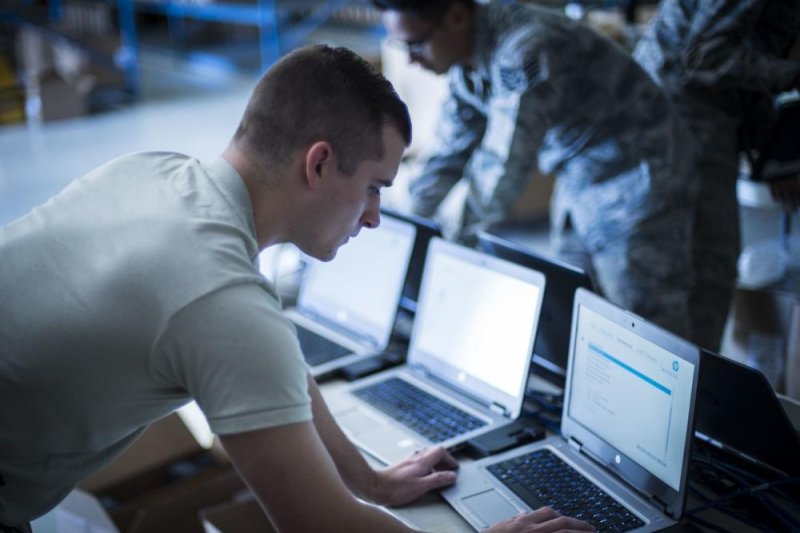
Senior Airman Zach Wilt, 49th Communications Squadron cyber operator, installs Microsoft Windows 10 to a laptop at Holloman Air Force Base, N.M., on Nov. 1, 2017. Lockheed Martin has been awarded a contract for the national cyber range capability, which allows potentially virulent code to be studied without compromising live computer systems. The deal, announced Tuesday by the Department of Defense, is valued at more than $33.9 million and is a modification to a previous contract under the terms of a cost-plus-fixed fee agreement.FUZZY THINKING ABOUT DRONES
Are drones reliable? Would you bet your life on them? In a recent article, Jacquelyn Schneider and Julia Macdonald argued that “the troops don’t trust drones” to protect them in combat with close air support. To understand how the people who actually coordinate airstrikes feel, they interviewed and surveyed Joint Terminals Air Controllers (JTACs) and Joint Fires Observers (JFOs) about their thoughts on working with manned and unmanned aircraft. They find some measure of hesitation about and distrust towards working with unmanned aircraft. In their conclusion, they argue that manned aircraft overhead inspire a “warm fuzzy” feeling of comfort and confidence in ground troops that unmanned platforms cannot provide. Ultimately, the authors recommend that “[p]olicymakers should reexamine their apparent commitment to an unmanned future.”Google Parent Alphabet Launches New Cyber Security Business Billed As A ‘Digital Immune System’ To Fight Off Hackers
$86,000 + 5,600 MPH = Hyper Velocity Missile Defense
Gen. Holmes Sketches Multi-Domain Warfare; A-10 Wings Funded in ’19
The Air Force and Army couldn’t start an important set of tabletop wargames last week because of the government shutdown. Air Force Gen. Mike Holmes revealed the information when he disclosed today that the Air Force was starting multi-domain war games to hammer out how the land and air services would work together in a high-intensity fight with Russia. Now, being forced to reschedule these isn’t the end of the world, but it’s a very good example of the waste and confusion that Congress causes when it fails to pass appropriations bills, especially the one that really matters to the Constitution — defense.