The Profession of Arms: A Guide for Young Army Officers
It takes courage, especially for a young officer, to check a man met on the road for not saluting properly or for slovenly appearance, but, every time he does, it adds to his stock of moral courage, and whatever the soldier may say, he has respect for the officer who does pull him up.
Read Document →The Dragon's Teeth: Assessing China's Military Modernization
PLA has focused on modernising its capabilities across all warfare domains to achieve these goals. This includes land, air, and maritime operations, nuclear, space, counter-space, electronic warfare and cyberspace operations, aiming to become a fully integrated joint force.
Read Document →Transforming the PLA: A Decade of reorganisation from SSF to ISF
PRC has engaged in a sustained and broad effort to transform the PLA from an infantry-heavy, low-technology, ground forces-centric military into a high-technology, networked force with an increasing emphasis on joint operations and naval and air power projection.
Read Document →Eyes without Borders: Exploring the World of Open Source Intelligence (OSINT) in the Digital Age
Open Source Intelligence (OSINT) is gaining prominence with the rise of social media, the digital society and the vast growth of publicly and commercially available information (PAI and CAI).
Read Document →
The PLA’s Developing Cyber Warfare Capabilities and India's Options
Informationised warfare blurs the lines between peacetime and wartime. A nation in the information age cannot wait for the hostilities to break out to collect intelligence, carryout influence operations, develop antisatellite systems or design computer software weapons.
Read Document →
Galwan and After
Why did China did this when he is under tremendous pressure in all fronts, is this China's salami slice tactics being progressed rigorously, what will be new Rules of Engagement, what will be escalatory control mechanism, who has taken this decision, will there be some pressure put by China in India's North-East through insurgency.
Read Document →
India’s Joint Doctrine for Cyberspace Operations: A Critical Review
Chief of Defence Staff (CDS) General Anil Chauhan and Secretary, Department of Military Affairs, formally released declassified versions of the Joint Doctrines for Cyberspace Operations during the Chiefs of Staff Committee meeting in New Delhi.
Read Document →
Know your Enemy General(now Field Marshal) Syed Aseem Munir
Gen SA Munir's position in the hierarchy of Pakistan was not very comfortable. The state of economy, insurgency in Pakhtoonistan and Balochistan, attack on the Jaffar Express, constant protests by supporters of Imran Khan's supporters inside and outside of parliament.
Read Document →
Decoding Operation SINDOOR: Key Aspects and Implications
Precision strikes were carried out on nine sites—four in Pakistan and five in PoK—linked to anti-India terrorist groups such as the LeT, JeM and the Hizbul Mujahideen. The targeted sites included Muridke (LeT headquarters) and Bahawalpur (JeM headquarters).
Read Document →
Chinese Cyber Exploitation in India's Power Grid - Is There a linkage to Mumbai Power Outage?
The New York Times (NYT), based on analysis by a U.S. based private intelligence firm Recorded Future, reported that a Chinese entity penetrated India’s power grid at multiple load dispatch points. Chinese malware intruded into the control systems that manage electric supply across India, along with a high-voltage transmission substation and a coal-fired power plant
Read Document →1 February 2016
Deepening the French connection
1962 – The War That Wasn’t book review: A Himalayan debacle
DO WE KNOW WHAT WE ARE DOING IN AFGHANISTAN THIS YEAR?
THERE IS STILL HOPE FOR THE U.S. RELATIONSHIP WITH PAKISTAN
Poor Intelligence Is Hindering Afghan Mission
State of the Afghan Economy Deteriorating Rapidly
The U.S. Has No Global Strategy
South Asia
Freedom by the Numbers

** National Commission on the Future of the Army (NCFA) Report
*** Hacking the Israeli Drones
The Strange Tale of Sino-Pakistani Friendship
China: Surviving the Camps
China
Competing Visions for Syria and Iraq: The Myth of an Anti-ISIS Grand Coalition
America’s Misplaced Faith in Bombing Campaigns
The United States Should Admit It No Longer Has a Middle East Policy
2016: THE YEAR OF THE GREAT MIDDLE EAST CYBERWAR?
* Senior Russian Official Warns of American Plot
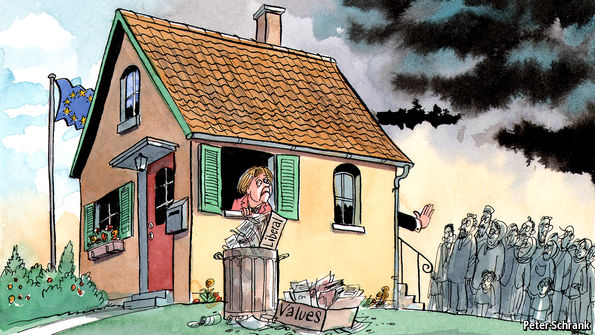
Charlemagne Value shoppers
* Chief of NSA’s Hacker Unit Gives First Public Talk About Cyber Spying
Cybersecurity
No threat facing America has grown as fast or in a manner as difficult to understand as has cybersecurity. The media vacillate between claiming that the threat is nothing but hype and panicked cries that the digital sky is falling. Neither position is correct.
President Bush took strong steps to improve the overall security of the nation’s networks, and it seemed that President Obama was following suit. Securing cyberspace was a very early priority for the Obama Administration, which was wise enough to use former Bush appointees to set the tone and maintain some continuity, but the initial flurry of activity was not followed up in a consistent and effective manner.
There have been several legislative fights over cyber bills. They have been characterized repeatedly as partisan battles that have left America exposed to a growing variety of cyber threats, but this is a very inaccurate and self-serving view. In fact, every cyber bill that has been introduced has had bipartisan support as well as bipartisan opposition. The fight is not over a need for appropriate cyber legislation; it is over how one defines “appropriate.”
The main point of contention is the degree to which federal regulatory powers should play a role in cybersecurity. Many seem to think reflexively that this 19th-century solution is the answer. Those with a little more understanding of the dynamic and fast-moving nature of cybersecurity see regulation as far too slow and clumsy to be of any benefit and recognize that it might actually hinder security by building a culture of mere compliance with regulations and a false sense of security against enemies who are agile, motivated, and clever.
Russia is the most sophisticated cyber threat, with China as a close second. China also has a strong desire to jump-start its economic efforts by rampant theft of commercial intellectual property. This fact is common fodder for the news media but is actually a greater problem than the news illustrates. Iran and North Korea are much less sophisticated than the two giants, but what they lack in expertise they make up for in malice. For example, the 2012 “Shamoon” virus unleashed upon the Saudi ARAMCO oil production company was a brute-force attack that destroyed 30,000 computers, and the recent cybersecurity breach of the Office of Personnel Management, a campaign believed to be undertaken by the Chinese government, resulted in compromised information of approximately 4 million federal employees. Attacks such as these have shown the U.S. that countries like China have the capabilities to inflict serious damage. North Korea has also used high-profile cyberattacks against the U.S., with the most notable being the one launched against Sony Pictures Entertainment, allegedly over a movie depicting North Korea in a negative light. The hackers took terabytes of private data and released confidential information to the public, including five Sony movies.
To address this growing threat, the U.S. should leverage the forces of the market, motivating the private sector to make the sort of continual and dynamic investment needed to really secure our diverse networks. Heritage Foundation analysts have developed steps to do this that should be taken legislatively to begin the process of improvement that is so badly needed.