After 26 years in operation, India’s Jet Airways had its final flight last week, following a refusal by lenders for emergency funding. The lenders’ action came as a result of a string of missed debt-servicing payments by the airline and disagreement over whether it could be revived under the management of its founder and 51% equity owner, Naresh Goyal.The Profession of Arms: A Guide for Young Army Officers
It takes courage, especially for a young officer, to check a man met on the road for not saluting properly or for slovenly appearance, but, every time he does, it adds to his stock of moral courage, and whatever the soldier may say, he has respect for the officer who does pull him up.
Read Document →The Dragon's Teeth: Assessing China's Military Modernization
PLA has focused on modernising its capabilities across all warfare domains to achieve these goals. This includes land, air, and maritime operations, nuclear, space, counter-space, electronic warfare and cyberspace operations, aiming to become a fully integrated joint force.
Read Document →Transforming the PLA: A Decade of reorganisation from SSF to ISF
PRC has engaged in a sustained and broad effort to transform the PLA from an infantry-heavy, low-technology, ground forces-centric military into a high-technology, networked force with an increasing emphasis on joint operations and naval and air power projection.
Read Document →Eyes without Borders: Exploring the World of Open Source Intelligence (OSINT) in the Digital Age
Open Source Intelligence (OSINT) is gaining prominence with the rise of social media, the digital society and the vast growth of publicly and commercially available information (PAI and CAI).
Read Document →
The PLA’s Developing Cyber Warfare Capabilities and India's Options
Informationised warfare blurs the lines between peacetime and wartime. A nation in the information age cannot wait for the hostilities to break out to collect intelligence, carryout influence operations, develop antisatellite systems or design computer software weapons.
Read Document →
Galwan and After
Why did China did this when he is under tremendous pressure in all fronts, is this China's salami slice tactics being progressed rigorously, what will be new Rules of Engagement, what will be escalatory control mechanism, who has taken this decision, will there be some pressure put by China in India's North-East through insurgency.
Read Document →
India’s Joint Doctrine for Cyberspace Operations: A Critical Review
Chief of Defence Staff (CDS) General Anil Chauhan and Secretary, Department of Military Affairs, formally released declassified versions of the Joint Doctrines for Cyberspace Operations during the Chiefs of Staff Committee meeting in New Delhi.
Read Document →
Know your Enemy General(now Field Marshal) Syed Aseem Munir
Gen SA Munir's position in the hierarchy of Pakistan was not very comfortable. The state of economy, insurgency in Pakhtoonistan and Balochistan, attack on the Jaffar Express, constant protests by supporters of Imran Khan's supporters inside and outside of parliament.
Read Document →
Decoding Operation SINDOOR: Key Aspects and Implications
Precision strikes were carried out on nine sites—four in Pakistan and five in PoK—linked to anti-India terrorist groups such as the LeT, JeM and the Hizbul Mujahideen. The targeted sites included Muridke (LeT headquarters) and Bahawalpur (JeM headquarters).
Read Document →
Chinese Cyber Exploitation in India's Power Grid - Is There a linkage to Mumbai Power Outage?
The New York Times (NYT), based on analysis by a U.S. based private intelligence firm Recorded Future, reported that a Chinese entity penetrated India’s power grid at multiple load dispatch points. Chinese malware intruded into the control systems that manage electric supply across India, along with a high-voltage transmission substation and a coal-fired power plant
Read Document →30 April 2019
Why India’s Jet Airways Lost Its Wings
After 26 years in operation, India’s Jet Airways had its final flight last week, following a refusal by lenders for emergency funding. The lenders’ action came as a result of a string of missed debt-servicing payments by the airline and disagreement over whether it could be revived under the management of its founder and 51% equity owner, Naresh Goyal.War & Peace in Contemporary India
Fear and Loathing in Balochistan
In Balochistan, bad news always keeps coming, despite the government’s near daily assurances about restoring peace in the province. Now, once again, Balochistan’s situation is going from bad to worse. There have been sporadic assaults on the security forces in Balochistan’s northern belt, the areas dominated by Pashtuns. There are reports of banned religious outfits regrouping and gaining momentum, too.How Can Sri Lanka Recover?
Panic has gripped Sri Lanka after the serial suicide bombings on Easter Sunday at three churches and three luxury hotels that claimed 253 lives and wounded hundreds of others. But the island nation has a fighting chance to restore peace and communal harmony, according to experts. The country had proven as much with the peace it had achieved over the last nine years following 26 years of civil war between the government and Tamil separatist groups in the north of the country. Even its tourism economy continued to flourish despite sporadic incidents of violence.From the Ruins of the Caliphate: Sri Lanka’s Bloody Easter
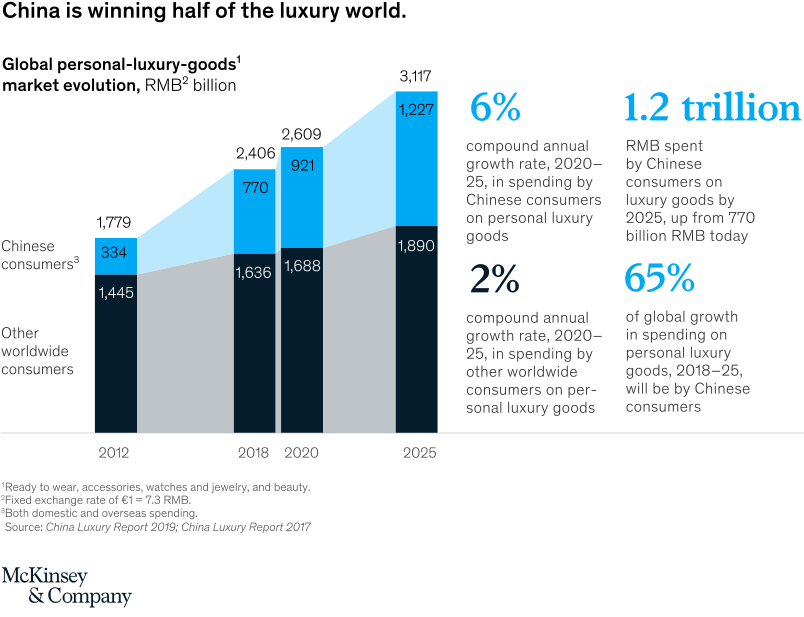
No sooner had the news of the serial bombings in Sri Lanka on Easter Sunday spread than fevered attempts were made to pin the attacks to the known brands of international terrorist outfits like the Islamic State (IS) and Al-Qaeda in the Indian Subcontinent (AQIS).How young Chinese consumers are reshaping global luxuryApril 2019 | Report
Why China Will Rival the U.S. in High Tech
Those who think China can’t catch up in innovation tend to base their arguments on abstractions: A rigid education system stifles creativity, they say, while heavy-handed industrial policies such as the “Made in China 2025” program encourage waste and inefficiency.The World China Wants
European Union leaders sat down this week in Brussels for a summit with a China it recently branded a “systemic rival,” and the United States is nearing the end game of trade talks with a China that national security documents refer to as a “strategic adversary.”China’s Belt and Road Debate
The Second Belt and Road Forum for International Cooperation is underway in Beijing. The Chinese media has projected the three-day forum, from April 25 to 28, as China’s most important diplomatic event as well as the most anticipated and high-profile global event for the year. Around 40 foreign leaders and thousands of representatives from more than 100 countries and international organizations are expected to attend the conference, which will focus on the theme “together building the One Belt One Road and creating a better future.”Making Sense of China’s Reaction to the French Navy’s Taiwan Strait Transit
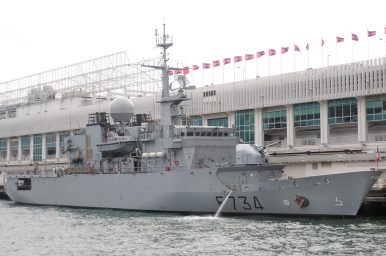
This week, a spokesperson for the Chinese Ministry of Defense accused France of “illegally entering Chinese waters.” Following this apparent transgression, Beijing withdrew the French Navy’s invitation to participate in the naval parade off Qingdao to commemorate the 70th year of the People’s Liberation Army Navy.A Slimmer Belt and Road Is Even Scarier
Time for Trilateral Coordination on 5G
ISIS's Newest Recruiting Tool: Regional Languages
Perceptions of American Decline
Did Russia Just Concede a Need to Regulate Military AI?
After years of Kremlin efforts to derail international guidelines on militarized artificial intelligence, a national-security leader appeared to signal a new course.Trump’s Inconsistent Approach to Iran Oil Waivers Means He Can’t Have His Cake and Eat it Too
The Trump administration shocked global oil markets on April 22 with US Secretary of State Michael Pompeo’s surprise announcement that the United States would not renew any waivers for importing Iranian oil when they expire on May 2. While Pompeo noted that Saudi Arabia and the United Arab Emirates (UAE) would increase production to match the approximate 1.1 million barrels per day (bpd) of Iranian crude that will come off the market, this will cut into global spare capacity and has already pushed Brent crude up over 3 percent over $74 as of publication.An ‘Increase in Clarity’ in US Cyber Strategy
Brig. Gen. Timothy D. Haugh (USAF), commander of the Cyber National Mission Force of the US Cyber Command, speaks at the International Conference on Cyber Engagement in Washington, DC on April 23, 2019. The Genetics Revolution is Already Here and Has Major National Security Implications
When most of us think about genetic technologies, healthcare comes to mind for some very good reasons. Our growing understanding of how our genes impact how our bodies function has made possible incredible medical innovations to treat and even cure some truly awful genetic diseases. But our genomes don’t just underpin our health, they are the blueprints of much of our lives.Opening supercomputing to all agencies
Department of Energy Secretary Rick Perry wrote last May that “the future is in supercomputers,” but until recently, only a handful of agencies have been able to tap into that kind of power. Traditionally, high performance computing (HPC, or supercomputing) has required significant capital investment -- as much as $400 million to $600 million for large-scale supercomputing infrastructures and operating expenses. It also called for small armies of scientists and engineers skilled in HPC application development. Precious few agencies had these resources and technical expertise.Is Cyber Command really being more ‘aggressive’ in cyberspace?
Earlier this year, Congress and the White House granted the U.S. Cyber Command a range of new authorities, and, in the months since national security experts have said the Department of Defense will be more aggressive in cyberspace, leading attacks against bad actors who have stolen intellectual property or against those who are attempting to influence American elections.Cyber Risk Wednesday: Supply Chain Security in the 21st Century
This Is Why Quantum Field Theory Is More Fundamental Than Quantum Mechanics
Visualization of a quantum field theory calculation showing virtual particles in the quantum vacuum. (Specifically, for the strong interactions.) Even in empty space, this vacuum energy is non-zero. As particle-antiparticle pairs pop in-and-out of existence, they can interact with real particles like the electron, providing corrections to its self-energy that are vitally important. On Quantum Field Theory offers the ability to calculate properties like this. 5G Access Key to Competing Globally, Says Former Homeland Security Secretary Chertoff
“We are poised for the next big revolution in infrastructure—that has to do with moving from 4G to 5G,” Michael Chertoff, a former secretary of the US Department of Homeland Security, said at the 8th annual International Conference on Cyber Engagement, a conference co-hosted by the Atlantic Council in Washington on April 23. (Photo Credit: ImageLinkPhoto.com/Dennis Kan)Characteristics of Successful U.S. Military Interventions
Is neuroscience the future of warfare?
Broad and rapid advancements in neuroscience and its technologies (i.e.- neuroS/T) have prompted renewed and growing interest in and use of these tools and methods to exert influence and power on the global stage. "The military is examining ways that brain science can be employed to augment warfighters’ and intelligence operators’ performance"