 Rajat Kumar, COO of ABP Digital, who previously had a leadership role at the Indian e-commerce company Snapdeal and was a consultant at McKinsey, writes in this opinion piece that Walmart’s $16 billion deal to buy online retailer Flipkart says a lot about India’s e-commerce ecosystem. Walmart’s much-anticipated $16 billion acquisition of Flipkart, India’s top e-commerce retailer, which was announced last week, brings to mind the opening lines from Charles Dickens’ A Tale of Two Cities: “It was the best of times, it was the worst of times; it was the age of wisdom, it was the age of foolishness; it was the epoch of belief, it was the epoch of incredulity; it was the season of light, it was the season of darkness; it was the spring of hope, it was the winter of despair.” The deal is all those things — and more.
19 May 2018
Where’s the Value? An Inside Look at Walmart’s Flipkart Deal
Rajat Kumar, COO of ABP Digital, who previously had a leadership role at the Indian e-commerce company Snapdeal and was a consultant at McKinsey, writes in this opinion piece that Walmart’s $16 billion deal to buy online retailer Flipkart says a lot about India’s e-commerce ecosystem. Walmart’s much-anticipated $16 billion acquisition of Flipkart, India’s top e-commerce retailer, which was announced last week, brings to mind the opening lines from Charles Dickens’ A Tale of Two Cities: “It was the best of times, it was the worst of times; it was the age of wisdom, it was the age of foolishness; it was the epoch of belief, it was the epoch of incredulity; it was the season of light, it was the season of darkness; it was the spring of hope, it was the winter of despair.” The deal is all those things — and more.China in Afghanistan: A military base in the offing?
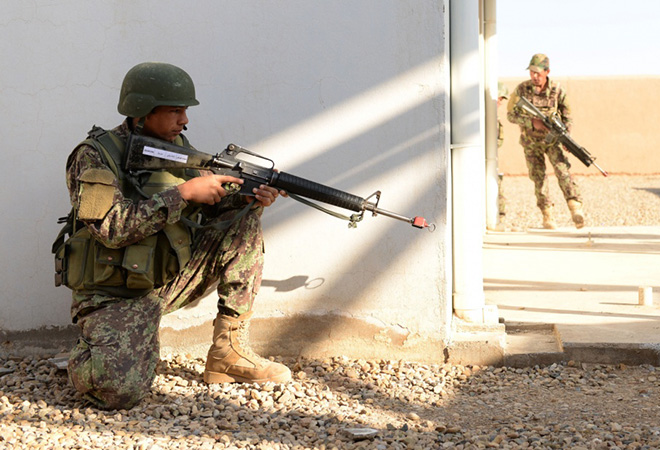 As the political and security situation in Afghanistan continues to deteriorate, China’s role in the war torn nation has come into sharp relief. Though China and Afghanistan share a border barely stretching 76 km, Beijing’s worries about the deteriorating security landscape there have continued to grown. As a major global power with its perhaps only ‘all-weather’ ally on the planet, Pakistan, in the region, the preponderance of jihadist narratives are counter-productive to the country’s Xinjiang region, which borders Afghanistan and Pakistan, and has a suppressed Uyghur Muslim population in a region widely considered to be one of the most surveilled in the world.
Afghanistan-Pakistan Finalize Joint Action Plan for Peace
The Ministry of Foreign Affairs (MoFA) on Tuesday said that diplomats from Afghanistan and Pakistan have wrapped up their fourth meeting in Islamabad on the joint action plan between the two countries. The plan is known as the Afghanistan-Pakistan Action Plan for Peace and Solidarity (APAPPS). Pakistan and Afghanistan agreed to draw up a plan in April following Pakistan Prime Minister Shahid Khaqan Abbasi’s trip to Kabul where he held talks with Afghanistan’s President Ashraf Ghani. The two leaders agreed to seven key principles to finalize the action plan.
The two leaders agreed to the following:
On China’s New Silk Road, Democracy Pays A Toll
 Great power competition is back. And China is now combining its vast economic resources with a muscular presence on the global stage. One of Beijing’s key efforts is the Belt and Road Initiative, a trillion-dollar endeavor to link together Asia, the Middle East, Africa, and Europe through a web of mostly Chinese-funded physical and digital infrastructure. Much of Washington has fretted over China’s mercantilist approach to economics in general and views the Belt and Road Initiative largely through this lens. Yet the concerns over Beijing’s current approach should go beyond dollars and yuan. By fueling debt dependency, advancing a “China First” development model, and undermining good governance and human rights, the initiative offers a deeply illiberal approach to regions that contain about 65 percent of the world’s population and one-third of its economic output.
China Has Decided Russia Is Too Risky an Investment
 On May 4, the planned investment by the Chinese company CEFC China Energy into Russian state oil giant Rosneft fell apart, eight months after it was first announced. The tie-up’s failure reveals the strict limits on the potential for energy cooperation between China — which is in the process of taking ownership of CEFC — and Russia, and with it a broader political alliance between the two countries. Beijing has come to view Rosneft more as a tool of the Russian state than a traditional oil company, and to the extent the two countries don’t share political priorities, China has little interest in any significant economic relationship. Although China is actively searching for new political and economic partners around the world, it seems to have decided the Russian government is too risky a political investment.
A Primer on Countering Terrorism
By Isaac Kfir
This article was published by the Australian Strategic Policy Institute (ASPI) on 2 May 2018.
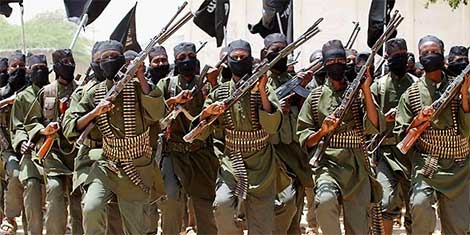 Terrorism’ is usually defined as the real or threatened use of violence by a non-state actor against non-combatants or civilians to achieve political, religious or ideological objectives. This definition underlines the fact that the term carries many additional connotations. (The Washington-based Center for Strategic and International Studies has established a database of legislation that defines terrorism.) With Daesh adjusting to a huge loss of territory and al-Qaeda resurrecting itself, we need to recognise the existence of several factors involved in terrorism if we are to respond to it effectively. There are two additional elements. One is that terrorist groups will seek to justify their actions by presenting them as a response to state oppression (the state is always the stronger party).
Fighting terrorism and storing intel in the age of big data
/arc-anglerfish-arc2-prod-mco.s3.amazonaws.com/public/J5FODECZPVGZ3DDWPCLEGHR3PM.jpg) AMMAN, Jordan — Several companies in attendance at the Special Operations Forces Exposition last week didn’t bring missiles, rockets, helicopters or drones, but rather laptops or other devices with software designed to make sense of the huge amount of data and intelligence flowing in for counterterror operations in the Middle East. The fight against terrorism has become more complicated in a data-rich and data-dependent, international stage. Terrorists have adeptly used avenues through social media to spread philosophy and recruit members while engaging in campaigns of misinformation to influence communities.
AMMAN, Jordan — Several companies in attendance at the Special Operations Forces Exposition last week didn’t bring missiles, rockets, helicopters or drones, but rather laptops or other devices with software designed to make sense of the huge amount of data and intelligence flowing in for counterterror operations in the Middle East. The fight against terrorism has become more complicated in a data-rich and data-dependent, international stage. Terrorists have adeptly used avenues through social media to spread philosophy and recruit members while engaging in campaigns of misinformation to influence communities.Why Trump Can Safely Ignore Europe
By Jeremy Shapiro
Europe has reacted swiftly and with great fury to U.S. President Donald Trump’s decision last week to pull out of the Iranian nuclear deal. The problem is not simply that the Trump administration has undermined one of the signature achievements of European foreign policy but that his inherent volatility, his unpredictability, and most of all his lack of commitment to the transatlantic alliance mean that any act of U.S. disruption is now possible. Righteous indignation is the language of the day, and predictions about the death of the transatlantic alliance abound. But laments and indignation do not add up to strategy. The real question is not whether Europeans are pissed off but whether they will do anything in response to Trump’s actions. The answer is most likely no.
Generals Worry US May Lose In Start Of Next War: Is Multi-Domain The Answer?
By SYDNEY J. FREEDBERG JR
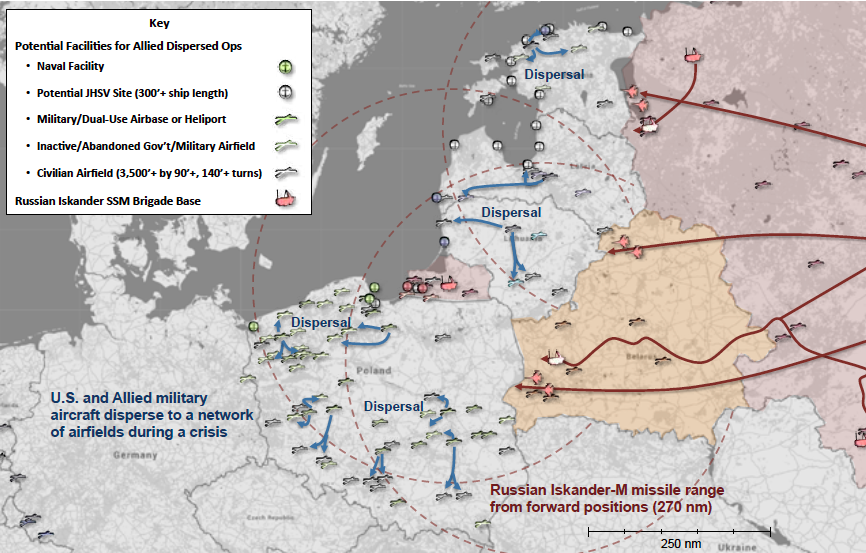
Defense of the Baltic States and Poland against a notional Russian missile barrage. (CSBA graphic)
QUANTICO: Russia or China could “overrun” US allies at the outbreak of war, senior military leaders fear, and our plan to stop them is very much a work in progress. Iraq and Syria have given sneak previews of how the US can combine, say, hackers, satellites, special operators, and airstrikes in a single offensive, but we’re not yet ready to launch such a multi-domain operation against a major power.
Tech Companies Are Ruining America’s Image
BY JOSHUA A. GELTZER, DIPAYAN GHOSH
 Not long ago, Americans used to worry — constantly and loudly — about what their country’s main cultural export was and what it said about them. In the 1990s, after the Iron Curtain came down, many Americans wondered whether the appealing lifestyles the world saw on U.S. sitcoms and blockbusters deserved some credit for energizing global resistance to communism. Then, as the optimism of the ’90s gave way to the shock and horror of 9/11, Americans asked, with palpable chagrin, whether the materialism and vulgarity of their TV shows and movies were contributing to the virulent anti-Americanism that had spread throughout much of the globe.
Examining Civil Society Legitimacy
SASKIA BRECHENMACHER, THOMAS CAROTHERS
The Carnegie Endowment for International Peace gratefully acknowledges support from the Ford Foundation, the Charles Stewart Mott Foundation, and the UK Department for International Development that helped make this study possible. Civil society is under stress globally as dozens of governments across multiple regions are reducing space for independent civil society organizations, restricting or prohibiting international support for civic groups, and propagating government-controlled nongovernmental organizations. Although civic activists in most places are no strangers to repression, this wave of anti–civil society actions and attitudes is the widest and deepest in decades. It is an integral part of two broader global shifts that raise concerns about the overall health of the international liberal order: the stagnation of democracy worldwide and the rekindling of nationalistic sovereignty, often with authoritarian features.
Friends With Benefits
FRANCES Z. BROWN, MARA KARLIN
What does an “America first” national security strategy look like in action? The White House provided a hint in April, when news broke that National Security Adviser John Bolton had asked Arab nations, including Egypt and possibly Saudi Arabia, to supply ground forces to replace U.S. troops in Syria. (This came only weeks after U.S. President Donald Trump announcedhis desire to “bring our troops back home.”) Although details are scarce, Bolton’s new initiative appears to mirror a broader talking point coming from the Trump administration: rather than putting American lives at risk, the United States will work “by, with, and through” local forces to achieve its national security objectives.
At Least Do No Harm: The Negative Effects and Unforeseen Consequences of US Contracting Practices on the Afghan Local Community and its Influence on the Perception of US Forces and Americans
Greg Kleponis
Introduction
In the medical profession they abide by the edict, “Primum non nocere.” This Latin phrase simply means "first, do no harm." Another way to state it is that, "given an existing problem, it may be better not to do something, or even to do nothing, than to risk causing more harm than good." 1 It reminds the health care provider that they must consider the possible harm that any intervention might do. It is invoked when debating the use of an intervention that carries an obvious risk of harm but a less certain chance of benefit. This axiom might be applied to the entire idea of intervention in foreign countries already riddled with conflict. This paper takes a more precise look at one element of the overall intervention/stability effort in Afghanistan that many believe is having perversely, the opposite effect of that which it is intended- contracting.
A Competitive Strategy To Counter Russian Aggression Against NATO
The world has entered a new era of great power competition. The 2017 U.S. National Security Strategy declared: After being dismissed as a phenomenon of an earlier century, great power competition returned. China and Russia began to reassert their influence regionally and globally. . . They are contesting our geopolitical advantages and trying to change the international order in their favor.[i] Building off the concept of a renewed great power competition, the U.S. National Defense Strategy took a broad view of the necessary actions to ensure national security:
US crude supply: longer market, lower prices
 The US closed 2017 with crude supply up by approximately 1 million barrels/day. This put production back at the previous peak seen in 2015 at 9.6 million barrels/day, a major turnaround from the low point of 2016 at 8.6 million barrels/day. Most of this growth is coming from the Permian Basin in West Texas and New Mexico where producers were optimizing efforts to produce at below $50/bbl. And virtually all the incremental volumes are flowing to the Gulf Coast. Over-investment in pipeline capacity to the coast has provided plenty of capacity to move additional supply. While refiners on the coast have upped their intake of domestic crude to the limits that its lighter quality allows – this has still resulted in a big growth in exports, up to 1.4 million barrels/day by the end of the year.
The Problems of Defence Planning
The new Defence Planning Committee needs to overcome structural flaws to be successful.
The recent establishment of the Defence Planning Committee (DPC) provides proof that the development of India’s military power is in dire need of political direction. For the most part, the Armed Forces, bereft of adequate political guidance, have been formulating their own schemes and plans based on their service-specific interpretations to shape themselves. The result has been a skewed development of the different sub-systems of military power, whose critical components have lacked integration, prioritisation, synergy and optimal utilisation of scarce resources. Coupled with a weak defence industrial base, the contemporary narrative cannot but project the notion that India is militarily ill-equipped to meet the threats posed by the growing global and regional geopolitical tensions.
Separating Better Data from Big Data: Where Analytics Is Headed
 Ten years ago, the most forward-thinking companies were just starting to dive into the potential of data and analytics. Since then, brands have moved from using analytics to answer what customers are doing to exploring the how and why, and also to figure out what they will do in the future. The Wharton Customer Analytics Initiative (WCAI) is celebrating its 10thanniversary this year and has seen every step of that evolution. Knowledge@Wharton recently sat down with Wharton marketing professors Eric Bradlow, Peter Fader and Raghuram Iyengar to discuss how the field has developed over time, and what they expect to be the key trends over the next decade. Bradlow and Fader are the founding directors of WCAI, and Bradlow and Iyengar are the current co-directors.
Spy Games: Ex-Mossad Chief’s Cybersecurity Startup Counters Attacks With A Hacker’s Mindset
By Ido Levy, NoCamels
For decades Tamir Pardo worked in the shadows, in a career that began in the Israeli military’s most elite commando unit and culminated in him leading the Mossad, one of the world’s most feared espionage organizations. Now, the former Mossad chief is in his second act – as a cybersecurity startup founder. After completing his term as head of the world-renown Israeli spy agency in 2016, Pardo, a veteran of the IDF’s Sayeret Matkal who served under the command of Yoni Netanyahu in Operation Entebbe in 1976, founded XM Cyber, a cybersecurity company that has since developed an automated advanced persistent threat simulation platform and whose tagline is “defense by offense.”
Senate votes to reinstate net neutrality — but it has a long way to go
/cdn.vox-cdn.com/uploads/chorus_image/image/59757809/951573798.jpg.0.jpg) In a 52–47 vote today, senators voted to overturn the Federal Communication Commission’s Restoring Internet Freedom Order, which took net neutrality rules off the books. They were able to do so using the Congressional Review Act, or CRA, which allows Congress to reverse recent decisions by government agencies. Republican control of Congress means that such a measure wouldn’t normally even make it up for a vote; but the CRA allows senators to force a vote by obtaining 30 signatures.
In a 52–47 vote today, senators voted to overturn the Federal Communication Commission’s Restoring Internet Freedom Order, which took net neutrality rules off the books. They were able to do so using the Congressional Review Act, or CRA, which allows Congress to reverse recent decisions by government agencies. Republican control of Congress means that such a measure wouldn’t normally even make it up for a vote; but the CRA allows senators to force a vote by obtaining 30 signatures.Air Force Electronic Warfare Push Gains Steam; C-5 Gets 3-D Printed Door Handles
By COLIN CLARK
We will probably never know much about it, but the Air Force's top Electronic Warfare task force has completed its first scrub and should report to top service leaders in the next month or so.The woman who leads the Air Force’s effort, Gen. Ellen Pawlikowski, started the Strategic Development Planning Experimentation unit to find gaps in the service’s capabilities. Once the gap is found, the service creates an Enterprise Capability Collaboration Team (ECCT) to examine the best ways to fill it. The EW ECCT was stood up last year. While most of what it’s doing is classified, we know that cyber, which had been deemed outside its purview, is now a solid part of the work.
TEL AVIV DIARY: HAMAS IS DESPERATE—AND DESPERATE PEOPLE DO STUPID, SELF-DESTRUCTIVE THINGS | OPINION
BY MARC SCHULMAN
When I began writing this article, I had just returned from Rabin Square (the central square in Tel Aviv), where tens of thousands gathered on Monday (May 14) to celebrate the Saturday night victory at the annual Eurovision song competition by Israeli pop sensation Netta Barzilai. During the congratulatory festivities, Netta belted out her winning balad TOY, as did a dozen other Israeli former Eurovision contestants—both winners and losers. This was the second celebration of Israel’s Eurovision victory that took place within two days. Saturday night, immediately following the announcement that Netta had won, ten thousand joyous people gleefully streamed to the main square, at 2am in the morning. Rarely have I seen teeming crowds so jubilant.
Inside Google, a Debate Rages: Should It Sell Artificial Intelligence to the Military?
Mark Bergen
Last July, 13 U.S. military commanders and technology executives met at the Pentagon's Silicon Valley outpost, two miles from Google headquarters. It was the second meeting of an advisory board set up in 2016 to counsel the military on ways to apply technology to the battlefield. Milo Medin, a Google vice president, turned the conversation to using artificial intelligence in war games. Eric Schmidt, Google’s former boss, proposed using that tactic to map out strategies for standoffs with China over the next 20 years. A few months later, the Defense Department hired Google’s cloud division to work on Project Maven, a sweeping effort to enhance its surveillance drones with technology that helps machines think and see.
Will the future of work be a utopia or a dystopia?
Emerging technologies like artificial intelligence and robotics will have a dramatic impact on the future of work. Already, today’s most valuable technology companies employ about one-fifth as many workers as the most valuable companies in the 1960s. Estimates of workforce displacement due to automation range from the OECD’s 14 percent of current jobs to the European think tank Bruegel’s 54 percent. Automation will disproportionately affect low-skill workers that are least able to adapt to these changes. On May 14, Center for Technology Innovation Founding Director Darrell West unpacked these trends in a presentation and a panel discussion held at Brookings based on his new book “The Future of Work: Robots, AI, and Automation.”
Here’s how a defense committee wants to better understand the future battlefield
By: Mark Pomerleau
/arc-anglerfish-arc2-prod-mco.s3.amazonaws.com/public/X56VLNSQSFAW5JUO6V74RSR5NQ.jpg) The House Armed Services Committee passed its annual defense policy bill for fiscal 2019 on May 10. Included in the bill are a series of provisions related to future battlefield technologies. Here’s what to watch as the bill moves through the legislative process this summer. - The bill requires the administration to submit a report on the effects of cyber-enabled information operations on U.S. national security. The report should include a summary of actions taken by the government to protect against those threats and a description of resources needed.
The House Armed Services Committee passed its annual defense policy bill for fiscal 2019 on May 10. Included in the bill are a series of provisions related to future battlefield technologies. Here’s what to watch as the bill moves through the legislative process this summer. - The bill requires the administration to submit a report on the effects of cyber-enabled information operations on U.S. national security. The report should include a summary of actions taken by the government to protect against those threats and a description of resources needed.Let’s Temper the Rhetoric About Civil-Military Relations
Charlie Dunlap
As readers of Duke University’s Lawfire know, I am a fan of Major Matt Cavanaugh, but I disagree with much (but not all) of his recent post, “Losing Our Profession: The Dire Consequences of a More Partisan Military .” Allow me to share a less “dire” perspective as someone who served three and half decades in the military through multiple administrations, and who has studied civil-military relations since authoring a rather well-known essay, The Origins of the American Military Coup of 2012 .
Matt’s concern seems to be this: