The Profession of Arms: A Guide for Young Army Officers
It takes courage, especially for a young officer, to check a man met on the road for not saluting properly or for slovenly appearance, but, every time he does, it adds to his stock of moral courage, and whatever the soldier may say, he has respect for the officer who does pull him up.
Read Document →The Dragon's Teeth: Assessing China's Military Modernization
PLA has focused on modernising its capabilities across all warfare domains to achieve these goals. This includes land, air, and maritime operations, nuclear, space, counter-space, electronic warfare and cyberspace operations, aiming to become a fully integrated joint force.
Read Document →Transforming the PLA: A Decade of reorganisation from SSF to ISF
PRC has engaged in a sustained and broad effort to transform the PLA from an infantry-heavy, low-technology, ground forces-centric military into a high-technology, networked force with an increasing emphasis on joint operations and naval and air power projection.
Read Document →Eyes without Borders: Exploring the World of Open Source Intelligence (OSINT) in the Digital Age
Open Source Intelligence (OSINT) is gaining prominence with the rise of social media, the digital society and the vast growth of publicly and commercially available information (PAI and CAI).
Read Document →
The PLA’s Developing Cyber Warfare Capabilities and India's Options
Informationised warfare blurs the lines between peacetime and wartime. A nation in the information age cannot wait for the hostilities to break out to collect intelligence, carryout influence operations, develop antisatellite systems or design computer software weapons.
Read Document →
Galwan and After
Why did China did this when he is under tremendous pressure in all fronts, is this China's salami slice tactics being progressed rigorously, what will be new Rules of Engagement, what will be escalatory control mechanism, who has taken this decision, will there be some pressure put by China in India's North-East through insurgency.
Read Document →
India’s Joint Doctrine for Cyberspace Operations: A Critical Review
Chief of Defence Staff (CDS) General Anil Chauhan and Secretary, Department of Military Affairs, formally released declassified versions of the Joint Doctrines for Cyberspace Operations during the Chiefs of Staff Committee meeting in New Delhi.
Read Document →
Know your Enemy General(now Field Marshal) Syed Aseem Munir
Gen SA Munir's position in the hierarchy of Pakistan was not very comfortable. The state of economy, insurgency in Pakhtoonistan and Balochistan, attack on the Jaffar Express, constant protests by supporters of Imran Khan's supporters inside and outside of parliament.
Read Document →
Decoding Operation SINDOOR: Key Aspects and Implications
Precision strikes were carried out on nine sites—four in Pakistan and five in PoK—linked to anti-India terrorist groups such as the LeT, JeM and the Hizbul Mujahideen. The targeted sites included Muridke (LeT headquarters) and Bahawalpur (JeM headquarters).
Read Document →
Chinese Cyber Exploitation in India's Power Grid - Is There a linkage to Mumbai Power Outage?
The New York Times (NYT), based on analysis by a U.S. based private intelligence firm Recorded Future, reported that a Chinese entity penetrated India’s power grid at multiple load dispatch points. Chinese malware intruded into the control systems that manage electric supply across India, along with a high-voltage transmission substation and a coal-fired power plant
Read Document →29 January 2018
The arc to Southeast Asia
India’s One Belt, One Road-Block
The USAF Expands MQ-9 Reaper Drone Force in Afghanistan to Its Largest Size Ever
Why the war in Afghanistan is unwinnable: American war aims in Afghanistan have been, and remain, riddled with contradictions and illusions
We Can’t Win in Afghanistan Because We Don’t Know Why We’re There
“The United States is not losing in Afghanistan, but it is not winning either, and that is not good enough,” reads the opening sentence of a top-secret review of the war in Afghanistan commissioned by President George W. Bush in 2008, according to multiple participants in that review. Subsequent classified reviews of the American strategy in the war have repeated that conclusion. The Trump administration undertook the latest rethinking of the war in August. President Trump’s advisers again reviewed its causes: opium, corruption, ethnic factionalism and, above all, the support and sanctuary provided to the Taliban by Pakistan, through the covert action arm of its powerful spy agency, the Directorate for Inter-Services Intelligence.Secretary of Defense Mattis’s Trip to Southeast Asia: A Few Thoughts
Secretary of Defense Jim Mattis traveled to Southeast Asia this past week, and during his first stop in Indonesia signaled a desire to improve strategic aspects of the U.S.-Indonesia relationship including on the South China Sea, training, and defense modernization. Visiting U.S. Secretary of Defense Jim Mattis shakes hands with Indonesia's Minister of Foreign Affairs Retno Marsudi at the Foreign Ministry in Jakarta, Indonesia on January 22, 2018. Darren Whiteside/ReutersChina’s Understanding of Global Order Shouldn’t Be Ours
Niall Ferguson is a prolific public intellectual who has made a career out of shattering shibboleths. At various points he has defended the achievements of the British Empire, argued that the United Kingdom’s entry into the First World War was “the biggest error in modern history,” and made the case at length that Henry Kissinger is a misunderstood idealist. Ferguson is at it again. In a recent op-ed, he takes on what he describes as the prevailing “myth of the liberal international order.” This piece appeared in China’s Global Times, a pugnacious nationalistic tabloid published by the official People’s Daily. It is not surprising, then, that the view it presents happens to conform quite closely with the official Chinese Communist Party line. It is also, in important respects, mistaken and misleading.Washington’s New Defense Strategy: Keep Russia, China Down
One thing can be said about the new Pentagon National Defense Strategy document just released under the name of Defense Secretary Jim Mattis. It is honest about what the target of US military policy is going forward. Washington military policy is explicitly aimed to keep China and Russia from developing any alternative counter-pole to unchallenged US military and political supremacy. The new document lays this out in no uncertain terms. The details are notable and show the disarray that is Washington today, as its once-firm grip on world power disintegrates.How Sharp Power Threatens Soft Power
Is the United States the new Saudi Arabia?
Turkey’s Attack on Kurds Tops USConcerns in Syria, Even as ISISKeeps Fighting
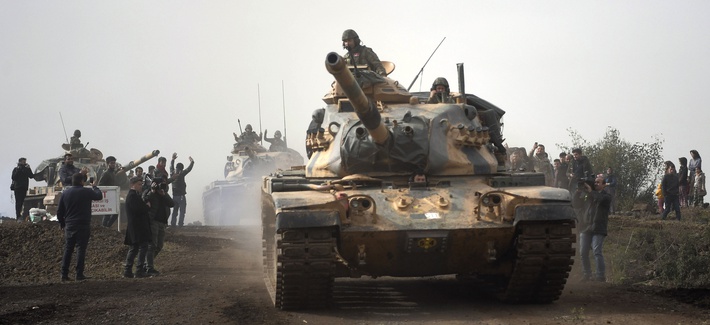
Over the past three days, the leader of U.S. Central Command and other American military commanders in the region have sounded increasingly alarmed. CAMP ARIFJAN, Kuwait – Turkey’s assault on Kurdish fighters around the northwest Syrian town of Afrin is now the top concern for U.S. military leaders in the region, who have sounded increasingly alarmed over the past three days. “Yeah, it certainly is. Definitely,” Gen. Joseph Votel told reporters Wednesday aboard a military aircraft traveling from Kuwait City to the United Arab Emirates. Senior leaders from U.S. Central Command, which Votel leads, and U.S. European Command are watching to see if Turkey’s President Recep Erdogan will make good his threat to send forces eastward from Afrin toward Manbij.In Europe, Subtle Signs Of A Softening On Putin's Russia
UK warned that Russian threat requires increased defence spending
Britain’s defence chief of general staff, Sir Nick Carter, is to warn that the UK is trailing Russia in terms of defence spending and capability. Carter is to use a speech in London to enter publicly into the debate over defence spending, which military chiefs and Conservative MPs claim has dropped to dangerously low levels. Failure to keep up with Russia will leave the UK exposed, particularly to unorthodox, hybrid warfare of the kind practised by Russia and other potentially hostile states, according to Carter. One of the biggest threats posed is from cyber-attacks that target both the military and civilian life.Trump’s National Defense Strategy Has the Pentagon Popping Champagne
Foresight Africa: Top priorities for the continent in 2018
Russian military was behind ‘NotPetya’ cyberattack in Ukraine, CIA concludes
The CIA has attributed to Russian military hackers a cyberattack that crippled computers in Ukraine last year, an effort to disrupt that country’s financial system amid its ongoing war with separatists loyal to the Kremlin. The June 2017 attack, delivered through a mock ransomware virus dubbed NotPetya, wiped data from the computers of banks, energy firms, senior government officials and an airport. The GRU military spy agency created NotPetya, the CIA concluded with “high confidence” in November, according to classified reports cited by U.S. intelligence officials.Facebook should be 'regulated like cigarette industry', says tech CEO
Social networks would be regulated “exactly the same way that you regulated the cigarette industry”, Benioff told CNBC at the World Economic Forum in Davos. “Here’s a product – cigarettes – they’re addictive, they’re not good for you, maybe there’s all kinds of different forces trying to get you to do certain things. There’s a lot of parallels.“I think that, for sure, technology has addictive qualities that we have to address, and that product designers are working to make those products more addictive, and we need to rein that back as much as possible,” he added. Benioff, who founded B2B cloud computing company Salesforce in 1999, and is now worth more than $4bn, suggested that regulation of some form was inevitable for the technology industry.Why digital strategies fail
Biden doesn't want cyber war with Russia
The next cyber arms race is in artificial intelligence
An Army sergeant launches a RQ-20 Puma Unmanned Aerial Vehicle (UAV) while conducting UAV training during exercise Combined Resolve V at the U.S. Army’s Joint Multinational Readiness Center in Hohenfels, Germany in 2015. The Army is investing in artificial intelligence to help protect its drone systems from cyber attacks. (U.S. Army photo by Spc. John Cress Jr./Released) In theory, the only technology capable of hacking a system run by artificial intelligence is another, more powerful AI system. That’s one reason why the U.S. Army incorporated a powerful AI capabilities into its drone systems that is expected to provide the ultimate cybersecurity — at least, for now. “It’s an arms race,” said Walter O’Brien, CEO of Scorpion Computer Services, whose AI system runs and protects the Army’s UAV operations. “Now I have an AI protecting the data center, and now the enemy would have to have an AI to attack my AI, and now it’s which AI is smarter.”Hacking: Another Weapon in the Asymmetrical Arsenal
Missile Defense Vs. China, Russia: Decentralize, Disperse, & Hide
Mattis: Pentagon Shifting Focus to Great Power Competition — ‘Not Terrorism’
The Trump administration’s long-awaited National Defense Strategy declares a decisive shift in America’s security priorities, away from the age of ISIS-level terrorism and toward a return to great-power competition with regional giants China and Russia. This shift, Pentagon planners say, will require a “more lethal, resilient, and rapidly innovating” military that can regain the overwhelming advantage the United States once held over those rivals and lesser adversaries such as Iran and North Korea.Teaching Multi-Domain Operations: The Case of British Field Marshal William Slim
CSA MiIley Bets On ‘Radical’ Tech, Promises No More FCS
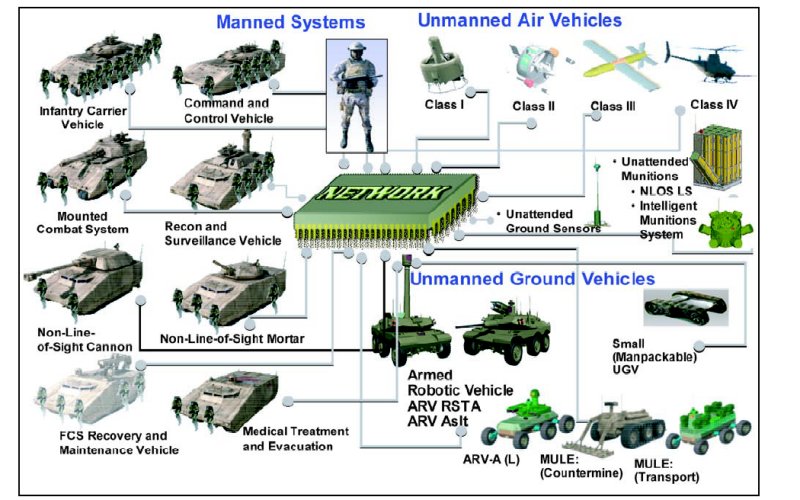
CRYSTAL CITY: The Army needs revolutionary technologies from robot tanks to a long-range super-rifle, the Chief of Staff said today — and it can get them without repeating the mistakes that doomed high-tech programs in the past. By reforming the acquisition bureaucracy, embracing commercial technology and rigorously prototyping new tech to work out bugs, Gen. Mark Milley said, the Army can improve 10-fold on its current weapons without falling into the pitfalls that doomed its last attempt to leap ahead, the canceled Future Combat System.