The Profession of Arms: A Guide for Young Army Officers
It takes courage, especially for a young officer, to check a man met on the road for not saluting properly or for slovenly appearance, but, every time he does, it adds to his stock of moral courage, and whatever the soldier may say, he has respect for the officer who does pull him up.
Read Document →The Dragon's Teeth: Assessing China's Military Modernization
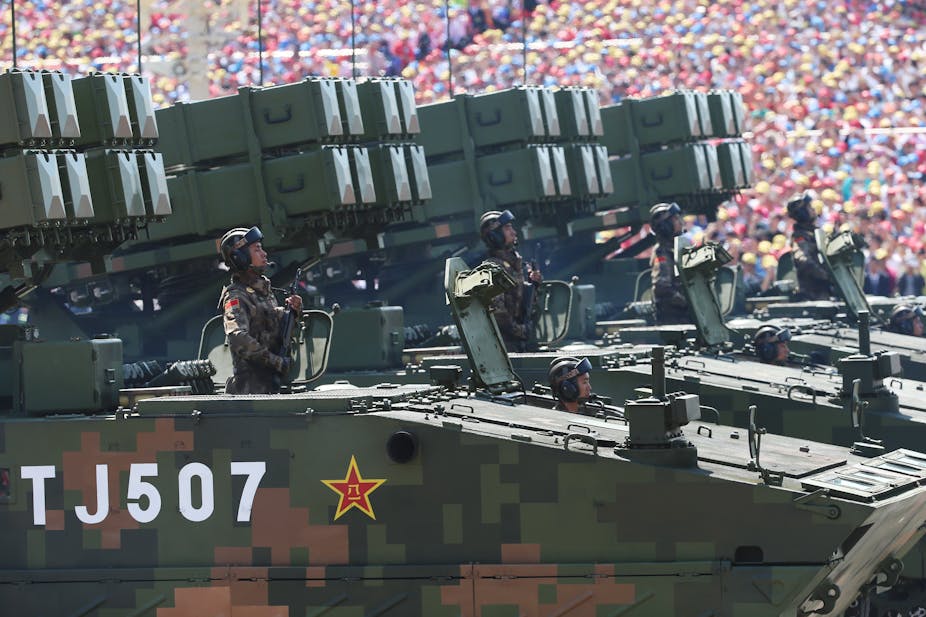
PLA has focused on modernising its capabilities across all warfare domains to achieve these goals. This includes land, air, and maritime operations, nuclear, space, counter-space, electronic warfare and cyberspace operations, aiming to become a fully integrated joint force.
Read Document →Transforming the PLA: A Decade of reorganisation from SSF to ISF
PRC has engaged in a sustained and broad effort to transform the PLA from an infantry-heavy, low-technology, ground forces-centric military into a high-technology, networked force with an increasing emphasis on joint operations and naval and air power projection.
Read Document →Eyes without Borders: Exploring the World of Open Source Intelligence (OSINT) in the Digital Age
Open Source Intelligence (OSINT) is gaining prominence with the rise of social media, the digital society and the vast growth of publicly and commercially available information (PAI and CAI).
Read Document →
The PLA’s Developing Cyber Warfare Capabilities and India's Options
Informationised warfare blurs the lines between peacetime and wartime. A nation in the information age cannot wait for the hostilities to break out to collect intelligence, carryout influence operations, develop antisatellite systems or design computer software weapons.
Read Document →
Galwan and After
Why did China did this when he is under tremendous pressure in all fronts, is this China's salami slice tactics being progressed rigorously, what will be new Rules of Engagement, what will be escalatory control mechanism, who has taken this decision, will there be some pressure put by China in India's North-East through insurgency.
Read Document →
India’s Joint Doctrine for Cyberspace Operations: A Critical Review
Chief of Defence Staff (CDS) General Anil Chauhan and Secretary, Department of Military Affairs, formally released declassified versions of the Joint Doctrines for Cyberspace Operations during the Chiefs of Staff Committee meeting in New Delhi.
Read Document →
Know your Enemy General(now Field Marshal) Syed Aseem Munir
Gen SA Munir's position in the hierarchy of Pakistan was not very comfortable. The state of economy, insurgency in Pakhtoonistan and Balochistan, attack on the Jaffar Express, constant protests by supporters of Imran Khan's supporters inside and outside of parliament.
Read Document →
Decoding Operation SINDOOR: Key Aspects and Implications
Precision strikes were carried out on nine sites—four in Pakistan and five in PoK—linked to anti-India terrorist groups such as the LeT, JeM and the Hizbul Mujahideen. The targeted sites included Muridke (LeT headquarters) and Bahawalpur (JeM headquarters).
Read Document →
Chinese Cyber Exploitation in India's Power Grid - Is There a linkage to Mumbai Power Outage?
The New York Times (NYT), based on analysis by a U.S. based private intelligence firm Recorded Future, reported that a Chinese entity penetrated India’s power grid at multiple load dispatch points. Chinese malware intruded into the control systems that manage electric supply across India, along with a high-voltage transmission substation and a coal-fired power plant
Read Document →27 June 2018
*** Perspective On Oil
India Remains World’s Top Recipient of Remittances From Its Diaspora
Strategy for J&K: The solution lies in winning hearts
Scaling Indian Science
Nationalist movement brews as Pakistan refuses to mainstream Gilgit-Baltistan
Baby Powder Is the Secret Weapon in the Afghanistan War
The Taliban’s counter-strategy in Afghanistan
How to read Turkey’s election results
China's Rise Doesn't Equate to America's Fall
U.S. Intel Says China To Have Railgun-Armed Ships By 2025
Pentagon Investigating Chinese Research Partnerships With U.S. Universities
China ‘adapting and improving’ on cyberattack tactics used by Russia during 2016 US national election
Tariff war of words with China resulting in cyber-attacks against the US
President Trump's threat last week to place additional tariffs on Chinese made goods have not only led to counter threats being made by China's leadership, but Stealthcare CEO Jeremy Samide believes the trade situation has spurred China to launch cyber-attacks against the United States. The attacks Samide's firm detected and attributed to China came from the LuckyMouse group, also known as, Emissary Panda, APT27. These were found pushing a new malware strain based on the HyperBro Remote Access Trojan RAT. Another incident involved an espionage campaign dubbed MirageFox, attributed to APT15, also known as Vixen Panda, Ke3chang, Royal APT and Playful Dragon. Talk of US cyber war on China ridiculous
Russian and Chinese nuclear arsenals: Posture, proliferation, and the future of arms control
Stock markets roiled as US-China trade dispute escalates
The trade dispute between the US and China escalated on Tuesday, with a senior Trump official accusing China of “theft” and Beijing accusing the US of blackmail. The news roiled global stock markets as investors feared that escalating tensions could trigger an international trade war. Donald Trump threatened to impose an additional $200bn in levies on Chinese goods on Monday evening, days after the US announced $50bn in tariffs aimed at punishing what the US administration sees as unfair trade practices. China has already said it will retaliate for last week’s move and said it would escalate its response if further tariffs were imposed.China and the US are racing to develop AI weapons
When Google’s AlphaGo defeated the Chinese grandmaster at a game of Go in 2017, China was confronted with its own “Sputnik moment”: a prompt to up its game on the development of artifical intelligence (AI). Sure enough, Beijing is pursuing launch a national-level AI innovation agenda for “civil-military fusion”. It’s part of China’s ambitious quest to become a “science and technology superpower” – but also a new front in an increasingly worrisome arms race. In 2017, the Chinese president, Xi Jinping explicitly called for the acceleration of military AI research to better prepare China for future warfare against a major adversary such as the US. China’s approach to AI has been heavily influenced by its assessment of US military initiatives, in particular the Pentagon’s Third Offset Strategy, an Obama-era plan that gave the Pentagon a mandate to experiment with cutting-edge weapons technologies, AI among them.China-based hackers target satellite and telecommunication firms
A Chinese group called Thrip has launched a wave of cyberattacks in the last 18 months and has specifically targeted a satellite operator, a telecommunication company, a geospatial imaging company and a defense contractor, the security company Symantec announced June 19. The news marks yet another allegation of digital espionage from the Asian giant. Symantec said the attacks raise the possibility that communications traffic could be intercepted or altered. “This is likely espionage,” said Greg Clark, Symantec CEO. “The Thrip group has been working since 2013 and their latest campaign uses standard operating system tools, so targeted organizations won’t notice their presence. They operate very quietly, blending in to networks, and are only discovered using artificial intelligence that can identify and flag their movements.”Trump's 'Space Force' Motivated By Russian, Chinese Threats To Critical U.S. Orbital Systems
3 Ways to Use Data to Fight Terrorism and Money Laundering
Trump wants to send the military into space - here's how a fight in space would go down
President Donald Trump is looking at sending the US military into space with a newly invented service, the Space Force. Combat in space is not only likely in a war scenario, but could prove highly devastating for those on earth. Most of the fighting would likely involve missiles taking out satellites, and possibly killer satellites and lasers shooting each other down. But a lot of the fighting would be things the US military already does, so many think it's a dumb idea. President Donald Trump is ordering the Pentagon to create the first new US military service branch in seven decades to establish "American dominance in space," and while experts quickly knocked the idea as premature - there's no doubt that space is a warfighting domain.How to Get States to Get Their Act Together
Highs and lows of a tale of two summits
Lithium and cobalt: A tale of two commodities
Pentagon Pushes Counterintel For Industry As China Hacks Away
Amazon staff call for no sales of facial recognition technology to law enforcement and government agencies
Space Force: Go Slow, Learn From Army Air Corps
Can industry help government make sense of artificial intelligence?
National security and defense officials are expressing concerns that the U.S. as a whole lacks a strategy for artificial intelligence on par with America’s competitors, so the House Armed Services Committee is engaging with key stakeholders in this space to establish an artificial intelligence commission. Rep. Elise Stefanik, R-N.Y., held a closed Emerging Threats and Capabilities Subcommittee roundtable on AI with various experts and members of industry, according to a release from the committee. Stefanik earlier this year introduced a bill (since included in the annual defense policy legislation) seeking to develop a commission to review advances in AI, identify AI needs and make recommendations to organize the federal government for threats in AI.AI, automation, and the future of work: Ten things to solve for
NSA ‘Systematically Moving’ All Its Data to The Cloud
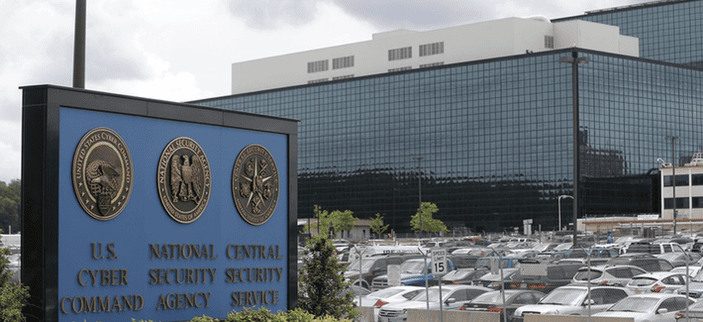
The National Security Agency has moved most of the mission data it collects, analyzes and stores into a classified cloud computing environment known as the Intelligence Community GovCloud. The IC GovCloud is a single integrated “big data fusion environment” that allows analysts to rapidly “connect the dots” across all NSA’s data sources, according to Chief Information Officer Greg Smithberger. The impetus for the multi-year move is getting the NSA’s data, including signals intelligence and other foreign surveillance and intelligence information it ingests from multiple repositories around the globe into a single data lake analysts from the NSA and other IC agencies can run queries against.