 As if the United States needed more evidence that its sixteen-year mission in Afghanistan is an exercise in futility, a new United Nations report provides an additional reason for depression. The 2017 Afghanistan Opium Survey from the UN’s Office on Drugs and Crime, released on November 15, confirms that Washington’s effort to curb illicit narcotics trafficking in the country has failed.
8 December 2017
America Can't Win the Drug War in Afghanistan
As if the United States needed more evidence that its sixteen-year mission in Afghanistan is an exercise in futility, a new United Nations report provides an additional reason for depression. The 2017 Afghanistan Opium Survey from the UN’s Office on Drugs and Crime, released on November 15, confirms that Washington’s effort to curb illicit narcotics trafficking in the country has failed.The Achilles Heel of China's Air Force
By Robert Farley
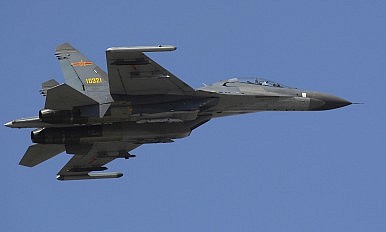 The Achilles Heel of China’s Air Force (PLAAF) has long been its lack of practical experience, both in combat and in deployments distant from Chinese borders. For the time being, a concentration on regional defense has served the PLAAF well. But as China’s interests and responsibilities grow, the air force may need to spin up the capabilities necessary to send its people and aircraft far away, for a long time.
The Coming Conflict Between China and Japan
It is easy to forget that as recently as the 19th century, China and Japan were provincial backwaters. So self-absorbed and technologically primitive were East Asia’s great powers that German philosopher Georg Wilhelm Friedrich Hegel said, “The extensive tract of eastern Asia is severed from the process of general historical development.” His description seems laughable today. China and Japan are now the second- and third-largest economies in the world. Japan’s failed quest for regional domination during World War II and its subsequent economic reconstruction profoundly affected the world. China’s unification under communism and its pursuit of regional power in the past decade have been no less significant.
The Achilles Heel of China's Air Force
By Robert Farley
The Achilles Heel of China’s Air Force (PLAAF) has long been its lack of practical experience, both in combat and in deployments distant from Chinese borders. For the time being, a concentration on regional defense has served the PLAAF well. But as China’s interests and responsibilities grow, the air force may need to spin up the capabilities necessary to send its people and aircraft far away, for a long time.
Saleh and the War in Yemen
By Anthony Cordesman
Few are likely to mourn the assassination of Yemen's former dictator, Ali Abdullah Saleh. His rule over Yemen presided over decades of failure to deal with his country's desperate levels of poverty and its steadily growing problems with overpopulation, a lack of water, and a dependence on Qat—a drug so unrewarding that the only country that would import it was the even poorer nation of Somalia.
North Korea boats off Japan spark spy scare; but some suspect just luckless fishermen
An increasing number of fishing boats from North Korea has been appearing off Japan - some in distress, some abandoned and some with dead bodies on board - raising fears about infiltration by spies as tension with North Korea surges. The coastguard has beefed up patrols in response to the boats - including one labeled military property - just off the coast, or even grounded on Japanese beaches. The coastguard and analysts of North Korea have played down the fears, attributing the surge in boats to more mundane reasons, such as a North Korean drive to increase winter fish catches.
But the worries persist.
How to Save Trump's State Department
 For ten months the State Department has been nearly immobilized between staffing cuts that are shredding its expertise and a reform process that has put lives and decisions on hold for almost a quarter of the administration’s term while it seeks to discover some holy grail of reform. Most press discussion has focused on what is happening at the moment, little has been on what reform might mean for the departement. Yet multiple studies of departmental reform already exist with common elements that suggest both the broad lines that reform should take and the fact that it could be managed without the agony of the current process.
Pentagon Acknowledges 2,000 Troops in Syria
 The Pentagon on Wednesday acknowledged that 2,000 American troops are on the ground in Syria, the first time the military has admitted that it deployed well more than the Obama-era limit of 503 troops. And it was recently even higher: The new number reflects the withdrawal of 400 Marines who had been providing artillery support to U.S.-backed Syrian rebels. The issue of just how many American troops are quietly deployed to conflict areas around the world has taken on a fresh urgency after the October ambush of U.S. forces in Niger that left four soldiers dead. Before the firefight, there had been no public acknowledgement that there were were 800 U.S. troops in the country, part of a growing U.S. presence battling Islamic extremists in Africa.
Trump Just Sabotaged His Own Peace Process
 President Donald Trump’s decision to recognize Jerusalem as Israel’s capital, as a prelude to moving the U.S. Embassy there, has thrown a wrench into an already moribund peace process and could well mean the end of U.S. efforts to forge a peace deal between the Israelis and Palestinians. Despite near-unanimous global opposition from Arab, European, and other world leaders, all of whom have cautioned that such a move could have dire consequences, Trump’s decision overturns 70 years of U.S. policy while undermining the basic international norms that have undergirded the peace process for decades. The Palestinian leadership has condemned the move, which it said effectively disqualifies the United States from serving as peace broker, and warned it would throw an already volatile region into chaos.
Why America Must Learn to Live with North Korea's Nukes
Yu-Hua Chen
 President Donald Trump and Chinese president Xi Jinping announced in a November 9 joint press conference at Beijing that “the U.S. and China both agreed not to replicate failed approaches of the past.” A week later, Xi sent Song Tao to North Korea on his behalf, but Kim Jong-un seemed to refuse to meet with the Chinese president’s special envoy. On the day Song returned to China, the United States redesignated North Korea as a state sponsor of terrorism. In response, North Korea tested its most advanced intercontinental ballistic missile. Such a development makes some people start to wonder: would the United States ultimately initiate a war against North Korea to remove its nuclear weapons? Or would China fully suspend its financial, energy and food support to North Korea to pressure North Korea to give up the weapons? In the end, would North Korea be denuclearized by either or both of the efforts of these two countries? The situation of the first North Korean nuclear crisis in 1993–1994 could provide some thought for the answer. Unfortunately, the answer to these questions is probably “no,” and the world may need to accept a nuclearized North Korea as it has been.
Is America Headed toward War with North Korea?
 After the 2016 election, President Barack Obama told President-elect Donald Trump that North Korea would be his biggest foreign policy challenge. The warning has proved prescient. Though Trump, as a candidate and president, has been more open than many top U.S. politicians to direct talks with the North Korean leadership, he has also ratcheted up the personal invective against leader Kim Jong-un to unprecedented levels, most notably calling him “Rocket Man” on the floor of the UN General Assembly.
The Global Oil War Rages On With OPEC Cut Deal Extension
By Catherine Putz
 Last week, OPEC and non-OPEC major oil producers agreed to extend production cuts that have prompted the recovery in oil prices through the end of 2018. With the cuts in place, oil prices have risen to above $60 per barrel from early 2016’s low of below $30. But as oil prices rise, market watchers are concerned that U.S. shale production will again hit a stride capable of knocking the entire Saudi Arabian-led market off kilter.
Countering Russian Information Operations in the Age of Social Media
 Russia's information warfare operations, aimed to weaken adversaries' social cohesion and political systems, are complex and adaptive, but Western governments can take steps to guard against them. A Russian flag and a 3-D model of the Facebook logo is seen through a cutout of the Twitter logo in this photo illustration taken in Zenica, Bosnia and Herzegovina, on May 22, 2015. Dado Ruvic/Reuters
Vladimir Putin Isn’t as Russian as He Seems
 At a recent event, former CIA Deputy Director Michael Morell asked a question about Russian President Vladimir Putin: Is Putin better understood as product of a long history of Russian leaders, Morell asked, or is he something new on the Russian stage? It’s a good question. To what extent can we explain Putin’s motives and actions based on his unique personality? And how much of his behavior should we ascribe to cultural and historical patterns of past Russian tsars and Soviet leaders?
How “Cyber” Sidelined “Development” at the ITU’s World Telecommunication Development Conference
Samantha Dickinson
 Cybersecurity has made the World Telecommunication Development Conference another political battleground for digital policy, threatening to sideline the very real problems that developing countries need to solve. Every four years or so, the International Telecommunication Union (ITU) holds the World Telecommunication Development Conference (WTDC), and this year’s conference was held in Buenos Aires, Argentina. You would be forgiven for thinking that discussing information and communication technologies (ICTs) and how they can contribute to social and economic development would be relatively uncontroversial. However, contentious issues like cybersecurity have made WTDC another political battleground for digital policy, threatening to sideline the very real problems that developing countries need to solve.
 WHEN ROUTINE ISN’T ENOUGH: WHY MILITARY CYBER COMMANDS NEED HUMAN CREATIVITY
MAX SMEETS
 I was largely disappointed in Cyber Command’s effectiveness against ISIS. It never really produced any effective cyber weapons or techniques. When CYBERCOM did produce something useful, the intelligence community tended to delay or try to prevent its use, claiming cyber operations would hinder intelligence collection. This would be understandable if we had been getting a steady stream of actionable intel, but we weren’t. The State Department, for its part, was unable to cut through the thicket of diplomatic issues involved in working through the host of foreign services that constitute the Internet. In short, none of our agencies showed very well in the cyber fight.
How to Save (Or Destroy) the Royal Navy
James Holmes
 Talk about role reversal. A long century ago, starting in 1909, Great Britain entreated its Pacific dominions—Canada, New Zealand, Australia—to construct “fleet units” to supplement a Royal Navy that confronted multiple challengers in multiple theaters. A fleet unit was a modular task force composed of a cruiser and its coterie of destroyers. Naval potentates such as Adm. Jacky Fisher expected each dominion to construct and maintain one. It would serve as the national navy while doubling as a module in an imperial navy. In peacetime each fleet unit could perform routine functions on its own, acting as a standalone armada. Or dominion navies could merge into a grand Pacific fleet alongside Royal Navy forces when storm clouds gathered. Having massed for action, the imperial fleet would face down some predator—presumably the Imperial Japanese Navy, a force casting covetous eyes on maritime Asia.
Deja Vu All Over Again: US Military Toying With the Already Tried-and-Failed Idea of Setting Up Another Pro-Afghan Government Militia to Fight Taliban
Suzanne Schmeidl
For long-time observers of Afghanistan, déjà vu happens with such frequency that one feels trapped in a never-ending farcical nightmare. This is why news of a mid-September visit to India by a joint US-Afghan military delegation to see whether the model of the Indian Territorial Army could work in Afghanistan was met with horror and disbelief. Surely standing up yet another militia was not being seriously considered? Afghanistan already has, and has had, several versions of such a force to support the struggling Afghan National Security Forces (ANSF), among them the Afghan Local Police created in 2010 by US Special Forces after toying with several prototypes since 2005, and the more recent ‘National Uprising Groups’ set up in 2015 by Afghanistan’s National Directorate for Security (NDS). The mandate of the proposed new force seems identical to these groups: to provide security in areas where the ANSF has not managed to do so.
Why the AK-47 is the World's Most Feared Firearm (75 Million Guns in Nearly 100 Nations)
Blake Franko
 The AK first saw widespread military use in Vietnam. American soldiers saw its effectiveness firsthand, as farmers armed with the rifle proved a tenacious foe. Washington would take this experience to heart and go on to design the AR-15 (what would become the M-16) with such lessons in mind. In doing so, the United States ended up arming its troops with a rifle that was lighter and capable of suppressing fire as well. In effect, America was saying goodbye to large-caliber rifles like the M-14 as standard infantry rifles, moving closer to the Soviet model. The reach of the AK and weapons inspired by it would go on to provide the fuel for much of the violent encounters of the Cold War.
The Army's plan to stop soldiers from staring at their tablets
By: Mark Pomerleau
/arc-anglerfish-arc2-prod-mco.s3.amazonaws.com/public/OPAXT52EWVAKVIXV2HOP5PPD7M.jpg) The tablets, known as Nett Warrior systems, often provide the location of friendly forces and other mapping data. Now that information is being moved to a heads up display available with a soldier’s helmet. This would allow soldiers to look forward and on alert as opposed to focusing, head down, on a tablet. What the Army wants to prevent is what is sometimes pejoratively termed the “Nett Warrior stare.”. “Anytime you’ve got a potential shooter looking down, when he’s looking down he’s not lethal,” Lt. Col. Ray Gary, Army Communications-Electronics Research, Development and Engineering Center (CERDEC) Night Vision and Electronic Sensors Directorate military deputy, said during a visit to its Fort Belvoir facility.
The tablets, known as Nett Warrior systems, often provide the location of friendly forces and other mapping data. Now that information is being moved to a heads up display available with a soldier’s helmet. This would allow soldiers to look forward and on alert as opposed to focusing, head down, on a tablet. What the Army wants to prevent is what is sometimes pejoratively termed the “Nett Warrior stare.”. “Anytime you’ve got a potential shooter looking down, when he’s looking down he’s not lethal,” Lt. Col. Ray Gary, Army Communications-Electronics Research, Development and Engineering Center (CERDEC) Night Vision and Electronic Sensors Directorate military deputy, said during a visit to its Fort Belvoir facility.The US Army Knows It’s Vulnerable to Space Attack. Here’s What They Want to Do About It
BY CAROLINE HOUCK
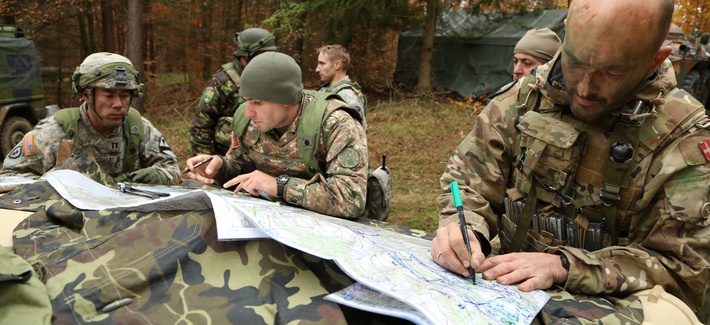 The Pentagon is well aware that its modern way of war is vulnerable to disruption, thanks to its reliance on satellites for communications, navigation, and timing. This has led the Army to reintroduced training with paper maps, and the Navy to break out its sextants. (Even Russian forces reportedly practiced map-based land navigation during the large-scale Zapad-17 exercise that simulated a full-scale conflict with the West.) But the U.S. military’s efforts to harden itself against space-based disruption hardly end with folded-up charts, said Col. Rick Zellmann, the commander of the U.S. Army’s 1st Space Brigade.