The private sector’s role in encouraging a country’s growth and economic development cannot be overstated. Private enterprises are the chief agents in creating employment, providing funds, building competitiveness and driving innovation - all essential instruments for growth.The Profession of Arms: A Guide for Young Army Officers
It takes courage, especially for a young officer, to check a man met on the road for not saluting properly or for slovenly appearance, but, every time he does, it adds to his stock of moral courage, and whatever the soldier may say, he has respect for the officer who does pull him up.
Read Document →The Dragon's Teeth: Assessing China's Military Modernization
PLA has focused on modernising its capabilities across all warfare domains to achieve these goals. This includes land, air, and maritime operations, nuclear, space, counter-space, electronic warfare and cyberspace operations, aiming to become a fully integrated joint force.
Read Document →Transforming the PLA: A Decade of reorganisation from SSF to ISF
PRC has engaged in a sustained and broad effort to transform the PLA from an infantry-heavy, low-technology, ground forces-centric military into a high-technology, networked force with an increasing emphasis on joint operations and naval and air power projection.
Read Document →Eyes without Borders: Exploring the World of Open Source Intelligence (OSINT) in the Digital Age
Open Source Intelligence (OSINT) is gaining prominence with the rise of social media, the digital society and the vast growth of publicly and commercially available information (PAI and CAI).
Read Document →
The PLA’s Developing Cyber Warfare Capabilities and India's Options
Informationised warfare blurs the lines between peacetime and wartime. A nation in the information age cannot wait for the hostilities to break out to collect intelligence, carryout influence operations, develop antisatellite systems or design computer software weapons.
Read Document →
Galwan and After
Why did China did this when he is under tremendous pressure in all fronts, is this China's salami slice tactics being progressed rigorously, what will be new Rules of Engagement, what will be escalatory control mechanism, who has taken this decision, will there be some pressure put by China in India's North-East through insurgency.
Read Document →
India’s Joint Doctrine for Cyberspace Operations: A Critical Review
Chief of Defence Staff (CDS) General Anil Chauhan and Secretary, Department of Military Affairs, formally released declassified versions of the Joint Doctrines for Cyberspace Operations during the Chiefs of Staff Committee meeting in New Delhi.
Read Document →
Know your Enemy General(now Field Marshal) Syed Aseem Munir
Gen SA Munir's position in the hierarchy of Pakistan was not very comfortable. The state of economy, insurgency in Pakhtoonistan and Balochistan, attack on the Jaffar Express, constant protests by supporters of Imran Khan's supporters inside and outside of parliament.
Read Document →
Decoding Operation SINDOOR: Key Aspects and Implications
Precision strikes were carried out on nine sites—four in Pakistan and five in PoK—linked to anti-India terrorist groups such as the LeT, JeM and the Hizbul Mujahideen. The targeted sites included Muridke (LeT headquarters) and Bahawalpur (JeM headquarters).
Read Document →
Chinese Cyber Exploitation in India's Power Grid - Is There a linkage to Mumbai Power Outage?
The New York Times (NYT), based on analysis by a U.S. based private intelligence firm Recorded Future, reported that a Chinese entity penetrated India’s power grid at multiple load dispatch points. Chinese malware intruded into the control systems that manage electric supply across India, along with a high-voltage transmission substation and a coal-fired power plant
Read Document →7 October 2019
What the private sector can do for India's economic growth
The private sector’s role in encouraging a country’s growth and economic development cannot be overstated. Private enterprises are the chief agents in creating employment, providing funds, building competitiveness and driving innovation - all essential instruments for growth.This is how India can become the next Silicon Valley
India has long branded itself as the world's leading outsourcing destination for global companies, particularly for those in the technology sector - but in the Fourth Industrial Revolution, the time is ripe for the world's most populous country to reinvent itself.India's record-breaking diaspora in numbers
India has the largest diaspora in the world, with around 18 million of its citizens living in other countries. The US is their top destination: in 2017, people of Indian descent made up 1.3% of the American population, and they are the most successful immigrants in the country.The Case Against Weakening India's No First Use Policy
Indian economy needs structural reforms & behavioural change, not macroeconomic jargon
Afghan election a cautious success story
Policy Roundtable: The Future of South Asia
Why China is Setting its Sights on Ukraine
How Military Spending Has Changed Since 2009 [Infographic]
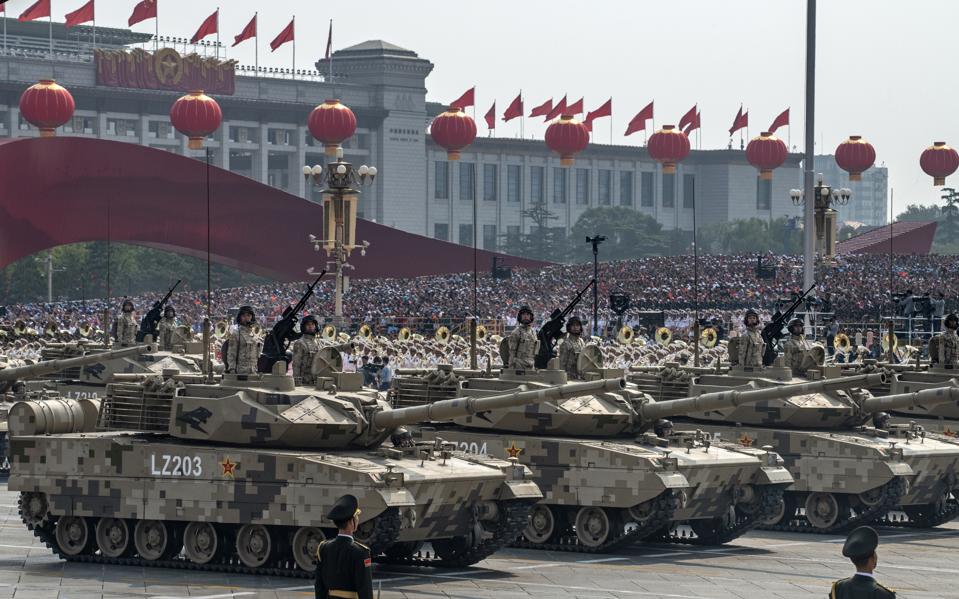
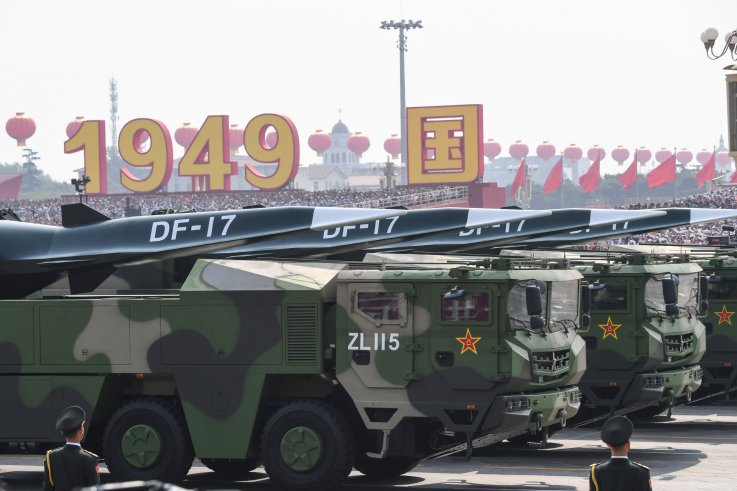
China has celebrated 70 years of Communist Party rule by holding a massive military parade in central Beijing. Even though the events have been overshadowed by months of protests in Hong Kong, the parade enabled the authorities to showcase the country's technological achievements and its steady rise to superpower status. At least 15,000 troops marched through Tiananmen Square, observed by leaders from China's past and present. They were accompanied by nuclear-capable intercontinental ballistic missiles and lines of rumbling main battle tanks along with flyovers by fighter jets and helicopters.China’s National Day Grand Military Parade
CHINA'S HYPERSONIC MISSILES, AKA 'CARRIER KILLERS,' ARE A 'HOLY S**T MOMENT' FOR US MILITARY
Iranian Supreme Leader Ali Khamenei Is One Despot Trump Might Not Win Over
The “Drone” Lexicon
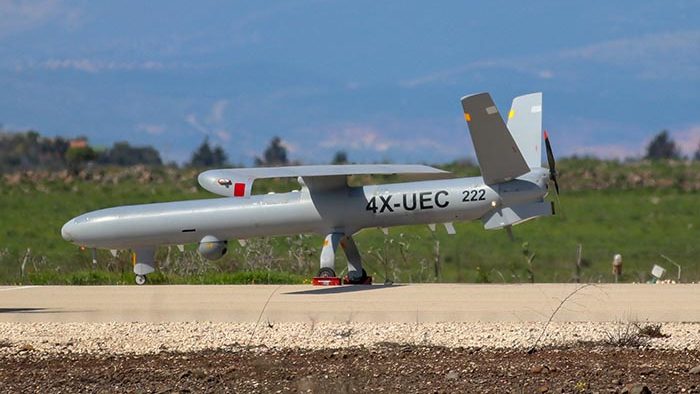
The literature on the ethics of remote warfare—some might say “drones”—has suffered from an unfortunate lexicon. Many of the terms that repeatedly arise in the literature are often misunderstood. I have addressed some of these, namely “bugsplat,” “squirter,” and “Hellfire” elsewhere (Chapa 2017, 2018). Conceptions of “distance,” “courage,” “combat,” and “precision” have also undergone some evaluation and revision in the literature (Fitzsimmons and Sangha 2013, Kirkpatrick 2015a, 202-219, Sparrow 2015, 220-227, Kirkpatrick 2015b, 228-231, Swarts 2016, Kaag and Kreps 2014, 12). Here I have a concern about even more fundamental nomenclature. The very term, “drone,” might have outlived its usefulness. Here I argue that “drone” is often unhelpful and is useful only to the degree that those who use it clarify the sub-categories within it that are actually at stake in any given claim. These subcategories should be understood in terms of a number of axes along which the set of drones extends: (1) function, (2) cost—as a proxy for technological sophistication—and (3) as a techno-social system.Trump’s Close-Call Diplomacy with Iran’s President
The U.S. Army Plans to Deploy Super-Charged Lasers to Shootdown Cruise Missiles
Why Europe Won't Combat Huawei's Trojan Tech
Putin Welcomes Stalin Back to the Pantheon
Special Report on the Ocean and Cryosphere in a Changing Climate
The World’s Oceans Are in Danger, Major Climate Change Report Warns
WASHINGTON — Climate change is heating the oceans and altering their chemistry so dramatically that it is threatening seafood supplies, fueling cyclones and floods and posing profound risks to the hundreds of millions of people living along the coasts, according to a sweeping United Nations report issued Wednesday.FBI Issues ‘High-Impact’ Cyber Attack Warning—What You Need To Know
Can cyber warfare be regulated?
Even If You Hate Zuckerberg Now, You’ll Love Him Later
New U.N. Debate on Cybersecurity in the Context of International Security
In 2018, the United Nations General Assembly voted to establish two separate groups to study international law and norms in relation to cyberspace. Resolution 73/27—proposed by a number of countries, including Russia—created an open-ended working group (OEWG) on the subject. Another group of countries—including Australia, France, Germany, the United Kingdom and the United States—supported a resolution advocating continuing the debate within the framework of a group of governmental experts (GGE) reporting to the secretary-general.SOCOM ramps up efforts to develop ‘cutting-edge data techniques,’ opens new data engineering lab
The U.S. Special Operations Command Data Engineering Lab grand opening ceremony took place in Tampa, Fla., on Sept. 25, 2019. The lab is an open-concept work environment and is the Command’s outpost of a larger DoD modernization eco-system, whose goal is to foster collaboration between Special Operations Forces professionals, data scientists, data architects, software developers, systems integrators and technologists. (Photo by U.S. Air Force Master Sgt. Barry Loo)The Army hopes less software leads to better results
The Army has completed a two-year effort to shrink the number of software programs it uses, a move that would allow service leaders to buy, maintain and field systems easier and to bolster network security.