The Profession of Arms: A Guide for Young Army Officers
It takes courage, especially for a young officer, to check a man met on the road for not saluting properly or for slovenly appearance, but, every time he does, it adds to his stock of moral courage, and whatever the soldier may say, he has respect for the officer who does pull him up.
Read Document →The Dragon's Teeth: Assessing China's Military Modernization
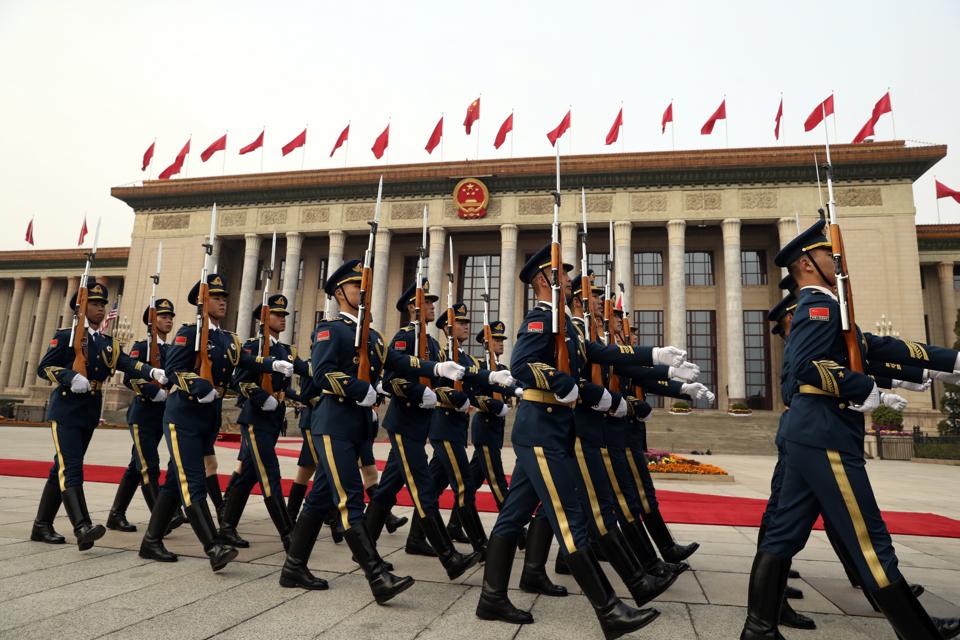
PLA has focused on modernising its capabilities across all warfare domains to achieve these goals. This includes land, air, and maritime operations, nuclear, space, counter-space, electronic warfare and cyberspace operations, aiming to become a fully integrated joint force.
Read Document →Transforming the PLA: A Decade of reorganisation from SSF to ISF
PRC has engaged in a sustained and broad effort to transform the PLA from an infantry-heavy, low-technology, ground forces-centric military into a high-technology, networked force with an increasing emphasis on joint operations and naval and air power projection.
Read Document →Eyes without Borders: Exploring the World of Open Source Intelligence (OSINT) in the Digital Age
Open Source Intelligence (OSINT) is gaining prominence with the rise of social media, the digital society and the vast growth of publicly and commercially available information (PAI and CAI).
Read Document →
The PLA’s Developing Cyber Warfare Capabilities and India's Options
Informationised warfare blurs the lines between peacetime and wartime. A nation in the information age cannot wait for the hostilities to break out to collect intelligence, carryout influence operations, develop antisatellite systems or design computer software weapons.
Read Document →
Galwan and After
Why did China did this when he is under tremendous pressure in all fronts, is this China's salami slice tactics being progressed rigorously, what will be new Rules of Engagement, what will be escalatory control mechanism, who has taken this decision, will there be some pressure put by China in India's North-East through insurgency.
Read Document →
India’s Joint Doctrine for Cyberspace Operations: A Critical Review
Chief of Defence Staff (CDS) General Anil Chauhan and Secretary, Department of Military Affairs, formally released declassified versions of the Joint Doctrines for Cyberspace Operations during the Chiefs of Staff Committee meeting in New Delhi.
Read Document →
Know your Enemy General(now Field Marshal) Syed Aseem Munir
Gen SA Munir's position in the hierarchy of Pakistan was not very comfortable. The state of economy, insurgency in Pakhtoonistan and Balochistan, attack on the Jaffar Express, constant protests by supporters of Imran Khan's supporters inside and outside of parliament.
Read Document →
Decoding Operation SINDOOR: Key Aspects and Implications
Precision strikes were carried out on nine sites—four in Pakistan and five in PoK—linked to anti-India terrorist groups such as the LeT, JeM and the Hizbul Mujahideen. The targeted sites included Muridke (LeT headquarters) and Bahawalpur (JeM headquarters).
Read Document →
Chinese Cyber Exploitation in India's Power Grid - Is There a linkage to Mumbai Power Outage?
The New York Times (NYT), based on analysis by a U.S. based private intelligence firm Recorded Future, reported that a Chinese entity penetrated India’s power grid at multiple load dispatch points. Chinese malware intruded into the control systems that manage electric supply across India, along with a high-voltage transmission substation and a coal-fired power plant
Read Document →9 August 2018
The sobering arithmetic of a two-front war
China courted Afghan Taliban in secret meetings
After Iran and North Korea; Now Hold Pakistan’s Feet to the Fire
Why an Attack by Grassroots Jihadists in Tajikistan Matters
The July 29 attack on a group of cyclists was clearly conducted by grassroots jihadists and not by a professional terrorist cadre. Despite its proximity to Afghanistan, Tajikistan has managed — with Russian assistance — to keep the jihadist threat in check. Beneath its relative stability, Tajikistan is significantly divided, and it will be important to watch for signs of increasing radicalization, specifically among younger members of the population.A Visit to the Dalai Lama’s Birthplace
On July 6, Tenzin Gyatso, the 14th Dalai Lama, celebrated his 83rd birthday in Ladakh, the Himalayan region in the Indian state of Jammu and Kashmir. On the other side of the world’s highest mountain range sits Lhasa, the Tibetan capital that he fled in 1959 during the Tibetan Uprising. The Dalai Lama has never been allowed to return. His has been a life lived in exile. But even Lhasa, home to the Jokhang Temple and Potala Palace, was a world away from the place where Tenzin Gyato was born.Are We Ready If China Suddenly Collapsed?
If Washington is concerned that the CCP is approaching its twilight, then asserting a moral stake in China’s development requires nothing less than a substantial effort to understand China’s political landscape beyond day-to-day policy-making concerns and to influence Chinese leaders before they pull the trigger on their citizens again. Without advance preparation, U.S. and other international leaders will find the prospects of an unstable China distressing, possibly with the view that it is “too big to fail.” They may even watch from the sidelines as in 1989, not knowing the best course of action or how to influence the decisions of Chinese leaders. This may not be wrong, but such a momentous decision should not be left to ignorance, preexisting mental images or scattered information collected as a crisis breaks.A better way to repel China in the South China Sea
China and Nepal reach across the Himalayan divide
China’s influence on digital privacy could be global
China is Waging a Maritime Insurgency in the South China Sea. It's Time for the United States to Counter It.
The Dangerous Myth The U.S. Is Winning The Trade War With China
In recent days there’s been a spate of high-profile press headlines and news stories pointing to seeming evidence that the U.S. is winning the trade war with China. Two examples on the economic side suffice: “China Loses Status as World's Second-Largest Stock Market Amid Trade War with U.S.,” which focused on the fall of the total value of Chinese equity shares being traded compared to those on Japan’s stock market, and “The Chinese Economy Starts to Feel Impact of U.S. Tariffs,” which, in part, pointed to slowing growth of China’s economy.China begins testing electronic warfare assets in South China Sea: report
Protecting America's Technology Industry From China
Monitoring Illicit Arms Flows: The Role of UN Peacekeeping Operations
Holder Andes contends that UN peacekeeping operations (PKOs) could make a significantly greater contribution to the monitoring of illicit arms flows. To highlight how, and address why so few PKOs take advantage of their potential capacity in this area, Andes reviews 1) the mandates of such operations; 2) their relations with UN panels of experts on embargo monitoring; and 3) their approaches to monitoring. He also presents case studies of the PKOs in Cรดte d’Ivoire and Mali, which have extensive experience in this field. This article was originally published by the Small Arms Survey on June 2018. Image courtesy of UN Photo/Nektarios Markogiannis/Flickr (CC BY-NC-ND 2.0).Trump administration coordinating with Facebook to combat disinformation
The White House and Facebook are working together to counter foreign influence operations, but research suggests social media sites need to be more aggressive in taking false content off their platforms. The Department of Homeland Security hosted a conference call Aug. 6 with state election officials and Facebook, according to a statement. The conference call included a discussion of disinformation tactics used online and was part of the Trump administration’s plan to work with the private sector to protect elections. “Strengthening collaboration between social media companies and federal, state, and local governments is critical to preventing foreign interference in our democratic processes, including elections,” Christopher Krebs, under secretary at Homeland Security, said in the release.The Agriculture Industry Is Losing Its Voice in American Politics
As agriculture's contribution to overall employment declines in large part because of farm consolidation and mechanization, the political influence of agriculture lobbies will also continue to decrease. The U.S. government will become less protective of its agricultural sector in the long term, making it more vulnerable to market forces. As agriculture's political power continues to wane, farming subsidies and protections could face cuts. As members of the U.S. Congress debate the 2018 Farm Bill, which outlines funding for the agriculture industry and food supplement programs, they are focusing less on the needs of U.S. farmers and more on the work requirements for the Supplemental Nutrition Assistance Program (SNAP). And though Secretary of Agriculture Sonny Perdue announced $12 billion in emergency aid for U.S. farmershit by retaliatory tariffs, producers are struggling more and more to succeed financially and to influence politicians on policies that directly affect the industry. The overshadowing of traditional support mechanisms in the Farm Bill, which controls government aid for U.S. producers, is one sign of the agriculture lobby's waning influence.Explaining the Hype Around Hypersonic Weapons
Countries around the world are in the process of developing hypersonic weapons technology, and the United States and China are leading the pack. With the technology needed for hypersonic missiles growing ever more feasible and accessible, we anticipate that both countries will have mature designs in the near future. The new missiles will be much faster than any current cruise missiles, and they will be extremely hard to detect. As the world adjusts to this evolving weaponry, the way countries approach offensive arms development and preemptive strikes is set to change dramatically.Nuclear Constraints and Concepts of Future Warfare
The United States Army and the Russian Army view each other as potential future adversaries. General Mark Milley, the U.S. Army Chief of Staff, has spoken extensively about the threat Russia poses and its adversarial nature.[1] Likewise, the 2014 “Military Doctrine of the Russian Federation” also identifies the U.S. and the North Atlantic Treaty Organization as the primary threat to Russia.[2] While the U.S. and Russian militaries view each other in an adversarial way, both have developed different conclusions about future warfare based on the current environment and the constraining impact of nuclear weapons. The U.S. Army has returned to emphasizing large-scale operations against near-peer threats like Russia, as outlined in its recently updated doctrine in Field Manual 3-0: Operations.Hot but not bothered: Major media are ignoring the climate crisis
Heat waves continue to wash over the globe, breaking records and threatening lives. This year is on track to rank among the four hottest years on record—together with 2015, 2016, and 2017. Buildings and roads in the United Kingdom are literally melting. In Japan, 116 people died and more than 30,000 were taken to hospitals by ambulance because of the heat wave in July. Along with the scorching heat, deadly wildfires are dominating much of the news cycle. Fires have raged in places as widespread as the American West, Greece, and the Arctic. More than 10,000 firefighters are battling the Carr Fire in California, which has killed six people and burned more than 100,000 acres and is still growing. In a July 29 tweet, writer Alex Steffen wrote that “the pyrocumulus [fire] cloud “is to this generation what the mushroom cloud was to Boomers.”The Spread Of Ideas And Innovation
DARPA Prototypes New AI-Enabled "Breakthrough" Cyberattack "Hunting" Technology
Turn Off Your Fitbit, Garmin, Apple Watch GPS NOW!
For years, cell phones have been banned from many offices in the Pentagon, not to mention any Secure Compartmentalized Information Facility (SCIF). The reason was simple: anything that can transmit and has a microphone can be used to record and send information. If it’s got a camera, then photographs or video can be taken as well. Today, the threat is less obvious. It comes from those Apple Watches, Garmins, Fitbits, custom smartwatches and other remote sensors that track your location and share it with remote databases. “These geolocation capabilities can expose personal information, locations, routines, and numbers of DoD personnel, and potentially create unintended security consequences and increased risk to the joint force and mission,” says Shanahan’s memo, which was released by the Pentagon press office too ensure everyone sees it.HOW TECHNOLOGY SHAPES THE WAY WE READ
Wordpress-powered websites publish more than 77 million posts each week. The New York Times runs about 150 stories every day. (Here at WIRED, it's more like 15 or 20.) Last year, 687.2 million books were sold in the United States—and that's just print versions, not e-books. Speaking of which: even as Amazon opens more stores, independent bookstores continue to thrive, despite the fact that a quarter of adults haven't cracked a cover in a year. Words are everywhere. Not all of them are the best words, granted, but we're awash in them like at no other point in our history. They're in our books and our e-readers, in our newspapers and magazines, on our laptop and phone screens.Homeland Security announces new first response cyber center
In the face of increasing cyberattacks, the Department of Homeland Security is creating a new center to share threat information with private companies and kicking off a 90 day sprint to identify the country’s digital “crown jewels" that may be especially vulnerable, the agency’s secretary said July 31.Army Boosts Electronic Warfare Numbers, Training, Role
AUSA: The Army is giving its electronic warfare force more troops, more training, and a more prominent role in combat headquarters, senior officers said here Thursday, pushing back on criticisms that the service neglects EW even as Russia and China pull ahead. The number of EW troops has increased from 813 (both officers and enlisted)in 2015 to 940 today and growing. While just a fraction of the formidable Russian EW force, that’s still a 15 percent increase in three years, remarkable at a time when the Army as a whole shrunk by four percent. What’s more, it reverses a stark decline in previous years when the Army decided to get rid of EW specialists because it no longer needed to jam radio-controlled roadside bombs in Iraq.