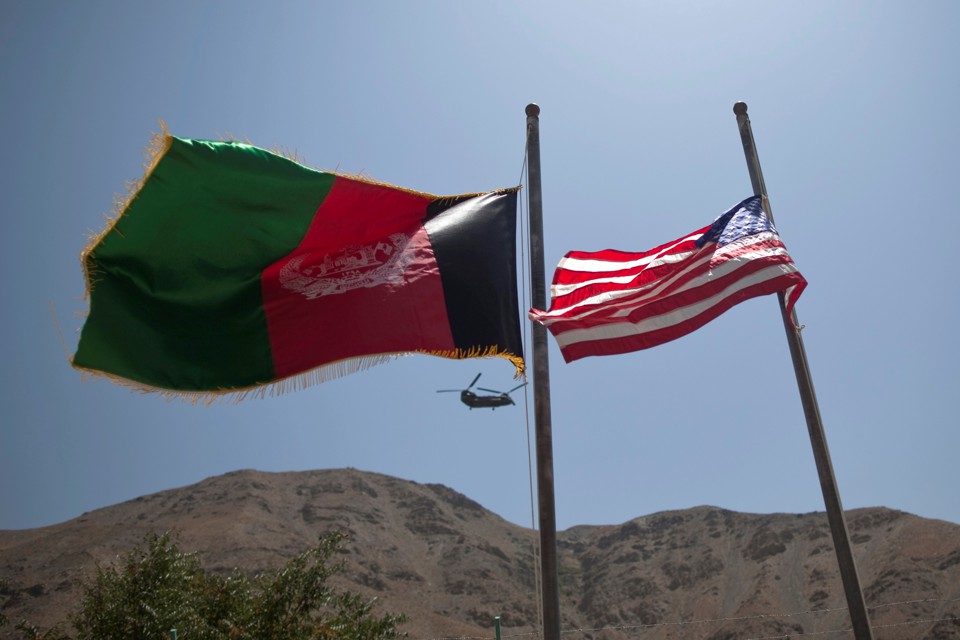
The Trump administration, as well as its critics, are reportedly wrestling with the question of a new strategy for the war in Afghanistan, where the government has shown no signs of being able to turn the tide in the 16-year war against the Taliban. General John Nicholson, the commander of U.S. forces in Afghanistan,with support from Secretary of Defense James Mattis and National Security Adviser H.R. McMaster, has asked for more troops, apparently in service of a strategy that, for the moment, seeks simply to “not lose.” President Trump has granted this request in principle, but these reinforcements have not yet been dispatched, because the president's advisors seem to believe that he is not committed to stay the course. Instead, a strategic review is underway. Meanwhile, Senator John McCain has offered his own strategy for Afghanistan, which appears to be the “old” strategy, with the admixture of a commitment to stay forever and provide the commanders with a blank check for forces and money to do so.The Profession of Arms: A Guide for Young Army Officers
It takes courage, especially for a young officer, to check a man met on the road for not saluting properly or for slovenly appearance, but, every time he does, it adds to his stock of moral courage, and whatever the soldier may say, he has respect for the officer who does pull him up.
Read Document →The Dragon's Teeth: Assessing China's Military Modernization
PLA has focused on modernising its capabilities across all warfare domains to achieve these goals. This includes land, air, and maritime operations, nuclear, space, counter-space, electronic warfare and cyberspace operations, aiming to become a fully integrated joint force.
Read Document →Transforming the PLA: A Decade of reorganisation from SSF to ISF
PRC has engaged in a sustained and broad effort to transform the PLA from an infantry-heavy, low-technology, ground forces-centric military into a high-technology, networked force with an increasing emphasis on joint operations and naval and air power projection.
Read Document →Eyes without Borders: Exploring the World of Open Source Intelligence (OSINT) in the Digital Age
Open Source Intelligence (OSINT) is gaining prominence with the rise of social media, the digital society and the vast growth of publicly and commercially available information (PAI and CAI).
Read Document →
The PLA’s Developing Cyber Warfare Capabilities and India's Options
Informationised warfare blurs the lines between peacetime and wartime. A nation in the information age cannot wait for the hostilities to break out to collect intelligence, carryout influence operations, develop antisatellite systems or design computer software weapons.
Read Document →
Galwan and After
Why did China did this when he is under tremendous pressure in all fronts, is this China's salami slice tactics being progressed rigorously, what will be new Rules of Engagement, what will be escalatory control mechanism, who has taken this decision, will there be some pressure put by China in India's North-East through insurgency.
Read Document →
India’s Joint Doctrine for Cyberspace Operations: A Critical Review
Chief of Defence Staff (CDS) General Anil Chauhan and Secretary, Department of Military Affairs, formally released declassified versions of the Joint Doctrines for Cyberspace Operations during the Chiefs of Staff Committee meeting in New Delhi.
Read Document →
Know your Enemy General(now Field Marshal) Syed Aseem Munir
Gen SA Munir's position in the hierarchy of Pakistan was not very comfortable. The state of economy, insurgency in Pakhtoonistan and Balochistan, attack on the Jaffar Express, constant protests by supporters of Imran Khan's supporters inside and outside of parliament.
Read Document →
Decoding Operation SINDOOR: Key Aspects and Implications
Precision strikes were carried out on nine sites—four in Pakistan and five in PoK—linked to anti-India terrorist groups such as the LeT, JeM and the Hizbul Mujahideen. The targeted sites included Muridke (LeT headquarters) and Bahawalpur (JeM headquarters).
Read Document →
Chinese Cyber Exploitation in India's Power Grid - Is There a linkage to Mumbai Power Outage?
The New York Times (NYT), based on analysis by a U.S. based private intelligence firm Recorded Future, reported that a Chinese entity penetrated India’s power grid at multiple load dispatch points. Chinese malware intruded into the control systems that manage electric supply across India, along with a high-voltage transmission substation and a coal-fired power plant
Read Document →21 August 2017
** It's Time to Make Afghanistan Someone Else's Problem A full withdrawal will force Iran, Russia, and others, to step up.
The Trump administration, as well as its critics, are reportedly wrestling with the question of a new strategy for the war in Afghanistan, where the government has shown no signs of being able to turn the tide in the 16-year war against the Taliban. General John Nicholson, the commander of U.S. forces in Afghanistan,with support from Secretary of Defense James Mattis and National Security Adviser H.R. McMaster, has asked for more troops, apparently in service of a strategy that, for the moment, seeks simply to “not lose.” President Trump has granted this request in principle, but these reinforcements have not yet been dispatched, because the president's advisors seem to believe that he is not committed to stay the course. Instead, a strategic review is underway. Meanwhile, Senator John McCain has offered his own strategy for Afghanistan, which appears to be the “old” strategy, with the admixture of a commitment to stay forever and provide the commanders with a blank check for forces and money to do so.The Telangana takeover of Naxalism
The logic of India’s response to China
From Doklam Standoff to a Trade War? India initiates review of IT imports from China
THE DRAGON BREATHES FIRE AT DOKLAM -- SHOULD INDIA BE PREPARED FOR LIMITED WAR ?
For the United States, India's Moves At Doklam Signal Its Willingness to Act
Doklam crisis echoes loudly in South and South-East Asia
Asian Security 2017 Endangered by China and its Proxies War-Mongering
Sri Lanka’s Hambantota gambit
Back to Basics: Pledging Nuclear Restraint
China has been a nuclear-weapon state for slightly more than five decades. Beijing has approached nuclear deterrence from a minimalist perspective, eschewing large stockpiles and launch on warning or launch under attack postures even when faced with two antagonistic superpowers. Embracing no first use (NFU) and emphasising the political nature of the weapon, China has maintained a low nuclear profile and a relaxed pace of modernization. Over the last decade, however, Beijing’s nuclear modernization programs have picked up in speed and variety, including operationalization of the new Jin-class nuclear-powered submarines, deployment of multiple independently-targetable re-entry vehicles (MIRVs) and perhaps manoeuvrable re-entry warheads (MARVs) atop its missiles, dual-use cruise missiles, research and development of hypersonic missiles, and the fast-expanding use of space capabilities to improve intelligence, surveillance, and reconnaissance (ISR). How far these developments will take China from its long-articulated minimalist deterrence strategy is unclear.Dangerous optimism on Doklam
China signals a shift in geostrategic goal
China’s Infrastructure development in the light of Doklam Stand-off
Chinese SEAD-equipped J-10B emerges at Aviadarts contest
China and India are dangerously close to military conflict in the Himalayas
NEW DELHI — As nuclear posturing between North Korea and the United States rivets the world, a quieter conflict between India and China is playing out on a remote Himalayan ridge — with stakes just as high.Remember that the fires we lite in Iraq still burn. Look and learn.
Summary: America led the invasion and occupation of Iraq, overthrowing a secular regime for what became a mostly Islamic theocratic state. It began in March 2003. Iraq is still burning. The news media seldom remind of the the chaos we created. The fighting Mosul is a vivid dot in the long war we irresponsibly ignited.Five myths about missiles
North Korea’s test launches have brought the possibility of a nuclear strike firmly back into the American consciousness. A recent survey by the Chicago Council on Global Affairs found that three-quarters of Americans now consider North Korea to be a “critical threat” to the United States. U.S. intelligence analysts believe that North Korea may start deploying intercontinental ballistic missiles (ICBMs) as soon as next year. And they think North Korea can fit nuclear warheads onto those missiles. How easy is it to detonate a nuclear weapon on foreign soil? Here are five myths about missiles, threats and deterrence.What Kissinger Gets Wrong About Korea
The physically and intellectually bionic Henry Kissinger is at it again. The former secretary of state recently published an article in the Wall Street Journal casually titled “How to Solve the North Korea Crisis,” perhaps his 12th such piece offering essentially the same advice over the past two decades.Korean War 2.0? The Signs To Watch
An ominous how-to for a terrorist attack in America
The terrorist attack in Barcelona follows a pattern that has left more than 100 people dead and hundreds more injured in Nice, Berlin, London, Stockholm and Ohio State University — a terrorist takes a van or truck and plows through innocent pedestrians on a crowded thoroughfare, turning the vehicle into “a mowing machine, not to mow grass but mow down the enemies of Allah.”In Latin America, Populism Is Alive And Well
Populism is frequently diagnosed as the root cause of Latin America's greatest political and economic ills. But just as the human body reacts to an infection by entering a feverish state, many consider populism to be the public's response to a society in disarray. By understanding the underlying conditions that enabled the rise of strongmen like Argentina's Juan Domingo Peron or Venezuela's Hugo Chavez, we can more easily spot the early signs of populism flaring in the region once again.Let’s try a defensive strategy in America’s wars, and win.
Will U.S. Cyberwarriors Be Ready For The Next Big Hack?
Military sees dramatic drop in demand for infantry service
Has the Time Come to Replace Manned Combat Aircraft With Armed Unmanned Aerial Vehicles?
America’s top 4 cyberspace foes
Russia, China, Iran and North Korea: These four nations come up often when discussing the top threats facing the United States. These nations also possess advanced cyber capabilities, which are used for achieving a competitive economic advantage, sowing discord, raising money and a whole host of other reasons.Here’s how the IC’s newest cyber center informs decision-makers
Established in 2015, the Cyber Threat Intelligence Integration Center — the newest of the Office of the Director of National Intelligence’s four multi-agency centers — seeks to build a better understanding of foreign cyberthreats to U.S. national interest and to enable informed decision-making.The UN GGE is dead: Time to fall forward
How military forces are combating the ransomware epidemic
Ships fooled in GPS spoofing attack suggest Russian cyberweapon
Reports of satellite navigation problems in the Black Sea suggest that Russia may be testing a new system for spoofing GPS, New Scientist has learned. This could be the first hint of a new form of electronic warfare available to everyone from rogue nation states to petty criminals.