The dilapidated state of the Indian Air Force was thrown into sharp relief last week when Pakistan shot down an Indian pilot flying a Russian-made MiG-21 Bison, a fighter jet first flown in 1956.The Profession of Arms: A Guide for Young Army Officers
It takes courage, especially for a young officer, to check a man met on the road for not saluting properly or for slovenly appearance, but, every time he does, it adds to his stock of moral courage, and whatever the soldier may say, he has respect for the officer who does pull him up.
Read Document →The Dragon's Teeth: Assessing China's Military Modernization
PLA has focused on modernising its capabilities across all warfare domains to achieve these goals. This includes land, air, and maritime operations, nuclear, space, counter-space, electronic warfare and cyberspace operations, aiming to become a fully integrated joint force.
Read Document →Transforming the PLA: A Decade of reorganisation from SSF to ISF
PRC has engaged in a sustained and broad effort to transform the PLA from an infantry-heavy, low-technology, ground forces-centric military into a high-technology, networked force with an increasing emphasis on joint operations and naval and air power projection.
Read Document →Eyes without Borders: Exploring the World of Open Source Intelligence (OSINT) in the Digital Age
Open Source Intelligence (OSINT) is gaining prominence with the rise of social media, the digital society and the vast growth of publicly and commercially available information (PAI and CAI).
Read Document →
The PLA’s Developing Cyber Warfare Capabilities and India's Options
Informationised warfare blurs the lines between peacetime and wartime. A nation in the information age cannot wait for the hostilities to break out to collect intelligence, carryout influence operations, develop antisatellite systems or design computer software weapons.
Read Document →
Galwan and After
Why did China did this when he is under tremendous pressure in all fronts, is this China's salami slice tactics being progressed rigorously, what will be new Rules of Engagement, what will be escalatory control mechanism, who has taken this decision, will there be some pressure put by China in India's North-East through insurgency.
Read Document →
India’s Joint Doctrine for Cyberspace Operations: A Critical Review
Chief of Defence Staff (CDS) General Anil Chauhan and Secretary, Department of Military Affairs, formally released declassified versions of the Joint Doctrines for Cyberspace Operations during the Chiefs of Staff Committee meeting in New Delhi.
Read Document →
Know your Enemy General(now Field Marshal) Syed Aseem Munir
Gen SA Munir's position in the hierarchy of Pakistan was not very comfortable. The state of economy, insurgency in Pakhtoonistan and Balochistan, attack on the Jaffar Express, constant protests by supporters of Imran Khan's supporters inside and outside of parliament.
Read Document →
Decoding Operation SINDOOR: Key Aspects and Implications
Precision strikes were carried out on nine sites—four in Pakistan and five in PoK—linked to anti-India terrorist groups such as the LeT, JeM and the Hizbul Mujahideen. The targeted sites included Muridke (LeT headquarters) and Bahawalpur (JeM headquarters).
Read Document →
Chinese Cyber Exploitation in India's Power Grid - Is There a linkage to Mumbai Power Outage?
The New York Times (NYT), based on analysis by a U.S. based private intelligence firm Recorded Future, reported that a Chinese entity penetrated India’s power grid at multiple load dispatch points. Chinese malware intruded into the control systems that manage electric supply across India, along with a high-voltage transmission substation and a coal-fired power plant
Read Document →8 March 2019
India’s Dogfight Loss Could Be a Win for U.S. Weapons-Makers
The dilapidated state of the Indian Air Force was thrown into sharp relief last week when Pakistan shot down an Indian pilot flying a Russian-made MiG-21 Bison, a fighter jet first flown in 1956.Modi Wave 2.0?
The devastating air strikes on the Pakistani Army-backed Jaish-e- Mohammad terror group in Khy ber Pakhtunkhwa, deep inside-Pakistani territory, has changed the calculus of the 2019 Lok Sabha elections, making it the most unpredictable in decades.IAF must reveal how many terrorists were killed
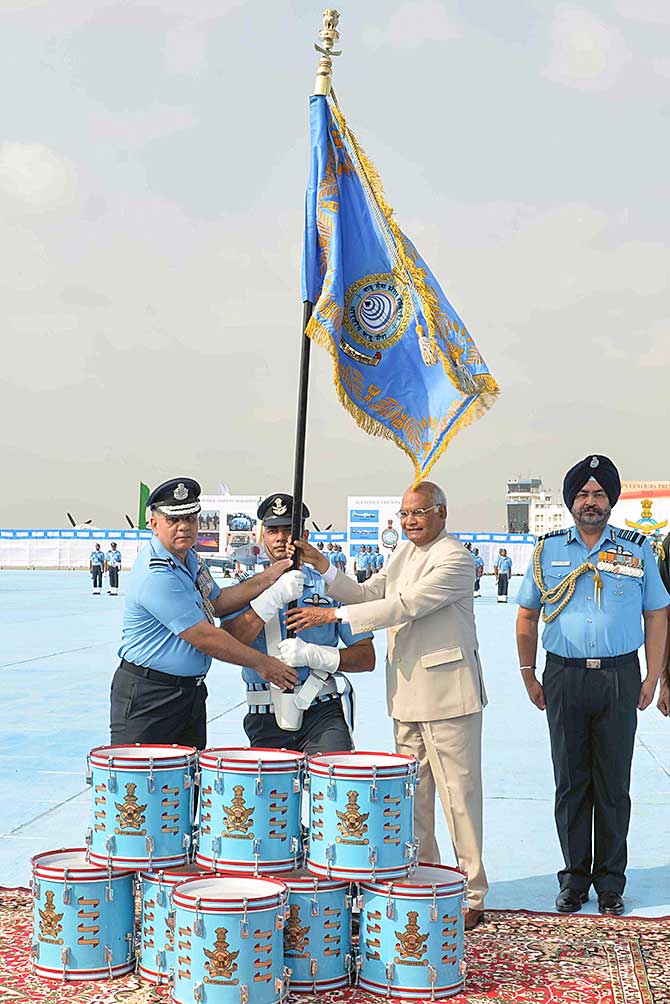
Air Chief Marshal Birender Singh Dhanoa, seen right, as President Ram Nath Kovind, supreme commander of the armed forces, presents colours to Air Force Station, Hakimpet, and 5 Base Repair Depot at the air force station, Sulur, Coimbatore, March 4, 2019. Photograph: Rashtrapati BhavanEnding the War in Afghanistan
On March 4, Senators Rand Paul and Tom Udall put forward bi-partisan draft legislation that would end U.S. military involvement in the war in Afghanistan. The proposed joint resolution gives the Trump administration forty-five days to present a plan for the orderly withdrawal of U.S. military personnel from the country. In keeping with a tradition going back to the Revolutionary War, some three million men and women who have deployed in support of all wars launched after 9/11 will receive a cash bonus of $2,500. Lastly, the resolution stipulates that all U.S. armed forces will be withdrawn from Afghanistan within one year of its passage.Pakistan Arrests 44 Suspected of Involvement in Pulwama Attack
Pakistan’s Interior Ministry said Tuesday that authorities arrested dozens of suspects in the wake of last month’s suicide bombing in the Pulwama district of Indian-controlled Kashmir that killed over 40 Indian troops. Among the detained is the brother of the leader of the outlawed Jaish-e-Mohammed (JeM) militant group.The new Afghanistan will be built on ceasefire solutions and Taliban trade-offs
Can ‘Wi-Fi in the sky’ work outside of Afghanistan?
Ending the War in Afghanistan
On March 4, Senators Rand Paul and Tom Udall put forward bi-partisan draft legislation that would end U.S. military involvement in the war in Afghanistan. The proposed joint resolution gives the Trump administration forty-five days to present a plan for the orderly withdrawal of U.S. military personnel from the country. In keeping with a tradition going back to the Revolutionary War, some three million men and women who have deployed in support of all wars launched after 9/11 will receive a cash bonus of $2,500. Lastly, the resolution stipulates that all U.S. armed forces will be withdrawn from Afghanistan within one year of its passage.U.S. and Taliban Talks Progress Despite Attacks and Regional Tensions
DOHA, Qatar — American negotiators and Taliban officials set to resume negotiations in the Qatari capital on Saturday expressed guarded optimism that they are getting closer to an agreement that could help end 17 years of conflict, America’s longest war.Familiar Issues Cloud the Prospects for Afghan Peace
Because Washington is seeking to exit Afghanistan — one of the Taliban's main demands — their talks will proceed, but various other outstanding issues will impede greater progress. Pakistan, the Taliban's primary external sponsor, will push the movement to remain in talks with the aim of ensuring that any U.S. withdrawal proceeds in an orderly manner. The collapse of the Afghan state would threaten Islamabad's economic and security interests. Even though the talks might not soon produce a breakthrough, yet regional powers like Iran, India, China and Russia will all prepare for the ramifications of a U.S. withdrawal.Developing a mutually beneficial US-China economic relationship
China’s Massive Belt and Road Initiative
In 2013, Chinese President Xi Jinping announced the launch of both the Silk Road Economic Belt and the 21st Century Maritime Silk Road, infrastructure development and investment initiatives that would stretch from East Asia to Europe. The project, eventually termed the Belt and Road Initiative (BRI) but sometimes known as the New Silk Road, is one of the most ambitious infrastructure projects ever conceived. It harkens back to the original Silk Road, which connected Europe to Asia centuries ago, enriching traders from the Atlantic to the Pacific.Will MBS’ Defense of China’s Uighur Crackdown Backfire in Saudi Arabia?
Before Saudi Crown Prince Mohammed bin Salman arrived in Beijing for a major visit late last month, he was the target of an intense lobbying effort at home and abroad. Members of the Uighur diaspora in Saudi Arabia and beyond hoped the young, powerful royal would acknowledge China’s nationwide crackdown on its own Muslim population. For the past year, a state-sponsored campaign against expressions of Islamic piety has roiled Muslim communities throughout China—especially in the northwestern region of Xinjiang, where analysts now estimate that more than 1 million ethnic Uighurs have been detained in so-called “re-education camps.”Top French officer raps West's tactics against IS in Syria, faces punishment
Like It or Not in Iraq, U.S. Ties Are Here to Stay
As the United States begins to withdraw troops from Syria, maintaining a presence in Iraq will become increasingly important to countering terrorism and Iranian influence in the region. The economic threat of U.S. sanctions because of Baghdad's ties to Iran will continue to spark debate and fracture Iraq's dominant Shiite political elite. Some Iraqi lawmakers have been pushing to legally expel the United States from their country, though such legislation is unlikely to pass. Despite mounting anti-U.S. sentiment in the country, Iraq's pervasive security concerns will solidify its need to keep ties with Washington.The Iranian Foreign Minister's Resignation Reveals a Political Struggle in Tehran
Iran's president did not accept Foreign Minister Javad Zarif's resignation, but if he had, it would have had significant implications for the country's politics and foreign policy. Zarif's decision could be part of a political ploy designed to push back against his rivals and strengthen his ministry's role in key foreign policy matters. Up until this point, Iranian foreign policy has held steady, but if hard-liners get their way and supplant more moderate figures like Zarif, that could change.Six Guidelines for Enhancing America's Security
America’s ultimate objective should be a stable international order. This is not a matter of altruism, but of self-interest. In any system, since those at the top secure a disproportionate share of the system’s valuables, their fundamental interest is in maintaining system stability . The challenge is to develop a strategy for achieving that objective in today’s world. This in turn requires questioning some of the assumptions people tend to make about the nature of the international system.What the Hanoi Summit Tells Us About North Korea’s Nuclear Intentions
Whoever Predicts the Future Will Win the AI Arms Race
The race for advanced artificial intelligence has already started. A few weeks ago, U.S. President Donald Trump signed an executive order creating the “American AI Initiative,” with which the United States joined other major countries pursuing national strategies for developing AI. China released its “New Generation Plan” in 2017, outlining its strategy to lead the world in AI by 2030. Months after that announcement, Russian President Vladimir Putin declared, “Whoever becomes the leader in this sphere will become the ruler of the world.”Trump Doesn’t Want to Play Peacemaker
Pakistan’s return of the captive Indian Air Force pilot Abhinandan Varthaman to India on March 1, two days after his plane was shot down over Pakistani territory in a dogfight, has been welcomed as the potential beginning of the end of the latest violent flare-up between the two countries. But the crisis may not yet be over, and the sudden possibility of war between two nuclear powers has highlighted the risks posed by the Trump administration’s recusal from the United States’ past role as global leader and peacemaker.A French Officer Speaks the Truth about the War in Syria
America’s military leaders do not like to rock the boat. Whether testifying before Congress or writing in professional journals, our modern major generals, and the colonels and majors who dream of wearing stars on their collars one day, have been largely unwilling to criticize either the strategy or the tactics of our failed post-9/11 wars. Though there have been honorable exceptions, our combat leaders mostly keep their opinions to themselves, even in retirement. So we owe thanks to our oldest ally for boasting an officer with the moral courage to put himself in the line of fire back at home.Russia’s New ‘AI Supercomputer’ Runs on Western Technology
Russia’s latest supercomputer is unique in some ways — it is the country’s first to be devoted to “solving problems in the field of artificial intelligence” — but not in others. Like some other Russian defense and dual-use projects, the Zhores computer is built on Western technology.The good, the bad, and the ugly at the US-North Korea summit in Hanoi
The Hanoi Summit Was Doomed From the Start
After Hanoi: North Korea, the US and Japan
Tanzania's 'Bulldozer' President Risks Flattening His Country's Reputation and Revenue
As Tanzania’s 2020 general elections approach, President John Magufuli and his ruling party will not modify their controversial domestic policies due to their popular support. As a result, Tanzania’s relations with the European Union and other Western powers will likely remain weak for the foreseeable future, cutting the country off from Europe's foreign aid in the process. Other countries such as China are unlikely to step in and fill the funding gaps left by Tanzania's eroding relationship with Europe.Caught in the Middle, Europe Attempts to Balance Hostile U.S.-Iranian Relations
Despite the United States' pleas for Europe to follow suit and withdraw from the Joint Comprehensive Plan of Action (JCPOA), the Continent will continue to ensure Iran stays within the framework. Although Washington has a laundry list of issues when it comes to Iran, nuclear proliferation in the Middle East remains the European Union's biggest concern.The Case for a Cyber Deterrence Plan that Works
U.S. strategy has not kept pace with the evolving cyber threat. Recent proposals ignore key strategic features of the cyber domain, resulting in overly narrow policies. We must take a global approach to cyber-deterrence, and we must blend aggressive retaliation when the origins of attacks are clear with forbearance when they aren’t.
/arc-anglerfish-arc2-prod-mco.s3.amazonaws.com/public/VLT72JZLOVDGFMLLYTS6QB24GI.jpg)