
Last week, efforts to “reset” India-China relations culminated in an “informal summit’ between Indian Prime Minister Modi and Chinese President Xi Jinping in Wuhan, China. Reports of the summit drew comparisons to earlier such summits between Indian Prime Ministers and Chinese leaders, notably Rajiv Gandhi’s summit with Deng Xiaoping in 1988, and Atal Bihari Vajpayee’s summit with Hu Jintao in 2003. However, these comparisons, particularly with the 1988 summit, fall short of India’s objective for a reset leading up to and during the summit. Indeed, the 1988 summit was a crucial moment for both countries, leading to the establishment of a broad framework, or modus vivendi, for engagement between India and China where the two countries would “not to allow the border dispute to hold the rest of the relationship back.” The Wuhan summit, by contrast, did not hold the same ambition.The Profession of Arms: A Guide for Young Army Officers
It takes courage, especially for a young officer, to check a man met on the road for not saluting properly or for slovenly appearance, but, every time he does, it adds to his stock of moral courage, and whatever the soldier may say, he has respect for the officer who does pull him up.
Read Document →The Dragon's Teeth: Assessing China's Military Modernization
PLA has focused on modernising its capabilities across all warfare domains to achieve these goals. This includes land, air, and maritime operations, nuclear, space, counter-space, electronic warfare and cyberspace operations, aiming to become a fully integrated joint force.
Read Document →Transforming the PLA: A Decade of reorganisation from SSF to ISF
PRC has engaged in a sustained and broad effort to transform the PLA from an infantry-heavy, low-technology, ground forces-centric military into a high-technology, networked force with an increasing emphasis on joint operations and naval and air power projection.
Read Document →Eyes without Borders: Exploring the World of Open Source Intelligence (OSINT) in the Digital Age
Open Source Intelligence (OSINT) is gaining prominence with the rise of social media, the digital society and the vast growth of publicly and commercially available information (PAI and CAI).
Read Document →
The PLA’s Developing Cyber Warfare Capabilities and India's Options
Informationised warfare blurs the lines between peacetime and wartime. A nation in the information age cannot wait for the hostilities to break out to collect intelligence, carryout influence operations, develop antisatellite systems or design computer software weapons.
Read Document →
Galwan and After
Why did China did this when he is under tremendous pressure in all fronts, is this China's salami slice tactics being progressed rigorously, what will be new Rules of Engagement, what will be escalatory control mechanism, who has taken this decision, will there be some pressure put by China in India's North-East through insurgency.
Read Document →
India’s Joint Doctrine for Cyberspace Operations: A Critical Review
Chief of Defence Staff (CDS) General Anil Chauhan and Secretary, Department of Military Affairs, formally released declassified versions of the Joint Doctrines for Cyberspace Operations during the Chiefs of Staff Committee meeting in New Delhi.
Read Document →
Know your Enemy General(now Field Marshal) Syed Aseem Munir
Gen SA Munir's position in the hierarchy of Pakistan was not very comfortable. The state of economy, insurgency in Pakhtoonistan and Balochistan, attack on the Jaffar Express, constant protests by supporters of Imran Khan's supporters inside and outside of parliament.
Read Document →
Decoding Operation SINDOOR: Key Aspects and Implications
Precision strikes were carried out on nine sites—four in Pakistan and five in PoK—linked to anti-India terrorist groups such as the LeT, JeM and the Hizbul Mujahideen. The targeted sites included Muridke (LeT headquarters) and Bahawalpur (JeM headquarters).
Read Document →
Chinese Cyber Exploitation in India's Power Grid - Is There a linkage to Mumbai Power Outage?
The New York Times (NYT), based on analysis by a U.S. based private intelligence firm Recorded Future, reported that a Chinese entity penetrated India’s power grid at multiple load dispatch points. Chinese malware intruded into the control systems that manage electric supply across India, along with a high-voltage transmission substation and a coal-fired power plant
Read Document →4 May 2018
Beyond Wuhan: India Should Establish A New Framework for Engagement With China
Last week, efforts to “reset” India-China relations culminated in an “informal summit’ between Indian Prime Minister Modi and Chinese President Xi Jinping in Wuhan, China. Reports of the summit drew comparisons to earlier such summits between Indian Prime Ministers and Chinese leaders, notably Rajiv Gandhi’s summit with Deng Xiaoping in 1988, and Atal Bihari Vajpayee’s summit with Hu Jintao in 2003. However, these comparisons, particularly with the 1988 summit, fall short of India’s objective for a reset leading up to and during the summit. Indeed, the 1988 summit was a crucial moment for both countries, leading to the establishment of a broad framework, or modus vivendi, for engagement between India and China where the two countries would “not to allow the border dispute to hold the rest of the relationship back.” The Wuhan summit, by contrast, did not hold the same ambition.The China - India - Nepal Triangle
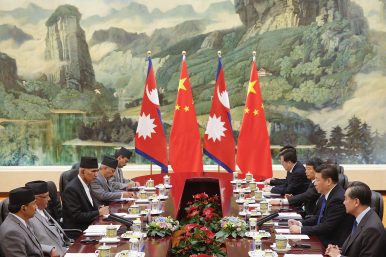
While Nepal’s Foreign Minister Pradeep Gyawali was in China from April 16-21, Chinese Foreign Minister Wang Yi asked India to be a part of new development projects in Nepal. “Whether it’s China or India, our two countries shall be happy to see Nepal’s new development after its political transition,” Wang said. China wants to invest in big connectivity projects in Nepal but prefers to bring its Asian competitor, India, on board. Some Nepali and Chinese scholars see this as an opportunity for trilateral cooperation between Nepal, India, and China, but Indian policymakers and academics have not shown much interest.Is India ready for cyber war?
India and China's Rapprochement Extends Only Skin Deep

Stakes of ‘Islamic vote bank’ and religious politics in Pakistan
ZTE's less-known roots: Chinese tech company falls from grace
TOKYO -- Chinese telecommunication equipment maker ZTE finds itself in a new, and undoubtedly uncomfortable, position: It is one of the most talked-about tech companies in the world following its recent ban by the U.S. government from purchasing American technology. In China, however, where free speech is limited but with almost 800 million internet users, the home-grown company appears to be gaining a wide range of support as most stories and comments from news media and netizens take on nationalistic overtones. Among the comments: "I believe in ZTE" and "Why can't we penalize Apple? Can't we stop Apple from selling in China?"Space: The next frontier for US-China rivalry
SINGAPORE -- With the U.S. government pledging to resume manned missions to the Moon, and eventually send a mission to Mars, Cold War-style competition over space exploration is re-emerging -- between China and the U.S. this time. China hopes to make its first manned lunar landing within 15 years, around six decades after the last American walked on the moon in 1972. But China is not as far behind as those dates suggest. It hopes to make the first-ever landing on the dark side of the Moon by the end of 2018. This feat eluded the U.S. and Soviet Union during the heyday of their Space Race from the late 1950s to the mid-1970s.Israel’s Got Its Own Refugee Dilemma: African ‘Dreamers’
TEL AVIV — It’s been obvious to me for some time that the Israeli-Arab conflict is to wider global geopolitical trends what Off Broadway is to Broadway. If you want a hint of what’s coming to a geopolitical theater near you, study this region. You can see it all here in miniature. That certainly applies to what’s becoming the most destabilizing and morally wrenching geopolitical divide on the planet today — the divide between what I call the “World of Order” and the “World of Disorder.” And Israel is right on the seam — which is why the last major fence Israel built was not to keep West Bank Palestinians from crossing into Israel but to keep more Africans from walking from their homes in Africa, across the Sinai Desert, into Israel.Geo-Economics as Concept and Practice in International Relations: Surveying the State of the Art
Sรถren Scholvin and Mikael Wigell contend that China’s Belt and Road Initiative, Western sanctions against Iran and Russia, and much more demonstrate a clear trend: states are increasingly practicing power politics by economic means and military means appear to matter less. While this shift is captured by ‘geo-economics’, our authors contend there is no clear definition of the term. To help address this gap, Scholvin and Wigell here provide their conception of what ‘geo-economics’ means as an analytical approach as well as a foreign policy practice.The Bear and the Eagle, Seen Through the Cyber Lens
5 Reasons Israel’s Army Wins Every War It Fights
Everything You Need to Know about the Cruise-Missile Strikes in Syria
The Pentagon Could Get Self-Driving Vehicles First
Forget Uber, Waymo and Tesla: the next big name in self-driving vehicles could be the Pentagon. “We’re going to have self-driving vehicles in theater for the Army before we’ll have self-driving cars on the streets,” Michael Griffin, the undersecretary of defense for research and engineering, told lawmakers at a hearing on Capitol Hill this month. “But the core technologies will be the same.” The stakes for the military are high. According to Griffin, 52 percent of casualties in combat zones can been attributed to military personnel delivering food, fuel and other logistics. Removing people from that equation with systems run on artificial intelligence could reduce injuries and deaths significantly, he added.How Russia Crafted a Three-Dimensional Strategy to Regain Global Influence
Russia acting as buffer between Israel, Iran
MOSCOW — As the standoff between Iran and Israel threatens to grow out of hand, Russia is apparently seeking a modus vivendi for the two regional enemies. Russia’s Black Sea resort of Sochi hosted April 25-26 its ninth International Meeting of High Representatives for Security Issues. The event, organized by Russia’s Security Council, brought together secretaries of security councils, presidential aides and heads of intelligence services from 118 countries. The meeting is becoming increasingly popular among international high-level security officials: The first year it was assembled, 43 nations attended the conference; last year, 95 states sent delegates.Damn, Busted
The Royal Air Force celebrated its 100th birthday last week with a gala program at the Smithsonian Institution’s National Air and Space Museum in Washington. No one does pomp better than the British, but the presence of the Queen’s Colour Squadron had a larger purpose: to solemnize the reformation of 617 Squadron, the famous Dambusters, now flying the stealthy F-35. Those 16 fighter jets are among the best in the world. Given how few planes the RAF has, they’d better be. As a nation, Brexit Britain is stepping out of the shadow of the EU. But as a military power, it’s stepped into the shade.House Russia report says major spy law has a cyber problem
A new report from the House Intelligence Committee recommends Congress update the Foreign Intelligence Surveillance Act — a law that dictates procedures for electronic surveillance of persons engaged in espionage on behalf of nation states or terrorist entities ― to cover malicious international cyber actors. The recommendation comes as part of the House Intelligence Committee’s final report on its investigation into alleged Russian meddling efforts in the 2016 presidential election. The House panel’s final report, which is roughly 250 pages and heavily redacted, notes that Congress sought to address cyber concerns as part of this year’s statutory reauthorization of the FISA. Revising the bill is part of a highly contentious process more commonly referred to as Section 702.Why do Trump’s announced trade policies keep coming up empty?
Federal 'turf war' complicates cybersecurity efforts
What Happens When Your Bomb-Defusing Robot Becomes a Weapon
Micah Xavier Johnson spent the last day of his life in a standoff, holed up in a Dallas community-college building. By that point, he had already shot 16 people. Negotiators were called in, but it was 2:30 in the morning and the police chief was tired. He’d lost two officers. Nine others were injured. Three of them would later die. In the early hours of July 7, 2016, the chief asked his swat team to come up with a plan that wouldn’t put anyone else in Johnson’s line of fire. Within 30 minutes, their Remotec Andros Mark 5A-1, a four-wheeled robot made by Northrop Grumman, was on the scene. The Mark 5A-1 had originally been purchased for help with bomb disposal. But that morning, the police attached a pound of C4 explosives to the robot’s extended arm, and sent it down the hallway where Johnson had barricaded himself. The bomb killed him instantly. The machine remained functional.DARPA wants to arm ethical hackers with AI
The Defense Advanced Research Projects Agency (DARPA) wants to leverage human-artificial intelligence teaming to accelerate the military’s cyber vulnerability detection, according to agency documents. The task of securing the Pentagon’s diverse networks, which support nearly every function of the military’s operations, presents a nightmare for defense officials. The current time-intensive and costly process involves extensively trained hackers using specialized software suites to scour the networks in search of vulnerabilities that could potentially be exploited, but the scarcity of expert hackers makes detecting cyberthreats a challenge for the Defense Department.Comms down? Don’t give up.
An artist concept of the distributed battle management system, an emerging solution to enable complex teamwork between manned and unmanned aviation even in comms-deprived environments. (BAE Systems). Adversaries are becoming ever more skilled at denying our communications links. That’s especially bad for pilots who need reliable comms for situational awareness. “Imagine you can’t talk to each other, but you still need to execute on a mission. It’s almost impossible,” said Jarrod Kallberg, distributed battle management technology development manager at BAE Systems. “A lot of times you have to scrub the mission because you are so reliant on the communication that you cannot proceed without that.”Cyber warfare may be less dangerous than we think
This February 2018 warning to the Senate from Director of National Intelligence Dan Coats included a message that “there should be no doubt” that Russia, emboldened by its 2016 cyberattacks and informational warfare campaign, will target the U.S. midterm elections this year. We agree. However, our research suggests that, although states like Russia will continue to engage in cyberattacks against the foundations of democracy (a serious threat indeed), states are less likely to engage in destructive “doomsday” attacks against each other in cyberspace. Using a series of war games and survey experiments, we found that cyber operations may in fact produce a moderating influence on international crises. Can the Navy protect this ship from hackers?
The Navy’s Expeditionary Fast Transport, or EFP, class of ships may be vulnerable to hackers and isn’t achieving key performance milestones, including some related to the cybersecurity of the ship’s systems, according to a new inspector general’s report. The aluminum catamaran-style ships, which are designed to quickly move troops and supplies, “lacks capability,” an April 2018 report from the Department of Defense Inspector General found. One of those capabilities is securing control systems aboard the vessels.