It is well-known that the Indian National Army (INA) was first proclaimed in April 1942 after the fall of Malaya and Singapore with Indian Prisoners of War (POW) and the Indian diaspora. This volunteer force known as INA 1 was disbanded in December 1942 due to differences with the Japanese, but later merged with INA 2 raised under Subhas Chandra Bose in July 1943. What is less known is that similar forces at a smaller scale were also raised by Italy and Germany. At the outbreak of World War II, the struggle for freedom in India had been on for over five decades. Hence, it was logical for the Axis powers to capitalise on the anti-British sentiments by attempting to recruit a military force from disaffected Indian POW captured while serving with the British Indian Army.The Profession of Arms: A Guide for Young Army Officers
It takes courage, especially for a young officer, to check a man met on the road for not saluting properly or for slovenly appearance, but, every time he does, it adds to his stock of moral courage, and whatever the soldier may say, he has respect for the officer who does pull him up.
Read Document →The Dragon's Teeth: Assessing China's Military Modernization
PLA has focused on modernising its capabilities across all warfare domains to achieve these goals. This includes land, air, and maritime operations, nuclear, space, counter-space, electronic warfare and cyberspace operations, aiming to become a fully integrated joint force.
Read Document →Transforming the PLA: A Decade of reorganisation from SSF to ISF
PRC has engaged in a sustained and broad effort to transform the PLA from an infantry-heavy, low-technology, ground forces-centric military into a high-technology, networked force with an increasing emphasis on joint operations and naval and air power projection.
Read Document →Eyes without Borders: Exploring the World of Open Source Intelligence (OSINT) in the Digital Age
Open Source Intelligence (OSINT) is gaining prominence with the rise of social media, the digital society and the vast growth of publicly and commercially available information (PAI and CAI).
Read Document →
The PLA’s Developing Cyber Warfare Capabilities and India's Options
Informationised warfare blurs the lines between peacetime and wartime. A nation in the information age cannot wait for the hostilities to break out to collect intelligence, carryout influence operations, develop antisatellite systems or design computer software weapons.
Read Document →
Galwan and After
Why did China did this when he is under tremendous pressure in all fronts, is this China's salami slice tactics being progressed rigorously, what will be new Rules of Engagement, what will be escalatory control mechanism, who has taken this decision, will there be some pressure put by China in India's North-East through insurgency.
Read Document →
India’s Joint Doctrine for Cyberspace Operations: A Critical Review
Chief of Defence Staff (CDS) General Anil Chauhan and Secretary, Department of Military Affairs, formally released declassified versions of the Joint Doctrines for Cyberspace Operations during the Chiefs of Staff Committee meeting in New Delhi.
Read Document →
Know your Enemy General(now Field Marshal) Syed Aseem Munir
Gen SA Munir's position in the hierarchy of Pakistan was not very comfortable. The state of economy, insurgency in Pakhtoonistan and Balochistan, attack on the Jaffar Express, constant protests by supporters of Imran Khan's supporters inside and outside of parliament.
Read Document →
Decoding Operation SINDOOR: Key Aspects and Implications
Precision strikes were carried out on nine sites—four in Pakistan and five in PoK—linked to anti-India terrorist groups such as the LeT, JeM and the Hizbul Mujahideen. The targeted sites included Muridke (LeT headquarters) and Bahawalpur (JeM headquarters).
Read Document →
Chinese Cyber Exploitation in India's Power Grid - Is There a linkage to Mumbai Power Outage?
The New York Times (NYT), based on analysis by a U.S. based private intelligence firm Recorded Future, reported that a Chinese entity penetrated India’s power grid at multiple load dispatch points. Chinese malware intruded into the control systems that manage electric supply across India, along with a high-voltage transmission substation and a coal-fired power plant
Read Document →24 November 2017
*** The Other Indian National Army
It is well-known that the Indian National Army (INA) was first proclaimed in April 1942 after the fall of Malaya and Singapore with Indian Prisoners of War (POW) and the Indian diaspora. This volunteer force known as INA 1 was disbanded in December 1942 due to differences with the Japanese, but later merged with INA 2 raised under Subhas Chandra Bose in July 1943. What is less known is that similar forces at a smaller scale were also raised by Italy and Germany. At the outbreak of World War II, the struggle for freedom in India had been on for over five decades. Hence, it was logical for the Axis powers to capitalise on the anti-British sentiments by attempting to recruit a military force from disaffected Indian POW captured while serving with the British Indian Army.*** In Afghanistan, The U.S. And Pakistan Fight A Conflict Of Interests
India and the 12th East Asia Summit
The recently-held 12th East Asia Summit (EAS) in the Philippines was crucial for India in many ways. With the Trump administration and many other countries increasingly veering towards the use of the terminology “Indo-Pacific,” many in India and outside see it as proof of India’s growing importance in the region. This Summit was important for India in many ways.How hypersonic flight could transform air combat
Uighur Foreign Fighters: An Underexamined Jihadist Challenge
Initial batch of J-20s may be deployed in western China
Is Islamic State losing control of its 'virtual caliphate'?
For years, a utopian vision of life under so-called Islamic State (IS) was at the heart of the propaganda it pumped out online. As it loses vast swathes of territory in Syria and Iraq, is it also losing control of its "virtual caliphate"? In Syria and Iraq, Islamic State is on the brink of collapse. Just days ago, it lost the city of Deir al-Zour, its last major stronghold in Syria: a defeat that followed those in Mosul, Tal Afar and Raqqa.America Shouldn’t Take Sides in the 1,400-Year-Old Sunni-Shia Conflict
Social Media Field Manual: The Iraqi Ministry of Defense Learned to Take the War to Facebook
SAY NO TO NEW, SMALLER NUCLEAR WEAPONS
During the tense days of the Cold War, the United States deployed many kinds of small-yield nuclear weapons in the field. The “logic” of the ladder of escalation led Washington to field nuclear landmines, anti-ship demolition mines to be attached to the hulls of ships by atomic frog men, and even close-range rocket-propelled nuclear weapons. We managed to avoid all-out nuclear war at each rung on the ladder through a combination of luck and careful efforts to avoid miscalculation.Sharing economy: creating opportunities in the digital era
The ‘Combination’: An Instrument In Russia’s Information War In Catalonia – Analysis
How Did North Korea's Missile and Nuclear Tech Get So Good So Fast?
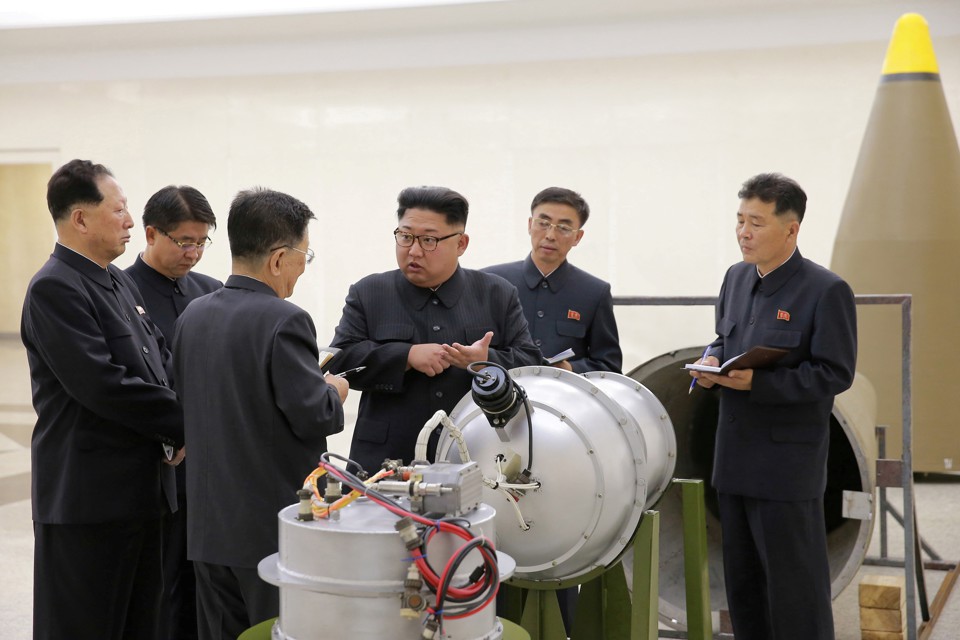
Shortly after North Korea launched the Hwasong-12 in May, the scientists who developed the intermediate-range ballistic missile were honored on the streets of Pyongyang as national heroes. “The buses carrying them went through the streets of the capital full of flowers of welcome,” KCNA, the state-run news agency, reported at the time. “Citizens warmly congratulated them, waving flags of [North Korea], red flags and bouquets.” Among those offering his congratulations was Kim Jong Un. KCNA reported that the 33-year-old North Korean leader “hugged officials in the field of rocket research, saying that they worked hard to achieve a great thing.”Stalingrad
Protecting the innocent from cyber warriors
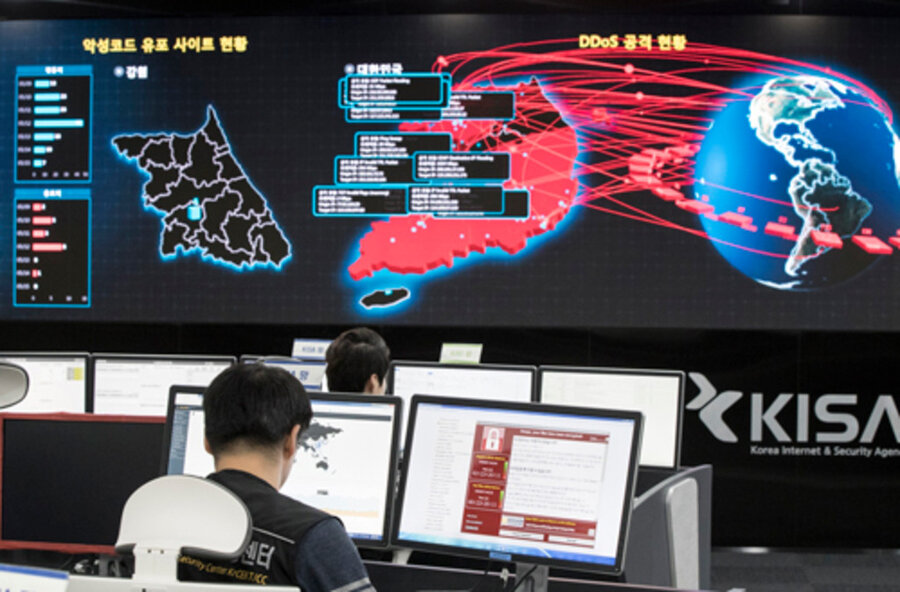
NOVEMBER 16, 2017 —In new warnings about cyberattacks by foreign entities, Britain and the United States have lately left the impression that innocent civilians, and not just governments, might become victims on a digital battlefield. On Nov. 15, for example, the US said North Korea is targeting banks, airlines, and telecom firms. And Britain claimed Russian hackers have targeted energy networks and the media. Prime Minister Theresa May accused the Kremlin of a campaign of cyber “disruption.”In the Era of Virtual Terrorism, All Cyber-Enabled Nations are Equal
Governments spy on one another, and on their people―that is what governments do. They always have and they always will. But in the era of Virtual Terrorism, spying has been taken to a whole new dimension, wherein access to other nations’ secrets, their businesses, and their people have intersected with the promotion of state interest as a new art form. Intrusion and theft beyond the reach of the law have made deception all the more possible because of anonymity. Those nations with the greatest financial, military, and cyber resources are naturally the most prolific at perpetrating Virtual Terrorism. The countries which are the most adept at this, and have been the best documented as such, are China, Russia, and the US.Technology helped fake news. Now technology needs to stop it
We’re at cyberwar. And the enemy is us.
The United States and its allies are under attack. The cyberwar we’ve feared for a generation is well underway, and we are losing. This is the forest, and the stuff about Russian election meddling, contacts with the Trump campaign, phony Twitter accounts, fake news on Facebook— those things are trees. We’ve been worried about a massive frontal assault, a work of Internet sabotage that would shut down commerce or choke off the power grid. And with good reason. The recent exploratory raid by Russian hackers on American nuclear facilities reminds us that such threats are real. $63 Trillion of World Debt in One Visualization
In the era of virtual terrorism, all cyber-enabled nations are equal
Army Looks To Replace $6 Billion Battlefield Network After Finding It Vulnerable
The U.S. Army has concluded that its $6 billion battlefield communications system would likely be breached by Russia or China in the event of a big-power conflict, rendering it all but useless against sophisticated foes. The Army says it needs at least two years to come up with a new, more resilient system that can provide the tactical networking that soldiers have come to rely on in Afghanistan and Iraq. Despite the vulnerabilities and flaws that the Army has identified in the program in recent months, the service will still finish fielding the system to the entire force over the next two years, officials said, while trying to quickly patch in upgrades where they can while they search for a new solution. Meanwhile, Congress is prodding the Army to find fixes for the communication system and is only offering half the $420 million the Army requested to finish deploying it in 2018.