 Prime Minister Narendra Modi’s office has proposed that services and cadres should be allocated after civil services entrants complete their three-month foundation course. At present, both are allocated on the basis of rank in the All India Civil Services Examination. ThePrint asks: Modi govt’s proposal to change how service & cadre are allocated to civil servants – a good idea? UPSC tests rote learning. If revamp can improve system, let’s explore it UPSC is an exam where selection often happens on the basis of chance. They test rote learning. It’s not like the best candidate is always picked. There are constraints about selecting and eliminating.
1 June 2018
Modi govt’s proposal to change how service & cadre are allocated to civil servants – a good idea?
Prime Minister Narendra Modi’s office has proposed that services and cadres should be allocated after civil services entrants complete their three-month foundation course. At present, both are allocated on the basis of rank in the All India Civil Services Examination. ThePrint asks: Modi govt’s proposal to change how service & cadre are allocated to civil servants – a good idea? UPSC tests rote learning. If revamp can improve system, let’s explore it UPSC is an exam where selection often happens on the basis of chance. They test rote learning. It’s not like the best candidate is always picked. There are constraints about selecting and eliminating.What the Long, Corruption-Enabling, Mostly Failed Afghanistan-Stabilization Effort Tells Us
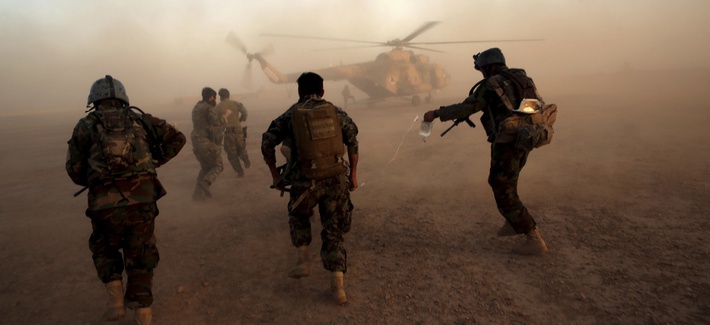 A damning report on the United States’ attempts to stabilize Afghanistan has two lessons that resonate in the nearly-post-ISISlandscape of Syria and Iraq: Arrogant reconstruction timelines will doom the effort from the start, and meeting the local populations’ expectations about governance and services is key. More than 17 years into America’s war in Afghanistan, the Special Inspector General for Afghanistan Reconstruction, or SIGAR, released its fourth lessons-learned report, this one on stabilization. The conclusions are grim: “Despite some very heroic efforts to stabilize insecure and contested areas in Afghanistan between 2002 and 2017, the program was mostly a failure,” SIGAR chief John F. Sopko said Thursday at the Brookings Institution while debuting the report.
North Korea Wants to End up Like Pakistan, Not Libya
DOMINIC TIERNEY
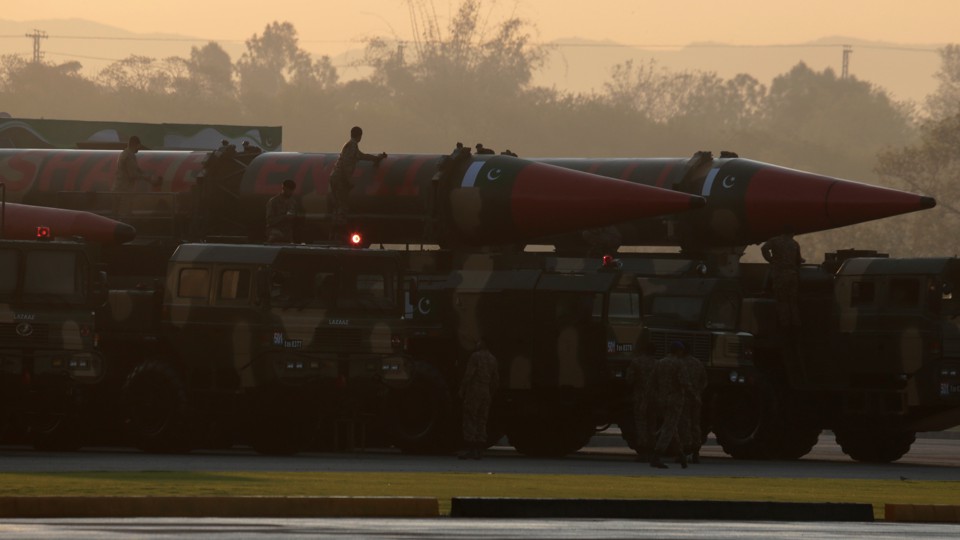 When Donald Trump canceled his planned summit with North Korean leader Kim Jong Un—before hinting that it might happen anyway after all, as the South Koreans moved into damage-control mode on Saturday with an impromptu summit of their own—it followed days of discussion over a historical parallel: Libya. U.S. National-Security Adviser John Bolton said the basis for a deal with North Korea was the “Libya model” from 2003 to 2004, when Muammar Qaddafi essentially handed over his entire nuclear program to the United States. For North Korea, however, this allusion to Libya looked “awfully sinister” because, in 2011, less than a decade after Libya appeased the West, the United States and its allies joined with local rebels to topple Qaddafi’s regime.
Erdogan Has Mastered Democracy
 For all the deserved criticisms of Turkey's president, the man knows how to win an election.
BY BORZOU DARAGAHI, | JUNE 25, 2018,
ISTANBUL — An animated two-minute video released by supporters of President Recep Tayyip Erdogan just days before his re-election Sunday depicted Turkey’s longtime leader as “Superdogan,” his face superimposed on the mustachioed protagonist of Nintendo’s Super Mario franchise. Erdogan racks up points as he becomes mayor of Istanbul, which he rids of pollution and garbage; he accumulates more even as the “people” free him from prison, and he becomes the country’s leader.
The points really add up as he slays inflation and allows a woman wearing a hijab into a university. He shoves aside leftists and liberals, as well as Israel, protesters at Gezi Park, reaching arrows that prompt him to continue on, developing industries and building vast projects, grabbing money from the sky, and hastily pushing aside political opponents as he scores win after win.
It’s a video that Erdogan’s critics, domestic and foreign alike, would do well to consider. There is plenty not to like about Erdogan, who will become Turkey’s longest-serving ruler if he completes his first term in the new role of executive president on the centenary of the republic in 2023. In recent years, Erdogan has been accused of undermining Turkey’s democratic institutions. He has jailed hundreds of journalists and activists, while his government has prosecuted dozens of people for critical posts on social media. He has faced allegations of undermining the independence of the judiciary, and for using state institutions for political gain.
But, amid all the criticisms, one basic fact should not be overlooked: The man knows how to win an election. And his political skills are as much — if not more — responsible for his unprecedented success as his autocratic excesses.
Trump breaks trade cease-fire with China ahead of Ross visit to Beijing
By MEGAN CASSELLA
 President Donald Trump is moving ahead with steps to protect U.S. intellectual property by punishing China with broad investment restrictions, litigation at the World Trade Organization and hefty tariffs on $50 billion worth of Chinese goods. The move, which the White House announced Tuesday morning, reignites trade tensions between the world's two largest economies and ratchets up the pressure just days before Commerce Secretary Wilbur Ross is set to travel to Beijing for further trade talks. A series of tit-for-tat trade actions earlier this year had depressed markets and threatened to harm consumers and industries in both countries, but relations had calmed down after the two sides launched an economic dialogue that led Treasury Secretary Steven Mnuchin to declare just over a week ago that the trade war was "on hold."
A Conversation About U.S. Credibility
By Jacob L. Shapiro
In an era in which reality is so often defined by how well something can be quantified, politics is a stubborn outlier. Some aspects are quantifiable, especially as they relate to military strength or economic conditions: We can measure the number and range of Iran’s missiles, or the widening wealth gap in the United States. But data (especially economic data) is imperfect, and it’s often deceptive. For instance, that Iran has a certain number of missiles says nothing about the quality of the missiles, let alone whether Iran would use them. “Political science” emerged as an academic discipline in the 19th century out of a desire to treat politics like a science – to define its truths in terms of empirical data, not ancient Greek philosophical principles. But exclusive reliance on data is no better than exclusive reliance on theory. And unfortunately, especially in the United States, political science has become not just data-driven but data-obsessed.
Beyond Tech Transfer: The Challenge of Chinese Tech Expanding Abroad
By Grzegorz Stec
 Over the last two years, Chinese outward investment has been become the subject of much controversy abroad, especially following the country’s buying spree in 2016. This shift has been particularly visible in the tech sector, where developed countries are becoming increasingly concerned by Chinese attitudes toward intellectual property (IP) and the prospect that China may very soon match their technological capabilities. The most notable in a series of recent moves has been the United States’ probe into China’s policies regarding technology transfer, IP, and innovation under Section 301 of the Trade Act. The results of the controversial probe suggested imposing a 25 percent tariff on around 1,300 industrial technology, medical, and transport products from China. While such probes are often motivated by the risks associated with Chinese firms buying foreign technology, there remains an important discussion to be had on the implications of Chinese tech companies selling their products abroad.
The U.S.-China Trade War
By Roncevert Ganan Almond
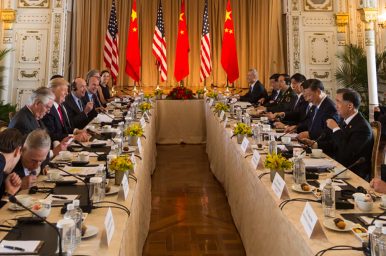 Prior to his invasion of Russia, Napoleon reportedly said: “[M]y campaign plan is a battle, and all my politics is success.” However, following a Pyrrhic victory in Borodino, Napoleon found himself without a plan or success. Not anticipating Tsar Alexander I’s refusal to surrender and General Mikhail Kutuzov’s strategic withdraw from Moscow into the vast Eurasian steppe, the Grande Armée was left exposed and exhausted. With the weight of a Russian winter coming, Napoleon submitted to a confused retreat, ultimately leading to the Little Emperor’s defeat. According to historian John Lewis Gaddis, Napoleon had transgressed Carl von Clausewitz’s maxim on strategy, whereby war must be subordinate to policy. When leaders fall in love with war, making it an end unto itself, the “culminating points of their offensives are self-defeat.”
The New Silk Road Is Old: Why You Should Ignore Belt and Road Initiative Maps
By Krzysztof Iwanek
 Each conference should have at least one brain-disabling paper. You know, the one during which you doze off to recharge your mental batteries, prepare your own paper which will be in the next panel, or check out your mobile phone (don’t forget to sit behind somebody, ideally somebody tall). Recently, the most brain-disabling presentations have been the ones that focus on maps of the Belt and Road Initiative (once referred to as the “New Silk Road”). I am obviously exaggerating here, but this plague has become so widespread that countering it requires strong language. PowerPoint Instead of Points of Power.
Army leaders need more payoff from cyber
By: Mark Pomerleau
/arc-anglerfish-arc2-prod-mco.s3.amazonaws.com/public/3375EC2QLND5NOLUGZTOUIJMVY.jpg) As the military seeks to better integrate capabilities across the five domains of warfare more seamlessly, operational vignettes provide concrete examples that progress has been made, but more work is required. This is especially true for cyber. Top military leaders have long said cyber isn’t done for cyber’s sake, but rather to support joint force commanders. In fact, former head of U.S. Cyber Command Adm. Michael Rogers has noted that Cyber Command’s success will be defined by others. “I try to do this with all the combatant commands, sit down face-to-face: ‘Where are we? Are we meeting your requirements?’” he said. “Cyber Command, in many ways ... functions to enable and support the success of others. I always tell our team that much of our success will be defined by others, not by us. That’s the way it should be.”
As the military seeks to better integrate capabilities across the five domains of warfare more seamlessly, operational vignettes provide concrete examples that progress has been made, but more work is required. This is especially true for cyber. Top military leaders have long said cyber isn’t done for cyber’s sake, but rather to support joint force commanders. In fact, former head of U.S. Cyber Command Adm. Michael Rogers has noted that Cyber Command’s success will be defined by others. “I try to do this with all the combatant commands, sit down face-to-face: ‘Where are we? Are we meeting your requirements?’” he said. “Cyber Command, in many ways ... functions to enable and support the success of others. I always tell our team that much of our success will be defined by others, not by us. That’s the way it should be.”Managing Expectations for NAFTA
By Allison Fedirka
It’s a lesson every world leader learns, even those who understand it going in: Campaigning is easy, governing is hard. Donald Trump, both the candidate and the president, repeatedly said the United States would completely overhaul, if not walk away from, the North American Free Trade Agreement. But time constraints, elections and business pressure have all conspired against any lofty expectations for a renegotiated NAFTA. It now appears the changes to the treaty will be more of a refresh than a remake.
F.B.I.’s Urgent Request: Reboot Your Router to Stop Russia-Linked Malware
 Hoping to thwart a sophisticated malware system linked to Russia that has infected hundreds of thousands of internet routers, the F.B.I. has made an urgent request to anybody with one of the devices: Turn it off, and then turn it back on. The malware is capable of blocking web traffic, collecting information that passes through home and office routers, and disabling the devices entirely, the bureau announced on Friday. A global network of hundreds of thousands of routers is already under the control of the Sofacy Group, the Justice Department said last week. That group, which is also known as A.P.T. 28 and Fancy Bear and believed to be directed by Russia’s military intelligence agency, hacked the Democratic National Committee ahead of the 2016 presidential election, according to American and European intelligence agencies.
The Korean nuclear roller coaster: Has time run out for a summit?
Jonathan D. Pollack
The turbulence and drama on the Korean Peninsula over the past week defies imagination. On May 24, President Trump withdrew from his planned summit with North Korean leader Kim Jong-un, acting almost as impulsively as when he first agreed to the meeting in early March. Following a conciliatory response from Pyongyang’s senior nuclear negotiator Kim Kye-gwan, the president two days later sharply reversed course and said that the summit might still take place.
Cyber Caliphate: What Apps Are The Islamic State Using? – Analysis
By Alexander Mamaev*
 As the argument goes, law enforcement agencies must protect the safety of citizens, and to do so, they must be in contact with representatives of the IT sector. This in turn compels the representatives of mail services, messaging apps, and smartphone manufacturers to contact the authorities and disclose user information. However, excesses do occur, and the founder of the Telegrammessaging app Pavel Durov refused to provide the FSB with their encryption keys. Telegram was repeatedly accused of being the messaging application of terrorists, and in the context of the messaging service’s being blocked, the discussion surrounding the rights of citizens to engage in private correspondence grew more heated. The example of the Islamic State, however, only goes to show that militants shall not live by Telegramalone: they act much more competently and work to keep a step ahead of law enforcement agencies. What tools do terrorists actually use and how should we fight against the digital technologies of militants?
The US and North Korea, Still Miles Apart
U.S. President Donald Trump canceled next month’s summit with North Korean leader Kim Jong Un on May 24, citing the “tremendous anger and open hostility” of recent North Korean rhetoric. (Of course, North Korea says angry and openly hostile things all the time; it would be more suspicious if it suddenly stopped.) Trump later said the summit might still happen with unspecified “constructive steps” from Kim. But the U.S. and North Korean positions on the North’s nuclear program are still miles apart, and the U.S. simply wasn’t going to get much of what it wanted in the June 12 summit in Singapore. It’s not clear if the White House ever truly thought otherwise – or, if so, why it did.
Senators look to emphasize U.S. cyber prowess
/arc-anglerfish-arc2-prod-mco.s3.amazonaws.com/public/H7LOQUBTPBGOROD4IPNXCNWXKQ.jpg) Members of the Senate Armed Services Committee want to ensure Cyber Command can conduct global cyber ops. A Senate committee’s version of the annual defense policy bill emphasizes the Department of Defense’s cyber prowess, particularly against Russia. Following the passage of the House’s version by the full body Thursday, the Senate Armed Services Committee began its process this week, releasing a summary of the measure late this week.
Members of the Senate Armed Services Committee want to ensure Cyber Command can conduct global cyber ops. A Senate committee’s version of the annual defense policy bill emphasizes the Department of Defense’s cyber prowess, particularly against Russia. Following the passage of the House’s version by the full body Thursday, the Senate Armed Services Committee began its process this week, releasing a summary of the measure late this week.Here’s how to ensure readiness of cyber forces
By: Mark Pomerleau
/arc-anglerfish-arc2-prod-mco.s3.amazonaws.com/public/V6ZOGGBIQNFLRDGLXVGHIQ7HEU.jpg) Earlier this month, U.S. Cyber Command announced a critical milestone for its cyber mission force. Its roughly 6,200-person cyber warrior cadre reached what is known as full operational capability, meaning all 133 teams are manned and passed their qualifications. Now, the command is shifting from building out the teams to bolstering its readiness. “As the build of the cyber mission force wraps up, we’re quickly shifting gears from force generation to sustainable readiness,” Gen. Paul Nakasone, commander of Cyber Command, said in a release marking the milestone. “We must ensure we have the platforms, capabilities and authorities ready and available to generate cyberspace outcomes when needed.”
Earlier this month, U.S. Cyber Command announced a critical milestone for its cyber mission force. Its roughly 6,200-person cyber warrior cadre reached what is known as full operational capability, meaning all 133 teams are manned and passed their qualifications. Now, the command is shifting from building out the teams to bolstering its readiness. “As the build of the cyber mission force wraps up, we’re quickly shifting gears from force generation to sustainable readiness,” Gen. Paul Nakasone, commander of Cyber Command, said in a release marking the milestone. “We must ensure we have the platforms, capabilities and authorities ready and available to generate cyberspace outcomes when needed.”One of these four robot vehicles could take the load off Army squads
By: Todd South
This year, two Army IBCTs and a not-yet-disclosed Marine unit will be testing variants of a load-bearing robot vehicle. Todd South tells us more. By November, two Army infantry brigade combat teams and a not-yet-disclosed Marine unit will be testing four variants of a load-bearing robot vehicle for the next year. During a technology demonstration focusing on Secretary of Defense Jim Mattis’ push to make close combat forces more lethal, officials with the Squad Multipurpose Equipment Transportshowcased the four submissions. The options range from vehicles with four, six and eight wheels and a tracked version. Each has its own characteristics but must meet basic needs. Army Capt. Erika Hanson, assistant product manager for SMET at Program Executive Office Combat Support and Combat Service Support, said the vehicle is designed to take the burden off the soldier.
The Pentagon has a ‘major’ automated information systems problem
/arc-anglerfish-arc2-prod-mco.s3.amazonaws.com/public/57NQX4K355HLNJVPX5W4JYKEIQ.jpg) The Department of Defense needs to improve its policies for managing and overseeing what it classifies as major automated information systems (MAIS), according to a new report from the Government Accountability Office. The report found that the policies dictating the Defense Department’s 10 MAIS business programs do not meet industry standards for providing performance data. These standards ensure that projects are keeping to their initial cost estimates, schedules, and performance goals. An IT program is designated as a MAIS when its single year costs exceed $40 million, its total acquisition costs exceed $165 million, or its total life-cycle costs exceed $520 million.
The Department of Defense needs to improve its policies for managing and overseeing what it classifies as major automated information systems (MAIS), according to a new report from the Government Accountability Office. The report found that the policies dictating the Defense Department’s 10 MAIS business programs do not meet industry standards for providing performance data. These standards ensure that projects are keeping to their initial cost estimates, schedules, and performance goals. An IT program is designated as a MAIS when its single year costs exceed $40 million, its total acquisition costs exceed $165 million, or its total life-cycle costs exceed $520 million.Here’s how the Navy is developing information warfare ‘Top Guns’
/arc-anglerfish-arc2-prod-mco.s3.amazonaws.com/public/QXCOCU7IKVCXXIBHXMANAYZ6E4.jpg) The Navy is looking to develop better information warfare personnel and improve doctrine such as intelligence experts in over the horizon targeting. The Navy recently celebrated the one-year mark of its development center aimed at growing more robust information warfare personnel for 21st century battlefronts. In order to meet evolving threats and challenges, the Navy is standing up a center to train warfighters. Top Navy officials have described the stand up of the Naval Information Warfighting Development Center, or NIWDC, as one of the most important things the service has done in the past two years.
The Navy is looking to develop better information warfare personnel and improve doctrine such as intelligence experts in over the horizon targeting. The Navy recently celebrated the one-year mark of its development center aimed at growing more robust information warfare personnel for 21st century battlefronts. In order to meet evolving threats and challenges, the Navy is standing up a center to train warfighters. Top Navy officials have described the stand up of the Naval Information Warfighting Development Center, or NIWDC, as one of the most important things the service has done in the past two years.An offensive cyber capability for every country
By: Kelsey Atherton
/arc-anglerfish-arc2-prod-mco.s3.amazonaws.com/public/GFFAEPQU35GG7K7DFI2ZHPYMTY.jpg) Nothing in international politics was ever simple, but sovereignty used to be simpler. The principles of how nations govern themselves within their borders are less clear for how nations should deal with attacks from outside the border that take place inside computers within those borders. International law has adapted somewhat, but we are still in the early days of setting and policing boundaries around cyber war, establishing norms and precedents to shape future action.
Nothing in international politics was ever simple, but sovereignty used to be simpler. The principles of how nations govern themselves within their borders are less clear for how nations should deal with attacks from outside the border that take place inside computers within those borders. International law has adapted somewhat, but we are still in the early days of setting and policing boundaries around cyber war, establishing norms and precedents to shape future action.Senate Defense Bill Aims to Scrub Cyber Adversaries from U.S. Military Tech
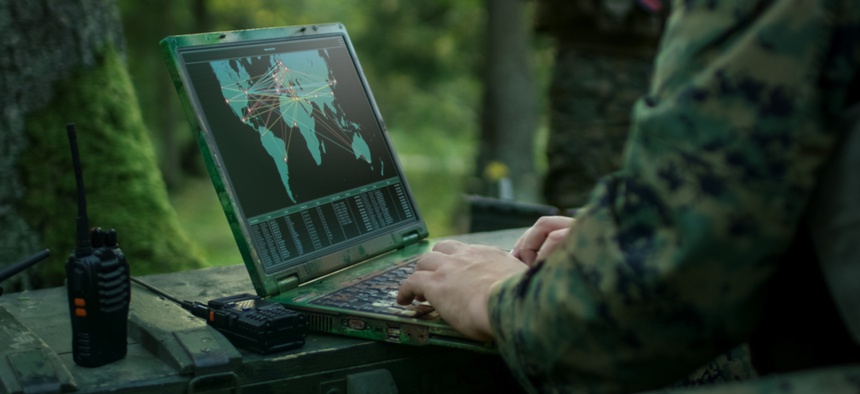 Companies that sell equipment and services to the U.S. military will be forced to disclose business ties that allow foreign governments to access their sensitive data, such as software source code, under the Senate version of an annual defense bill. Both Russia and China have required companies to submit to source code reviews in order to win certain government contracts. The provision, added by Sen. Jeanne Shaheen, D-N.H., comes amid heightened concern about how U.S. cyber adversaries might use private companies as spying tools. The Senate version of the 2019 National Defense Authorization Act explicitly bars the Chinese telecoms Huawei and ZTE from Defense Department networks while the House draft banned the companies from all federal networks. Intelligence officials and lawmakers have long fretted the companies were tied too closely to the Chinese government.
Encryption: the cornerstone of information and national security
.jpg) Every day we send sensitive information via the internet – whether this is voice, credit card data or government secrets – the success of which lies with competent encryption. Encryption protects information stored and transmitted via computers, including smartphones and other devices. Encryption algorithms provide confidentiality and drive key security initiatives including authentication, integrity, and non-repudiation. Authentication allows for the verification of a message’s origin, and integrity provides proof that a message’s contents have not changed since it was sent. Non-repudiation ensures that a message sender cannot deny sending the message.
Every day we send sensitive information via the internet – whether this is voice, credit card data or government secrets – the success of which lies with competent encryption. Encryption protects information stored and transmitted via computers, including smartphones and other devices. Encryption algorithms provide confidentiality and drive key security initiatives including authentication, integrity, and non-repudiation. Authentication allows for the verification of a message’s origin, and integrity provides proof that a message’s contents have not changed since it was sent. Non-repudiation ensures that a message sender cannot deny sending the message.Central Command Needs High-Level Middle East Cyber Ops Advisers, Fast
 U.S. Central Command—responsible for military operations in the Middle East, central Asia and part of northern Africa—is looking for a contractor to help identify targets, plan and execute cyber operations. Beyond basic cyber and geopolitical expertise, CENTCOM needs 8(a) contractors who understand the policy and process behind military cyber operations. CENTCOM is issuing a solicitation through the General Services Administration, which released a presolicitation notice May 24. The agency is looking for a quick turnaround on the procurement process: The request for proposals is expected to land June 5 and give interested vendors three weeks to respond.
Smart Rifles For Foot Soldiers: Army NGSW Prototype Contracts Out In June
A soldier fires his M249 SAW Squad Automatic Weapon in Afghanistan.
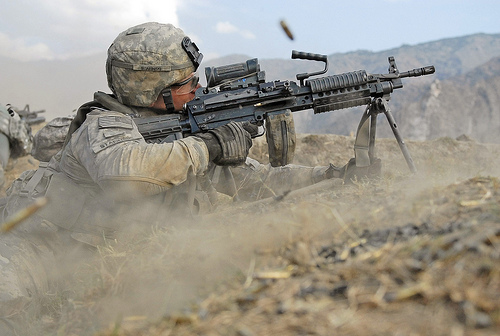 PENTAGON COURTYARD: The Army is just weeks away from awarding contracts to begin buying prototypes of new infantry weapons, with live-fire tests next year. After years of struggle to replace the Vietnam-era M16/M4 family, these prototypes are a big step towards giving squads precision-guided firepower, a key part of both the Army’s Big Six modernization plan and Defense Secretary Jim Mattis’s urgent effort to overhaul the infantry. (The Marines, by contrast, are buying off-the-shelf replacements for the M16).
US Air Force Is Waiting a Year for Parts That It Could 3D-Print
 Someday, the military will 3D-print missiles as needed, the U.S.Air Force’s acquisition chief says. In the shorter term, he just wants to use additive manufacturing technology to get broken planes back in the air. The roadblock is legal, not technical. “I have airplanes right now that are waiting on parts that are taking a year and a half to deliver. A year and a half,” Will Roper, the assistant Air Force secretary for acquisition, technology and logistics, said in an interview. Today’s 3D-printers could make short work of those deliveries, but some of those parts’ original manufacturers control the intellectual property — and so far, the service lacks clear policy for dealing with that.