Even as it seeks to cut off Iran from the world economy, the Donald Trump administration acknowledged today that it will allow India to continue developing the Iranian port of Chabahar, an alternative South Asian trade route to the congested Suez Canal. The reason, in a word: Afghanistan.The Profession of Arms: A Guide for Young Army Officers
It takes courage, especially for a young officer, to check a man met on the road for not saluting properly or for slovenly appearance, but, every time he does, it adds to his stock of moral courage, and whatever the soldier may say, he has respect for the officer who does pull him up.
Read Document →The Dragon's Teeth: Assessing China's Military Modernization
PLA has focused on modernising its capabilities across all warfare domains to achieve these goals. This includes land, air, and maritime operations, nuclear, space, counter-space, electronic warfare and cyberspace operations, aiming to become a fully integrated joint force.
Read Document →Transforming the PLA: A Decade of reorganisation from SSF to ISF
PRC has engaged in a sustained and broad effort to transform the PLA from an infantry-heavy, low-technology, ground forces-centric military into a high-technology, networked force with an increasing emphasis on joint operations and naval and air power projection.
Read Document →Eyes without Borders: Exploring the World of Open Source Intelligence (OSINT) in the Digital Age
Open Source Intelligence (OSINT) is gaining prominence with the rise of social media, the digital society and the vast growth of publicly and commercially available information (PAI and CAI).
Read Document →
The PLA’s Developing Cyber Warfare Capabilities and India's Options
Informationised warfare blurs the lines between peacetime and wartime. A nation in the information age cannot wait for the hostilities to break out to collect intelligence, carryout influence operations, develop antisatellite systems or design computer software weapons.
Read Document →
Galwan and After
Why did China did this when he is under tremendous pressure in all fronts, is this China's salami slice tactics being progressed rigorously, what will be new Rules of Engagement, what will be escalatory control mechanism, who has taken this decision, will there be some pressure put by China in India's North-East through insurgency.
Read Document →
India’s Joint Doctrine for Cyberspace Operations: A Critical Review
Chief of Defence Staff (CDS) General Anil Chauhan and Secretary, Department of Military Affairs, formally released declassified versions of the Joint Doctrines for Cyberspace Operations during the Chiefs of Staff Committee meeting in New Delhi.
Read Document →
Know your Enemy General(now Field Marshal) Syed Aseem Munir
Gen SA Munir's position in the hierarchy of Pakistan was not very comfortable. The state of economy, insurgency in Pakhtoonistan and Balochistan, attack on the Jaffar Express, constant protests by supporters of Imran Khan's supporters inside and outside of parliament.
Read Document →
Decoding Operation SINDOOR: Key Aspects and Implications
Precision strikes were carried out on nine sites—four in Pakistan and five in PoK—linked to anti-India terrorist groups such as the LeT, JeM and the Hizbul Mujahideen. The targeted sites included Muridke (LeT headquarters) and Bahawalpur (JeM headquarters).
Read Document →
Chinese Cyber Exploitation in India's Power Grid - Is There a linkage to Mumbai Power Outage?
The New York Times (NYT), based on analysis by a U.S. based private intelligence firm Recorded Future, reported that a Chinese entity penetrated India’s power grid at multiple load dispatch points. Chinese malware intruded into the control systems that manage electric supply across India, along with a high-voltage transmission substation and a coal-fired power plant
Read Document →12 November 2018
Intel: Why the US is allowing India to develop an Iranian port
Even as it seeks to cut off Iran from the world economy, the Donald Trump administration acknowledged today that it will allow India to continue developing the Iranian port of Chabahar, an alternative South Asian trade route to the congested Suez Canal. The reason, in a word: Afghanistan.PAKISTAN: Sectarian Groups Running Riot:
Pompeo approves sanctions exception for development of Iranian port to help Afghan economy
China Wants More Nuclear-Armed Submarines. Should Everyone Be Worried?
Trump’s tough-love policy for China
China's Corporate Espionage Looms Large in Its Battle With the U.S
Xi Jinping promises to expand imports and lower tariffs
SHANGHAI -- President Xi Jinping on Monday promised to further open China to foreigners by expanding imports, lowering tariffs and relaxing market access -- an apparent bid to counter criticism from U.S. President Donald Trump and others regarding Beijing's trade and business practices.The Illusion of a Russia-China Alliance
Scott Kennedy: China’s Expensive Gamble on New-Energy Vehicles
Henry Kissinger: China, US must reveal red lines to avoid conflict
America accuses China of stealing aerospace trade secrets
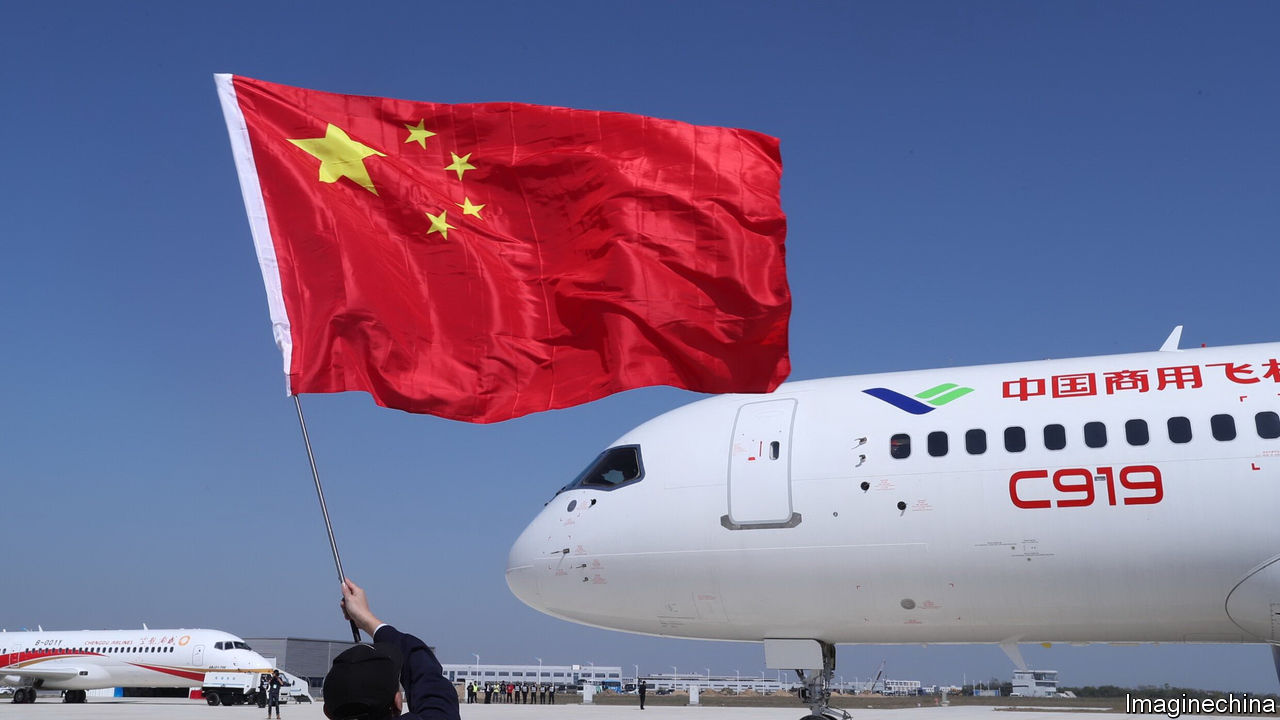
AIRLINES HAVE remarkably little choice about where to buy their airliners. The global market for big civil aircraft is dominated by two firms: Boeing of America and Airbus of Europe. China has long dreamed of breaking their stranglehold, and will be showing off its latest designs at the Zhuhai Airshow, which starts on November 6th. Many of these, such as the C919 airliner and a new stealth drone, bear more than a passing resemblance to rival models made by American firms. That suggests that the Chinese have found it harder than expected to develop its own aircraft from scratch. And a growing volume of evidence suggests that the Chinese are now resorting to cheating in order to catch up instead.The Power of Affiliates: Which Islamic State Franchise Could Become the Most Capable?
With the Islamic State's caliphate in ruins, one of its affiliates could grow to become even more deadly and operationally capable than the core organization was during its peak in 2015. With ISIS franchise groups and affiliates across the globe, there is no shortage of contenders to supplant ISIS as the world's most dangerous terrorist group.What's the Future of U.S. Support for the Saudi War in Yemen?
Will Khashoggi's Killing Force Mohammed bin Salman to Cede Some Control?
Iranian Oil Sanctions: Myths and Realities of U.S. Energy Independence
Renewed U.S. sanctions against Iranian oil exports kick in officially this week as part of the Trump administration’s decision to exit the Iranian nuclear deal. Estimations on how effective the sanctions have been is a relatively messy affair to date. Iran is expected to lose between 1 million to 1.5 million barrels a day in oil sales to Europe, Japan, South Korea, and India, with speculation that some of that oil might wind up instead in China or being repurposed in barter trade with Russia.Iran accuses Israel of failed cyber attack
The Ideologue’s Case Against Iran
The Coming Battle for European Civilization
In the next weeks, months, and possibly years, I plan to write here and elsewhere about the European immigration crisis. Alongside global warming, and of course the possibility of nuclear war, it strikes me as the most critical issue for today’s West, one that can make reasonable people feel they have no future, that there is no point in having children, etc. Many good books dealing with different facets of the subject have been published. The intellectual debate about immigration, diversity, and multiculturalism in Europe is generally richer than in the United States, reflective of the fact that theirs is a genuine civilizational crisis, considerably more dire than ours.Reimposing Iran Sanctions, Trump Places 3 Bets (One a Long Shot)
Russia’s Air Force Wants To Use Robots As ‘Automated Forward Air Controllers’
Don't be fooled by Democrats taking House of Representatives, America’s democracy is dying on the vine
Olympic-Caliber Cybersecurity
Source Link
5 ORGANIZATIONAL TRAITS THAT ATTRACT TOP CYBER TALENT
Today’s job market looks pretty good from the perspective of a qualified cyber professional. According to Cyberseek, there are more than 300,000 cybersecurity job openings in the U.S. right now, and the Center for Cyber Safety and Education predicts that by 2022 there will be a global cyber talent shortage of 1.8 million, and growing.Mitigating electromagnetic and radio-frequency interference
The chief of naval research on AI: ‘If we don’t all dogpile on this thing, were going to find ourselves behind’
“Sanctions are coming”— but Trump has no achievable end game for Iran
What Happens When the US Starts to ‘Defend Forward’ in Cyberspace?
A couple of weeks ago, the U.S. Defense Department took the first step in executing its new “defend forward” doctrine in cyberspace. The Pentagon telegraphed this step in its new cyber strategy, which told Russia, China, and others that if they continue to conduct cyberspace operations against U.S. interests, the U.S. will push back by targeting their military cyberspace infrastructure and disrupting their operations.Is the U.S. military ready for the threats it faces? Experts discuss
Army to Launch Large-Scale "Major Warfare" TableTop Wargames
The Sins of Celibacy
On August 25 Archbishop Carlo Maria Viganรฒ published an eleven-page letter in which he accused Pope Francis of ignoring and covering up evidence of sexual abuse in the Catholic Church and called for his resignation. It was a declaration of civil war by the church’s conservative wing. Viganรฒ is a former apostolic nuncio to the US, a prominent member of the Roman Curia—the central governing body of the Holy See—and one of the most skilled practitioners of brass-knuckle Vatican power politics. He was the central figure in the 2012 scandal that involved documents leaked by Pope Benedict XVI’s personal butler, including letters Viganรฒ wrote about corruption in Vatican finances, and that contributed to Benedict’s startling decision to abdicate the following year. Angry at not having been made a cardinal and alarmed by Francis’s supposedly liberal tendencies, Viganรฒ seems determined to take out the pope.AIR AND MISSILE DEFENSE AT A CROSSROADS: New Concepts and Technologies to Defend America’s Overseas Bases
Mark Gunzinger and Carl Rehberg address how DoD could take advantage of mature technologies to develop higher capacity and more cost-effective air and missile defenses for its overseas bases. It assesses the potential for a layered, distributed defense that integrates multiple new non-kinetic and kinetic systems to defeat salvo attacks.