The Profession of Arms: A Guide for Young Army Officers
It takes courage, especially for a young officer, to check a man met on the road for not saluting properly or for slovenly appearance, but, every time he does, it adds to his stock of moral courage, and whatever the soldier may say, he has respect for the officer who does pull him up.
Read Document →The Dragon's Teeth: Assessing China's Military Modernization
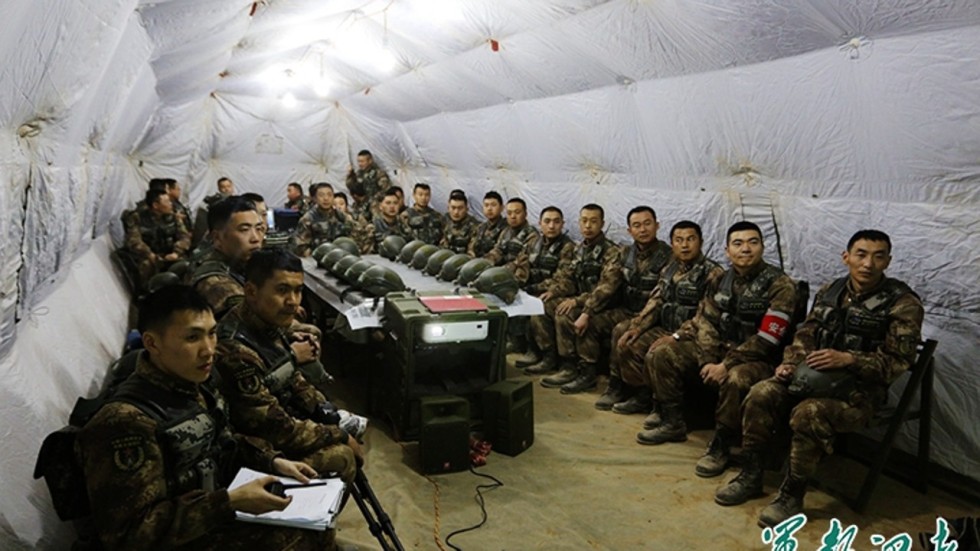
PLA has focused on modernising its capabilities across all warfare domains to achieve these goals. This includes land, air, and maritime operations, nuclear, space, counter-space, electronic warfare and cyberspace operations, aiming to become a fully integrated joint force.
Read Document →Transforming the PLA: A Decade of reorganisation from SSF to ISF
PRC has engaged in a sustained and broad effort to transform the PLA from an infantry-heavy, low-technology, ground forces-centric military into a high-technology, networked force with an increasing emphasis on joint operations and naval and air power projection.
Read Document →Eyes without Borders: Exploring the World of Open Source Intelligence (OSINT) in the Digital Age
Open Source Intelligence (OSINT) is gaining prominence with the rise of social media, the digital society and the vast growth of publicly and commercially available information (PAI and CAI).
Read Document →
The PLA’s Developing Cyber Warfare Capabilities and India's Options
Informationised warfare blurs the lines between peacetime and wartime. A nation in the information age cannot wait for the hostilities to break out to collect intelligence, carryout influence operations, develop antisatellite systems or design computer software weapons.
Read Document →
Galwan and After
Why did China did this when he is under tremendous pressure in all fronts, is this China's salami slice tactics being progressed rigorously, what will be new Rules of Engagement, what will be escalatory control mechanism, who has taken this decision, will there be some pressure put by China in India's North-East through insurgency.
Read Document →
India’s Joint Doctrine for Cyberspace Operations: A Critical Review
Chief of Defence Staff (CDS) General Anil Chauhan and Secretary, Department of Military Affairs, formally released declassified versions of the Joint Doctrines for Cyberspace Operations during the Chiefs of Staff Committee meeting in New Delhi.
Read Document →
Know your Enemy General(now Field Marshal) Syed Aseem Munir
Gen SA Munir's position in the hierarchy of Pakistan was not very comfortable. The state of economy, insurgency in Pakhtoonistan and Balochistan, attack on the Jaffar Express, constant protests by supporters of Imran Khan's supporters inside and outside of parliament.
Read Document →
Decoding Operation SINDOOR: Key Aspects and Implications
Precision strikes were carried out on nine sites—four in Pakistan and five in PoK—linked to anti-India terrorist groups such as the LeT, JeM and the Hizbul Mujahideen. The targeted sites included Muridke (LeT headquarters) and Bahawalpur (JeM headquarters).
Read Document →
Chinese Cyber Exploitation in India's Power Grid - Is There a linkage to Mumbai Power Outage?
The New York Times (NYT), based on analysis by a U.S. based private intelligence firm Recorded Future, reported that a Chinese entity penetrated India’s power grid at multiple load dispatch points. Chinese malware intruded into the control systems that manage electric supply across India, along with a high-voltage transmission substation and a coal-fired power plant
Read Document →16 July 2018
India in a changing global order
Considering the ramifications of India’s exclusion from the British “Low-Risk” visa list
The Indus Waters Treaty: an exemplar of cooperation
Pakistani Taliban: Mullah Fazlullah’s Death Revives Mehsud Clan Fortunes
Why America Should Let Its Rivals Play the Great Game in Afghanistan
Is China Influencing Pakistan’s Elections?
As an emerging power in the region, China is closely watching the developments taking place in the South Asia region. It is in China’s best interests to have friendly governments in neighboring countries, and to a large extent, Beijing is succeeding. China has been meticulously working to attract South Asian countries, big and small alike, by all means. One of China’s friendliest neighbors is Pakistan. When al-Qaeda chief Osama bin Laden was assassinated by U.S. forces on May 2, 2011 in Pakistan’s garrison city of Abbotabad, Pakistan put all its eggs in China’s basket. As a result of this paradigm shift, Pakistan has put the highest priority on its friendship with China. For Pakistan, whether China can replace the United States or not is a separate debate, but one thing is sure: since 2011, China has increased its presence in the country, as seen most readily in the China-Pakistan Economic Corridor (CPEC), the multibillion-dollar project announced in 2014.Bangladesh: Demand for Elections under Caretaker Government
Election times are quintessentially interesting, more so when some of the South Asian countries are involved. The element of unpredictability and host of other varied considerations surrounding any election in the region, makes these events an analysts delight to piece together the various issues and possibilitiesand come up with plausible answers. In the context of elections in Bangladesh, added confusion arises out of the long list of unresolvable issues including demand for holding elections under caretaker governments.How Rare Earths (What?) Could Be Crucial in a U.S.-China Trade War
KUANTAN, Malaysia — Amanda Lacaze grabbed her iPhone and rattled off the names of the special minerals needed to make it. The screen was polished with lanthanum and cerium. The inside has a magnet made with neodymium and praseodymium. Those minerals almost certainly came from China. Ms. Lacaze’s job is to give the world an alternative source, in case a global trade war spirals out of control and China cuts off supply. Right now, she can’t. Her company, Lynas Corporation, can provide only a fraction of the minerals — known as rare earths — that China produces. And even that source isn’t a sure thing: The work is so volatile, complex and expensive that Lynas once came close to collapsing.Welcome to the modern military: China’s new combat units prepare for electronic warfare
Who the US and China have trade disputes with
Not long after US tariffs on $34 billion worth of Chinese goods kicked in, the Chinese government has responded by imposing its own 5% tariff on 545 US products, also worth a total of $34 billion. Trade disputes are nothing new for the two economic superpowers, and they are not confined to targeting each other. In total, China and the US have more than 300 disputes with different countries and trading blocks.US-China Trade: China Is Building Bridges With The World While The US Puts Up Walls
China & Russia In The Arctic: Axis Of Ambivalence
Samvad: the Fourth Symposium held in Tokyo - A Report
In 2015, Prime Minister Modi and Prime Minister Abe of Japan had mooted a unique idea of a holding a regular dialogue on ‘Samvad’ amongst Asians to discuss conflict avoidance, and philosophical and cultural heritage of Buddhism and Hinduism, the dominant religions in Asia. Four conferences have been held within the Samvad framework since in New Delhi (2015), Tokyo (2016), Yangon (2017), and Tokyo (2018). The Japan Foundation, in collaboration with Hajime Nakamura Institute, the foreign office of Japan and Nikkei Corporation hosted a symposium titled ‘Shared Values and Democracy in Asia’, on 05th Jul 2018 in Tokyo, under the Samvad series of dialogues.NATO: Pushing Boundaries for Resilience
Tim Prior argues that addressing the security vulnerabilities created by global connectivity and interdependence is at the heart of the Alliance’s current push to increase its resilience. However, this push presents a challenge to NATO, contends Prior, as it will require a cultural change within the Alliance that recognizes 1) the need for strong cooperation with civilian organizations and the private sector; and 2) support for the building of resilience beyond NATO’s territorial borders.Brexit, Defence, and the EU’s Quest for ‘Strategic Autonomy’
There is more joy in heaven (or so we are told, on the best available authority) over one sinner who repents than over ninety-nine already-righteous folk. On that basis, fatted calves in the vicinity of Brussels should have been keeping a very low profile as the British, after long years decrying and obstructing European defence integration, have rediscovered an unconditional commitment to Europe’s security, and pressed for the closest possible post-Brexit partnership.The growing power and influence of Russia’s military intelligence agency, the GRU
Why The NATO Summit Could Deal A Major Blow To The International Order
Profiling Russia’s S-400 Missile Defense System
Global manufacturing scorecard: How the US compares to 18 other nations
Cyber War – And Nobody Will Come?
When a cyberattack has been orchestrated by a state actor, people may be tempted to call it “war”. After all, it’s an attack waged on national infrastructures by a foreign power. But the term “cyber war” has been used so often for dramatic effect that I don’t just want to warn against hype. It’s also time to dampen expectations regarding the scope of governmental intervention.TCS May Have Achieved Escape Velocity From Traditional Indian IT Services Business Model
THE PROBLEM WITH JOINT DOCTRINE
Chairman of the Joint Chiefs of Staff Gen. Joseph Dunford publicly and frequently expresses his frustration with the legacy joint phasing construct (Phases 0–V) for organizing joint force actions across theaters. Gen. Dunford’s comments echo other national security officials’ conclusions, but a deeper problem beyond the notion of phasing resides within professional joint literature. Doctrine misses the art of connecting the use of force with the force’s use in competitive and wartime statecraft. To a casual reader, joint doctrine presents an imposing, seemingly comprehensive and authoritative expression of joint force principles and processes. In general, doctrine’s characterizations of employing military force throughout its primary publications are thematic. While much of the content is indeed worthwhile, joint literature is not necessarily precise or sufficient in explaining utilization of the force. Most of these doctrinal themes reinforce sound principles, but a few perpetuate incomplete and obsolete ideas from the early 1990s. One case in point is doctrine’s overlapping articulation of campaigns and major operations, as well as their associated objectives. These shortfalls weaken our professional methodologies and models for attaining outcomes.A Dynamic Field Of Defence Against Terrorist Weapons Options
Army: New Command Won’t Piss Away Billions On Bad Technology
With the establishment of its new Futures Command, the Army pinky swears that the problems that doomed its $18 billion Future Combat Systems program in the last decade will not recur. On Friday, senior Army leaders announced the service was consolidating its modernization efforts in a single command that will be located in Austin, Texas. The city was selected based on a number of factors, including the availability of talent from the private sector, access to top-tier academic institutions, and quality of life. Task & Purpose asked Army officials how the new command will prevent a repeat of the Future Combat Systems debacle — an eight-year Army effort to develop revolutionary new vehicles, communications networks, drones, and other technology that bled cash until it was mercifully put to sleep by then-defense secretary Robert Gates in 2009. The failure was so colossal that the Army has still not recovered, nearly a decade later.