Over the span of the decades since World War II, the United States Navy has made Asia rich but not altogether stable. It was only the security guarantee provided by the U.S. Navy that allowed Asian countries not to fear one another and thus to concentrate on building their economies instead of their militaries. The result has been the Asian economic miracle, which began to gather force in the late 1970s and has continued to the present day. Of course, Asians themselves have ascribed their success to “Asian values”—the emphasis on order and hierarchy embodied in the Confucian ethos. But “the region’s peaceful postwar coexistence, far from being somehow organic to local political cultures,” notes Richard McGregor in “Asia’s Reckoning,” “had been underwritten by the U.S. military.”The Profession of Arms: A Guide for Young Army Officers
It takes courage, especially for a young officer, to check a man met on the road for not saluting properly or for slovenly appearance, but, every time he does, it adds to his stock of moral courage, and whatever the soldier may say, he has respect for the officer who does pull him up.
Read Document →The Dragon's Teeth: Assessing China's Military Modernization
PLA has focused on modernising its capabilities across all warfare domains to achieve these goals. This includes land, air, and maritime operations, nuclear, space, counter-space, electronic warfare and cyberspace operations, aiming to become a fully integrated joint force.
Read Document →Transforming the PLA: A Decade of reorganisation from SSF to ISF
PRC has engaged in a sustained and broad effort to transform the PLA from an infantry-heavy, low-technology, ground forces-centric military into a high-technology, networked force with an increasing emphasis on joint operations and naval and air power projection.
Read Document →Eyes without Borders: Exploring the World of Open Source Intelligence (OSINT) in the Digital Age
Open Source Intelligence (OSINT) is gaining prominence with the rise of social media, the digital society and the vast growth of publicly and commercially available information (PAI and CAI).
Read Document →
The PLA’s Developing Cyber Warfare Capabilities and India's Options
Informationised warfare blurs the lines between peacetime and wartime. A nation in the information age cannot wait for the hostilities to break out to collect intelligence, carryout influence operations, develop antisatellite systems or design computer software weapons.
Read Document →
Galwan and After
Why did China did this when he is under tremendous pressure in all fronts, is this China's salami slice tactics being progressed rigorously, what will be new Rules of Engagement, what will be escalatory control mechanism, who has taken this decision, will there be some pressure put by China in India's North-East through insurgency.
Read Document →
India’s Joint Doctrine for Cyberspace Operations: A Critical Review
Chief of Defence Staff (CDS) General Anil Chauhan and Secretary, Department of Military Affairs, formally released declassified versions of the Joint Doctrines for Cyberspace Operations during the Chiefs of Staff Committee meeting in New Delhi.
Read Document →
Know your Enemy General(now Field Marshal) Syed Aseem Munir
Gen SA Munir's position in the hierarchy of Pakistan was not very comfortable. The state of economy, insurgency in Pakhtoonistan and Balochistan, attack on the Jaffar Express, constant protests by supporters of Imran Khan's supporters inside and outside of parliament.
Read Document →
Decoding Operation SINDOOR: Key Aspects and Implications
Precision strikes were carried out on nine sites—four in Pakistan and five in PoK—linked to anti-India terrorist groups such as the LeT, JeM and the Hizbul Mujahideen. The targeted sites included Muridke (LeT headquarters) and Bahawalpur (JeM headquarters).
Read Document →
Chinese Cyber Exploitation in India's Power Grid - Is There a linkage to Mumbai Power Outage?
The New York Times (NYT), based on analysis by a U.S. based private intelligence firm Recorded Future, reported that a Chinese entity penetrated India’s power grid at multiple load dispatch points. Chinese malware intruded into the control systems that manage electric supply across India, along with a high-voltage transmission substation and a coal-fired power plant
Read Document →6 September 2017
*** The Eastern Time Bomb
Over the span of the decades since World War II, the United States Navy has made Asia rich but not altogether stable. It was only the security guarantee provided by the U.S. Navy that allowed Asian countries not to fear one another and thus to concentrate on building their economies instead of their militaries. The result has been the Asian economic miracle, which began to gather force in the late 1970s and has continued to the present day. Of course, Asians themselves have ascribed their success to “Asian values”—the emphasis on order and hierarchy embodied in the Confucian ethos. But “the region’s peaceful postwar coexistence, far from being somehow organic to local political cultures,” notes Richard McGregor in “Asia’s Reckoning,” “had been underwritten by the U.S. military.”** China’s PLA readying missiles to counter Indian air power
BEYOND DOKLAM: THE BRICS CONNECT
Raja Mandala: Rearranging the BRICS
What the Raksha Mantri needs to do
Surgical striker – BrahMos is India’s chance to be bold
Days before China-Pakistan cooperation was taken to the next level by side-stepping India’s concerns over Beijing’s Belt and Road Initiative (BRI), Army chief General Bipin Rawat had played with a straight bat before an audience in the national capital.Sharper teeth and a shorter tail: How the Indian Army can be reformed to fight wars of the future
In December 2016, Lieutenant General DB Shekatkar submitted a report to Manohar Parrikar, who as defence minister at the time, detailing bold reforms to give the Indian Army sharper teeth and a shorter tail.North East, Foreign Policy And Going Back To The Roots
Ram Madhav spoke to Swarajya on a wide range of important issues, from the growing influence of the BJP in the North East and its historic alliance with the PDP in Jammu and Kashmir to the shift in India’s foreign policy and the work of his think tank, India Foundation.Everyone Loves India’s Growth Potential Except Its Industry Leaders
It is money that confounds the readers of Indian economy at this stage. There is a lot of it but at the wrong places. The government is flooded with cash in the till – 99 per cent of the demonetised sum has come back as gross domestic product (GDP) numbers are anaemic, but the worry is the reluctance of industry to just take out a loan.The gap between India’s richer and poorer states is widening
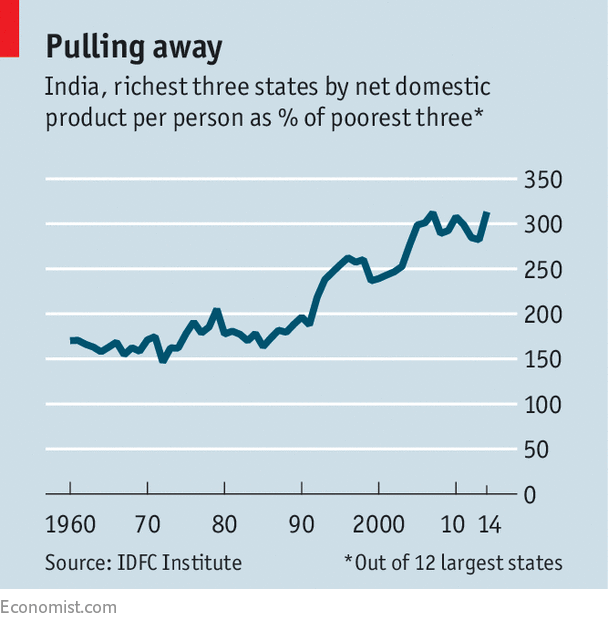
COUNTRIES find it easier to get rich once their neighbours already are. East Asia’s growth pattern has for decades been likened to a skein of geese, from Japan at the vanguard to laggards such as Myanmar at the rear. The same pattern can often be seen within big countries. Over the past decade, for example, China’s poorer provinces have grown faster than their wealthier peers. India is different. Far from converging, its states are getting ever more unequal. A recent shake-up in the tax system might even make matters worse.
India and Pakistan are seeing more intense monsoon rains
WITH the giant Himalayas caging its towering clouds, the great basin where the Brahmaputra merges with the Ganges and Meghna rivers is prone not only to heavy rainfall but also to sudden deluges. Bits of the Indian state of Meghalaya receive over 11 metres (36 feet) of rain a year, making them the wettest places on the planet. Where there is so much water plus so many people—the basin, which covers just 1% of the world’s land area, is home to one in ten of its people—flooding is a perpetual hazard. In the thickening heat of every summer the locals greet the monsoon with both relief and trepidation.BRICS: Modi meets Xi in Xiamen
The U.S.-Pakistan Relationship Is on Life Support
Anatomy of a Taliban Ambush
Negotiating Afghanistan: The New US Strategy And The Pursuit Of A Deal – Modern War Institute
Braving security fears, Chinese seek 'Silk Road' riches in Pakistan
I Was a Mercenary. Trust Me: Erik Prince’s Plan Is Garbage.
How Much Work Should the US Put Into Developing Cyber Rules With China?
How deeply should the United States engage China on the development of international norms and rules of cyber-security behavior? This question is most often asked in context of an assumption of Chinese bad faith; Beijing, as one of the world’s best-known practitioners of cyber-espionage, will not likely comply with established norms in any case. But in a recent essay, Julian Ku approaches the question from a different perspective: might China’s engagement change the nature of the rules established, possibly in the wrong direction?Here Is America’s Battle Plan For Destroying North Korea
At the Leading Edge of Counterinsurgency

Coal's Future Looks Uncertain As Rival Fuels Grow
The Benefits of Getting Comfortable With Uncertainty
“Wanting and not wanting the same thing at the same time is a baseline condition of human consciousness.”Maybe today’s Navy is just not very good at driving ships
In the wake of two fatal collisions of Navy warships with commercial vessels, current and former senior surface warfare officers are speaking out, saying today’s Navy suffers from a disturbing problem: The SWO community is just not very good at driving ships.MAN, THE MACHINE, AND WAR
Deputy Secretary of Defense Robert Work recently announced that the core of the United States’ new “offset strategy” to counter emerging operational and technological threats from Russia and China will be a “centaur” approach of teaming humans with machine intelligence of varying levels of autonomy. The offset strategy, often described as a “competitive strategy,” aims to convince a putative group of future opponents that the cost of opposing the United States is too high by teaming humans and machines. The new offset, Work argues, is necessary to continue to militarily support larger U.S. policy goals imperiled by military-technical developments in competing states such as Russia and China. How do the fundamental components of Work’s efforts — competitive strategy and human-machine teaming — go together? What are the obstacles that Work and his colleagues will need to surmount to make the new offset strategically successful?