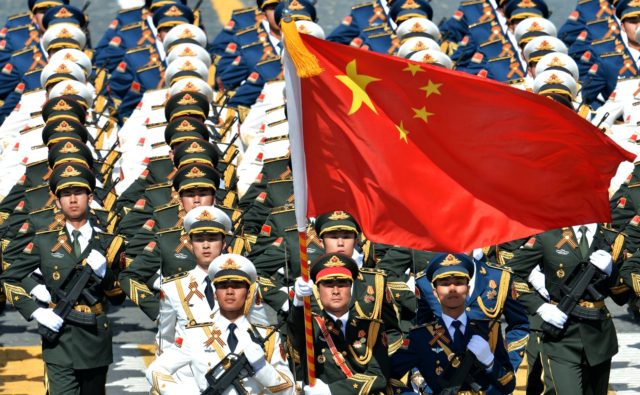
The Profession of Arms: A Guide for Young Army Officers
It takes courage, especially for a young officer, to check a man met on the road for not saluting properly or for slovenly appearance, but, every time he does, it adds to his stock of moral courage, and whatever the soldier may say, he has respect for the officer who does pull him up.
Read Document →The Dragon's Teeth: Assessing China's Military Modernization
PLA has focused on modernising its capabilities across all warfare domains to achieve these goals. This includes land, air, and maritime operations, nuclear, space, counter-space, electronic warfare and cyberspace operations, aiming to become a fully integrated joint force.
Read Document →Transforming the PLA: A Decade of reorganisation from SSF to ISF
PRC has engaged in a sustained and broad effort to transform the PLA from an infantry-heavy, low-technology, ground forces-centric military into a high-technology, networked force with an increasing emphasis on joint operations and naval and air power projection.
Read Document →Eyes without Borders: Exploring the World of Open Source Intelligence (OSINT) in the Digital Age
Open Source Intelligence (OSINT) is gaining prominence with the rise of social media, the digital society and the vast growth of publicly and commercially available information (PAI and CAI).
Read Document →
The PLA’s Developing Cyber Warfare Capabilities and India's Options
Informationised warfare blurs the lines between peacetime and wartime. A nation in the information age cannot wait for the hostilities to break out to collect intelligence, carryout influence operations, develop antisatellite systems or design computer software weapons.
Read Document →
Galwan and After
Why did China did this when he is under tremendous pressure in all fronts, is this China's salami slice tactics being progressed rigorously, what will be new Rules of Engagement, what will be escalatory control mechanism, who has taken this decision, will there be some pressure put by China in India's North-East through insurgency.
Read Document →
India’s Joint Doctrine for Cyberspace Operations: A Critical Review
Chief of Defence Staff (CDS) General Anil Chauhan and Secretary, Department of Military Affairs, formally released declassified versions of the Joint Doctrines for Cyberspace Operations during the Chiefs of Staff Committee meeting in New Delhi.
Read Document →
Know your Enemy General(now Field Marshal) Syed Aseem Munir
Gen SA Munir's position in the hierarchy of Pakistan was not very comfortable. The state of economy, insurgency in Pakhtoonistan and Balochistan, attack on the Jaffar Express, constant protests by supporters of Imran Khan's supporters inside and outside of parliament.
Read Document →
Decoding Operation SINDOOR: Key Aspects and Implications
Precision strikes were carried out on nine sites—four in Pakistan and five in PoK—linked to anti-India terrorist groups such as the LeT, JeM and the Hizbul Mujahideen. The targeted sites included Muridke (LeT headquarters) and Bahawalpur (JeM headquarters).
Read Document →
Chinese Cyber Exploitation in India's Power Grid - Is There a linkage to Mumbai Power Outage?
The New York Times (NYT), based on analysis by a U.S. based private intelligence firm Recorded Future, reported that a Chinese entity penetrated India’s power grid at multiple load dispatch points. Chinese malware intruded into the control systems that manage electric supply across India, along with a high-voltage transmission substation and a coal-fired power plant
Read Document →18 May 2017
***The Dalai Lama and the Shugden Schism
*** Exclusive: CPEC master plan revealed
Dawn has acquired exclusive access to the original document, and for the first time its details are being publicly disclosed here. The plan lays out in detail what Chinese intentions and priorities are in Pakistan for the next decade and a half, details that have not been discussed in public thus far.*** Beating the Islamic State
* NO RETREAT: THE AMERICAN LEGACY IN AFGHANISTAN DOES NOT HAVE TO BE DEFEAT
As President Donald Trump prepares to embark on his first foreign trip since taking office, he finds himself considering a conundrum that has beguiled his three predecessors — Clinton, Bush, and Obama — over the past two decades: What does “success” in Afghanistan look like? Put another way, what level of stability is required in Afghanistan to prevent the resurgence of jihadist groups that can pose renewed threats to United States? Importantly, two key factors have changed since Trump’s predecessors wrestled with this issue: First, the national security team around the president — Secretary of Defense James Mattis, Lt. Gen. H.R. McMaster, and Gen. John Nicholson, the commander in Afghanistan — have no learning curve when it comes to Afghanistan and the broader region. Second, the American people, having watched the U.S. military’s precipitous withdrawal from Iraq and the rise of the self-proclaimed Islamic State, now have a greater appreciation of the need to deal with local instability as a means to keeping international terrorism at bay. Thus, as the president reviews options this week for America’s role going forward in Afghanistan, gone will be the Vice President Joe Biden-like recommendations of focusing solely on counterterrorism problems in isolation of local and regional dynamics.India skips Belt Road Forum meet: Let's not fret, Hitory is not on China's side
THE GREAT GAME OF MAPPING THE HIMALAYA
Why India is not part of the Belt and Road Initiative summit
Aadhaar arguments: For and against
BACK TO FIRST PRINCIPLES: FOUR FUNDAMENTAL QUESTIONS ABOUT AFGHANISTAN
Time to Revisit the Durand Line
Relations between Afghanistan and Pakistan have deteriorated sharply over the last few years, as also evident in the increase in exchange of fire between security forces of the two countries, along the Af-Pak border. The last such incident took place on May 7 at the Chaman border in Balochistan, when firing by the Pakistan Army resulted in the death of Afghan soldiers. While Pakistan maintained that it had killed 50 soldiers and injured more than 100, Afghanistan contended that only 2 had died. This incident was in retaliation to an earlier one in which 9 persons were killed and 45 injured on the Pak side, when Afghan border forces fired at Pakistan security personnel guarding a census team.Bangladesh 2017: Resurgence of Radicalism
In the last two years, Islamist radicalism has witnessed resurgence in Bangladesh... much of these attacks are owned by the Islamic State. While the world believes these claims, government in Dhaka continues to con-test this popular narrative. The ruling Awami League (AL) government on the contrary blames the indigenous Islamists rather than the transnational terror formation for the terror acts. Its response to end such terror has consisted of a series of kinetic operations and systemic targeting of the Islamists.Chinese Defense Adviser Says Djibouti Naval Facility Is A Much-Needed ‘Military Base’
An ISIS–Al Qaeda ‘Frankenstein’ Could Be On Its Way
The End of the Road
To defeat ISIS for good, US needs to take the war beyond the battlefield
BrexitUnited Kingdom Theresa May's Gamble
Russian ‘Cyber Troops’: A Weapon of Aggression
Modern wars are won by grinding, not by genius
27 Questions to Identify Culture and Define Vision
I’ve had a lot of conversations lately about organizational culture and vision. [To me, vision is where the team is going and culture is the behavior, beliefs, and norms that get it there.] One point of dispute deals with when the new leader of an organization (say, an incoming commander) should begin shaping the culture and setting the vision.U.S. military cyber operation to attack ISIS last year sparked heated debate over alerting allies
A secret global operation by the Pentagon late last year to sabotage the Islamic State’s online videos and propaganda sparked fierce debate inside the government over whether it was necessary to notify countries that are home to computer hosting services used by the extremist group, including U.S. allies in Europe.Terrorist Use of Virtual Currencies: Containing the Potential Threat
Infographic: The 5 phases of a ransomware attack
I Side With the 'Bad Guys' on Encryption
One of the more intriguing pearls in FBI Director James Comey’s testimony before the Senate Judiciary Committee last week was his disclosure that the Bureau has been unable to penetrate the encryption on about half of the 6,000 cell phones seized in the course of various investigations between October and March. To Comey and the senators, this was plainly a problem. I will confess that my own feelings are more mixed.U.S. military cyber operation to attack ISIS last year sparked heated debate over alerting allies
A secret global operation by the Pentagon late last year to sabotage the Islamic State’s online videos and propaganda sparked fierce debate inside the government over whether it was necessary to notify countries that are home to computer hosting services used by the extremist group, including U.S. allies in Europe.