The Profession of Arms: A Guide for Young Army Officers
It takes courage, especially for a young officer, to check a man met on the road for not saluting properly or for slovenly appearance, but, every time he does, it adds to his stock of moral courage, and whatever the soldier may say, he has respect for the officer who does pull him up.
Read Document →The Dragon's Teeth: Assessing China's Military Modernization
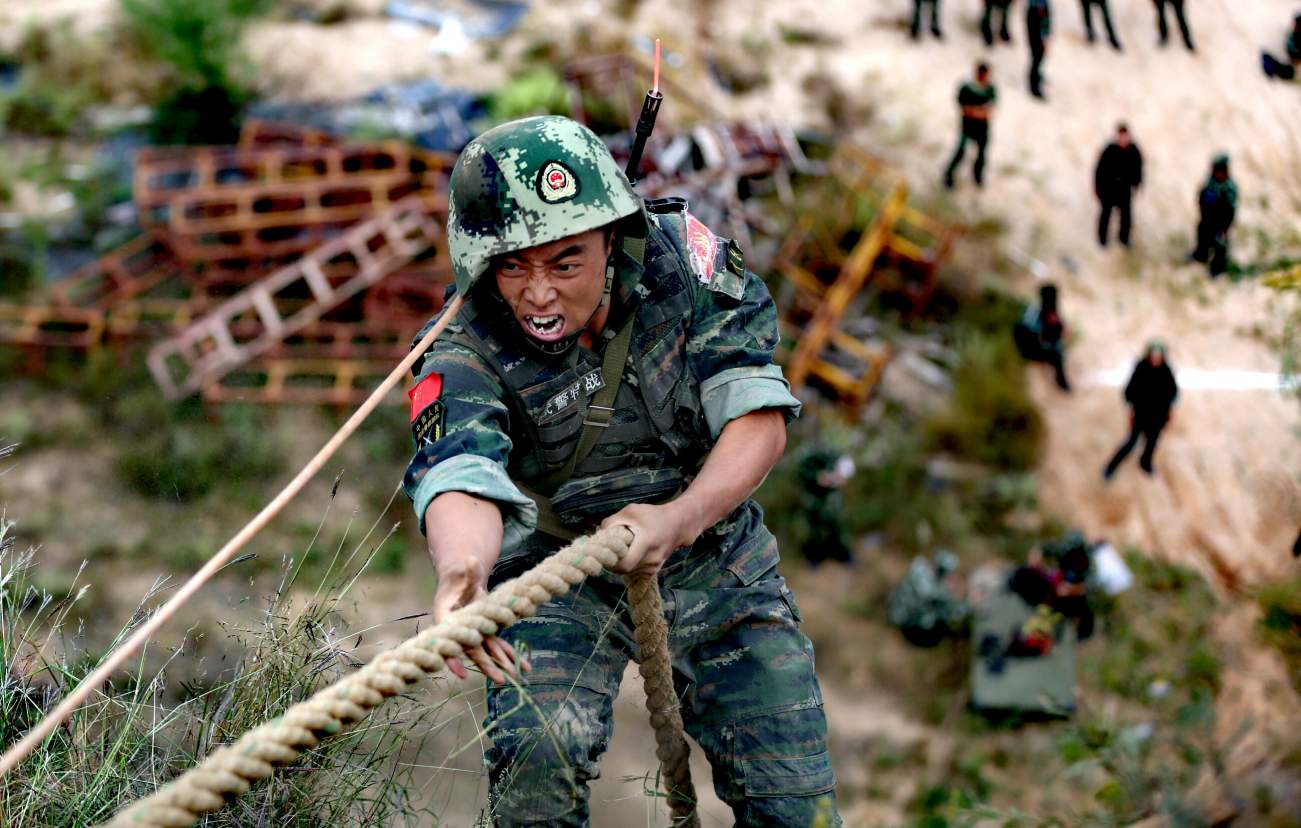
PLA has focused on modernising its capabilities across all warfare domains to achieve these goals. This includes land, air, and maritime operations, nuclear, space, counter-space, electronic warfare and cyberspace operations, aiming to become a fully integrated joint force.
Read Document →Transforming the PLA: A Decade of reorganisation from SSF to ISF
PRC has engaged in a sustained and broad effort to transform the PLA from an infantry-heavy, low-technology, ground forces-centric military into a high-technology, networked force with an increasing emphasis on joint operations and naval and air power projection.
Read Document →Eyes without Borders: Exploring the World of Open Source Intelligence (OSINT) in the Digital Age
Open Source Intelligence (OSINT) is gaining prominence with the rise of social media, the digital society and the vast growth of publicly and commercially available information (PAI and CAI).
Read Document →
The PLA’s Developing Cyber Warfare Capabilities and India's Options
Informationised warfare blurs the lines between peacetime and wartime. A nation in the information age cannot wait for the hostilities to break out to collect intelligence, carryout influence operations, develop antisatellite systems or design computer software weapons.
Read Document →
Galwan and After
Why did China did this when he is under tremendous pressure in all fronts, is this China's salami slice tactics being progressed rigorously, what will be new Rules of Engagement, what will be escalatory control mechanism, who has taken this decision, will there be some pressure put by China in India's North-East through insurgency.
Read Document →
India’s Joint Doctrine for Cyberspace Operations: A Critical Review
Chief of Defence Staff (CDS) General Anil Chauhan and Secretary, Department of Military Affairs, formally released declassified versions of the Joint Doctrines for Cyberspace Operations during the Chiefs of Staff Committee meeting in New Delhi.
Read Document →
Know your Enemy General(now Field Marshal) Syed Aseem Munir
Gen SA Munir's position in the hierarchy of Pakistan was not very comfortable. The state of economy, insurgency in Pakhtoonistan and Balochistan, attack on the Jaffar Express, constant protests by supporters of Imran Khan's supporters inside and outside of parliament.
Read Document →
Decoding Operation SINDOOR: Key Aspects and Implications
Precision strikes were carried out on nine sites—four in Pakistan and five in PoK—linked to anti-India terrorist groups such as the LeT, JeM and the Hizbul Mujahideen. The targeted sites included Muridke (LeT headquarters) and Bahawalpur (JeM headquarters).
Read Document →
Chinese Cyber Exploitation in India's Power Grid - Is There a linkage to Mumbai Power Outage?
The New York Times (NYT), based on analysis by a U.S. based private intelligence firm Recorded Future, reported that a Chinese entity penetrated India’s power grid at multiple load dispatch points. Chinese malware intruded into the control systems that manage electric supply across India, along with a high-voltage transmission substation and a coal-fired power plant
Read Document →15 June 2019
U.S.-India Ties: Long-Term Courtship, but No Marriage in Sight
India To Launch First Simulated Space Warfare Exercise – Analysis
India and Brexit: How New Delhi Can Position Itself to Maximize Benefit
The United Kingdom’s planned exit from the European Union, Brexit, keeps getting messier by the month. It led Theresa May to resign, just like David Cameron before her. It may end up making Boris Johnson the U.K.’s next prime minister, or be the cause of him facing judicial consequences. Brexit also led to the creation of the Brexit party, which got the largest vote share in recent European elections. So we now have British representatives in the EU who don’t want to be there. As of now, it shows no signs of getting better for the U.K.Meeting U.S. Counterterrorism Objectives in Afghanistan
Can China Solve Pakistan’s Energy Crisis?
CPEC has great promise, but Pakistan must be clear-eyed about the environmental and political costs.Waigal, Afghanistan: ‘This War Will Never End Here’
In Afghanistan’s “Land of Light,” the Taliban-government war is as much personal blood feud as political conflict.As Hong Kong stands up to China, US should do the right thing — this time
The ‘Xi Doctrine’: Proclaiming and Rationalizing China’s Aggression
The United States must respond to China’s belligerence with greater strength, adamantine determination, and more vigorous diplomatic and military measures.The Risks of a ‘Total’ US-China Competition
Even China hawks need to make a careful appraisal of what sparks joy in the Sino-American relationship.The Shanghai Cooperation Organization: Harmony or Discord?
Defeating the Islamic State of Idlib
The Trump administration has made clear that it wants to avoid getting involved in the Idlib’s crisis and appears reluctant to deal with the Salafi-jihadi threat there—and that puts Americans in danger.US Imposes New Iran-Related Sanctions On Iraq-Based Firm, Associates
The US has imposed Iran-related sanctions on an Iraq-based company and two people, according to a notice posted on the US Treasury Department website on Wednesday.Russians Are Getting Sick of Church
A Gulf Between Sudan's Military and Civilians Dims Hopes of Stability
Successful negotiations on a transitional process between the military council and the civilian opposition in Sudan are increasingly unlikely, as security forces stick to their plans and repress civilian opponents.NATO’s Ukraine Challenge
Ukrainian President Volodymyr Zelenskiy visited Brussels on June 4 and 5, where he met with the leadership of the European Union and NATO. He reaffirmed Kyiv’s goal of integrating into both institutions—goals enshrined earlier this year as strategic objectives in Ukraine’s constitution.‘Icebreaker Diplomacy’: Russia’s New-Old Strategy to Dominate the Arctic
One Thing Russia and the West Agree On
Europe has its own Venezuela now: Its poorest or second poorest nation, depending on how you count, has two governments. The main difference: Russia and the West prefer the same one, because the alternative is worse – blatant state capture by an oligarch who is only in this for himself.The Cruel Truth about Population Control
No matter how it may be rationalized, there is never any moral or practical justification for coerced sterilization.Experts: Spy used AI-generated face to connect with targets
Cyber Gaslighting: PsyOps in the Home
Home-based internet devices are becoming an increasingly integral part of our daily lives. By 2021, more than half of the houses in the country will be smart homes—homes equipped with electronic devices that can be controlled remotely by phone or computer. Many of us are buying internet-enabled personal assistants, thermostats, door locks, dimmers and kitchen appliances. These devices bring us numerous benefits, most notably the ability to save time by remotely accessing our homes and controlling multiple systems through easy-to-use interfaces. These benefits are real and should not be discounted. At the same time, there is a growing awareness that, like all technologies, smart home devices also introduce risks. Most of the attention to date has focused on risks to privacy from personal assistants like Alexa, which can overhear conversations even when one is not speaking to the device. However, last year the New York Times highlighted a more serious risk that has received scant attention: the potential use of smart home devices by one person to monitor and harass another person.Entering the Third Decade of Cyber Threats: Toward Greater Clarity in Cyberspace
Over the course of just a few decades, the world has entered into a digital age in which powerful evolving cyber capabilities provide access to everyone connected online from any place on the planet. Those capabilities could be harnessed for the benefit of humanity; they might also be abused, leading to enormous harms and posing serious risks to the safety and stability of the entire world.Nuclear Weapons Vulnerable To Cyber Threats – OpEd
According to a new report from the Nuclear Threat Initiative (NTI), Cyber Nuclear Weapons Study Group, US nuclear weapons can’t be effectively protected against cyberattacks with technical means alone. Why We Need a People-first AI Strategy
With more access to data and growing computing power, artificial intelligence (AI) is becoming increasingly powerful. But for it to be effective and meaningful, we must embrace people-first artificial intelligence strategies, according to Soumitra Dutta, professor of operations, technology, and information management at the Cornell SC Johnson College of Business. “There has to be a human agency-first kind of principle that lets people feel empowered about how to make decisions and how to use AI systems to support their decision-making,” notes Dutta. Knowledge@Wharton interviewed him at a recent conference on artificial intelligence and machine learning in the financial industry, organized in New York City by the SWIFT Institute in collaboration with Cornell’s SC Johnson College of Business.Regulating Big Tech: Is a Day of Reckoning Coming?
Big technology companies such as Facebook, Amazon, Google and Apple are on the cusp of a new era of regulatory oversight in the U.S., after years of being penalized in Europe for anticompetitive practices. The clamor from U.S. regulators has gotten louder recently, with calls for investigations into Big Tech’s antitrust activities, as well as the implications of their data gathering on privacy and the democratic process.