 The world is on the brink of a new, all-encompassing revolution moving at exponential speed. We are witnessing the emergence of innovative technological trends such as artificial intelligence, the internet of things, robotics, 3D printing, nanotechnology, and others with applications as diverse as the technologies themselves. The combination of these technological breakthroughs is the Fourth Industrial Revolution. Each revolution brings systemic implications and this one is no different. What is different is the extensiveness of its scope and the vitality of its impact on our existing interaction, distribution, production and consumption systems – and even on our identities.
16 April 2018
India’s opportunity and role in shaping the Fourth Industrial Revolution
The world is on the brink of a new, all-encompassing revolution moving at exponential speed. We are witnessing the emergence of innovative technological trends such as artificial intelligence, the internet of things, robotics, 3D printing, nanotechnology, and others with applications as diverse as the technologies themselves. The combination of these technological breakthroughs is the Fourth Industrial Revolution. Each revolution brings systemic implications and this one is no different. What is different is the extensiveness of its scope and the vitality of its impact on our existing interaction, distribution, production and consumption systems – and even on our identities.Red Star over Nepal irks India
UNDER Prime Minister Khadga Prasad Oli the undercurrents of India-Nepal ties will remain troubled despite his just concluded visit to India. In the wake of his electoral success, Oli has been rather upfront publicly about his vexed feelings towards India even when greater discretion would have served him and future ties with India better. His interview to a Hong Kong-based newspaper after assuming office contained themes that portended continuing tensions with India, be it his determination to revive the $2.5 billion (`16,200 crore) Budhi Gandaki project (allotted to China) that the preceding Nepali Congress government had cancelled, increasing infrastructure connectivity with China in order to lessen Nepal’s reliance on India and updating relations with India “in keeping with the times”, including a possible “correction” of the longstanding practice of Gurkha recruitment to serve in the Indian army, and so on.
Preserving banking and financial stability
 Almost a decade after the global financial crisis, economists continue to debate what went wrong, and how the world can avoid another blowout. One concern right now is that years of excessively easy monetary policy have resulted in higher leverage. The corporate credit-to-gross domestic product ratio in both advanced and emerging market economies is at near-historic highs. From the financial stability perspective, what matters is not just the total amount of credit in an economy but also the quality of the firms that are getting funded. It is in this context that the work in an analytical chapter of the latest “Global Financial Stability Report” (GFSR) of the International Monetary Fund (IMF) could be useful. Some of the takeaways from the research can also be useful for India, which is struggling with a massive bad debt problem.
India and the Commonwealth: Redirecting the Relationship
C. S. R. MURTHY
INTRODUCTION
The Commonwealth stands out as a time-tested forum where India can build, renew, and redefine links with the group’s other fifty-two member states in Africa, Asia, Europe, the Pacific, and the Caribbean. Despite its colonial roots, it is the oldest institution that provided India with a view of the world decades before it achieved independence. After independence, the Commonwealth has served India’s interests in varied ways: maintaining cordial relations with the former colonial power and other countries belonging to the Western bloc; showing solidarity with newly joined African countries, as well as small island countries, by expanding trade ties and economic assistance; and showcasing its diplomatic and organizational capabilities by hosting a Commonwealth Summit as well as the Commonwealth Games.
How a Remote Iranian Port Could Heighten China-India Tensions
By Iain Marlow and Ismail Dilawar
A remote Iranian port could be the next trigger for geopolitical tensions between rivals China and India. India has pledged more than $500 million to develop the strategically located port of Chabahar -- roughly 1,800 kilometers (1,110 miles) from the capital Tehran -- since it first expressed interest in 2003. Yet repeated delays have prompted Iran to turn to China in the hope of speeding up construction. On a March trip to Islamabad, Iran Foreign Minister Javad Zarif said he’d welcome Chinese and Pakistani investment in Chabahar, according to Dawn newspaper. He cited China’s development of Gwadar, a port down the coast that is a showcase of President Xi Jinping’s Belt-and-Road infrastructure initiative.
Drones: Guidelines, regulations, and policy gaps in India
RAJESWARI PILLAI RAJAGOPALAN RAHUL KRISHNA
 Technology affects us in positive ways yet can also be disruptive; such is the case with Remotely Piloted Aircraft (RPA or more commonly known as drones). While drones are proving to be useful for military, commercial, civilian, and even humanitarian activities, their unregulated use carries serious consequences that need to be addressed. This paper examines drone operations in India and analyses the major policy gaps in the country’s evolving policy framework. It argues that ad-hoc measures taken by state and central agencies have been ineffective, whether in addressing issues of quality control, or response mechanisms in the event of an incident, questions of privacy and trespass, air traffic, terrorist threat management, and legal liability. The paper makes a case for India to play a more proactive role in shaping global norms around the use of drones, as the evolution of these technologies could create an impact on the country’s security in multiple ways.
Introduction
Commentary: What U.S. generals get wrong about Afghanistan
Patricia Gossman
U.S. Army General John Nicholson is repeating the dangerous mistakes of the past. In a recent interview he echoed the mantra of his predecessors, that the new U.S. military strategy — which includes increasing both air power and the number of American troops training Afghan forces — has fundamentally changed the situation in Afghanistan. Nicholson, commander of U.S. forces in Afghanistan and head of NATO’s Resolute Support Mission since March 2016, should know better by now. A U.S. Army crew chief flying on board a CH-47F Chinook helicopter observes the successful test of flares during a training flight in Afghanistan, March 14, 2018. U.S. Air Force/Tech. Sgt. Gregory Brook/Handout via REUTERS.
How Pakistan’s ‘Deep State’ Wants To Cut Nawaz Sharif Down To Size – Analysis
By Sushant Sareen
Despite being badly wounded and pushed into a corner, the tiger (election symbol of Nawaz Sharif’s party and his own image among his followers) hasn’t stopped roaring. But while the tiger remains a formidable adversary and isn’t showing any signs of throwing in the towel in the face of overwhelming odds, he is undeniably in trouble. Given the forces arraigned against him – the military, judiciary, most of the media or at least the section that tows the line of the ‘deep state’, and of course opposition parties, most of which have either struck deals, or are working under instructions, or even trying to desperately suck up and win the affections of the ‘deep state’ – the prospects for Nawaz Sharif’s party in the forthcoming General Elections don’t look very bright. Not only history but also current political realities are heavily loaded against Nawaz Sharif and his party.
What was General Bajwa doing in Maldives?
Sanjay Kapoor
The recent trip of Pakistani Army Chief, General Qamar Javed Bajwa, to the Maldives has implications for India as it struggles to preserve its waning influence in the Indian subcontinent. Last week, the Maldivian capital city, Male, had an interesting visitor in Pakistan’s Army Chief, Qamar Bajwa. This was the first visit by a Pakistani army chief to Maldives in the last four years. It is also significant that General Bajwa is the first person of eminence to come to this Indian Ocean archipelago after a crisis erupted in early February resulting in the imposition of an internal emergency. His presence not only sought to lend legitimacy to a government that has been savaged globally for the manner in which it has smothered dissent, but also sent out a clear message to India that Maldives has other friends.
China and India’s geopolitical tug of war for Bangladesh
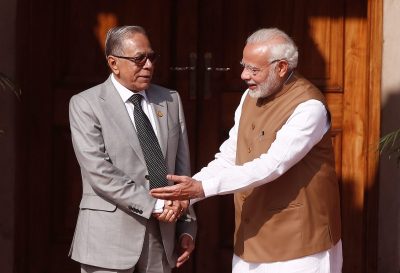 The Indian government sees Bangladesh as an important neighbour for political, national security and religious reasons. Bangladesh is a transport corridor to India’s northeastern states and a vital alternative route to the vulnerable Siliguri corridor that in the past has been threatened by China’s military, isolating all of northeast India. India also fears that Islamic fundamentalism and jihadism in Bangladesh may spill over the border. China’s broader program of developing influence throughout Asia through trade, finance, military cooperation and soft power includes Bangladesh. Bangladesh is the world’s seventh most populous country and the only one bordering India (except Bhutan) where Chinese influence is not dominant.
At the Boao Forum, Xi Unveils His Vision for the Global Economy
By Zhixing Zhang
 It can be difficult to separate the important from unimportant on any given day. Reflections mean to do exactly that — by thinking about what happened today, we can consider what might happen tomorrow. Since Chinese President Xi Jinping indirectly addressed some of the concerns the United States has expressed in its escalating trade dispute with China, Washington will once again have to choose between escalating and easing tensions with Beijing.
It can be difficult to separate the important from unimportant on any given day. Reflections mean to do exactly that — by thinking about what happened today, we can consider what might happen tomorrow. Since Chinese President Xi Jinping indirectly addressed some of the concerns the United States has expressed in its escalating trade dispute with China, Washington will once again have to choose between escalating and easing tensions with Beijing.Trump’s Syria Policy Isn’t Retrenchment. It’s Pandering.
BY STEVEN A. COOK
 President Donald Trump’s recent announcement that the United States would be getting out of Syria “very soon” stunned the policy community. Almost immediately, the op-ed pages, Twitter, and talking heads bellowed that the Trump administration had “no Middle East strategy.” But this wasn’t entirely accurate. Trump’s declaration about withdrawing from Syria was an abrupt policy shift. It was also perfectly consistent with the Middle East strategy he laid out in his presidential campaign.
Trump’s Tweets and the Authorization of War
By Amy Davidson Sorkin
 Can President Trump tweet a declaration of war? The words he posted on Wednesday morning suggest that he might think so. “Russia vows to shoot down any and all missiles fired at Syria,” he tweeted. “Get ready Russia, because they will be coming, nice and new and ‘smart!’ You shouldn’t be partners with a Gas Killing Animal who kills his people and enjoys it!” By “Gas Killing Animal,” Trump meant President Bashar al-Assad, whose government appears to be behind a chemical attack over the weekend that killed dozens of people in the town of Douma, many of them children. Trump has also called him Animal Assad. His regime’s brutality is, indeed, hard to express. And Russia has kept Assad in power.
Syria's War: Tracking the Descent Into Horror
Zachary Laub
In the seven years since protesters in Syria first demonstrated against the four-decade rule of the Assad family, hundreds of thousands of Syrians have been killed and some twelve million people—more than half the country's pre-war population—have been displaced. The country has descended into an ever-more-complex civil war: Jihadis promoting a Sunni theocracy eclipsed many opposition forces fighting for a democratic and pluralistic Syria. Regional powers backed various local forces to advance their geopolitical interests on Syrian battlefields. The United States has been at the fore of a coalition conducting air strikes on the self-proclaimed Islamic State, while Turkey, a U.S. ally, has invaded in part to prevent Kurdish forces, the United States' main local partner in the fight against the Islamic State, from linking up their autonomous cantons. Russia too has carried out air strikes in Syria, coming to the Assad regime's defense, while Iranian forces and their Hezbollah allies have done the same on the ground.
London, the Vanguard of an Economic Revolution
For the first several centuries of Britain’s existence, much of the world used London as a bridgehead for invasion. But after the Industrial Revolution, when the British Empire reached the height of its power, London instead became a bridgehead for England to invade much of the world.

Political Warfare Is Back with a Vengeance
Raphael S. Cohen Linda Robinson
 Perhaps one of the most important yet least defined leitmotifs of the Trump administration’s approach to national security is that of competition. The National Defense Strategy, released earlier this year, argues that “the central challenge to U.S. prosperity and security is the reemergence of long-term, strategic competition.” The concept pervades the National Security Strategy released in December with dozens of references throughout the document. President Donald Trump even introduced the new strategy saying, "Whether we like it or not, we are engaged in a new era of competition.” Despite the ubiquitous rhetoric, the United States still struggles to internalize what this means in practice. For much of the national-security apparatus, the “new era of competition” means a renewed focused on a high-end conflict with near peer adversaries, when it, in fact, reflects a deeper strategic reality. The United States’ principal adversaries are actually fighting—and gaining ground—by employing a host of tactics short of all-out war. This form of warfare, once called political warfare, is back with a vengeance, empowered by new tools and techniques. The United States has not sufficiently grappled with this form of orchestrated challenge across the political, economic and informational realms. The United States could benefit from relearning how to fight and win in this domain.
THE QUESTIONS ZUCKERBERG SHOULD HAVE ANSWERED ABOUT RUSSIA
 Russian agents used Facebook to influence the 2017 election. Congress missed the chance to delve into what the company's CEO Mark Zuckerberg knows about it—and how he'll stop it in 2018. OVER THE LAST two days, Facebook CEO Mark Zuckerberg was questioned for more than 10 hours by two different Congressional committees. There was granular focus on privacy definitions and data collection, and quick footwork by Zuckerberg—backed by a phalanx of lawyers, consultants, and coaches—to craft a narrative that users “control” their data. (They don’t.) But the gaping hole at the center of both hearings was the virtual absence of questions on the tactics and purpose of Russian information operations conducted against Americans on Facebook during the 2016 elections.
 U.S. Cyber Command chief calls for debate around hacking unit's authorities
NSA Director Adm. Mike Rogers
Lawmakers and Pentagon leadership are considering plans that could one day provide U.S. Cyber Command with additional authorities to more easily operate outside declared war zones, two senior U.S. officials acknowledged Wednesday during an open congressional hearing. The testimony confirms aspects of a story CyberScoop published Wednesday about a push inside the government to give more authority to the military’s top hacking unit. That story described concerns shared in the intelligence community about the potential impact of a spike in cyber warfare operations.
The sneaky ways China and Russia could threaten US satellites
By: Aaron Mehta and Mike Gruss
/arc-anglerfish-arc2-prod-mco.s3.amazonaws.com/public/5732TKG7PNFWNNAKENFLOCSYLQ.jpg) In this Dec. 12, 2012, file photo, a screen at the General Satellite Control and Command Center shows the moment North Korea's Unha-3 rocket is launched in Pyongyang, North Korea. WASHINGTON – Major global powers, such as China and Russia, are focusing more on space weapons that neutralize others’ satellites rather than those that destroy payloads on orbit, a new report has found. The study by the Secure World Foundation, released Wednesday morning and previewed exclusively with Defense News, is a comprehensive collection of public-source information about the counterspace capabilities of China, Russia, North Korea and other world powers that could threaten American dominance in space.
In this Dec. 12, 2012, file photo, a screen at the General Satellite Control and Command Center shows the moment North Korea's Unha-3 rocket is launched in Pyongyang, North Korea. WASHINGTON – Major global powers, such as China and Russia, are focusing more on space weapons that neutralize others’ satellites rather than those that destroy payloads on orbit, a new report has found. The study by the Secure World Foundation, released Wednesday morning and previewed exclusively with Defense News, is a comprehensive collection of public-source information about the counterspace capabilities of China, Russia, North Korea and other world powers that could threaten American dominance in space.A new target for hackers? Satellites
By: Mike Gruss
/arc-anglerfish-arc2-prod-mco.s3.amazonaws.com/public/JLMFD7KYNNH7DEA3VGNHCOYU34.jpg) The medium terminals in the Very Small Aperture Terminal Family of Systems undergo interoperability evaluations at Marine Corps Tactical Systems Support Activity aboard Camp Pendleton, California. Marines want to replace this system with a newer, lighter, faster and more reliable satellite communications platform (Marines) Government and commercial satellite operators are increasingly the target of hackers, who are looking for inexpensive, but effective ways to limit space capabilities, according to a new report from the Secure World Foundation.
The medium terminals in the Very Small Aperture Terminal Family of Systems undergo interoperability evaluations at Marine Corps Tactical Systems Support Activity aboard Camp Pendleton, California. Marines want to replace this system with a newer, lighter, faster and more reliable satellite communications platform (Marines) Government and commercial satellite operators are increasingly the target of hackers, who are looking for inexpensive, but effective ways to limit space capabilities, according to a new report from the Secure World Foundation.With the rise of hypersonics, the Missile Defense Agency wants more sensors
By: Brandon Knapp
/arc-anglerfish-arc2-prod-mco.s3.amazonaws.com/public/CHSSBT7ZNRDPJHFJT6AHHT72BM.jpg) The head of the Missile Defense Agency wants the Pentagon to improve its sensors to combat new missile technology coming from Russia and China, according to his testimony before a Senate Appropriations subcommittee April 11. When pressed by Sen. Richard Durbin (D- Illinois) about whether the agency should spend $4 billion on a new layer of sensors or on a new east coast missile defense site to address a potential future threat from the Iranians, Lt. Gen. Samuel A. Greaves was unwavering in his support for new sensors.
The head of the Missile Defense Agency wants the Pentagon to improve its sensors to combat new missile technology coming from Russia and China, according to his testimony before a Senate Appropriations subcommittee April 11. When pressed by Sen. Richard Durbin (D- Illinois) about whether the agency should spend $4 billion on a new layer of sensors or on a new east coast missile defense site to address a potential future threat from the Iranians, Lt. Gen. Samuel A. Greaves was unwavering in his support for new sensors.How GCHQ plans to protect the UK from all-out cyberwar
Thomas McMullan
 As evidence of the increasingly central role cybersecurity plays in the UK, the National Cyber Security Centre (NCSC) is tightening its ties with law enforcement – announcing a new joint approach to how the country handles digital attacks.
The GCHQ-based NCSC has unveiled an extensive cyber incident framework, broadening existing guidelines around identified threats. The aim, according to the centre, is to create the most comprehensive picture of the cyber threats facing the nation. Paul Chichester, the NCSC’s Director of Operations, said the new framework of six categories will “strengthen the UK’s ability to respond to the significant, growing and diverse cyber threats we face”.
Gen. Zinni, Adm. Stavridis: What Pompeo must do first if confirmed as secretary of state
By Gen. Anthony Zinni, Adm. James Stavridis
A look at Mike Pompeo: from Kansas representative and CIA Director to secretary of state.
The Senate Foreign Relations Committee will hold a confirmation hearing Thursday on President Trump’s nomination of CIA Director Mike Pompeo to become secretary of state. If confirmed as America’s next chief diplomat, Pompeo will immediately face a world of growing crises that demand U.S. diplomatic leadership and a renewal and strengthening of all of the tools of American power. A West Point graduate, Pompeo says he intends to restore the State Department’s central role in national security. That’s a good signal. But Pompeo is in the hot seat, because the State Department he hopes to lead is a shadow of its former self, as a recent letter signed by over 200 former diplomats attests.
In the move to multi-domain operations, what gets lost?
By: Mark Pomerleau
/arc-anglerfish-arc2-prod-mco.s3.amazonaws.com/public/O53CEO5F7BGR5G43JQC2CJPPTU.jpg) As the services debate the future of so-called multi-domain operations, some fear current service-specifics could be at risk in favor of a more joint concept. The Army, in coordination with the Marine Corps, is developing new ways to fight in a “multi-domain” environment and to synchronize capabilities seamlessly across land, air, sea, space and cyber. The Air Force is pursuing a similar effort called multi-domain command and control. But part of bringing these capabilities together could lead to breaking down silos between the services and creating a more collaborative, joint effort throughout the Department of Defense than exists today.
As the services debate the future of so-called multi-domain operations, some fear current service-specifics could be at risk in favor of a more joint concept. The Army, in coordination with the Marine Corps, is developing new ways to fight in a “multi-domain” environment and to synchronize capabilities seamlessly across land, air, sea, space and cyber. The Air Force is pursuing a similar effort called multi-domain command and control. But part of bringing these capabilities together could lead to breaking down silos between the services and creating a more collaborative, joint effort throughout the Department of Defense than exists today.