The Profession of Arms: A Guide for Young Army Officers
It takes courage, especially for a young officer, to check a man met on the road for not saluting properly or for slovenly appearance, but, every time he does, it adds to his stock of moral courage, and whatever the soldier may say, he has respect for the officer who does pull him up.
Read Document →The Dragon's Teeth: Assessing China's Military Modernization
PLA has focused on modernising its capabilities across all warfare domains to achieve these goals. This includes land, air, and maritime operations, nuclear, space, counter-space, electronic warfare and cyberspace operations, aiming to become a fully integrated joint force.
Read Document →Transforming the PLA: A Decade of reorganisation from SSF to ISF
PRC has engaged in a sustained and broad effort to transform the PLA from an infantry-heavy, low-technology, ground forces-centric military into a high-technology, networked force with an increasing emphasis on joint operations and naval and air power projection.
Read Document →Eyes without Borders: Exploring the World of Open Source Intelligence (OSINT) in the Digital Age
Open Source Intelligence (OSINT) is gaining prominence with the rise of social media, the digital society and the vast growth of publicly and commercially available information (PAI and CAI).
Read Document →
The PLA’s Developing Cyber Warfare Capabilities and India's Options
Informationised warfare blurs the lines between peacetime and wartime. A nation in the information age cannot wait for the hostilities to break out to collect intelligence, carryout influence operations, develop antisatellite systems or design computer software weapons.
Read Document →
Galwan and After
Why did China did this when he is under tremendous pressure in all fronts, is this China's salami slice tactics being progressed rigorously, what will be new Rules of Engagement, what will be escalatory control mechanism, who has taken this decision, will there be some pressure put by China in India's North-East through insurgency.
Read Document →
India’s Joint Doctrine for Cyberspace Operations: A Critical Review
Chief of Defence Staff (CDS) General Anil Chauhan and Secretary, Department of Military Affairs, formally released declassified versions of the Joint Doctrines for Cyberspace Operations during the Chiefs of Staff Committee meeting in New Delhi.
Read Document →
Know your Enemy General(now Field Marshal) Syed Aseem Munir
Gen SA Munir's position in the hierarchy of Pakistan was not very comfortable. The state of economy, insurgency in Pakhtoonistan and Balochistan, attack on the Jaffar Express, constant protests by supporters of Imran Khan's supporters inside and outside of parliament.
Read Document →
Decoding Operation SINDOOR: Key Aspects and Implications
Precision strikes were carried out on nine sites—four in Pakistan and five in PoK—linked to anti-India terrorist groups such as the LeT, JeM and the Hizbul Mujahideen. The targeted sites included Muridke (LeT headquarters) and Bahawalpur (JeM headquarters).
Read Document →
Chinese Cyber Exploitation in India's Power Grid - Is There a linkage to Mumbai Power Outage?
The New York Times (NYT), based on analysis by a U.S. based private intelligence firm Recorded Future, reported that a Chinese entity penetrated India’s power grid at multiple load dispatch points. Chinese malware intruded into the control systems that manage electric supply across India, along with a high-voltage transmission substation and a coal-fired power plant
Read Document →16 December 2017
Internet Governance - How do we select people representing India
A Strong U.S.-India Partnership Is in Our Strategic Interest
Pakistan’s Military: The Fire Brigade and the Arsonist?
Tensions that mounted during a deadly, Islamist protest in Pakistan last month were resolved not by the country’s civilian government, but by leaders of its military and intelligence agency. The incident was another reminder of who really holds the reins in a tumultuous nation that the U.S. has leaned on to help defeat terrorist adversaries and bring stability to Afghanistan. This reality has serious consequences for U.S. policymakers engaging with Pakistan.Current Trends in Islamist Ideology
Pakistan Army as a Politically Disruptive Force in Nation-Building
Why China Won’t Rescue North Korea
What to do about China’s “sharp power”
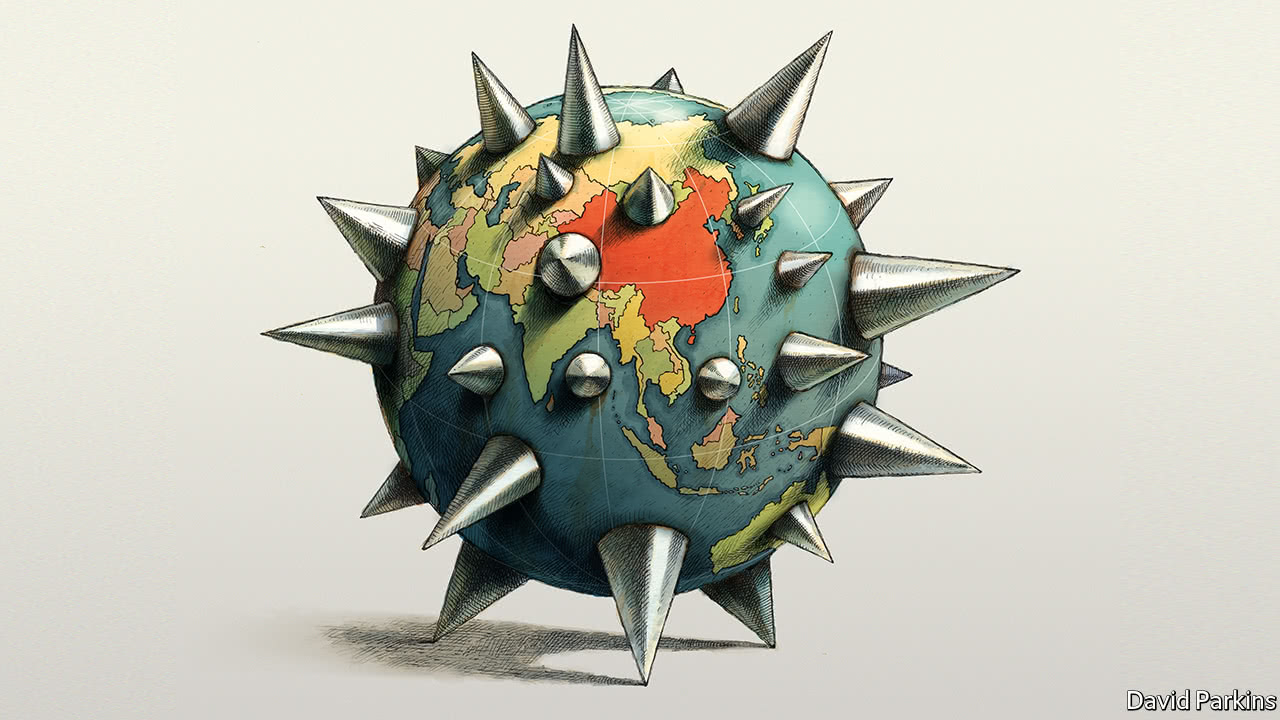
WHEN a rising power challenges an incumbent one, war often follows. That prospect, known as the Thucydides trap after the Greek historian who first described it, looms over relations between China and the West, particularly America. So, increasingly, does a more insidious confrontation. Even if China does not seek to conquer foreign lands, many people fear that it seeks to conquer foreign minds. Australia was the first to raise a red flag about China’s tactics. On December 5th allegations that China has been interfering in Australian politics, universities and publishing led the government to propose new laws to tackle “unprecedented and increasingly sophisticated” foreign efforts to influence lawmakers (see article). This week an Australian senator resigned over accusations that, as an opposition spokesman, he took money from China and argued its corner. Britain, Canada and New Zealand are also beginning to raise the alarm. On December 10th Germany accused China of trying to groom politicians and bureaucrats. And on December 13th Congress held hearings on China’s growing influence.US forces could potentially lose next war to Russia or China, warns sobering Rand report
U.S. defense modernization efforts are “failing to keep pace” when compared with its two big adversaries, and American forces are “poorly postured to meet key challenges in Europe and East Asia,” according to a starkly worded new report from think-tank Rand. As tensions with North Korea heighten, Rand’s 190-page report, entitled “U.S. Military Capabilities and Forces for a Dangerous World,” also discussed war scenarios with NATO-Russia involving the Baltic states. It also broke down a possible U.S.-China clash over Taiwan and gaps in existing U.S. capabilities.Assessment of the Lone Wolf Terrorist Concept
North Korean Nuclear Reactor Safety: The Threat No One is Talking About
In a Second Korean War, U.S. Troops Will Fight Underground
What North Korea's ICBM Means for Japan's Defense Planning
Two weeks have passed since North Korea test-launched the Hwasong-15, Pyongyang’s most advanced nuclear-capable inter-continental ballistic missile (ICBM). Prior to this November 29 test, there was debate among Korean affairs experts over whether a seeming suspension of missile tests by North Korea (no test had been conducted since September 15) might be a gesture on Pyongyang’s part to hint that they may be ready to talk. But the most recent test ended such debate, at least for now. More importantly, the latest test confirmed what U.S. Secretary of Defense James Mattis said months ago — that North Korea is “the most urgent and dangerous threat to peace and security.”North Korea is hacking bitcoin exchanges as currency value soars, expert says
What is Bitcoin? Bitcoin, a digital currency, was created in 2008. Shares of Bitcoin are sold on internet exchanges where users remain anonymous. As the value of the cryptocurrency continues to hit record highs, here’s how it works. As bitcoin’s value continues to surge, North Korean hackers are taking advantage by targeting exchanges to gain financial profit, experts said on Friday as sanctions against Kim Jong Un’s regime threaten to impede on economic development.The Ideologues Who Wrecked Libya
In the Middle East, Russia Seems to Be Everywhere
It can be difficult to separate the important from unimportant on any given day. Reflections mean to do exactly that — by thinking about what happened today, we can consider what might happen tomorrow. Russia's growing prominence in the Middle East was on full display Dec. 11 when Vladimir Putin visited three key Middle Eastern countries in one day. The Russian president followed a surprise trip to Syria with a quick stop in Egypt before ending his day's travels in Turkey. He met with his presidential counterparts in all three countries, and the economic deals, military agreements and political settlements he discussed highlighted Russia's role in the region. While Russia has its own reasons for bolstering its relationships with Syria, Egypt and Turkey, it also benefits from being visible where its regional rival, the United States, is not.The True Danger of Repealing Net Neutrality
Kamikaze UAVs, Drones on Leashes, Information Bombs Top Pentagon’s Counterterror Wishlist
Want a glimpse of the irregular grey-zone battles of the near future? One great indicator is the annual wishlist of the Pentagon’s Combating Terrorism Technical Support Office, or CTTSO. Released on Wednesday, the office’s broad agency announcement, or BAA, emphasizes drones and ways to counter misinformation. Here are a few highlights:Estonia, the Digital Republic
The Most And Least Expensive Countries For Broadband
Bitcoin And Financial Governance
Cyberattacks And The Digital Dilemma
One-third of US businesses hit by hacks, data breaches
A leader in business cyber-insurance reports how a lack of cyber knowledge and neglected hardware leads to data breaches and, in turn, lost resources and damaged reputations. A press release from The Hartford Steam Boiler Inspection and Insurance Company (HSB) found that one-third of U.S. businesses (29 percent) suffered from data breaches in 2016. The largest amount of said breaches were caused by business contractors and vendors, followed by employee negligence and stolen or lost storage and mobile devices. Furthermore, affected businesses tended to spend between $5,000 to $100,000 to ameliorate the damage.Ten trends redefining enterprise IT infrastructure
Looking Back to the Future: The Beginnings of Drones and Manned Aerial Warfare
This essay is part of the #WarBots series, which asked a group of academics and national security professionals to provide their thoughts on the confluence of automation and unmanned technologies and their impact in the conduct of war. We hope this launches a debate that may one day shape policy. On 8 December 1909, British Army Major Baden Fletcher Smyth Baden-Powell was invited to give a talk at the Royal United Services Institute (RUSI). Baden-Powell had been among the first soldiers to see the use of military aviation. He experimented with flying kites and built an aircraft with his sister Agnes, and he had just stepped down as President of the Royal Aeronautical Society, the oldest aeronautical society in the world. On that Wednesday afternoon in December 1909, he spoke about “How Airships are Likely to Affect War.”