The Profession of Arms: A Guide for Young Army Officers
It takes courage, especially for a young officer, to check a man met on the road for not saluting properly or for slovenly appearance, but, every time he does, it adds to his stock of moral courage, and whatever the soldier may say, he has respect for the officer who does pull him up.
Read Document →The Dragon's Teeth: Assessing China's Military Modernization
PLA has focused on modernising its capabilities across all warfare domains to achieve these goals. This includes land, air, and maritime operations, nuclear, space, counter-space, electronic warfare and cyberspace operations, aiming to become a fully integrated joint force.
Read Document →Transforming the PLA: A Decade of reorganisation from SSF to ISF
PRC has engaged in a sustained and broad effort to transform the PLA from an infantry-heavy, low-technology, ground forces-centric military into a high-technology, networked force with an increasing emphasis on joint operations and naval and air power projection.
Read Document →Eyes without Borders: Exploring the World of Open Source Intelligence (OSINT) in the Digital Age
Open Source Intelligence (OSINT) is gaining prominence with the rise of social media, the digital society and the vast growth of publicly and commercially available information (PAI and CAI).
Read Document →
The PLA’s Developing Cyber Warfare Capabilities and India's Options
Informationised warfare blurs the lines between peacetime and wartime. A nation in the information age cannot wait for the hostilities to break out to collect intelligence, carryout influence operations, develop antisatellite systems or design computer software weapons.
Read Document →
Galwan and After
Why did China did this when he is under tremendous pressure in all fronts, is this China's salami slice tactics being progressed rigorously, what will be new Rules of Engagement, what will be escalatory control mechanism, who has taken this decision, will there be some pressure put by China in India's North-East through insurgency.
Read Document →
India’s Joint Doctrine for Cyberspace Operations: A Critical Review
Chief of Defence Staff (CDS) General Anil Chauhan and Secretary, Department of Military Affairs, formally released declassified versions of the Joint Doctrines for Cyberspace Operations during the Chiefs of Staff Committee meeting in New Delhi.
Read Document →
Know your Enemy General(now Field Marshal) Syed Aseem Munir
Gen SA Munir's position in the hierarchy of Pakistan was not very comfortable. The state of economy, insurgency in Pakhtoonistan and Balochistan, attack on the Jaffar Express, constant protests by supporters of Imran Khan's supporters inside and outside of parliament.
Read Document →
Decoding Operation SINDOOR: Key Aspects and Implications
Precision strikes were carried out on nine sites—four in Pakistan and five in PoK—linked to anti-India terrorist groups such as the LeT, JeM and the Hizbul Mujahideen. The targeted sites included Muridke (LeT headquarters) and Bahawalpur (JeM headquarters).
Read Document →
Chinese Cyber Exploitation in India's Power Grid - Is There a linkage to Mumbai Power Outage?
The New York Times (NYT), based on analysis by a U.S. based private intelligence firm Recorded Future, reported that a Chinese entity penetrated India’s power grid at multiple load dispatch points. Chinese malware intruded into the control systems that manage electric supply across India, along with a high-voltage transmission substation and a coal-fired power plant
Read Document →9 March 2017
*** Putin Faces an Enemy of His Own Design
** Must It Always Be Wartime?
** 21ST-CENTURY FORWARD AIR CONTROL: THE ROOTS TO REBUILD
A downed pilot or dislocated friendly servicemember is sighted and being closed on by an overwhelming enemy force. Suddenly, coordinated airstrikes rain down to avert the enemy and protect the friendly position. This is the result of one of the most misunderstood and under-used military instruments of airpower — the airborne forward air controller. Distinguished from his ground-based brethren by an appended “(A)” for airborne, the FAC(A) is the airborne equivalent of a joint terminal air controller (JTAC). Both the JTAC and FAC(A) can nominate and mark targets, de-conflict airspace, relay critical ground schemes of maneuver, and authorize airstrikes — all for the purpose of synergizing the ground and air attack team. One does it from the ground, while the other performs it from the air.** Political control of the military is the new battleground
India-China border dispute is here to stay
All You Wanted To Know About GDP Numbers But Were Too Lazy To Ask
How on earth could the economy have grown 7 per cent during a quarter that saw 84 per cent of currency in circulation being yanked out of the system?'India will be world's fastest economy for the next decade'
Insurance and the Almighty
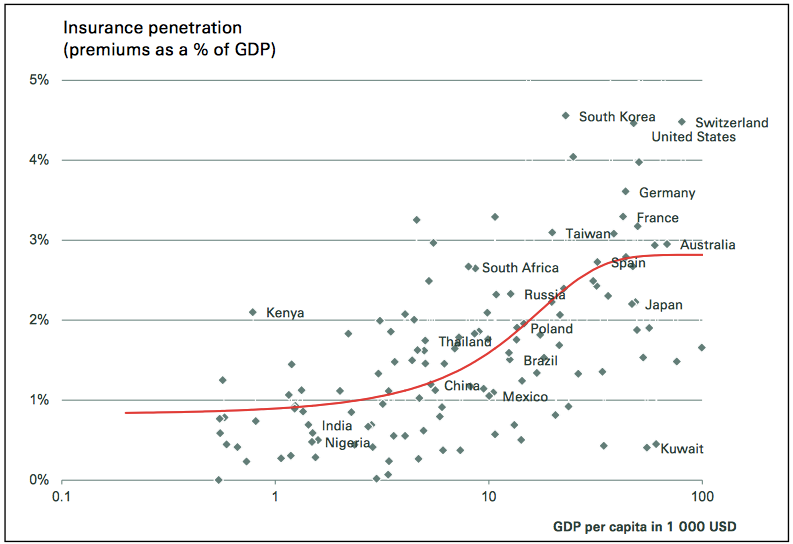
Non-life insurance penetration (premiums as share of GDP) vs GDP per capita (2013) — Source: Swiss ReAMBLING BLINDLY BACK INTO THE MOUNTAINS: 5 HARD QUESTIONS FOR THE NEXT PHASE OF AFGHANISTAN
Gen. John Nicholson, who commands the American-led international military force in Afghanistan, recently made headlines when he called for “a few thousand” more troops and a deeper American commitment to the fight in Afghanistan in testimony before the Senate Armed Services Committee earlier this month.The New Arab–Israeli Alliance
Renewed Conflict Over Nagorno-Karabakh
Russia’s Naval Shipyards Are an Unmitigated Disaster, Report
Andrey Kortunov: From Post-Modernism to Neo-Modernism, or Recalling the Future
The Sri Lankan Counterterrorism Model: Intelligence Innovation Outside the Anglosphere
A World Without Borders
How US nuclear force modernization is undermining strategic stability: The burst-height compensating super-fuze
PART II: HOW THE U.S. AIR FORCE WENT FROM EAGLE TO CHICKEN
In 1964, the Air Force officially entered the war in Vietnam. And they did so with the wrong mix of tactical airpower. The fighter force of the time bore little resemblance to an actual fighter force. It consisted largely of leftover Korean-era relics, interceptors designed to fight Soviet bombers, and “fighters” designed for a nuclear strike role. Blinded by the perceived need to engage in a massive nuclear exchange with the Soviets, the Air Force leadership of the time had built a combat aviation enterprise that was largely unsuited for anything short of nuclear war. Vietnam quickly proved this. The Air Force adapted, and did so at an impressive pace. Within five years, it added new fighters as well as attack and observation aircraft for service in Vietnam – all with new capabilities. This explosive growth increased the inventory by over 1200 aircraft, more than offsetting the 1000 tactical aircraft lost in that same time period. This was the eagle at its best, making a sharp turn to adjust to the reality of Vietnam, and incidentally laying the groundwork for the aircraft that would face the Soviets in the Cold War.Soft law: New tools for governing emerging technologies
A VETERAN OF THE BATTLE OF 73 EASTING OFFERS MCMASTER SOME FRIENDLY ADVICE
When President Donald Trump announced the selection of Lt. Gen. H.R. McMaster as his new national security advisor, I thought back to my days as a young lieutenant in 1991. I served as then-Capt. McMaster’s fire support officer in Eagle Troop, 2nd U.S. Cavalry, and I observed first-hand his outstanding leadership qualities at the Battle of 73 Easting, in which McMaster’s nine tanks and 12 Bradley Fighting Vehicles utterly destroyed an Iraqi Republican Guard armored brigade.Missile Defense and Defeat Considerations for the New Policy Review
Tallinn Manual 2.0: Stepping Out of the Fog in Cyberspace
State of encryption, part II: Policy limbo
For IBM’s CTO for Watson, not a lot of value in replicating the human mind in a computer
“Everybody and their mother is out to create their own specialized voice-activated devices,” IBM fellow and CTO for its Watson project Rob High told me during an interview at MWC. IBM, of course, doesn’t offer a direct competitor to Siri, Google Assistant or Alexa, but the company hopes that developers will choose Watson, in all its various guises, to power their AI apps, smart chatbots and similar services.Missile Defense and Defeat: Considerations for the New Policy Review
The national defense authorization act signed into law in 2016 contained a provision mandating a review of missile defeat policy, strategy, and capability, to be completed and submitted to Congress by January 2018. This Missile Defeat Review (MDR) appears likely to serve as a successor to both the Department of Defense’s 2010 Ballistic Missile Defense Review and other publications by the Joint Staff. The first of its kind, the MDR represents a unique opportunity for the Donald Trump administration to articulate a vision for the future of air and missile defense and determine how that vision is to be implemented by the Missile Defense Agency, the Joint Staff, the services, and other entities. This review will take place in the context of both an evolving strategic environment and several recent strategic analyses on related issues.