The attack on Saudi oil installations has large scale implications for the hydrocarbon supply to the world specially for countries like China, India and the Asian giants of Japan and South Korea. The Strait of Hormuz becomes critical for energy imports of these countries.The Profession of Arms: A Guide for Young Army Officers
It takes courage, especially for a young officer, to check a man met on the road for not saluting properly or for slovenly appearance, but, every time he does, it adds to his stock of moral courage, and whatever the soldier may say, he has respect for the officer who does pull him up.
Read Document →The Dragon's Teeth: Assessing China's Military Modernization
PLA has focused on modernising its capabilities across all warfare domains to achieve these goals. This includes land, air, and maritime operations, nuclear, space, counter-space, electronic warfare and cyberspace operations, aiming to become a fully integrated joint force.
Read Document →Transforming the PLA: A Decade of reorganisation from SSF to ISF
PRC has engaged in a sustained and broad effort to transform the PLA from an infantry-heavy, low-technology, ground forces-centric military into a high-technology, networked force with an increasing emphasis on joint operations and naval and air power projection.
Read Document →Eyes without Borders: Exploring the World of Open Source Intelligence (OSINT) in the Digital Age
Open Source Intelligence (OSINT) is gaining prominence with the rise of social media, the digital society and the vast growth of publicly and commercially available information (PAI and CAI).
Read Document →
The PLA’s Developing Cyber Warfare Capabilities and India's Options
Informationised warfare blurs the lines between peacetime and wartime. A nation in the information age cannot wait for the hostilities to break out to collect intelligence, carryout influence operations, develop antisatellite systems or design computer software weapons.
Read Document →
Galwan and After
Why did China did this when he is under tremendous pressure in all fronts, is this China's salami slice tactics being progressed rigorously, what will be new Rules of Engagement, what will be escalatory control mechanism, who has taken this decision, will there be some pressure put by China in India's North-East through insurgency.
Read Document →
India’s Joint Doctrine for Cyberspace Operations: A Critical Review
Chief of Defence Staff (CDS) General Anil Chauhan and Secretary, Department of Military Affairs, formally released declassified versions of the Joint Doctrines for Cyberspace Operations during the Chiefs of Staff Committee meeting in New Delhi.
Read Document →
Know your Enemy General(now Field Marshal) Syed Aseem Munir
Gen SA Munir's position in the hierarchy of Pakistan was not very comfortable. The state of economy, insurgency in Pakhtoonistan and Balochistan, attack on the Jaffar Express, constant protests by supporters of Imran Khan's supporters inside and outside of parliament.
Read Document →
Decoding Operation SINDOOR: Key Aspects and Implications
Precision strikes were carried out on nine sites—four in Pakistan and five in PoK—linked to anti-India terrorist groups such as the LeT, JeM and the Hizbul Mujahideen. The targeted sites included Muridke (LeT headquarters) and Bahawalpur (JeM headquarters).
Read Document →
Chinese Cyber Exploitation in India's Power Grid - Is There a linkage to Mumbai Power Outage?
The New York Times (NYT), based on analysis by a U.S. based private intelligence firm Recorded Future, reported that a Chinese entity penetrated India’s power grid at multiple load dispatch points. Chinese malware intruded into the control systems that manage electric supply across India, along with a high-voltage transmission substation and a coal-fired power plant
Read Document →8 January 2020
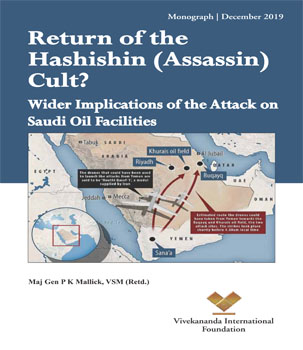
Return of the Hashishin (Assassin) Cult?: Wider Implications of the Attack on Saudi Oil Facilities
The attack on Saudi oil installations has large scale implications for the hydrocarbon supply to the world specially for countries like China, India and the Asian giants of Japan and South Korea. The Strait of Hormuz becomes critical for energy imports of these countries.Trends In Terrorism: What’s On The Horizon In 2020 – Analysis
Soleimani's Killing Sets the Stage for a Long-Term Oil Price Rise
Iran has the capability to launch cyber attacks on very short notice, expert says
Soleimani ‘Revenge’—This Is Why Iran’s Most Dangerous Cyber Weapons Will Stay Hidden
The fact the U.S. has taken the decision to kill Iran’s most powerful general, Qassem Suleimani, is less surprising than the fact it took them this long. The commander of the country’s Quds Force was viewed as an extreme threat to U.S. interests, the second most influential person in Iran behind Ali Khamenei, the most dangerous person in the region. American and European nationals have now been warned to leave a Middle East bracing for a short-term physical response that might include attacks on security and commercial facilities, on tourism and shipping, on the Strait of Hormuz.US officials, lawmakers warn of potential Iranian cyberattacks
US government agency website hacked by group claiming to be from Iran
Will Iran’s Response to the Soleimani Strike Lead to War?
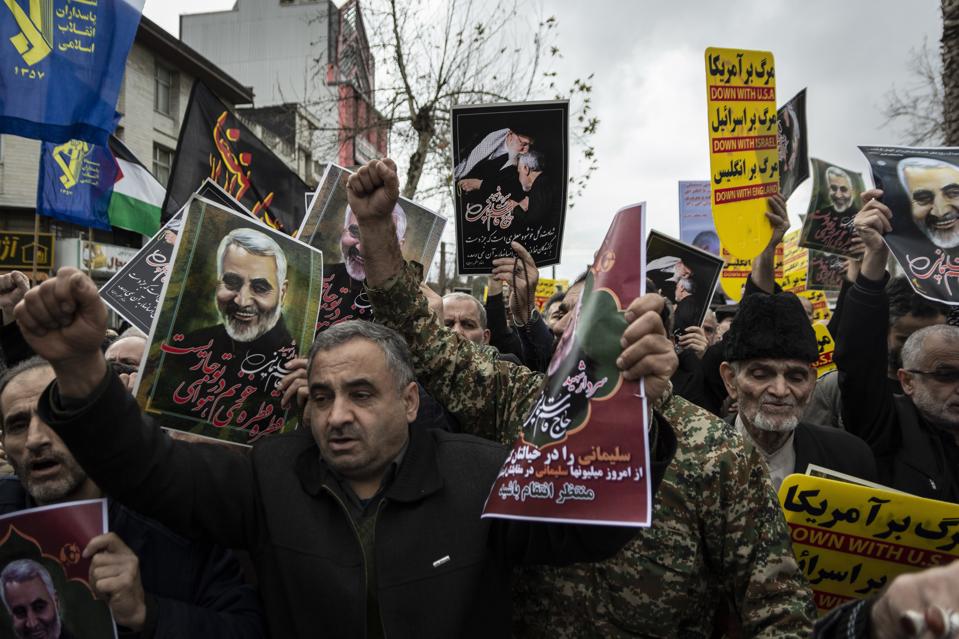
Qasem Soleimani, commander of the Islamic Revolutionary Guard Corps Quds Force, was one of the most influential and popular figures in the Islamic Republic and a particular nemesis of the United States. He led Iran’s campaign to arm and train Shiite militias in Iraq—militias responsible for the deaths of an estimated 600 American troops from 2003 to 2011— and became the chief purveyor of Iranian political influence in Iraq thereafter, most notably through his efforts to fight the Islamic State (ISIS). He drove Iran’s policies to arm and support Syrian President Bashar al-Assad, including by deploying an estimated 50,000 Shiite militia fighters to Syria. He was the point man for Iran’s relationship with Hezbollah in Lebanon, helping to supply the group with missiles and rockets to threaten Israel. He drove Iran’s strategy to arm the Houthis in Yemen. For all these reasons and more, Soleimani was a cult hero in Iran and across the region.Killing Iran’s Qassem Soleimani changes the game in the Middle East
How to Avoid Another War in the Middle East
Killing the Iranian commander Qasem Soleimani may well have been the most consequential foreign policy decision of Donald Trump’s presidency. Its repercussions will be felt for days, months, and even years to come—but what exactly they will be depends on what the Trump administration does next.Johns Hopkins University Applied Physics Laboratory
The challenge of non-state actors and stand-off weapons
Fleet commander directs US Navy’s surface force to develop concepts for unmanned ships
WASHINGTON — The head of the U.S. Navy’s Fleet Forces Command has ordered the service’s surface force to develop a concept of operations for both the large and medium unmanned surface vessels in development, according to a Dec. 19 message seen by Defense News.Trump and His Generals: The Cost of Chaos
Is This The Next Great Oil Frontier?
Now Namibia is joining the African oil conversation with one of the most oil-friendly regimes on the continent. It’s offering 5% royalties on what might just be a very productive shale play in Reconnaissance Africa’s (RECO.V) Kavango Basin.CSIS Bad Idea: Debating Grand Strategy
It is fitting that the last in our series from the Center for Strategic and International Studies (CSIS) on “Bad Ideas in National Security” should center on the role of ‘grand strategy’ in US foreign and military policy. Readers of history will recall that the pre-eminent grand strategy of the Cold War was ‘containment’ of the Soviet Union and the Communist ideology, crafted by senior diplomat George Kennan, writing anonymously as ‘Mr. X’ in Foreign Affairs in 1947. Since then, US pundits, theorists, diplomats, and former statesmen/women have been struggling to come up with something similar for the post-Cold War world, and as CSIS’s Matthew Fey argues below, largely failed — perhaps because the task itself is impossible.There are fewer wars when you take power away from men in big castles
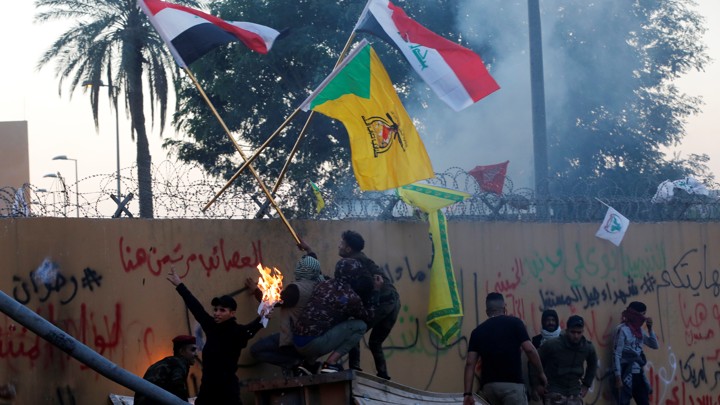
The Embassy Attack Revealed Trump’s Weakness
The End of the Soft-Power Delusion
A New Cold War…With Eurasia?
A Decade of No Lessons Learned in U.S. Overseas Intervention
As this decade began, U.S. armed forces were in year nine of their occupation of Afghanistan. A fresh surge of new U.S. military personnel was sent in by then-President Barack Obama that raised troop levels there to just below 100,000 by August 2010. The estimated expense of the occupation for 2010 was $94 billion, with a cumulative total through the end of that year of $338 billion.Royal United Services Institute (RUSI)
The World Didn’t Change Much in 2019. That’s Bad News for 2020.
Why the Berlin Wall Still Matters
The Year of the Trade Truce
U.S. President Donald Trump meets with Chinese Vice Premier Liu He and members of the U.S. and Chinese trade negotiation teams while announcing a “phase one” trade agreement with China at the White House on Oct. 11.