Inconsistencies in Parliamentary Standing Committee report have worrying implications for the state of India’s China policy.The Profession of Arms: A Guide for Young Army Officers
It takes courage, especially for a young officer, to check a man met on the road for not saluting properly or for slovenly appearance, but, every time he does, it adds to his stock of moral courage, and whatever the soldier may say, he has respect for the officer who does pull him up.
Read Document →The Dragon's Teeth: Assessing China's Military Modernization
PLA has focused on modernising its capabilities across all warfare domains to achieve these goals. This includes land, air, and maritime operations, nuclear, space, counter-space, electronic warfare and cyberspace operations, aiming to become a fully integrated joint force.
Read Document →Transforming the PLA: A Decade of reorganisation from SSF to ISF
PRC has engaged in a sustained and broad effort to transform the PLA from an infantry-heavy, low-technology, ground forces-centric military into a high-technology, networked force with an increasing emphasis on joint operations and naval and air power projection.
Read Document →Eyes without Borders: Exploring the World of Open Source Intelligence (OSINT) in the Digital Age
Open Source Intelligence (OSINT) is gaining prominence with the rise of social media, the digital society and the vast growth of publicly and commercially available information (PAI and CAI).
Read Document →
The PLA’s Developing Cyber Warfare Capabilities and India's Options
Informationised warfare blurs the lines between peacetime and wartime. A nation in the information age cannot wait for the hostilities to break out to collect intelligence, carryout influence operations, develop antisatellite systems or design computer software weapons.
Read Document →
Galwan and After
Why did China did this when he is under tremendous pressure in all fronts, is this China's salami slice tactics being progressed rigorously, what will be new Rules of Engagement, what will be escalatory control mechanism, who has taken this decision, will there be some pressure put by China in India's North-East through insurgency.
Read Document →
India’s Joint Doctrine for Cyberspace Operations: A Critical Review
Chief of Defence Staff (CDS) General Anil Chauhan and Secretary, Department of Military Affairs, formally released declassified versions of the Joint Doctrines for Cyberspace Operations during the Chiefs of Staff Committee meeting in New Delhi.
Read Document →
Know your Enemy General(now Field Marshal) Syed Aseem Munir
Gen SA Munir's position in the hierarchy of Pakistan was not very comfortable. The state of economy, insurgency in Pakhtoonistan and Balochistan, attack on the Jaffar Express, constant protests by supporters of Imran Khan's supporters inside and outside of parliament.
Read Document →
Decoding Operation SINDOOR: Key Aspects and Implications
Precision strikes were carried out on nine sites—four in Pakistan and five in PoK—linked to anti-India terrorist groups such as the LeT, JeM and the Hizbul Mujahideen. The targeted sites included Muridke (LeT headquarters) and Bahawalpur (JeM headquarters).
Read Document →
Chinese Cyber Exploitation in India's Power Grid - Is There a linkage to Mumbai Power Outage?
The New York Times (NYT), based on analysis by a U.S. based private intelligence firm Recorded Future, reported that a Chinese entity penetrated India’s power grid at multiple load dispatch points. Chinese malware intruded into the control systems that manage electric supply across India, along with a high-voltage transmission substation and a coal-fired power plant
Read Document →5 October 2018
Parliamentary committee report on Doklam can’t see China’s game is just beginning
Inconsistencies in Parliamentary Standing Committee report have worrying implications for the state of India’s China policy.The ‘2+2’ India–U.S. Dialogue and the Maritime Tango in the Indo-Pacific
WILL TRUMP STOP ISSUING STUDENT VISAS TO CHINESE CITIZENS?
Taiwan Confronts the Costs of Economic Integration With Mainland China
Taiwanese electronic firms are still more advanced than mainland China's in developing most cutting-edge technologies, but they are increasingly linked to mainland supply chains.Forget Stanford, Tsinghua Beckons
In a recent Chinese national television program, a group of Kenyan students gamely grapple with their professor’s instructions in a classroom adorned with Mandarin characters. They are not studying in Nairobi but at China’s prestigious Peking University. The Kenyan students explain how China has given them full scholarships to receive educational opportunities they are deprived of at home and how they will gain skills they can take back to enrich their own countries.China’s Uyghur Crackdown Goes Global
Life didn’t turn out as Wumaerjiang Jiamali had expected. He got the opportunity to leave western China in 2014 to attend university studies in Istanbul. Four years later he is a refugee in northern Sweden. His son is locked up in their home province of Xinjiang, and Wumaerjiang no longer has any contact with the rest of his family.Another US-China Dialogue Bites the Dust
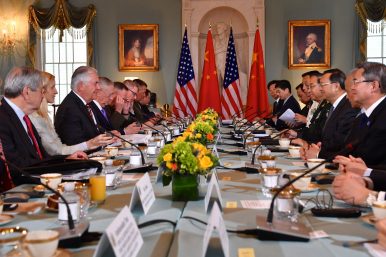
China has pulled out of the next round of ministerial-level talks with the United States, underscoring the continued deterioration of the relationship. From the trade war to the U.S. conception of China as a “strategic competitor,” frictions are building on nearly every front of the relationship.CHINA, YOU'RE AN EMBARRASSMENT ON TRADE | OPINION
NAFTA 2.0 is just a warmup to Trump’s bout with China
NAFTA 1.0 wasn’t the terrible deal President Trump said it was, but NAFTA 2.0 is an improvement and, more importantly, it tells us good things about Trump’s skill at deal making.America's Iran Policy is Helping China Advance Its Vision of a Multipolar World
The U.S. withdrawal from the Iran deal, and subsequent escalation of tensions between Washington and Tehran presents immediate challenges for China:higher prices for the world’s largest oil importer , a potential conflict along a key juncture in the Belt and Road Initiative, and heightened risk of nuclear proliferation. Chinese Middle East experts have also raised concerns that overly constrictive U.S. pressure could sideline moderate elements in Tehran, and drive Iran to “adopt a more radical foreign policy ” (้ๅๆดๆฟ่ฟ็ๅคไบคๆฟ็ญ), which would further intensify sectarianism and extremism across an already volatile region.Learning to Love Kim's Bomb
The US Threatens Russia Over Missiles
Russia’s High-Precision Strike Capabilities and ‘Pre-Nuclear’ Deterrence
Moscow is paying increasing attention to the development and strengthening of its Armed Forces’ conventional high-precision strike capabilities. This encapsulates its cruise missile, coastal-defense, operational-strategic and operational-tactical high-precision weapons. Some of these have been tried and tested during combat operations in Syria. And undoubtedly, such weapons will become more of a prominent feature in Russian military operations in the future: the authorities have promised to fully outfit the Missile and Artillery Troops by 2021 with the latest systems as well as to diversify the types and production of such assets. But at the same time, this advanced conventional weaponry is closely tied to the embellishment of Russia’s so-called “pre-nuclear” deterrence. Since they are so expensive, such systems feature more in actual combat operations in Syria and less in the testing that takes place during strategic exercises; although these kinds of experiments utilizing high-precision strikes also occurred during Vostok 2018 (Voyenno Promyshlennyy Kuryer, September 25).How the US cyber force is maturing
America's Foreign Policy Power Is Changing Under Trump
At a baffling moment full of Russian intrigue, made-for-reality-TV summitry, presidential Twitter rants, and trade wars, history can offer perspective, if not comfort. The ancient Greeks often understood our world more clearly than we do. Thucydides’ history of the Peloponnesian Wars between Athens and Sparta, many modern scholars now recognize, was intended as a work of Greek tragedy. It provides a morality play for the ages, offering insights into the foreign-policy challenges facing the United States in the years ahead, even after Donald Trump’s presidency.A New Trade Deal Gets NAFTA Members Back Together
The United States, Mexico and Canada have reached a new trade agreement that largely replicates the North American Free Trade Agreement, with a few significant changes in the automotive and dairy sectors, as well as in environmental and labor standards.Trump Hits Brazil, India Commerce After Clinching N. American Trade Deal
Fresh from clinching an updated North American commerce pact, U.S. President Donald Trump on Monday criticized Indian and Brazilian trade tactics, describing the latter as being "maybe the toughest in the world" in terms of protectionism.A Conversation With Abdullah Abdullah
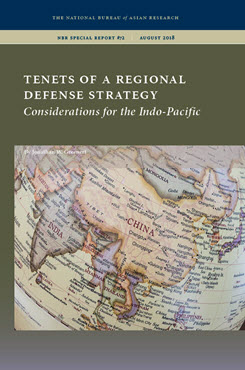
Tenets of a Regional Defense Strategy
A new report by Admiral Jonathan W. Greenert, the current John M. Shalikashvili Chair in National Security Studies at NBR, provides an assessment of seven key countries in the Indo-Pacific and considers implications for U.S. security concerns.Why Understanding Is Key to Thwarting Social Media Threats
Like any other technology, social media is neutral, meaning it can be used for good or bad purposes.The Digital Divide In Asia
Microsoft's efforts for a Digital Geneva Convention get underway
On Saturday, September 29, Microsoft launched the Digital Peace Now initiative, a campaign that aims to get governments around the world to agree on rules for the use of state-sponsored cyber-weapons.‘Everything smart has a problem:’ Cybergeddon looms
Russia’s Cyberattacks Aren’t Meddling—They’re Acts of War
The Army is working toward a cyber domain doctrine
There needs to be a doctrine for every domain, whether on the ground, at sea, in the air, or out in space. And that goes for cyberspace as well.What You May Not Know About 'Black Hawk Down'
Industry 4.0 Is The 21st Century Global Battlefield - America Could Lose
America's Military Is Losing Its Counterinsurgency Operations Capabilities
Ever wonder why or how the U.S. military forgets how to do counterinsurgency and stability operations? We are witnessing the process happen in real time.The Army is working toward a cyber domain doctrine
There needs to be a doctrine for every domain, whether on the ground, at sea, in the air, or out in space. And that goes for cyberspace as well.HUMINT Isn’t Dead, It Just Smells That Way. Time For Us To Learn From the Past
In June of 1960, KGB officers shot Pyotr Semyonovich Popov in the back of the head after he was abruptly recalled from East Berlin to Moscow. Formerly a field-grade officer in the Main Intelligence Directorate (GRU) of the Soviet military, Popov was the CIA’s most valuable Human Intelligence (HUMINT) asset during the Cold War, providing hundreds of millions of dollars’ worth of military intelligence and the names of over 600 Soviet agents. Despite his invaluable contribution, however, the CIA missed vital clues left by Popov after his arrest by the KGB in 1959 and subsequent use as a double agent. Why did the CIA fail one of its most important sources? Whether through ignorance or complacency, Popov’s handlers had simply become accustomed to the ease of operating with the same seemingly-secure tradecraft that had served them so well in the past./arc-anglerfish-arc2-prod-mco.s3.amazonaws.com/public/ETI4U26T3ZAOTPF5C4JZNHIXLQ.jpg)