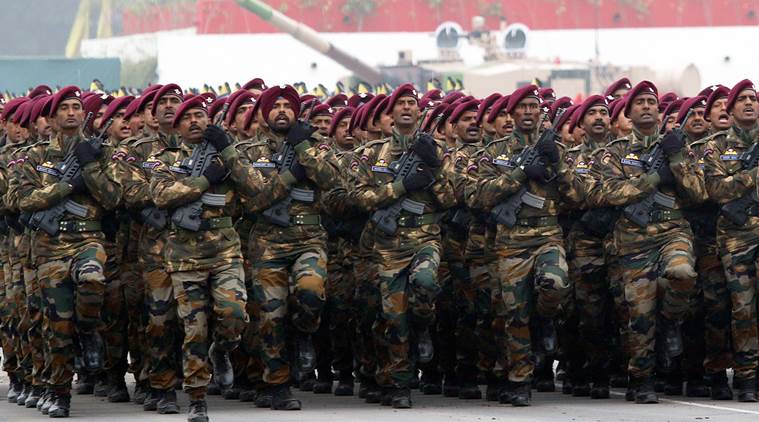
The Profession of Arms: A Guide for Young Army Officers
It takes courage, especially for a young officer, to check a man met on the road for not saluting properly or for slovenly appearance, but, every time he does, it adds to his stock of moral courage, and whatever the soldier may say, he has respect for the officer who does pull him up.
Read Document →The Dragon's Teeth: Assessing China's Military Modernization
PLA has focused on modernising its capabilities across all warfare domains to achieve these goals. This includes land, air, and maritime operations, nuclear, space, counter-space, electronic warfare and cyberspace operations, aiming to become a fully integrated joint force.
Read Document →Transforming the PLA: A Decade of reorganisation from SSF to ISF
PRC has engaged in a sustained and broad effort to transform the PLA from an infantry-heavy, low-technology, ground forces-centric military into a high-technology, networked force with an increasing emphasis on joint operations and naval and air power projection.
Read Document →Eyes without Borders: Exploring the World of Open Source Intelligence (OSINT) in the Digital Age
Open Source Intelligence (OSINT) is gaining prominence with the rise of social media, the digital society and the vast growth of publicly and commercially available information (PAI and CAI).
Read Document →
The PLA’s Developing Cyber Warfare Capabilities and India's Options
Informationised warfare blurs the lines between peacetime and wartime. A nation in the information age cannot wait for the hostilities to break out to collect intelligence, carryout influence operations, develop antisatellite systems or design computer software weapons.
Read Document →
Galwan and After
Why did China did this when he is under tremendous pressure in all fronts, is this China's salami slice tactics being progressed rigorously, what will be new Rules of Engagement, what will be escalatory control mechanism, who has taken this decision, will there be some pressure put by China in India's North-East through insurgency.
Read Document →
India’s Joint Doctrine for Cyberspace Operations: A Critical Review
Chief of Defence Staff (CDS) General Anil Chauhan and Secretary, Department of Military Affairs, formally released declassified versions of the Joint Doctrines for Cyberspace Operations during the Chiefs of Staff Committee meeting in New Delhi.
Read Document →
Know your Enemy General(now Field Marshal) Syed Aseem Munir
Gen SA Munir's position in the hierarchy of Pakistan was not very comfortable. The state of economy, insurgency in Pakhtoonistan and Balochistan, attack on the Jaffar Express, constant protests by supporters of Imran Khan's supporters inside and outside of parliament.
Read Document →
Decoding Operation SINDOOR: Key Aspects and Implications
Precision strikes were carried out on nine sites—four in Pakistan and five in PoK—linked to anti-India terrorist groups such as the LeT, JeM and the Hizbul Mujahideen. The targeted sites included Muridke (LeT headquarters) and Bahawalpur (JeM headquarters).
Read Document →
Chinese Cyber Exploitation in India's Power Grid - Is There a linkage to Mumbai Power Outage?
The New York Times (NYT), based on analysis by a U.S. based private intelligence firm Recorded Future, reported that a Chinese entity penetrated India’s power grid at multiple load dispatch points. Chinese malware intruded into the control systems that manage electric supply across India, along with a high-voltage transmission substation and a coal-fired power plant
Read Document →16 April 2016
*** China Expanding Its Nuclear Capabilities

*** Europe, Islam and Radical Secularism
Glacial mistrust - Whose Siachen is it anyway?
J.J. Singh
South of the Pamirs, there is a knot of mountains formed by the Karakoram, Hindu Kush and Kuen Lun ranges. Emanating from the mighty Karakoram range, which forms the northern crown of India is the Siachen: the second-longest glacier (76 kms) in the world. The Siachen glacier is joined by many smaller glaciers and is the source of the Nubra river, which flows into the Shyok and then after entering Pakistan Occupied Kashmir joins the Indus river. This frozen landscape has craggy and rocky pinnacles and a sea of ice and snow with moraines on both sides. The people of the region have a saying, "The land is so barren and the passes so high that only the best of friends and the fiercest of enemies come by."
As debate on the demilitarization of this frozen battlefield rages in our society and media consequent to the unfortunate natural calamity that struck there recently, the question, "Whose Siachen is it?", begs asking. Did the brave martyrs who made the highest sacrifice on those icy heights die in vain or could the loss of lives be avoided? ask our countrymen. The fact is that de jure the whole of Jammu and Kashmir and de facto the Siachen glacier, an important part of it, are unquestionably Indian. Consequent to the signing of the instrument of accession by the Maharaja of J&K in 1947, the state became a part of the Union of India.
At the end of hostilities in the Indo-Pak war of 1947-48, a ceasefire line in J&K was agreed to by both countries and was authenticated on the maps. This delineation was specific up to a point: NJ 9842. Beyond that, the agreement went on to say, "and thence north to the glaciers". This broad definition was resorted to as neither side had any troops in that area nor believed that the glaciers would one day spawn a conflict. In case the CFL was to run beyond NJ 9842 in a straight-line northeast-ward to the Karakoram Pass as Pakistan's maps depict, the Karachi Agreement would have stated so. After the decisive victory in the 1971 Indo-Pak war, India had every reason to insist on a precise definition of the line of control beyond NJ 9842 in a northward direction along the Saltoro Range towards Indira Col on the Karakoram Range, thereby respecting in letter and spirit the Karachi Agreement of 1949. Historically, too, the Saltoro has been the traditional boundary dividing the Balti people and the Ladakhis. It was a huge political error when we let that opportunity pass. In an engrossing account of the deliberations during the Simla Conference of 1972, Harish Kapadia, a renowned adventurer, has stated, "A desperate Bhutto had pleaded with our Prime Minister Indira Gandhi that he be trusted to do so [to agree to delineate the borders along the Saltoro Range, but later], as he did not want to antagonize his generals at that point in time. Aap mujhpe bharosa kijiye [Trust me], he is reported to have said." We know what happened thereafter.
Defending the frontiers of India, however daunting the challenges posed by an adversary and inhospitable the terrain, is a sacred and primary responsibility of the armed forces. For the defence of the motherland, loss of life or limb and other sacrifices in the line of duty is a part of soldiering. That notwithstanding, one of the most important functions of military leaders is to ensure minimum casualties without compromising operational imperatives. Every soldier's life is precious and a national asset, and that is why the martyrs earn the privilege of being draped in the tricolour and eternal respect of our countrymen. In our case, we must not lose sight of the fact that we have unresolved boundary issues with both Pakistan and China, and hence face a situation of "no war - no peace". Occupation of our territory in Aksai Chin in north Ladakh by China in the early 1950s and Pakistan's intrusions in Kargil in 1999 resulted in costly armed conflicts. Ironically, Rudyard Kipling's words have become a truism: "In times of war and not before, God and the soldier we adore. But in times of peace and all things righted, God is forgotten and the soldier slighted."
Why fighting for Balochistan is key to Modi's Pakistan policy Much of the story of the country is uncontested, provided we do not pay undue attention to the neighbour's claims.
Activists fighting for a cause, especially one that has a lot of popular emotion attached to it, are usually loud and shrill when holding forth at public fora. They tend to be belligerent and turn excessively aggressive if their views are contradicted.
In a sense, loud speech, belligerence and aggression are necessary for effective activism. After all, if an activist is an easy pushover, then his or her cause cannot be worth fighting for. At the same time, needlessly pushy activism can put off people and make them indifferent to causes that could be perfectly legitimate and deserving of support.
History
Hence listening to professor Naela Quadri Baloch at a recent discussion on Balochistan organised by the Observer Research Foundation came as a pleasant surprise. She was soft-spoken yet firm, persuasive yet polite. She presented her case, or rather the case for free Balochistan, without taking recourse to either maudlin sentiments or theatrical hyperbole.
Balochistan continues to witness horrors. (Reuters)
Much of the story of Balochistan is uncluttered and uncontested, provided we do not pay undue attention and attach unwarranted credibility to Pakistan's claims. In 1947, when British colonial rule came to an end in the Indian subcontinent, 535 princely states were given the option of either acceding to India or Pakistan through merger of territory, or remain free and independent.
The Khan of Kalat, which comprised nearly all of Balochistan barring three minor principalities, was not too eager to accede to Pakistan. The Baloch were, and remain, a fiercely independent people with their own cultural and social identity, along with a land endowed with natural resources. That early impulse for freedom became the root cause of Balochistan's subsequent misery.
Since its violent Caesarian birth, assisted by a scalpel-wielding Britain, on August 14, 1947, Pakistan has been as deceitful as its Quaid-e-Azam Mohammed Ali Jinnah was during his brief and bitter life as the ruler of a moth-eaten country, one half of which fell off the map in 1971.
Jinnah, the barrister helped the Khan of Kalat to prepare his brief for independence and a Standstill Agreement in the interim. Jinnah the smash-and-grab politician paved the path for Kalat's annexation by Pakistan on March 27, 1948. Thus was Balochistan forcibly converted into a province of Pakistan, against the wishes of the Baloch and their Khan.
Balochistan's struggle against Pakistani rule and Islamabad's "One Unit" policy has been relentless since the annexation of Kalat. Brutal repression by the Pakistani army has failed to break the spirit of resistance. Beginning with 1948-49, it has been horrific campaign to put down dissent and silence voice of freedom.
There are several similarities between the Pakistani army committing hideous crimes in Bangladesh (then East Pakistan) and Balochistan. Mass killings, rape of women, laying human habitations to waste, targeted assassinations, Bangladesh saw it all during its Liberation War of 1971. Balochistan continues to witness these horrors.
Butcher
General Tikka Khan, nicknamed the "Butcher of Bangladesh", had the dubious distinction of also being called the "Butcher of Balochistan" for the bloody campaign he led from 1973-77. But for all the sorrow, grief and misery heaped on the people of Balochistan, they have risen again. The freedom movement, relaunched in 2004 continues unabated.
Divided by the Goldsmith Line of 1871, Balochistan is split between Pakistani and Iranian occupation, with some bits spilling into Afghanistan on account of the flawed Durand Line. Britain understood the strategic importance of Balochistan and played its game accordingly to keep the Russians out. Today, both Pakistan and Iran are leveraging that strategic importance to further their own economic and security interests.
India's position on Balochistan has been, at best, ambivalent. Notwithstanding the arrest of an Indian national (Pakistan claims he is a "RAW agent" and was arrested on its side of the Goldsmith Line; there are credible claims he was arrested by the Iranians and handed over to the ISI) it would be silly to imagine a grand Indian conspiracy in action. New Delhi has long been incapable of doing what Indira Gandhi did in 1970-71.
Option
Yet there is a case for an Indian policy on Balochistan. India did play a major role in propping up the Northern Alliance so as not to concede all ground to the Taliban and its mentor, Pakistan, in Afghanistan. A hands-off approach, therefore, is lacking in precedence, even if we were to discount India's proactive role in the liberation of Bangladesh from the tyranny of Pakistan.
The issue is what should be that policy. Investing in Chabahar port that lies on the Iranian side of Balochistan cannot be a policy in entirety. At best, it will partially countervail China's captive port at Gwadar on the Pakistani side of Balochistan. That's one pawn moved. Next what?
India’s Rock ’n’ Roll Approach to Guarding Its Nuclear Sites
By Adrian Levy and R. Jeffrey Smith On 2/14/16
This article first appeared on the Center for Public Integrity site.
On October 8, 2014, Head Constable Vijay Singh awoke before dawn in Kalpakkam, India, and scurried across the ocher gravel outside the constabulary barracks at the Madras Atomic Power Station, “looking like the monsoon was about to break,” as a grounds sweeper later recalled.
Singh was one of 620 paramilitary officers in the country’s Central Industrial Security Force assigned to protect the facility’s nuclear-related buildings and materials. But he did not have his usual tasks in mind that morning.
By 4:40 a.m., the 44-year-old officer reached the armory, where he signed out a 9 mm submachine gun and 60 rounds of ammunition in two magazines. Singh loaded one clip into his weapon, pocketed the other and entered the portico of a cream and red, three-story residential complex.
He climbed up one flight to the room where a senior colleague, Mohan Singh, dozed and abruptly opened fire at him in a controlled burst, to conserve rounds, just as he had been trained.
Then he jogged downstairs, where he shot dead two more men and seriously injured another two. With 10 rounds left in his magazine, and an unused 30-round clip in his pocket, he prowled unimpeded across the gravel, with no alert called.
A bystander shouted out to him, and suddenly Singh halted and dropped to his knees, an eyewitness recalled later. He was finally surrounded and led away, glassy-eyed, “as docile as anything, a neat guy, his hair still perfectly parted,” the witness said.
The episode was a fresh example of what officials here and outside India depict as serious shortcomings in the country’s nuclear guard force, tasked with defending one of the world’s largest stockpiles of fissile material and nuclear explosives.
An estimated 90 to 110 Indian nuclear bombs are stored in six or so government-run sites patrolled by the same security force, according to the Stockholm International Peace Research Institute, an independent think tank, and Indian officials.
Within the next two decades, as many as 57 reactors could also be operating under the force’s protection, as well as four plants where spent nuclear fuel is dissolved in chemicals to separate out plutonium to make new fuel or be used in nuclear bombs.
The sites are spread out over vast distances: from the stony foothills of the Himalayas in the north down to the red earth of the tropical south. Shuttling hundreds of miles in between will be occasional convoys of lightly protected trucks laden with explosive and fissile materials—including plutonium and enriched uranium—that could be used in civilian and military reactors or to spark a nuclear blast.
As a result, the Kalpakkam shooting alarmed Indian and Western officials who question whether this country, which is surrounded by unstable neighbors and has a history of civil tumult, has taken adequate precautions to safeguard its sensitive facilities and keep the building blocks of a devastating nuclear bomb from being stolen by insiders with grievances, ill motives or, in the worst case, connections to terrorists.
Although experts say they regard the issue as urgent, Washington is not pressing India for quick reforms. The Obama administration is instead trying to avoid any dispute that might interrupt a planned expansion of U.S. military sales to New Delhi, several senior U.S. officials said in interviews.
The experts’ concerns are based in part on a series of documented nuclear security lapses in the past two decades, in addition to the shooting:
Several kilograms of what authorities described as semiprocessed uranium were stolen by a criminal gang, allegedly with Pakistani links, from a state mine in Meghalya, in northeastern India, in 1994. Four years later, a federal politician was arrested near the West Bengal border with 100 kilograms of uranium from India’s Jadugoda mining complex that he was allegedly attempting to sell to Pakistani sympathizers associated with the same gang. A police dossier seen by the Center for Public Integrity (CPI) states that 10 more people connected with smuggling were arrested two years after this, in operations that recovered 57 pounds of stolen uranium.
US wants a stronger Indian military to deter, not provoke, conflict with China - See more at: http://indianexpress.com/article/opinion/columns/us-wants-a-stronger-indian-military-to-deter-not-provoke-conflict-with-china-mind-the-dangerous-gap/#sthash.jdljHHBB.dpuf
* A billion-dollar digital opportunity for oil companies
By Richard Ward
Making better use of existing technology can deliver serious returns—by increasing production, streamlining the supply chain, or reducing engineering time.
The computers in the offices of the average big oil company can find an additional $1 billion in value, if you let them.
Modern advanced-analytics programs are able to diagnose, sort, compare, and identify cost savings, or opportunities for increased production, in a manner beyond the capabilities of the average employee. The tools that allow you to do this have been available for several years, but adoption by the oil and gas industry has been slow. This is partly the result of the recent crash in oil prices, but competing internal IT projects and organizational reluctance to put in the effort required are also factors.
In this article, three stories are told. In each story, the average big oil company (AB Oil Co.)1 could realize $1 billion in cost savings or production increases by deploying technologies that exist today.
Finding $1 billion in the supply chain
The vendors have been brought in for meetings. AB Oil Co. has demanded discounts, and the vendors have agreed. What more can be done to save money?
For the past several years, hundreds of millions of design, procurement, and operational choices have been made by the organization. Valves have been sized and ordered, casing-team contracts awarded, and orders for cement placed, pretty much with the same vendors in the same way. In the meantime, some vendors were charging less in one field than another; some crews had fewer failures than others; one supplier had lowered the cost of an entire class of suitable products. But AB Oil’s engineers never took advantage of any of these opportunities. Why? Because there is too much of this type of information: there are too many dynamic variables in too many places for any single person to know everything, or enough to make optimal decisions. It is too much even for a team of professionals dedicated to the task.
But it is not too much for your computers.
The new generation of advanced-analytics programs are able to execute a massive analysis of all these data, normalize them, and identify opportunities for cost savings that can be leveraged across future operations.
In one case, a super-major drilling horizontal shale wells in North America found that its costs, as well as those of its competitors, varied highly across plays. The company assembled a data team and collected information from finance, operations, competitor investor presentations, and industry news stories. A software program did bottom-up analysis, churning through millions of records, normalizing, correlating, and seeking high-probability maximums and minimums, guided by an experienced team of engineers and procurement staff. At the end of this multiweek process, the team could confidently propose critical changes to casing design, procurement, and casing crew selection.
The savings came to $700,000 per well. As this company had about 1,300 future wells to drill, the total potential was $910 million—not quite a billion, but awfully close.
Saving $1 billion in engineering time
AB Oil Co. employs tens of thousands of engineers and technicians working on thousands of projects. They are scattered around offices and facilities in many locations and time zones. Instinctively, we know that not all those projects can be successful, or even efficient in how they operate. The challenge for oil and gas companies long has been how to quantify, and thereby identify, the poor performers. Project reviews inevitably surface unique circumstances that justify the status quo, and reviewers are rarely given the resources to drill down to the root causes of poor performance.
But your computers can.
A new analytical method to study this exact problem was developed in the world of Formula One racing, in which global racing teams have hundreds of engineers pursuing thousands of technical projects in parallel. Researchers gathered communications data (for example, email subject lines, dates, and names), interim work products (for example, meeting presentations), time sheets, staff locations, and travel expenses. Then, using analytical tools, they were able to gain comprehensive views of the efficiency and effectiveness of the different teams. Without the bias of any top-down assumptions (for example, that bigger teams are less efficient), the tools processed millions of correlations and hypotheses. Each step in the analysis highlighted high correlations with and predictions of high performance while eliminating low-value insights. After thousands of iterations, two clear sources of inefficiency became apparent.
Taliban Begin Their Spring Offensive Against Embattled Afghan Army

Afghanistan Threat Assessment
A U.S. Military Equal to the Threat
Report Calls for Dramatic Change to Rebuild Societies in Conflict Amid Refugee Crisis
Why Xi is Purging the Chinese Military
* A Grain of Salt for China’s Export Growth
March of an empire- China's aggression over land and water must be resisted
Dictators don’t stabilize the Middle East. They just create more terrorists.
The Hell After ISIS
Why ISIS wants a 'clash of civilizations' Extremist tracker sees language of group moving toward notion of revenge
By Adrienne Arsenault, Michelle Gagnon, Apr 12, 2016
The rash of arrests in Brussels late last week may impress some, but don't expect showers of praise for Europe's intelligence agencies from Pieter Van Ostaeyen.
"They're like a bunch of blind men," he says in his spectacularly blunt way. "Nobody knows what they are looking for, where they should look for it, who to look for. It's like this network will basically only grow. It's not like they are even close, in my opinion, to stopping this."
This isn't a cheap shot from a man being glib. It's a sad warning from a man who should know.
Van Ostaeyen is a Middle East historian, an Arabist, a lover of Syria, a multilingual maestro. For years, from his tiny apartment in Mechelen, Belgium, he has tracked, studied and communicated with European jihadists who joined ISIS and other extremist groups.
His contacts are vast and eyebrow-raising. When we first met in November to talk about the network behind the Paris attacks, he had to break from the interview to read a text from an al-Qaeda contact. They often berate him, try to convert him and sometimes just answer his questions.
Pieter Van Ostayen says intelligence groups are failing in the fight against ISIS. 'Nobody knows what they are looking for, where they should look for it, who to look for,' he says. (CBC News)
Few understand ISIS like Van Ostaeyen. And what he sees now is a mutation in the group, in the rhetoric and the recruiting. He points out that the language is less about Islamic fundamentalism and is increasingly focussed on the notion of revenge.
"What they really want … is the clash of civilizations," he says. Revenge for what ISIS claims the West has done to Iraq and Syria. And the more ground ISIS loses there, the more the group lusts for bloodshed in Europe.
Along the railway line
The shift in language may coincide with recruiting patterns.
After the Paris attacks, Van Ostaeyen pulled out a map and pointed to a train line between Antwerp and Brussels. It was the towns along that line, he said, that were home to the bulk of the foreign fighters from Belgium.
Radical clerics used to preach in those towns, he said. They groomed dozens of young men. They turned them into fundamentalists and then into jihadists. And those young men were the ones investigators worried about. But it's different now.
"We have been looking at the wrong part of the country," Van Ostaeyen says. "We were looking north when we should have been looking south."
Except for UK, German and Netherlands, Most European Nations Refuse to Share Intelligence
It’s 2016 and you aren’t using encryption. Why?
All breaches aren’t created equally. Encryption, not breach prevention, separates damaging hacks from annoying intrusions.
By Jason Hart, CTO Data Protection, Gemalto April 13, 2016
Encryption sounds synonymous with complexity.
It's not. It's very, very simple.
There should be no reason why an organization shouldn't be encrypting its data in 2016. The technology is there. And the rationale for using it is simple: Breach prevention is dead.
Recommended:Sponsor Content 2015 in breaches: The year digital attacks got personal
Our 2015 Breach Level Index showed over 1,600 disclosed breaches worldwide. That lead to more than 700 million records being exposed.
To put it simply, blocking breaches isn’t working.
As we watch hackers hone in on data critical to our lives and our businesses, we need to develop a mindset that accepts attackers will find a way in — but that our critical data is protected so it doesn’t make its way out.
Where are hackers headed?
Attackers pursued and achieved more valuable and durable information in 2015, according to the same Breach Level Index. While bad guys pilfered less financial data, the main takeaway from the report was the focus on long-lasting information (think of your health records or massive, comprehensive government databases) that allows them to conduct other attacks.
Hackers, in short, understand that it’s way harder to change your Social Security Number than it is to cancel a credit card — and in some cases, such as with one’s medical history, that information can’t be altered at all.
Bad guys see the enduring value of this data. At a consumer level, if a hacker can capture key information on an individual, they can potentially attack not only that individual but the organization they work for and other organizations that the compromised person accesses online.
Compare that to what happens when a digital attacker steals your credit card information: if the credit card's compromised, it's comparatively extremely easy for that credit card to be rejected, stopped, and a new credit card issued.