The Profession of Arms: A Guide for Young Army Officers
It takes courage, especially for a young officer, to check a man met on the road for not saluting properly or for slovenly appearance, but, every time he does, it adds to his stock of moral courage, and whatever the soldier may say, he has respect for the officer who does pull him up.
Read Document →The Dragon's Teeth: Assessing China's Military Modernization
PLA has focused on modernising its capabilities across all warfare domains to achieve these goals. This includes land, air, and maritime operations, nuclear, space, counter-space, electronic warfare and cyberspace operations, aiming to become a fully integrated joint force.
Read Document →Transforming the PLA: A Decade of reorganisation from SSF to ISF
PRC has engaged in a sustained and broad effort to transform the PLA from an infantry-heavy, low-technology, ground forces-centric military into a high-technology, networked force with an increasing emphasis on joint operations and naval and air power projection.
Read Document →Eyes without Borders: Exploring the World of Open Source Intelligence (OSINT) in the Digital Age
Open Source Intelligence (OSINT) is gaining prominence with the rise of social media, the digital society and the vast growth of publicly and commercially available information (PAI and CAI).
Read Document →
The PLA’s Developing Cyber Warfare Capabilities and India's Options
Informationised warfare blurs the lines between peacetime and wartime. A nation in the information age cannot wait for the hostilities to break out to collect intelligence, carryout influence operations, develop antisatellite systems or design computer software weapons.
Read Document →
Galwan and After
Why did China did this when he is under tremendous pressure in all fronts, is this China's salami slice tactics being progressed rigorously, what will be new Rules of Engagement, what will be escalatory control mechanism, who has taken this decision, will there be some pressure put by China in India's North-East through insurgency.
Read Document →
India’s Joint Doctrine for Cyberspace Operations: A Critical Review
Chief of Defence Staff (CDS) General Anil Chauhan and Secretary, Department of Military Affairs, formally released declassified versions of the Joint Doctrines for Cyberspace Operations during the Chiefs of Staff Committee meeting in New Delhi.
Read Document →
Know your Enemy General(now Field Marshal) Syed Aseem Munir
Gen SA Munir's position in the hierarchy of Pakistan was not very comfortable. The state of economy, insurgency in Pakhtoonistan and Balochistan, attack on the Jaffar Express, constant protests by supporters of Imran Khan's supporters inside and outside of parliament.
Read Document →
Decoding Operation SINDOOR: Key Aspects and Implications
Precision strikes were carried out on nine sites—four in Pakistan and five in PoK—linked to anti-India terrorist groups such as the LeT, JeM and the Hizbul Mujahideen. The targeted sites included Muridke (LeT headquarters) and Bahawalpur (JeM headquarters).
Read Document →
Chinese Cyber Exploitation in India's Power Grid - Is There a linkage to Mumbai Power Outage?
The New York Times (NYT), based on analysis by a U.S. based private intelligence firm Recorded Future, reported that a Chinese entity penetrated India’s power grid at multiple load dispatch points. Chinese malware intruded into the control systems that manage electric supply across India, along with a high-voltage transmission substation and a coal-fired power plant
Read Document →22 November 2017
American Leadership in the Asia-Pacific
ISIS PLOTTING ATTACKS FROM AFGHANISTAN
Infographic Of The Day: 35 Chinese Cities With Economies As Big As Countries
The Rise Of A Not-So-New World Order
Ian Bremmer Argues That We Are At The End Of The Global Free Market — As The Rise Of China Dominates Recent Asean Summit
The Real Winner in America's Russia Crisis Is China
THE LEAP INTO QUANTUM TECHNOLOGY: A PRIMER FOR NATIONAL SECURITY PROFESSIONALS
China recently announced the launch of its Jinan Project, a quantum information effort billed as “the world’s first unhackable computer network.” Building on its launch last year of the world’s first quantum-enabled satellite, China has made significant strides in quantum technology, a field with rapidly increasing relevance to national security. Its satellite has been hailed as a major step toward “unbreakable” encrypted communications.Nuclear War: Could China's Mach 10 Hypersonic Weapons Unleash the Unthinkable?
ISIS, Radicalization and Humiliation
THE UNCOUNTED
Dealing with the Russian Bear: Improving NATO’s Response to Moscow’s Military Exercise Zapad 2017
Roger Pielke Jr. describes the decay of climate science
Welcome to issue #7 of my occasional newsletter on climate and energy issues. As a reminder, my day-to-day research or writing is focused on sports governance and various issues of science policy. But I’ve written a fair bit on the topics of climate and energy over the past 25 years, including two recent books and a boatload of academic papers, and I’m paying attention. So caveat lector {reader beware}! …Russia's T-72 Tank: Over 40 Years Old and Still the Backbone of the Russian Army
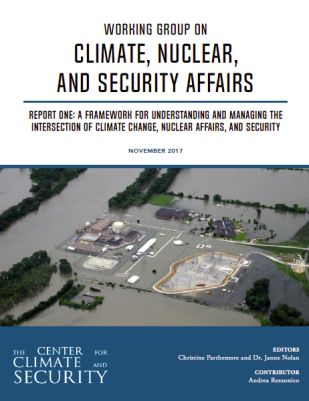
Working Group on Climate, Nuclear, and Security Affairs: Report One
How technology has taken the Cold War online
Fifty years ago, when the Cold War was in full swing, the easiest way for Moscow to sow the seeds of discord and disharmony in the West was to recruit and fund Communist sympathisers who sought to destroy the political status quo. Now a new form of information warfare being waged against the West by hostile states can achieve the same aims through the clever application of modern technology. And what is really terrifying about this new propaganda war is how credible it can appear. One of the more egregious examples of Moscow’s modern-day black arts was the photograph that went viral on the internet that appeared to show a Muslim woman nonchalantly walking past the bodies of victims of the westminster Bridge terror attack in March as they lay prone in the street. It was an image that was guaranteed to stoke the fires of Islamophobia in the highly charged atmosphere immediately after the attack, and could easily have resulted in greater antipathy towards Muslims in Britain.Pandora’s Box of the Digital Age
a series of hacks and ransomware attacks by hostile governments and other malign actors have raised alarms about a major threat to global stability. Unfortunately, many governments are responding by developing still more cyber weapons, on the mistaken assumption that offense is the best defense. One country after another has begun exploring options for bolstering their offensive capabilities in cyberspace, and many other countries have already done so. This is a dangerous escalation. In fact, few other trends pose a bigger threat to global stability.Dunford: U.S. Military Advantage Over Russia, China Eroding
An Expert on Warfare Examines Centuries of Evolving Mayhem
When it mattered most, the next war was too awful to imagine. In 1933, the year Adolf Hitler took power in Germany, an influential French author warned what might happen: “A hundred planes each carrying a ton of asphyxiating shells would cover Paris with a gas sheet 20 meters high, all in an hour.” To a French public preoccupied with aerial bombardment and chemical warfare, much of the appeal of appeasing Nazi Germany was that the alternative was unthinkable. To justify selling out Czechoslovakia to Hitler in 1938, Neville Chamberlain played on similar fears among the British, emphasizing how “horrible, fantastic, incredible” it was that a foreign quarrel led to “trying on gas masks here.”