Pakistan’s economic woes – dwindling foreign exchange reserves, low exports, high inflation, growing fiscal deficit, and current account deficit – are nothing new, and once again, the country finds itself knocking on the doors of the International Monetary Fund (IMF) for what will be its 22nd loan. While the exact amount of this package has not been determined, Pakistan already owes the IMF billions from previous programs. Indeed, 30.7% of Pakistan’s government expenditure is earmarked for debt servicing, which cannot be supported by its decreasing revenues. Already on the Financial Action Task Force’s (FATF) grey list, and with the current Pakistan Tehreek-e-Insaaf (PTI) government enjoying internal institutional consensus on the national agenda, Pakistan must focus its attention on resolving its economic woes before it finds itself on the shores of bankruptcy.The Profession of Arms: A Guide for Young Army Officers
It takes courage, especially for a young officer, to check a man met on the road for not saluting properly or for slovenly appearance, but, every time he does, it adds to his stock of moral courage, and whatever the soldier may say, he has respect for the officer who does pull him up.
Read Document →The Dragon's Teeth: Assessing China's Military Modernization
PLA has focused on modernising its capabilities across all warfare domains to achieve these goals. This includes land, air, and maritime operations, nuclear, space, counter-space, electronic warfare and cyberspace operations, aiming to become a fully integrated joint force.
Read Document →Transforming the PLA: A Decade of reorganisation from SSF to ISF
PRC has engaged in a sustained and broad effort to transform the PLA from an infantry-heavy, low-technology, ground forces-centric military into a high-technology, networked force with an increasing emphasis on joint operations and naval and air power projection.
Read Document →Eyes without Borders: Exploring the World of Open Source Intelligence (OSINT) in the Digital Age
Open Source Intelligence (OSINT) is gaining prominence with the rise of social media, the digital society and the vast growth of publicly and commercially available information (PAI and CAI).
Read Document →
The PLA’s Developing Cyber Warfare Capabilities and India's Options
Informationised warfare blurs the lines between peacetime and wartime. A nation in the information age cannot wait for the hostilities to break out to collect intelligence, carryout influence operations, develop antisatellite systems or design computer software weapons.
Read Document →
Galwan and After
Why did China did this when he is under tremendous pressure in all fronts, is this China's salami slice tactics being progressed rigorously, what will be new Rules of Engagement, what will be escalatory control mechanism, who has taken this decision, will there be some pressure put by China in India's North-East through insurgency.
Read Document →
India’s Joint Doctrine for Cyberspace Operations: A Critical Review
Chief of Defence Staff (CDS) General Anil Chauhan and Secretary, Department of Military Affairs, formally released declassified versions of the Joint Doctrines for Cyberspace Operations during the Chiefs of Staff Committee meeting in New Delhi.
Read Document →
Know your Enemy General(now Field Marshal) Syed Aseem Munir
Gen SA Munir's position in the hierarchy of Pakistan was not very comfortable. The state of economy, insurgency in Pakhtoonistan and Balochistan, attack on the Jaffar Express, constant protests by supporters of Imran Khan's supporters inside and outside of parliament.
Read Document →
Decoding Operation SINDOOR: Key Aspects and Implications
Precision strikes were carried out on nine sites—four in Pakistan and five in PoK—linked to anti-India terrorist groups such as the LeT, JeM and the Hizbul Mujahideen. The targeted sites included Muridke (LeT headquarters) and Bahawalpur (JeM headquarters).
Read Document →
Chinese Cyber Exploitation in India's Power Grid - Is There a linkage to Mumbai Power Outage?
The New York Times (NYT), based on analysis by a U.S. based private intelligence firm Recorded Future, reported that a Chinese entity penetrated India’s power grid at multiple load dispatch points. Chinese malware intruded into the control systems that manage electric supply across India, along with a high-voltage transmission substation and a coal-fired power plant
Read Document →21 April 2019
PAKISTAN’S ECONOMIC WOES: THE WAY FORWARD
Pakistan’s economic woes – dwindling foreign exchange reserves, low exports, high inflation, growing fiscal deficit, and current account deficit – are nothing new, and once again, the country finds itself knocking on the doors of the International Monetary Fund (IMF) for what will be its 22nd loan. While the exact amount of this package has not been determined, Pakistan already owes the IMF billions from previous programs. Indeed, 30.7% of Pakistan’s government expenditure is earmarked for debt servicing, which cannot be supported by its decreasing revenues. Already on the Financial Action Task Force’s (FATF) grey list, and with the current Pakistan Tehreek-e-Insaaf (PTI) government enjoying internal institutional consensus on the national agenda, Pakistan must focus its attention on resolving its economic woes before it finds itself on the shores of bankruptcy.Pentagon crafts options to counter Russian and Chinese influence in Venezuela
Army Secretary Reveals Weapons Wishlist for War with China & Russia
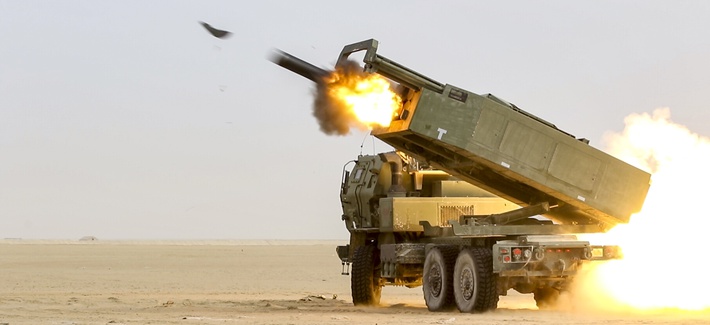
Army Secretary Mark Esper says he wants to shift money away from light vehicles and cargo helicopters made for “different conflicts” of the past.Army Secretary Reveals Weapons Wishlist for War with China & Russia
Army Secretary Mark Esper says he wants to shift money away from light vehicles and cargo helicopters made for “different conflicts” of the past.‘Belt and Road’ Will Help the World. China? Not So Much.
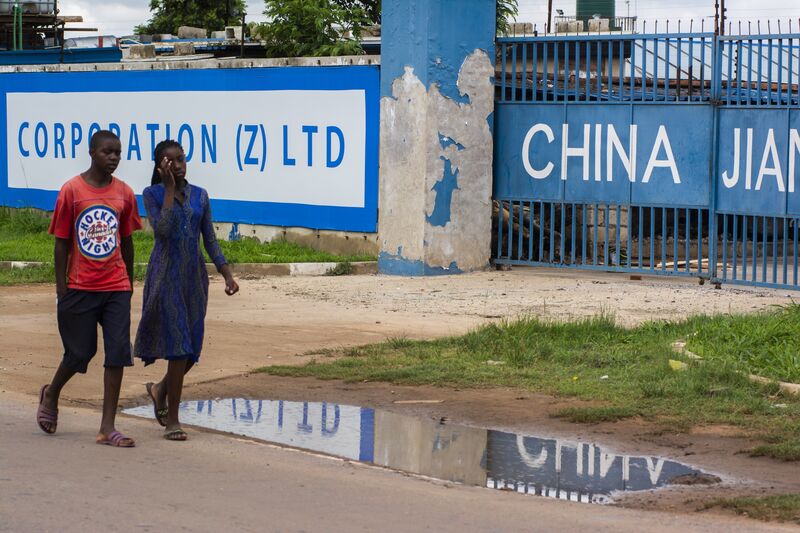
The global economic development initiative that China calls “One Belt, One Road” is considered one of Beijing’s major instruments in its geopolitical conflict with the U.S. But it’s unlikely to do much to boost Chinese power as it helps most of the world.The World China Wants
European Union leaders sat down this week in Brussels for a summit with a China it recently branded a “systemic rival,” and the United States is nearing the end game of trade talks with a China that national security documents refer to as a “strategic adversary.”The Dangerous Dregs of ISIS
Hard Truths in Syria: America Can’t Do More With Less, and It Shouldn’t Try
Doing the Haka
How global value chains open opportunities for developing countries
Advanced gene editing may mutate into WMDs
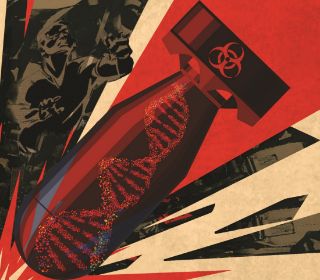
Last June, German police arrested a man planning a terror attack by releasing large quantities of the biological toxin ricin, said to be 6,000 times more poisonous than cyanide. The raids on a block of flats in Cologne blew the lid off our worst fears: non-state actors laying their hands on bioweapons.Op-Ed: A force for the final frontier
Alan Greenspan: Can the U.S. Economy Stay on Top?
The markets are jittery about a possible recession. The U.S. Federal Reserve’s decision earlier this year to ease off further interest rate increases in 2019 as it keeps a watchful eye on economic signals — after doing four hikes in the previous year — has only buttressed those fears.The United States Will Be Shocked by Its Future
The Russian State’s Use of Irregular Forces and Private Military Groups: From Ivan the Terrible to the Soviet Period
To Avoid an Iraq-Style Disaster Under Trump, Bolton Must Go
Lowering The ‘Barr’: The Attorney General’s Disappointing And Disrespectful Dissing Of US Intelligence Community – Analysis
(FPRI) — Last week, while testifying before a Senate Appropriations subcommittee, William Barr, the Attorney General of the United States, the nation’s chief law enforcement officer, and the executive official who sits at the apex of the national security pyramid in terms of approving applications for foreign intelligence electronic surveillance in the United States, said he would scrutinize the FBI’s investigation of the Trump campaign’s ties to Russia, including whether “‘spying’ conducted by American intelligence agencies on the campaign’s associates had been properly carried out.”Diego Garcia: The ‘Unsinkable Carrier’ Springs A Leak – OpEd
The recent decision by the Hague-based International Court of Justice that the Chagos Islands — with its huge U.S. military base at Diego Garcia — are being illegally occupied by the United Kingdom (UK) has the potential to upend the strategic plans of a dozen regional capitals, ranging from Beijing to Riyadh.The Russian State’s Use of Irregular Forces and Private Military Groups: From Ivan the Terrible to the Soviet Period
What the Army learned from a February cyber exercise
The Department of Defense’s cyber warriors have started using the first cyber training platform developed by the military specifically for their needs.The Good Life After Work
Our Zero-Emission Future
Data Protection is Social Protection
What the Air Force learned from insurgents’ networks
Gen. Mike Holmes, commander of Air Combat Command, meets Airmen in March. Holmes wants an Air Force network that would mimic the way commercial cell phones automatically connect to the proper cell phone network or Wi-Fi. (U.S. Air Force photo by Airman First Class Andrew Kobialka)