There has been a surreal yet surprising silence on the part of Indian strategic circle, political parties, press, academia and intelligentsia, in that order, about the working, motives, capacity and efficacy of Pakistan Army’s propaganda arm — Inter-Services Public Relations (ISPR). Sporadic op-ed articles produced by some of the seasoned serving and retired officials on this subject recently defied depth and constructed on borrowed surface-level ideas.The Profession of Arms: A Guide for Young Army Officers
It takes courage, especially for a young officer, to check a man met on the road for not saluting properly or for slovenly appearance, but, every time he does, it adds to his stock of moral courage, and whatever the soldier may say, he has respect for the officer who does pull him up.
Read Document →The Dragon's Teeth: Assessing China's Military Modernization
PLA has focused on modernising its capabilities across all warfare domains to achieve these goals. This includes land, air, and maritime operations, nuclear, space, counter-space, electronic warfare and cyberspace operations, aiming to become a fully integrated joint force.
Read Document →Transforming the PLA: A Decade of reorganisation from SSF to ISF
PRC has engaged in a sustained and broad effort to transform the PLA from an infantry-heavy, low-technology, ground forces-centric military into a high-technology, networked force with an increasing emphasis on joint operations and naval and air power projection.
Read Document →Eyes without Borders: Exploring the World of Open Source Intelligence (OSINT) in the Digital Age
Open Source Intelligence (OSINT) is gaining prominence with the rise of social media, the digital society and the vast growth of publicly and commercially available information (PAI and CAI).
Read Document →
The PLA’s Developing Cyber Warfare Capabilities and India's Options
Informationised warfare blurs the lines between peacetime and wartime. A nation in the information age cannot wait for the hostilities to break out to collect intelligence, carryout influence operations, develop antisatellite systems or design computer software weapons.
Read Document →
Galwan and After
Why did China did this when he is under tremendous pressure in all fronts, is this China's salami slice tactics being progressed rigorously, what will be new Rules of Engagement, what will be escalatory control mechanism, who has taken this decision, will there be some pressure put by China in India's North-East through insurgency.
Read Document →
India’s Joint Doctrine for Cyberspace Operations: A Critical Review
Chief of Defence Staff (CDS) General Anil Chauhan and Secretary, Department of Military Affairs, formally released declassified versions of the Joint Doctrines for Cyberspace Operations during the Chiefs of Staff Committee meeting in New Delhi.
Read Document →
Know your Enemy General(now Field Marshal) Syed Aseem Munir
Gen SA Munir's position in the hierarchy of Pakistan was not very comfortable. The state of economy, insurgency in Pakhtoonistan and Balochistan, attack on the Jaffar Express, constant protests by supporters of Imran Khan's supporters inside and outside of parliament.
Read Document →
Decoding Operation SINDOOR: Key Aspects and Implications
Precision strikes were carried out on nine sites—four in Pakistan and five in PoK—linked to anti-India terrorist groups such as the LeT, JeM and the Hizbul Mujahideen. The targeted sites included Muridke (LeT headquarters) and Bahawalpur (JeM headquarters).
Read Document →
Chinese Cyber Exploitation in India's Power Grid - Is There a linkage to Mumbai Power Outage?
The New York Times (NYT), based on analysis by a U.S. based private intelligence firm Recorded Future, reported that a Chinese entity penetrated India’s power grid at multiple load dispatch points. Chinese malware intruded into the control systems that manage electric supply across India, along with a high-voltage transmission substation and a coal-fired power plant
Read Document →31 August 2020
Information Warfare: Why India needs to give Pak propaganda machinery a taste of its own medicine
There has been a surreal yet surprising silence on the part of Indian strategic circle, political parties, press, academia and intelligentsia, in that order, about the working, motives, capacity and efficacy of Pakistan Army’s propaganda arm — Inter-Services Public Relations (ISPR). Sporadic op-ed articles produced by some of the seasoned serving and retired officials on this subject recently defied depth and constructed on borrowed surface-level ideas.Conscripted Chinese soldiers no match to battle-ready Indian military
Almost one third of the People’s Liberation Army (PLA) is made up of conscripted soldiers who are forced to serve in the military for two years and then retired. PLA’s conscripted soldiers hardly undergo the rigorous military training.India’s turning point: An economic agenda to spur growth and jobs
Source Link
The Pakistan-Saudi Arabia relationship hits a bump in the road
China Holds Trio of Military Drills, Including in South China Sea
China’s military is holding three separate naval exercises and live-fire drills simultaneously this week, with one of them covering parts of the South China Sea disputed between China, Taiwan, and Vietnam. DoD War Games Predict ‘Extremely Destabilizing’ Chinese Military Parity
WASHINGTON: Worried about America’s eroding dominance at sea, the Pentagon has been running through a series of war games to shake out a plan to stay ahead of the rapid-fire Chinese military modernization effort. What Is the U.S. Ban on TikTok and WeChat All About?
Chinese military fires ‘aircraft-carrier killer’ missile into South China Sea in ‘warning to the United States’
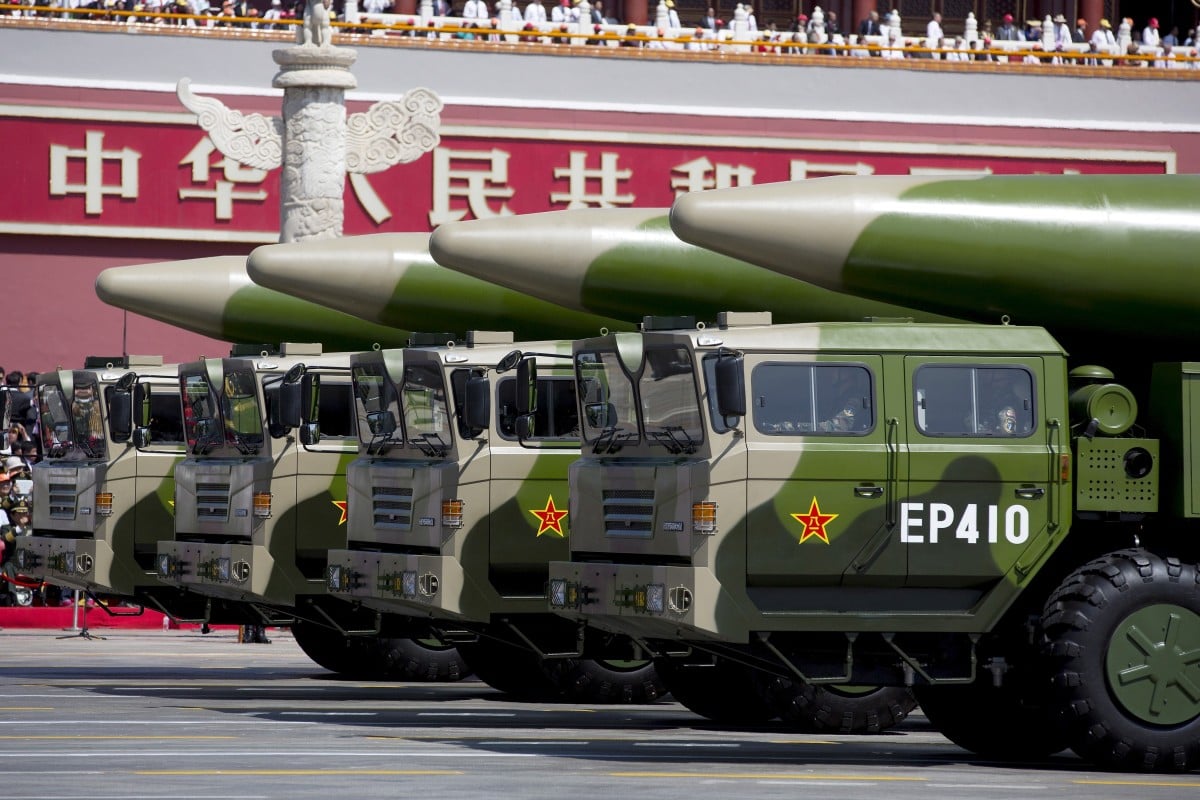
A DF-26 missile was from Qinghai into the South China Sea on Tuesday, according to a source close to the Chinese military. Playing a long game on Hong Kong
When Beijing Is Angry: China’s Punitive Reprisals when Its Interests are Harmed
In recent years, as China has grown stronger, the regime in Beijing has pursued a policy of punitive reprisals against countries that harm Chinese interests, sometimes due to activity related to the close ties of those countries with the United States. The punitive measures are aimed at the "soft underbelly" of trade in order to strike at a central manufacturing sector and delineate China’s red lines. This policy was put into practice against Norway, South Korea, Canada, Australia, and others. Will China take similar action against Israel? Despite its close commercial ties, Israel has not become dependent on China. Israel should continue to diversify its international cooperative efforts in order to avoid a situation in which a foreign country, such as China, can employ coercive diplomacy against leading economic sectors in Israel.More pain than gain: How the US-China trade war hurt America
Avoiding a new Cold War between the US and China
China’s expansionism enters dangerous phase
NEW DELHI – China’s expansionism drive, from the East and South China seas to the Himalayas and Central Asia, is making Asia more volatile and unstable. Along with the spread of the Wuhan-originating new coronavirus, this has also given rise to growing anti-China sentiment.Chinese missile launch ‘could raise risk of military clash with US’
China’s missile launch over the South China Sea may push the United States to deploy more missiles and take a more aggressive stance towards Beijing, elevating the risk of an accidental armed conflict, analysts said.The Revolutionary Guards Are Poised to Take Over Iran
Which Past Is Prologue?
U.S. President Donald Trump largely ignores the past or tends to get it wrong. “What’s this all about?” he is reported to have asked on a visit to the Pearl Harbor National Memorial, in Hawaii, in 2017. When he has paid attention to history, it has been to call on it as a friendly judge, ready to give him top marks and vindicate him: his administration, he has claimed repeatedly, has been the best in U.S. history. The evidence—something that historians, at least, take seriously—suggests a different picture.Turmoil in Belarus: Looking Beyond the Horizon
The world to come: Revenge of the nation state
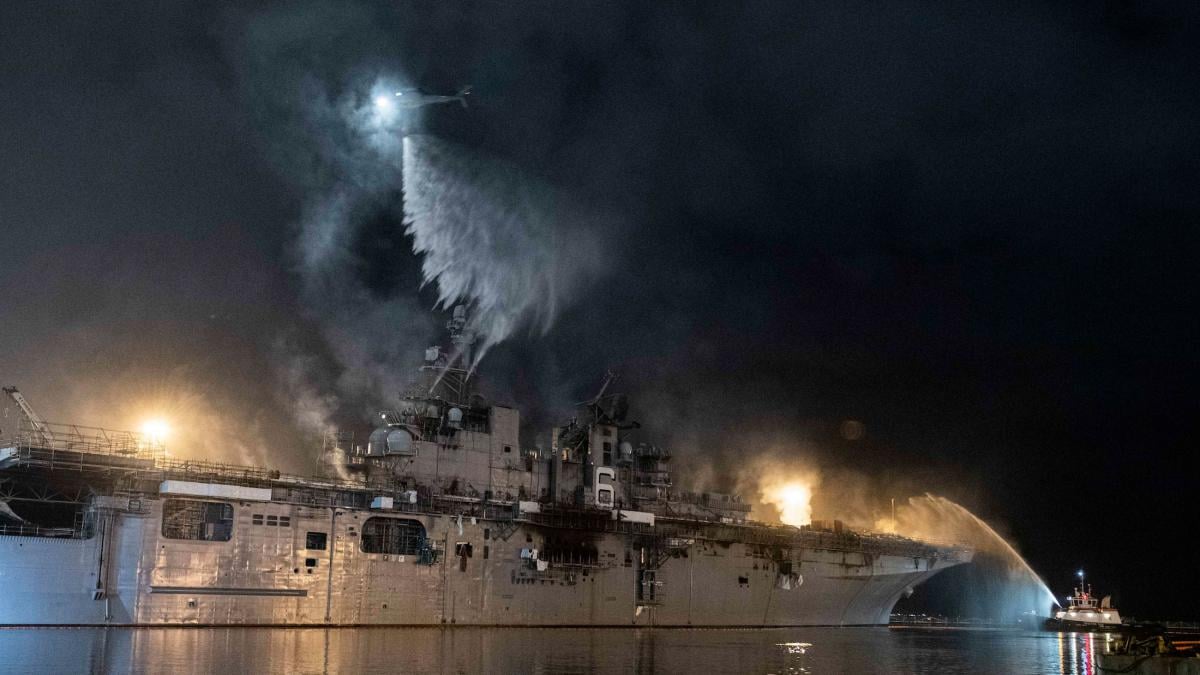
Repairing the Bonhomme Richard Is Worth Almost Any Cost
The July fire on board the USS Bonhomme Richard (LHD-6) offers the Navy and the nation’s shipyards a valuable opportunity they have not had the since the end of World War II—the chance to repair a capital ship that has suffered catastrophic damage. As USNI News notes: “Between December 1941 and September 1945, over 350 U.S. Navy warships and patrol craft were sunk or damaged beyond repair. In the nearly seven decades since, fewer than 30 ships have been lost directly due to enemy action or accidents.” Sources: Sailor under investigation for arson in USS Bonhomme Richard ship fire
SAN DIEGO (KGTV) -- A Navy sailor is under investigation in connection with the fire that caused extensive damage to the USS Bonhomme Richard at Naval Base San Diego, sources told ABC 10News.NORTHEAST SYRIA PATROL ROUTES MAP: RUSSIAN AND US FORCES COLLIDE
What Navalny’s Poisoning Says About Russia’s Putin
Do intelligence agencies need restructuring for the digital disinformation age?
The current architecture of the intelligence world is full of historical accidents dating back to the Second World War, says Andrew Davies, a senior fellow at the Australian Strategic Policy Institute (ASPI) in Canberra.MARINES AND MERCENARIES: BEWARE THE IRREGULAR THREAT IN THE LITTORAL
The Perils of Mission Command – A Historical Perspective
Mission command is firmly built into UK and Allied military doctrine. It has become an article of faith that it produces better results as it “…encourages initiative and decentralized decision-making” and thus “promotes…speed of action…”. UK doctrine argues that the British approach goes further than the Allied one, with use of the concept encouraged down to the lowest levels of command. So, despite considerable advances in communications and information technology, there is broad consensus that, in a fast-moving battlefield, delegation of decision making, coupled with sound understanding of the broader tactical or operational context and plan, will outpace a more directive system.30 August 2020
Can 'The Quad' Work Together to Contain Chinese Aggression?
A once in a decade series of events in the Asia-Pacific region have conspired to bring about closer ties between America’s most important allies in the Asia-Pacific. Regardless of who wins the election in November, the U.S. has an opportunity to expand this emerging alliance to include other areas of potential cooperation beyond nominal defense ties.Indo-Pacific Pivot in India’s Geostrategy
Gilded aspirations
Taiwan and the United States — much thunder, little rain
Since April, the administration of US President Donald Trump has been ratcheting up its rhetoric and actions regarding China. This strategy is intended to deflect blame for its mismanagement of the COVID-19 pandemic at home. It is having the side effect of appearing to dismantle the policy of ‘engagement’ with China of the previous seven US administrations and the way they treated Taiwan.The Current Situation in Pakistan
To Counter China Online, Regulate Big Tech
The heads of Amazon, Google, Apple and Facebook fended off tough questions from lawmakers last month at a hearing of the House Judiciary Committee’s antitrust subcommittee. To help allay concerns about monopolistic business practices, each CEO sought to portray his company as representing American values and serving American interests. They all did so in part by pointing to a threat supposedly bigger than their own companies: China.China Locks Down Xinjiang to Fight Covid-19, Angering Residents
First came the notices that Chinese officials had declared a “wartime” state. Then the authorities started going door to door, sealing off apartments and warning residents to stay inside.