The Profession of Arms: A Guide for Young Army Officers
It takes courage, especially for a young officer, to check a man met on the road for not saluting properly or for slovenly appearance, but, every time he does, it adds to his stock of moral courage, and whatever the soldier may say, he has respect for the officer who does pull him up.
Read Document →The Dragon's Teeth: Assessing China's Military Modernization
PLA has focused on modernising its capabilities across all warfare domains to achieve these goals. This includes land, air, and maritime operations, nuclear, space, counter-space, electronic warfare and cyberspace operations, aiming to become a fully integrated joint force.
Read Document →Transforming the PLA: A Decade of reorganisation from SSF to ISF
PRC has engaged in a sustained and broad effort to transform the PLA from an infantry-heavy, low-technology, ground forces-centric military into a high-technology, networked force with an increasing emphasis on joint operations and naval and air power projection.
Read Document →Eyes without Borders: Exploring the World of Open Source Intelligence (OSINT) in the Digital Age
Open Source Intelligence (OSINT) is gaining prominence with the rise of social media, the digital society and the vast growth of publicly and commercially available information (PAI and CAI).
Read Document →
The PLA’s Developing Cyber Warfare Capabilities and India's Options
Informationised warfare blurs the lines between peacetime and wartime. A nation in the information age cannot wait for the hostilities to break out to collect intelligence, carryout influence operations, develop antisatellite systems or design computer software weapons.
Read Document →
Galwan and After
Why did China did this when he is under tremendous pressure in all fronts, is this China's salami slice tactics being progressed rigorously, what will be new Rules of Engagement, what will be escalatory control mechanism, who has taken this decision, will there be some pressure put by China in India's North-East through insurgency.
Read Document →
India’s Joint Doctrine for Cyberspace Operations: A Critical Review
Chief of Defence Staff (CDS) General Anil Chauhan and Secretary, Department of Military Affairs, formally released declassified versions of the Joint Doctrines for Cyberspace Operations during the Chiefs of Staff Committee meeting in New Delhi.
Read Document →
Know your Enemy General(now Field Marshal) Syed Aseem Munir
Gen SA Munir's position in the hierarchy of Pakistan was not very comfortable. The state of economy, insurgency in Pakhtoonistan and Balochistan, attack on the Jaffar Express, constant protests by supporters of Imran Khan's supporters inside and outside of parliament.
Read Document →
Decoding Operation SINDOOR: Key Aspects and Implications
Precision strikes were carried out on nine sites—four in Pakistan and five in PoK—linked to anti-India terrorist groups such as the LeT, JeM and the Hizbul Mujahideen. The targeted sites included Muridke (LeT headquarters) and Bahawalpur (JeM headquarters).
Read Document →
Chinese Cyber Exploitation in India's Power Grid - Is There a linkage to Mumbai Power Outage?
The New York Times (NYT), based on analysis by a U.S. based private intelligence firm Recorded Future, reported that a Chinese entity penetrated India’s power grid at multiple load dispatch points. Chinese malware intruded into the control systems that manage electric supply across India, along with a high-voltage transmission substation and a coal-fired power plant
Read Document →10 September 2018
Digital hatred, real violence: Majoritarian radicalisation and social media in India
India’s Enduring Tragedy: Where Political Parties Happily Destabilise a Relatively Calm Situation
Is the Taliban Prepared to Make Peace?
Here’s the blueprint for Erik Prince’s $5 billion plan to privatize the Afghanistan war
Pompeo Upbeat on 'Reset' With Pakistan After Meeting New PM Khan
Pakistani nuclear forces, 2018
US-Pakistan Dialogue of the Deaf
Why Russia and China Are Expanding Their Roles in Afghanistan
The shared threat of an Islamic State affiliate in Afghanistan will drive Pakistan and Russia into a closer partnership as Moscow strengthens its leverage over the Afghan negotiations. Pakistan's national security imperatives mean it will always choose to promote a sympathetic government in Kabul, even if this choice means relations with the United States deteriorate.SOUTH ASIA INTELLIGENCE REVIEW [SAIR]
Chinese fume over Xi’s $60-billion Africa handout
The Chinese Cyber Sovereignty Concept (Part 1)
Africa: Eyes On Uhuru At China-Africa Summit Just Days After U.S. Tour
China’s Latest Vaccine Scandal: An Analysis of Key Factors and Assessment of China’s Way Forward
R.I.P. Chinese Exceptionalism?
China is Losing the New Cold War
How We Got the Iran Deal
Amit Chaudhuri: ‘All non-western literature is wilfully underrated’
Final Thoughts on Secular Stagnation
Is the U.S. Headed for Another Mortgage Crisis?
5 ways the Army will keep pace in cyber and electronic warfare
The Army is making several changes to be in a better position to compete with adversaries in cyber, the electromagnetic spectrum and space. Russia and China have begun to organize all information-related capability — to include cyber, electronic warfare, information operations and space — under singular entities. Now, Army leaders, say the service must do the same. “Integrated formations will be innovative because they’ll help us create novel approaches to problem solving by leveraging multiple skillsets,” David May, senior intelligence adviser at the Army Cyber Center of Excellence, said during a presentation at TechNet Augusta in August.DHS Secretary Urges Hit-Back-Harder Response to Cyber Strikes
The U.S. response to enemy cyber strikes should be “more than commensurate,” Homeland Security Secretary Kirstjen Nielsen said during an on-stage discussion Wednesday. A Chicago way response model could fall afoul of international rules and norms in some circumstances, however, and risks escalating cyber conflicts rather than deterring them, a top international law scholar told Nextgov. Nielsen’s statement came after a fiery speech at George Washington University during which she warned U.S. cyber adversaries that the nation’s “days of cyber surrender are over” and declared that the Trump administration is “replacing complacency with consequences [and] replacing nations’ deniability with accountability” in cyberspace.Today's Headlines and Commentary
Don’t @ me, bro: the need for social media on the battlefield
Believe it and retweet it. The engineers say commanders could benefit from having a finer understanding of the social media landscape in a conflict zone. “Social media is a new channel that offers massive amounts of information,” said Reginald Hobbs, branch chief of the multilingual computing and analytics groups at the U.S. Army Research Laboratory. “In the past people would be consumers of information. Social media makes people producers of information, and the Army can leverage that.” In their search to turn social information into a tactical tool, Army scientists recently wrote a paper on “social sensing” accepted for publication by the IEEE Computer Society. Still in its infancy, the science here faces some challenges: The volume of information is vast, and it’s largely unstructured. But researchers say they are making headway.It’s Now Possible To Telepathically Communicate with a Drone Swarm
A person with a brain chip can now pilot a swarm of drones — or even advanced fighter jets, thanks to research funded by the U.S. military’s Defense Advanced Research Projects Agency, or DARPA. The work builds on research from 2015, which allowed a paralyzed woman to steer a virtual F-35 Joint Strike Fighter with only a small, surgically-implantable microchip. On Thursday, agency officials announced that they had scaled up the technology to allow a user to steer multiple jets at once. “As of today, signals from the brain can be used to command and control … not just one aircraft but three simultaneous types of aircraft,” said Justin Sanchez, who directs DARPA’s biological technology office, at the Agency’s 60th-anniversary event in Maryland.Google leaves an empty chair at Senate hearing on internet companies
DHS chief: US response to foreign cyberattacks should be 'more than commensurate'
Five Ways Government Can Help Businesses Fight Nation-State Attacks
David Sanger on the perfect weapon
Even though major newspapers cover the thrust and parry of cyberwar, it can be difficult to grasp the bigger picture. After all, cyberweapons are new, shrouded in secrecy, and invisible to the untrained eye, making them harder to comprehend than bullets or bombs. But with governments fighting ongoing cyberwars, inflicting damage that has cost billions of dollars and undermined democracy, it is time for a much larger public conversation on the subject, as David Sanger insists in his new book The Perfect Weapon: War, Sabotage and Fear in the Cyber Age.e Promise and Pitfalls of AI
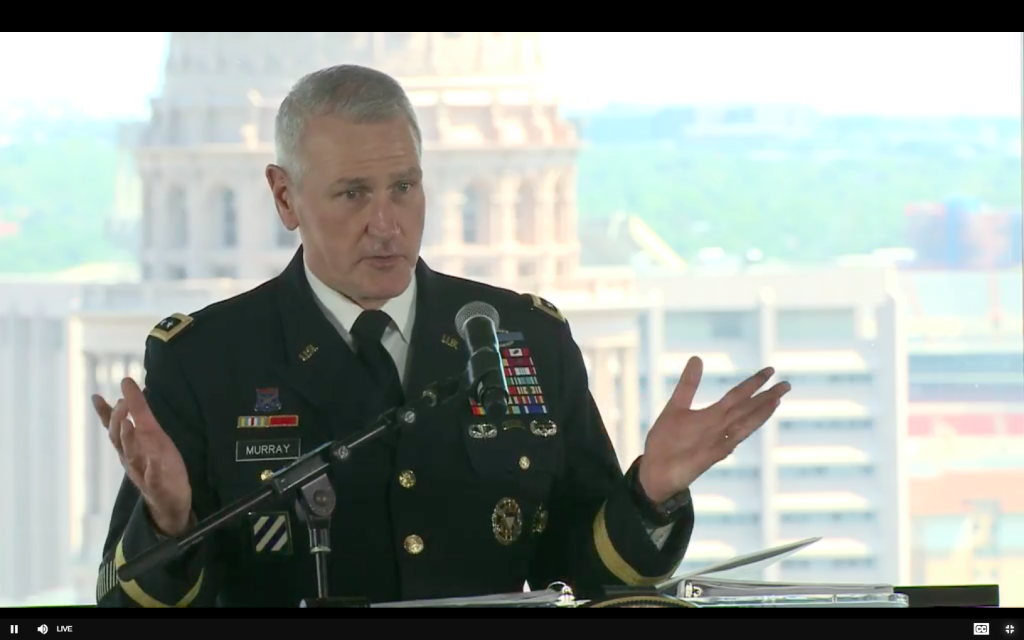
‘A Little Bit Disruptive’: Murray & McCarthy On Army Futures Command
DEFENSE NEWS CONFERENCE: The Army’s new Futures Command won’t tear down the most failure–prone procurement system in the entire US military. Instead, both its commander and the Army’s No. 2 civilian emphasize they want to be just “a little bit disruptive” and “work with the institution.” That will disappoint critics of the service’s chronically troubled acquisition programs who saw the Army’s much-touted “biggest reorganization in 40 years” as an opportunity to tear the whole thing down and start again. The necessary change to Army culture “is going to take time,” brand-new four-star Gen. John “Mike” Murray said here yesterday, “and I think you do that by being a little bit disruptive, but not being so disruptive you upset the apple cart.”