Dai Binguo is a respected Chinese politician and diplomat. Many in India will be familiar with him as the long time interlocutor with a line of Indian NSA’s in the Sino-Indian border discussions. He has served as a State Councilor and also as the director of the General Offices of Foreign Affairs and the National Security Group of the CPC Central Committee. A senior Chinese official once described him to me as China’s Kissinger. He retired in 2013 but his voice is still heard in the higher echelons of the Chinese Communist Party and his voice is also often their voice. Hence it’s as important to have him hear you, as it is to hear him.The Profession of Arms: A Guide for Young Army Officers
It takes courage, especially for a young officer, to check a man met on the road for not saluting properly or for slovenly appearance, but, every time he does, it adds to his stock of moral courage, and whatever the soldier may say, he has respect for the officer who does pull him up.
Read Document →The Dragon's Teeth: Assessing China's Military Modernization
PLA has focused on modernising its capabilities across all warfare domains to achieve these goals. This includes land, air, and maritime operations, nuclear, space, counter-space, electronic warfare and cyberspace operations, aiming to become a fully integrated joint force.
Read Document →Transforming the PLA: A Decade of reorganisation from SSF to ISF
PRC has engaged in a sustained and broad effort to transform the PLA from an infantry-heavy, low-technology, ground forces-centric military into a high-technology, networked force with an increasing emphasis on joint operations and naval and air power projection.
Read Document →Eyes without Borders: Exploring the World of Open Source Intelligence (OSINT) in the Digital Age
Open Source Intelligence (OSINT) is gaining prominence with the rise of social media, the digital society and the vast growth of publicly and commercially available information (PAI and CAI).
Read Document →
The PLA’s Developing Cyber Warfare Capabilities and India's Options
Informationised warfare blurs the lines between peacetime and wartime. A nation in the information age cannot wait for the hostilities to break out to collect intelligence, carryout influence operations, develop antisatellite systems or design computer software weapons.
Read Document →
Galwan and After
Why did China did this when he is under tremendous pressure in all fronts, is this China's salami slice tactics being progressed rigorously, what will be new Rules of Engagement, what will be escalatory control mechanism, who has taken this decision, will there be some pressure put by China in India's North-East through insurgency.
Read Document →
India’s Joint Doctrine for Cyberspace Operations: A Critical Review
Chief of Defence Staff (CDS) General Anil Chauhan and Secretary, Department of Military Affairs, formally released declassified versions of the Joint Doctrines for Cyberspace Operations during the Chiefs of Staff Committee meeting in New Delhi.
Read Document →
Know your Enemy General(now Field Marshal) Syed Aseem Munir
Gen SA Munir's position in the hierarchy of Pakistan was not very comfortable. The state of economy, insurgency in Pakhtoonistan and Balochistan, attack on the Jaffar Express, constant protests by supporters of Imran Khan's supporters inside and outside of parliament.
Read Document →
Decoding Operation SINDOOR: Key Aspects and Implications
Precision strikes were carried out on nine sites—four in Pakistan and five in PoK—linked to anti-India terrorist groups such as the LeT, JeM and the Hizbul Mujahideen. The targeted sites included Muridke (LeT headquarters) and Bahawalpur (JeM headquarters).
Read Document →
Chinese Cyber Exploitation in India's Power Grid - Is There a linkage to Mumbai Power Outage?
The New York Times (NYT), based on analysis by a U.S. based private intelligence firm Recorded Future, reported that a Chinese entity penetrated India’s power grid at multiple load dispatch points. Chinese malware intruded into the control systems that manage electric supply across India, along with a high-voltage transmission substation and a coal-fired power plant
Read Document →10 March 2017
*** Sino-Indian border: New Deal is No Deal.
Dai Binguo is a respected Chinese politician and diplomat. Many in India will be familiar with him as the long time interlocutor with a line of Indian NSA’s in the Sino-Indian border discussions. He has served as a State Councilor and also as the director of the General Offices of Foreign Affairs and the National Security Group of the CPC Central Committee. A senior Chinese official once described him to me as China’s Kissinger. He retired in 2013 but his voice is still heard in the higher echelons of the Chinese Communist Party and his voice is also often their voice. Hence it’s as important to have him hear you, as it is to hear him.*** How Terrorism Could Derail China's 'One Belt, One Road'
** Trump's Disruptive Approach to Trade
A shift in U.S. trade policy that follows the outline presented today to Congress would upend the foundations of global trade as it is currently conducted. The biggest change in the approach that the administration of President Donald Trump may take is its assertion that U.S. sovereignty in trade disputes could empower it to supersede rulings made by the World Trade Organization (WTO). ** Nationalism and Liberal Democracy
War, state and martyrdom
India boosts its non-proliferation anti-terrorism credentials
Israel Is India’s BFF: Modi’s Visit Will Bring This Critical Relationship Out Of Purdah
For its own reasons, Israel has been one of our most reliable friends. Isn’t it time we also demonstrated our friendship based on hard-nosed realities?Antecedents Of Non-Alignment: The Hope That Was USSR, The Question That Was Israel
At a time when India’s foreign relations and geopolitical strategy are undergoing a realignment, the republished edition of Bimal Prasad’s book from 1960 is a very useful readAfghan drugs via Pakistan corroding Punjab society
China warns against cyber 'battlefield' in internet strategy
China releases first strategy on cyberspace cooperation
Crimicon Valley: Russia’s Cybercrime Underground
The Alternative Report on Operation Protective Edge
Doubts about Gen. McMaster
Getting to the root causes of antimicrobial resistance
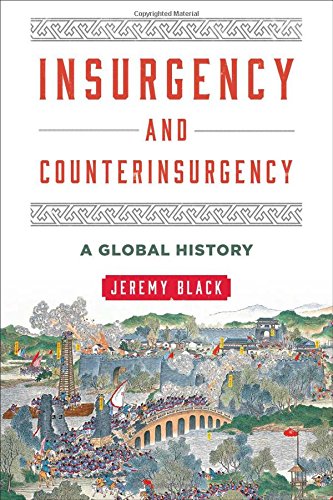
Black: Insurgency and Counterinsurgency
There have been a great many books published on the subjects of insurgency and counterinsurgency since the inception of the Global War on Terror (or “current, ongoing overseas contingency operations”, if you prefer); a number of these have focused on the U.S. Army’s mistakes in Vietnam or on the efforts on the United States and its allies in Iraq and Afghanistan. Jeremy Black’s recent contribution, Insurgency and Counterinsurgency: A Global History, offers more insight; it is a comprehensive history of insurgency and counterinsurgency warfare that is not limited in scope to the efforts of Western powers.Report Finds Botched Israeli Leadership and Intelligence Failings During 2014 Gaza Strip War
Ex-NATO commander: US falling behind on military modernization
Trump Inherits a Secret Cyberwar Against North Korean Missiles
An image distributed by the North Korean government showing the country’s leader, Kim Jong-un, visiting a missile test center in North Pyongan Province. Analysts say the pair of engines he is standing in front of could power an intercontinental ballistic missile.CreditKorean Central News Agency, via ReutersA Vietnam War Hero Discusses How The Nature Of Combat Has Changed Over The Years
Finance and artificial intelligence are going 'fintech' and open source
Big Data: the devil’s in the detail
As the government’s review of the Australian Intelligence Community (AIC) picks up steam, one of the key challenges is to identify and resolve growing gaps in the AIC’s technological capabilities. One such capability is the collection and use of Big Data.Understanding the cyber threat: defence, response, democracy
As Russia’s campaign to influence the US election falls out of the news cycle, it’s important to maintain a focus on the key lessons from the Democratic National Committee hack in order to understand what could’ve prevented it. The main takeaway is that any actor with enough resources and determination can compromise almost any system using an extraordinary range of tools (see here, here and here). The other is a fundamental change of thinking: total security is currently impossible to obtain and that there’s always a risk of your system being penetrated. With operations and data breaches increasingly being used to embarrass, extort and influence, there are several ways to better understand and manage the risk.