America's top nuclear commander said the U.S. doesn't have defenses against hypersonic weapons. "Both Russia and China are aggressively pursuing hypersonic capabilities," said Gen. John Hyten, commander of U.S. Strategic Command. Earlier this month, Russia announced a slew of new nuclear weapons as well as hypersonic missiles. America's top nuclear commander described a grim scenario for U.S. forces facing off against a new breed of high-speed weapons that Russia and China are developing. "We don't have any defense that could deny the employment of such a weapon against us," Air Force Gen. John Hyten, commander of U.S. Strategic Command, told the Senate Armed Services Committee on Tuesday. This means that, as of now, the U.S. has to rely on deterrence against these so-called hypersonic weapons, he said.The Profession of Arms: A Guide for Young Army Officers
It takes courage, especially for a young officer, to check a man met on the road for not saluting properly or for slovenly appearance, but, every time he does, it adds to his stock of moral courage, and whatever the soldier may say, he has respect for the officer who does pull him up.
Read Document →The Dragon's Teeth: Assessing China's Military Modernization
PLA has focused on modernising its capabilities across all warfare domains to achieve these goals. This includes land, air, and maritime operations, nuclear, space, counter-space, electronic warfare and cyberspace operations, aiming to become a fully integrated joint force.
Read Document →Transforming the PLA: A Decade of reorganisation from SSF to ISF
PRC has engaged in a sustained and broad effort to transform the PLA from an infantry-heavy, low-technology, ground forces-centric military into a high-technology, networked force with an increasing emphasis on joint operations and naval and air power projection.
Read Document →Eyes without Borders: Exploring the World of Open Source Intelligence (OSINT) in the Digital Age
Open Source Intelligence (OSINT) is gaining prominence with the rise of social media, the digital society and the vast growth of publicly and commercially available information (PAI and CAI).
Read Document →
The PLA’s Developing Cyber Warfare Capabilities and India's Options
Informationised warfare blurs the lines between peacetime and wartime. A nation in the information age cannot wait for the hostilities to break out to collect intelligence, carryout influence operations, develop antisatellite systems or design computer software weapons.
Read Document →
Galwan and After
Why did China did this when he is under tremendous pressure in all fronts, is this China's salami slice tactics being progressed rigorously, what will be new Rules of Engagement, what will be escalatory control mechanism, who has taken this decision, will there be some pressure put by China in India's North-East through insurgency.
Read Document →
India’s Joint Doctrine for Cyberspace Operations: A Critical Review
Chief of Defence Staff (CDS) General Anil Chauhan and Secretary, Department of Military Affairs, formally released declassified versions of the Joint Doctrines for Cyberspace Operations during the Chiefs of Staff Committee meeting in New Delhi.
Read Document →
Know your Enemy General(now Field Marshal) Syed Aseem Munir
Gen SA Munir's position in the hierarchy of Pakistan was not very comfortable. The state of economy, insurgency in Pakhtoonistan and Balochistan, attack on the Jaffar Express, constant protests by supporters of Imran Khan's supporters inside and outside of parliament.
Read Document →
Decoding Operation SINDOOR: Key Aspects and Implications
Precision strikes were carried out on nine sites—four in Pakistan and five in PoK—linked to anti-India terrorist groups such as the LeT, JeM and the Hizbul Mujahideen. The targeted sites included Muridke (LeT headquarters) and Bahawalpur (JeM headquarters).
Read Document →
Chinese Cyber Exploitation in India's Power Grid - Is There a linkage to Mumbai Power Outage?
The New York Times (NYT), based on analysis by a U.S. based private intelligence firm Recorded Future, reported that a Chinese entity penetrated India’s power grid at multiple load dispatch points. Chinese malware intruded into the control systems that manage electric supply across India, along with a high-voltage transmission substation and a coal-fired power plant
Read Document →21 April 2018
China and Russia are 'aggressively pursuing' hypersonic weapons, and the US can't defend against them, top nuclear commander says
America's top nuclear commander said the U.S. doesn't have defenses against hypersonic weapons. "Both Russia and China are aggressively pursuing hypersonic capabilities," said Gen. John Hyten, commander of U.S. Strategic Command. Earlier this month, Russia announced a slew of new nuclear weapons as well as hypersonic missiles. America's top nuclear commander described a grim scenario for U.S. forces facing off against a new breed of high-speed weapons that Russia and China are developing. "We don't have any defense that could deny the employment of such a weapon against us," Air Force Gen. John Hyten, commander of U.S. Strategic Command, told the Senate Armed Services Committee on Tuesday. This means that, as of now, the U.S. has to rely on deterrence against these so-called hypersonic weapons, he said.U.S. politicians get China in Africa all wrong
Loans from China helped Uganda build a speedy new road to its main airport. But critics say the country is now too deep in debt to Beijing. Deborah Brรคutigam is the Bernard L. Schwartz Professor of International Political Economy and director of the China Africa Research Initiative at Johns Hopkins School of Advanced International Studies. Her latest book is Will Africa Feed China? In Washington, Republicans and Democrats generally look at China as a new imperial power in Africa: bad news for Africans. But is this really the case? Just before his visit to Africa last month, former secretary of state Rex Tillerson accused China of using “predatory loan practices,” undermining growth and creating “few if any jobs” on the continent. In Ethiopia, Tillerson charged the Chinese with providing “opaque” project loans that boost debt without providing significant training. As secretary of state, Hillary Clinton sang the same tune, warning Africans to beware of this “new colonialism.” China, we are often told, is bringing in all its own workers or “grabbing” African land to grow food to send back to feed China. Should the West suspect Chinese tech?
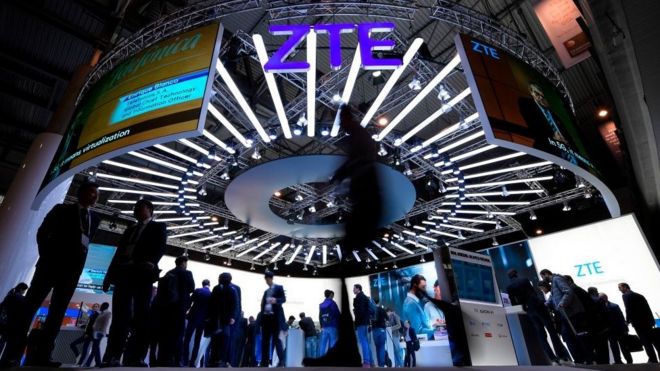
Both the US and UK have issued warnings about the Chinese technology and telecoms giant ZTE. The decision by the US Commerce Department to ban American firms from selling equipment to ZTE for the next seven years dates back to a case from a few years ago, when ZTE was accused by the US government of violating sanctions against Iran. At the time, the US said if ZTE refused to comply, there would be consequences. This week, the US made good on those threats and is hitting ZTE where it hurts. A shortage of US components is likely to cause ZTE to miss shipment deadlines and lose orders, according to investment firm Jefferies. It has cut its estimates for ZTE sales by 13.5% in 2018 and 7.6% in 2019.Chinese Influence Activities with U.S. Allies and Partners in Southeast Asia
CHINA AND THE EU IN THE HORN OF AFRICA
CHINA’S AIR FORCE ACTIVATES J-10C STEALTH FIGHTER JETS
Are Iran and Israel Headed for Their First Direct War?
SYRIA-ISRAEL BORDER, Golan Heights — Ever since the Iranian Islamic Revolution in 1979, Iran and Israel have been fighting each other in the shadows — through proxies, assassination squads and cyber-virus attacks, but never as rival armies meeting on the field of battle. That may be about to change, and if it does, it will have vast implications for Syria, Lebanon and the whole Middle East. I’m sure neither side really wants a war. It could be devastating for Israel’s flourishing high-tech economy and for Iran’s already collapsing currency. But Iran’s Revolutionary Guards’ Quds Force seems determined to try to turn Syria into a base from which to pressure Israel, and Israel seems determined to prevent that. And in the past few weeks — for the first time ever — Israel and Iran have begun quietly trading blows directly, not through proxies, in Syria.A Norm in Crisis: Implications of Persistent Chemical Weapons Use
United States-Russia Military Confrontation 2018 & its Implications for Indian Foreign Policy
Operational-Level Strikes Finally Enforce Obama’s Red Line | National Review
A Syrian firefighter is seen inside the destroyed Scientific Research Centre in Damascus, Syria, April 14, 2018. (Omar Sanadiki/Reuters)Plenty of future challenges remain, in Syria and elsewhere around the globe. But Friday’s strikes are victory worth celebrating.By all accounts, Friday night’s strikes against the Assad regime’s chemical-weapons facilities were successful — they reduced their targets to rubble, and there were no reported threats to allied forces or equipment in their aftermath. Armchair strategists are quick to point out that the strikes didn’t fit into any broader American Syria strategy. But the chemical-weapons attack of April 7 demonstrated, once again, the Syrian regime’s flagrant disregard for international moral and legal norms. And unlike last April’s retaliatory American strike on aircraft used for chemical-weapons delivery at Shayrat Air Base, Friday’s strikes sought to hit the heart of the regime’s chemical-weapons capabilities, and were coordinated with our oldest and closest allies.America and China duel for influence over North Korea
Could Russia and West be heading for cyber-war?
The latest warning of Russian intrusions is another sign that cyber-space is becoming one of the focal points for growing tension between Russia and the West.But so far, much of the talk about cyber-war remains hypothetical rather than real. It is true that Britain's National Cyber Security Centre (NCSC) is on high alert for the possibility of some kind of Russian activity. More people and resources have been devoted to monitoring and investigation. There has also been outreach to companies to warn them on what to look out for and what to do.The Future of the United States and Europe: An Irreplaceable Partnership
How the EU responds to the Trump administration will be the hallmark of how it sees its role in the world, and how successful it will be in promoting its worldview. European Council President Donald Tusk speaks to US President Donald Trump as he welcomes him at EU headquarters in Brussels as part of a NATO meeting, 25 May 2017. The partnership between the United States and Europe has been an anchor of the world’s economic, political and security order for more than seven decades, but we should not take it for granted. The transatlantic relationship faces many dangers. However, the issues that bring the two sides together ultimately carry much greater weight than those that might divide them.Greece and Turkey Are Inching Toward War
The relationship between Greece and Turkey has never been easy. The neighboring countries have been at war with each other several times in the 20th century and were close to military conflict over the Greek islet Imia in 1996, before the United States stepped in to avert disaster.The NATO allies are now at the brink again, goaded by populists on both sides — and this time, Washington is nowhere to be found. On Monday, a Greek-Turkish confrontation rekindled old memories. Turkish Prime Minister Binali Yildirim, during an event in Ankara, claimed that the Turkish coast guard had removed a Greek flag from an islet near the island of Fournoi, after it was placed there earlier by three Greeks. The Hellenic National Defense General Staff responded that no Turkish boat had been seen in the area in the last 48 hours; the mayor of Fournoi then visited the islet and reported that the Greek flag was still there.OPERATIONALIZING THE DECISIVE POINT: OPERATION OQAB “EAGLE” – COMBINED AND UNIFIED ACTION
How Social Media Built the Case for Trump’s Strike on Syria
Portraits of the Russian and Syrian presidents are displayed at the government-held Wafideen checkpoint on the outskirts of Damascus on April 3. Social media has emerged as a key battleground in the U.S. and Russian media campaign to promote their sharply divergent accounts of chemical weapons in Syria. The intelligence assessments presented over the weekend by the United States and France to justify missiles strikes against Syria for its alleged use of chemical weapons in a Damascus suburb relied to an unusual degree on information gleaned from open source material and social media. Russia, meanwhile, is mustering an army of internet trolls to shift blame for the chemical weapons attack.US and UK blame Russia for 'malicious' cyber-offensive
Security officials issue alert directly blaming Kremlin for attack as US warns Moscow it is ‘pushing back hard’ The decision of the US and UK governments to go public reflects a loss of patience with Moscow after a series of cyber-attacks and hacks allegedly originating from within Russia. Photograph: Yui Mok/PAThe cyberwar between the west and Russia has escalated after the UK and the US issued a joint alert accusing Moscow of mounting a “malicious” internet offensive that appeared to be aimed at espionage, stealing intellectual property and laying the foundation for an attack on infrastructure.Russia Vs The West: A War Scenario And A New Logic Of Confrontation – Analysis
Trump's Syria Strategy Actually Makes Sense
THE STRATEGIC GOALS OF A RESTORED RUSSIA
War and the Asymmetry of Interests
Globalization Helps Spread Knowledge And Technology Across Borders
Tech firms, including Microsoft, Facebook, vow not to aid government cyber attacks
The Machine That Can Never Be Hacked: ‘Random Number Generator’ Is Created Using Quantum Physics — And, Even Supercomputers Can’t Steal Its Data
Army Service Could Be the Answer to Europe’s Integration Problem
France’s Foreign Legion is the stuff of military legend: a band of mostly foreign men serving the French government essentially as mercenaries — and doing so with extraordinary success. Though the legion was formed in the 19th century to police France’s far-flung dominions, it has evolved into an all-purpose combat force. Indeed, thanks to its dependability in combat, the legion has become so useful that the French government is now significantly expanding it. Other European countries should follow France’s lead. All European Union nations need to do more for the Europe’s security — but their armed forces are struggling to find enough new recruits. The answer may be in plain sight; many of these countries have a growing population of young male immigrants who could be an asset to the military.