Pakistan’s ideology has not really enhanced its functionality even if it helped its first generation get through the transition of seeing themselves as Pakistanis. A favourable international environment, specifically Pakistan’s cold war alliance with the West, enabled the country to sustain hostility towards India and to justify its Islamic orientation as a barrier to communism. The current dependence on China might pay for anti-Indianism for a few more years but is unlikely to help Pakistan overcome its fundamental contradictions.The Profession of Arms: A Guide for Young Army Officers

It takes courage, especially for a young officer, to check a man met on the road for not saluting properly or for slovenly appearance, but, every time he does, it adds to his stock of moral courage, and whatever the soldier may say, he has respect for the officer who does pull him up.
Read Document →The Dragon's Teeth: Assessing China's Military Modernization
PLA has focused on modernising its capabilities across all warfare domains to achieve these goals. This includes land, air, and maritime operations, nuclear, space, counter-space, electronic warfare and cyberspace operations, aiming to become a fully integrated joint force.
Read Document →Transforming the PLA: A Decade of reorganisation from SSF to ISF
PRC has engaged in a sustained and broad effort to transform the PLA from an infantry-heavy, low-technology, ground forces-centric military into a high-technology, networked force with an increasing emphasis on joint operations and naval and air power projection.
Read Document →Eyes without Borders: Exploring the World of Open Source Intelligence (OSINT) in the Digital Age
Open Source Intelligence (OSINT) is gaining prominence with the rise of social media, the digital society and the vast growth of publicly and commercially available information (PAI and CAI).
Read Document →
The PLA’s Developing Cyber Warfare Capabilities and India's Options
Informationised warfare blurs the lines between peacetime and wartime. A nation in the information age cannot wait for the hostilities to break out to collect intelligence, carryout influence operations, develop antisatellite systems or design computer software weapons.
Read Document →
Galwan and After
Why did China did this when he is under tremendous pressure in all fronts, is this China's salami slice tactics being progressed rigorously, what will be new Rules of Engagement, what will be escalatory control mechanism, who has taken this decision, will there be some pressure put by China in India's North-East through insurgency.
Read Document →
India’s Joint Doctrine for Cyberspace Operations: A Critical Review
Chief of Defence Staff (CDS) General Anil Chauhan and Secretary, Department of Military Affairs, formally released declassified versions of the Joint Doctrines for Cyberspace Operations during the Chiefs of Staff Committee meeting in New Delhi.
Read Document →
Know your Enemy General(now Field Marshal) Syed Aseem Munir
Gen SA Munir's position in the hierarchy of Pakistan was not very comfortable. The state of economy, insurgency in Pakhtoonistan and Balochistan, attack on the Jaffar Express, constant protests by supporters of Imran Khan's supporters inside and outside of parliament.
Read Document →
Decoding Operation SINDOOR: Key Aspects and Implications
Precision strikes were carried out on nine sites—four in Pakistan and five in PoK—linked to anti-India terrorist groups such as the LeT, JeM and the Hizbul Mujahideen. The targeted sites included Muridke (LeT headquarters) and Bahawalpur (JeM headquarters).
Read Document →
Chinese Cyber Exploitation in India's Power Grid - Is There a linkage to Mumbai Power Outage?
The New York Times (NYT), based on analysis by a U.S. based private intelligence firm Recorded Future, reported that a Chinese entity penetrated India’s power grid at multiple load dispatch points. Chinese malware intruded into the control systems that manage electric supply across India, along with a high-voltage transmission substation and a coal-fired power plant
Read Document →13 April 2018
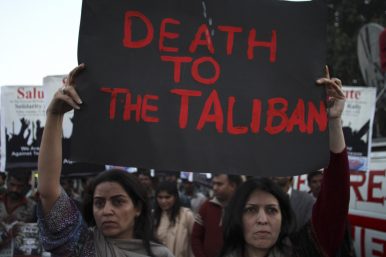
The terrible price ordinary Pakistanis have paid for hating India
Pakistan’s ideology has not really enhanced its functionality even if it helped its first generation get through the transition of seeing themselves as Pakistanis. A favourable international environment, specifically Pakistan’s cold war alliance with the West, enabled the country to sustain hostility towards India and to justify its Islamic orientation as a barrier to communism. The current dependence on China might pay for anti-Indianism for a few more years but is unlikely to help Pakistan overcome its fundamental contradictions.How Fake News Spreads in India
When U.S. President Donald Trump began crying “fake news,” and prime time news slots in India began to hold debates on photoshopped WhatsApp forwards, we knew post-truth times had truly arrived. But as is the nature of governments, it took some time for the arrival of fake news to register with the government of India. On April 2, India’s Ministry of Information and Broadcasting (I&B) woke up to the “increasing instances of fake news in electronic and print media” in the country, and released a circular announcing amendments to guidelines that the Press Information Bureau (PIB) follows while granting accreditation to journalists.Afghan-Pakistani Cross-Border Terrorism Cuts Both Ways
KABUL — Reports about Afghan Taliban safe havens on Pakistani soil are abundant and such refuges are seen as crucial for the militants’ ability to sustain their insurgency inside Afghanistan. What is often overlooked is that some extremist groups, like the Tehrik-e-Taliban Pakistan (TTP), do the same, but in reverse – seeking shelter on the Afghan side of the border (which Kabul does not officially recognize) to launch assaults on the Pakistani side. While Pakistani officials have been making such accusations for years, they – unlike the allegations from Afghan and U.S. officials regarding Afghan insurgents hiding out on Pakistani soil – never really gained much traction or attention.Afghanistan’s Comparative Perceptions of Pakistan and India
The Indo-Pacific? The Quad? Please explain …
Australia’s embrace of the Indo-Pacific concept over the past five years drew mild interest from the region and curious discussion. The US adoption of the Indo-Pacific in both its national security strategy and national defence strategy means the construct/label/geographic vision suddenly matters big time. What does the Indo-Pacific frame portend or predict for the way business will get done around here? Understandings aren’t agreed. The meaning of the Indo-Pacific matters if it’s ‘an organising principle for US foreign policy’.Why the South China Sea is critical to security
When the U.S. aircraft carrier, Carl Vinson, recently made a port call at Da Nang, Vietnam, it attracted international attention because this was the first time that a large contingent of U.S. military personnel landed on Vietnamese soil since the last of the American troops withdrew from that country in 1975. The symbolism of this port call, however, cannot obscure the fact that the United States, under two successive presidents, has had no coherent strategy for the South China Sea.China eyes Vanuatu military base in plan with global ramifications
China, Russia 'Show Americans' Their Close Relationship
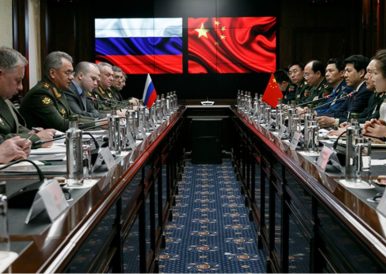
Chinese Foreign Minister and State Councilor Wang Yi visited Russia from April 4 to 5, making up for a previously scheduled visit that was postponed. Wang’s trip overlapped with that of Chinese Defense Minister and State Councilor Wei Fenghe. Wei was in Russia from April 1 to 5 both to attend the Moscow Conference on International Security and to conduct his first visit abroad since assuming his post. While in Russia, both Wang and Wei made it clear that their visits signaled increasingly tight China-Russia cooperation amid tensions on both sides with the United States.South China Sea: China Deploys Jamming Equipment
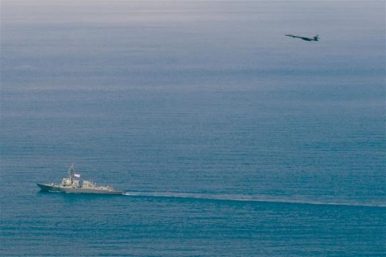
According to U.S. military officials, China has deployed communications and radar jamming equipment to Fiery Cross Reef in the Spratly group in the South China Sea. The deployment took place during the last 90 days, according to U.S. intelligence. First reported by the Wall Street Journal, the deployment marks a significant capability improvement for the Chinese military in the South China Sea. Fiery Cross Reef is the site of one of China’s seven artificial island facilities in the Spratlys. The U.S. military commissioned commercial satellite imagery from DigitalGlobe to point out the deployment to reporters with the Journal. “China has deployed military jamming equipment to its Spratly Island outposts,” one Pentagon official told the reporters.How Do We Prevent ISIS 2.0? Withdrawing From Syria Is Not The Answer.
Stability in the Middle East: The Range of Short and Long-Term Causes
The potential futures of British power projection
U.S. Deficit to Surpass $1 Trillion Two Years Ahead of Estimates, CBO Says
Israel’s strike on Syria’s nuclear plant The compelling story behind Israel’s strike on Syria’s nuclear plant – and its ramifications.
The West’s defeat in Syria is complete
The Syrian civil war is in its endgame, and the ‘political solution’ that the leaders of the Western democracy talk about is in sight. That is one meaning of the appalling images from the chemical weapons attack on Eastern Ghouta. In 2011, Western intelligence agencies unanimously declared that Bashar al-Assad was finished, and that it was only a matter of time before he fell. Today, Assad, with massive Russian and Iranian support, has regained control over most of Syria.New Zealand military confirms spending millions on controversial spy software produced by secretive Silicon Valley firm Palantir Technologies
The strengths and weaknesses of Russia’s military
Three Flashpoints in the Syrian Civil War
A Global Arms Race for Killer Robots Is Transforming the Battlefield
Autonomous weapons and the law: the Yale and Brookings discussions
One of the hottest topics these days in the law of war is the increasing autonomy in weaponry. We are not yet seeing (and may never see) the emergence of a “Terminator” robot, but there are still plenty of complex issues to discuss. In anticipation of this week’s meeting at the UN of the Group of Governmental Experts (GGE) on Lethal Autonomous Weapons Systems (LAWS), events were held at Yale and Brookings last week. I was privileged to participate in them, and here are some observations about those discussions. At Yale Law School, the dialog was cast as a debate between my friend Professor Rebecca Crootof and myself entitled “Killer Robots: Is Existing Law Sufficient? A Debate on How Best to Regulate Autonomous Weapons.” Professor Crootof has a new paper, entitled “Autonomous Weapon Systems and the Limits of Analogy,” in which she argues that analogies often made to “weapons already in use” as well as “analogies based on unconventional entities that participate in armed conflict—namely, child soldiers and animal combatants” do not work for autonomous weapons.Meet the scholar challenging the cyber deterrence paradigm
In recent years, U.S. thinking on a national cyber strategy has included, at least in part, a focus on the concept of cyber deterrence. The deterrence theme has been prevalent in civilian government and military leaders' speeches, as well as congressional hearings and scholarly literature. (See, for instance, Fifth Domain coverage While many agree on the need for a U.S. national cyber strategy, few have challenged the premise of a strategy built largely around cyber deterrence. But one scholar has recently published a series of academic papers that do exactly that — question the very premise for and the effectiveness of a deterrence strategy in cyberspace.Forecasting the Future of Warfare
Modern Political Warfare Current Practices and Possible Responses
IMPROVING THE UNDERSTANDING OF SPECIAL OPERATIONS: A CASE HISTORY ANALYSIS
The Era of Urban Warfare is Already Here
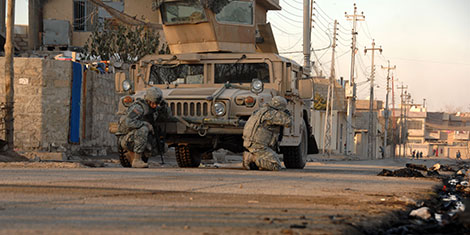
Aleppo. Mosul. Sana’a. Mogadishu. Gaza. These war-ravaged cities are but a few examples of a growing trend in global conflict, where more and more of the world’s most violent conflicts are being fought in densely populated urban areas, at a tremendously high cost to the civilians living there. Despite their aversion to urban warfare, American and NATO military strategists increasingly acknowledge that the future of war is in cities. Concurrently, humanitarian agencies such as International Committee of the Red Cross (ICRC) and United Nations High Commissioner for Refugees (UNHCR) are adjusting their response to relief operations in urban centers in real time. This rise in urban violence and the resurgence of warfare in cities comes from three key factors: the global trend toward urbanization, increasingly volatile domestic political conditions in developing countries, and changes in the character of armed conflict.