The Profession of Arms: A Guide for Young Army Officers
It takes courage, especially for a young officer, to check a man met on the road for not saluting properly or for slovenly appearance, but, every time he does, it adds to his stock of moral courage, and whatever the soldier may say, he has respect for the officer who does pull him up.
Read Document →The Dragon's Teeth: Assessing China's Military Modernization
PLA has focused on modernising its capabilities across all warfare domains to achieve these goals. This includes land, air, and maritime operations, nuclear, space, counter-space, electronic warfare and cyberspace operations, aiming to become a fully integrated joint force.
Read Document →Transforming the PLA: A Decade of reorganisation from SSF to ISF
PRC has engaged in a sustained and broad effort to transform the PLA from an infantry-heavy, low-technology, ground forces-centric military into a high-technology, networked force with an increasing emphasis on joint operations and naval and air power projection.
Read Document →Eyes without Borders: Exploring the World of Open Source Intelligence (OSINT) in the Digital Age
Open Source Intelligence (OSINT) is gaining prominence with the rise of social media, the digital society and the vast growth of publicly and commercially available information (PAI and CAI).
Read Document →
The PLA’s Developing Cyber Warfare Capabilities and India's Options
Informationised warfare blurs the lines between peacetime and wartime. A nation in the information age cannot wait for the hostilities to break out to collect intelligence, carryout influence operations, develop antisatellite systems or design computer software weapons.
Read Document →
Galwan and After
Why did China did this when he is under tremendous pressure in all fronts, is this China's salami slice tactics being progressed rigorously, what will be new Rules of Engagement, what will be escalatory control mechanism, who has taken this decision, will there be some pressure put by China in India's North-East through insurgency.
Read Document →
India’s Joint Doctrine for Cyberspace Operations: A Critical Review
Chief of Defence Staff (CDS) General Anil Chauhan and Secretary, Department of Military Affairs, formally released declassified versions of the Joint Doctrines for Cyberspace Operations during the Chiefs of Staff Committee meeting in New Delhi.
Read Document →
Know your Enemy General(now Field Marshal) Syed Aseem Munir
Gen SA Munir's position in the hierarchy of Pakistan was not very comfortable. The state of economy, insurgency in Pakhtoonistan and Balochistan, attack on the Jaffar Express, constant protests by supporters of Imran Khan's supporters inside and outside of parliament.
Read Document →
Decoding Operation SINDOOR: Key Aspects and Implications
Precision strikes were carried out on nine sites—four in Pakistan and five in PoK—linked to anti-India terrorist groups such as the LeT, JeM and the Hizbul Mujahideen. The targeted sites included Muridke (LeT headquarters) and Bahawalpur (JeM headquarters).
Read Document →
Chinese Cyber Exploitation in India's Power Grid - Is There a linkage to Mumbai Power Outage?
The New York Times (NYT), based on analysis by a U.S. based private intelligence firm Recorded Future, reported that a Chinese entity penetrated India’s power grid at multiple load dispatch points. Chinese malware intruded into the control systems that manage electric supply across India, along with a high-voltage transmission substation and a coal-fired power plant
Read Document →25 December 2015
Amartya Sen: National security is one component of human security
SETTING THE SALARY OF A SOLDIER
Rebooted with U.S. help
For now, ‘Make in India’ is a mere slogan
What to Expect from Modi’s Moscow Visit
Prime Minister Narendra Modi is scheduled to visit Moscow on December 24 and 25 for the annual Summit Meeting with President Vladimir Putin. This will be his 23rd and probably last foreign trip during 2015 unless he also stops over in Kabul on his return from Moscow.
This time around last year, Indo-Russian ties were a bit frosty. Russians were complaining about the Americans overtaking them as the number one arms supplier to India. They expressed disquiet and even sought retribution by ending the arms blockade to Pakistan to offset the loss. Indians on their part were frustrated by the Russian failure to meet delivery schedules, tendency to increase costs, and reluctance to transfer technology and supply spares. In fact, ties with Russia had started drifting during the Manmohan Singh era, with deals inked on defence and nuclear issues remaining only on paper.
Now it seems that both Modi and Putin are all set not only to straighten the loose ends of existing projects but also bring new big items on the table. This could well bring back Russia as India’s top military hardware supplier.
Modi is visiting Moscow after concluding a string of summit level meetings with the United States, France, Germany, Israel, United Kingdom and most recently Japan, at each of which defence and security aspects received robust attention. This, along with Modi’s drumming up of foreign investments for his ‘Make in India’ initiative, would have made the Russians jittery about actually losing an established market.
Sitting on top of a smouldering mountain
WTO : How we failed to protect our farmers
Top MEA, DAE officials trash reports of secret nuke city, radioactive leaks
Trashing reports of India building a secret nuclear city in Mysore and radioactive leaks at Jaduguda's uranium mines, top government officials today termed them as "deliberate distortion of facts" and asserted the country's nuclear establishment followed high safety standards prescribed by the IAEA.
Sources in the Ministry of External Affairs and the Department of Atomic Energy also questioned the timing of a raft of articles in international publications questioning safety of India' .
Read more at:
http://economictimes.indiatimes.com/articleshow/50287134.cms?from=mdr&utm_source=contentofinterest&utm_medium=text&utm_campaign=cppst
Explained: What Raghuram Rajan Just Did To Make Monetary Policy More Effective
Vivek Kaul
Vivek Kaul is the author of the 'Easy Money' trilogy. He tweets @kaul_vivek
23 Dec, 2015
Here’s how Rajan ensured that banks react faster to RBI repo rate cuts.
In the last monetary policy statement released by the Reserve Bank of India(RBI) on December 1, 2015, the governor Raghuram Rajan had said:
“Since the rate reduction cycle that commenced in January [2015], less than half of the cumulative policy repo rate reduction of 125 basis points [one basis point is one hundredth of a percentage] has been transmitted by banks. The median base lending rate has declined only by 60 basis points.”
Repo rate is the rate at which RBI lends to banks and acts as a sort of a benchmark to the interest rates that banks pay for their deposits and in turn charge on their loans.
What this means is that even though the Rajan led RBI has cut the repo rate by 125 basis points, banks in turn have cut their lending rate by only around 60 basis points on an average. This clearly tells us is that the monetary policy of the RBI (or the process of setting interest rates) has only been half effective.
Why is that the case? A major reason for this lies in the way the banks calculate their base rate or the minimum interest rate that a bank can charge its customers. How is this base rate calculated? As the RBI Draft Guidelines on Transmission of Monetary Policy Rates to Banks’ Lending Rates released earlier this year pointed out:
Besieged Afghan forces in Sangin receive airdrops as UK sends troops
http://www.theguardian.com/world/2015/dec/22/much-of-sangin-in-taliban-hands-amid-reports-uk-and-us-have-deployed-special-forces?CMP=Share_iOSApp_OtherTiny but symbolic deployment of 10 British troops in non-combat role comes as residents say town has been almost overrun by Taliban
Sune Engel Rasmussen in Kabul, Ewen MacAskill Tuesday 22 December 2015
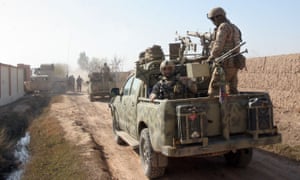
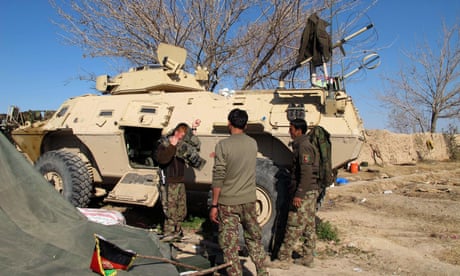
Ammunition, military equipment and food is being airdropped to besieged Afghan forces battling to prevent the complete fall of Sangin in Helmand province, according to government officials in Kabul.
The move came as a third day of fighting between Afghan forces and the Taliban ended with the insurgents in control of large swaths of the town, according to local residents.
The beleaguered Afghan army and police were still waiting late on Tuesday for reinforcements promised by the government in Kabul.
A Sangin police source, pleading for reinforcements, said the Taliban had taken the entire centre except for the police building, which had been under attack from about 50 to 60 Taliban fighters each day.
“If Kabul or the Helmand governor don’t send support, we will all be killed, or we should join the Taliban. We don’t have anything to eat or fight with,” he said.
Sangin assault is sign of Taliban confidence and warning to Kabul
Read more
Nepal's Government Considers Amendment to Resolve Constitutional Crisis
Nepal’s prolonged constitutional crisis may be headed toward a solution.
By Ankit Panda, December 23, 2015
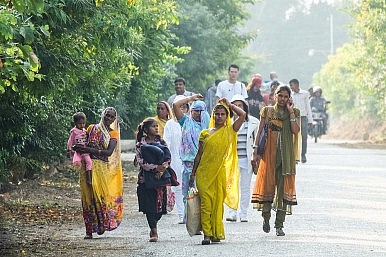
Nepal’s months-long constitutional crisis appears to be winding down after the government indicated that it is willing to acquiesce to some of the core demands of protestors. At a meeting of the Nepali cabinet this weekend, the government agreed to back a bill including a constitutional amendment that, if ratified by the country’s parliament, would alter the new constitution to satisfy two of the three primary grievances of the protestors. Specifically, the amendment would address proportional representation and federal constituency delimitation issues in the constitution. The political crisis over Nepal’s constitution has been particularly bitter given that the nation is almost evenly split over the appropriateness of the new constitution.
“The bill has ensured proportional inclusive participation in various state organs as demanded by the agitating parties and has also proposed delimitation of the electoral constituencies based on population,” Nepal’s Minister for Industry Som Prasad Pandey told the press, according to the Hindu. He added that a political mechanism “will recommend solutions to disputes over the proposed provincial boundaries within three months of its formation.”
“Besides these issues, the demands related to citizenship and other issues can also be settled through negotiations. So, we urge them to withdraw the protests immediately,” Pandey added.
Across the border to the south, in India, the Nepali government’s signaling has been met positively. Vikas Swarup, a spokesperson for the Indian foreign ministry, in a tweet noted that “India welcomes develop’ts in Nepal as positive steps that help create the basis for a resolution of current impasse.” India, given its important interests in Nepal and historic ties, has sought to resolve Nepal’s constitutional crisis. Additionally, due to cross-border ethnic and cultural ties between the Nepalis of the Terai and Indians living along the Nepali border, the current instability, if prolonged, could destabilize the Indian border. The de facto blockade of the border is one symptom of the problems arising for India from the constitutional crisis.
China's Nukes: What Happens in a Showdown with America?
Harry J. Kazianis, December 23, 2015
As the Islamic State dominates national security headlines, tensions between Washington and Beijing on a whole host of issues—think the East and South China Seas, Taiwan, China’s rising conventional military power with growing overseas power projection capabilities etc.—only get the occasional attention they truly deserve. Getting even less attention these days: China’s multi-decade quest to modernize its nuclear weapons arsenal. Beijing is developing nuclear armed missiles that have longer ranges (and yes, they can hit the United States), tipped with multiple warheads that are now being deployed across multiple domains (air, land and now in the ocean).
While recent attention on China’s nuclear arsenal—specifically that Beijing is testing a railcar based mobile intercontinental ballistic missile (ICBM) with a range of 7,500 miles or more—was certainly welcomed, America’s academic community has been keeping a close eye on China’s growing nuclear weapons program for many years. Case in point, a recent article in the renowned academic journal International Security sheds new light on Beijing’s nukes. So what makes this article special? The author’s detailed analysis on an important subtopic: if Beijing will eventually abandon its long-standing nuclear strategy of assured retaliation for what MIT-based authors Fiona Cunningham and M. Taylor Fravel call a “first-use posture” that “will be a critical factor in future U.S.-China strategic stability.”
As I like to do of late, here are the major themes of this recent article, titled Assuring Assured Retaliation: China's Nuclear Posture and U.S.-China Strategic Stability.
Point #1- Revealing China’s Current Nuclear Posture:
“In general, China has sought to maintain the smallest possible force capable of surviving a first strike and being able to conduct a retaliatory strike that would inflict unacceptable damage on an adversary, at the time and place of China's choosing. Rather than expend all of its nuclear forces in a single, massive retaliatory strike, China has structured its nuclear forces to conduct multiple waves of large- or small-scale retaliatory strikes. As result, key principles in force development since 1980 have been “close defense” (yanmi fanghu) and “key-point counterstrikes” (zhongdian fanji). Close defense refers to ensuring the survivability of China's forces, which first emphasized concealment and then mobility. Key-point counterstrikes refer to the means and methods of retaliation and how to inflict unacceptable damage on an adversary. Historically, Chinese planning has targeted population and industrial centers as well as soft military targets, such as military bases.”
The Forces Awakening Against an Antagonistic China
Diplomatic and legal pressure—along with military might—are limiting Beijing's options.
Richard Javad Heydarian, December 22, 2015
Few can deny that China has had a particularly challenging year. In an effort to augment its sovereignty claims over what it considers as its national “blue soil,” China has inadvertently encouraged a growing number of nations to coalesce against it. One could argue that China has overplayed its hand, unleashing a dangerous strategic dynamic that threatens the whole region.
Throughout the early years of this decade, China rapidly and inexorably altered the maritime status quo in East Asia, wresting control of Philippine-claimed Scarborough Shoal and deploying a giant oil rig into Vietnamese-claimed waters in the South China Sea. In possession of cutting-edge technology, and confidently overseeing decades of relentless military modernization as well as paramilitary mobilization, China has transformed a whole host of contested low-tide elevations (LTEs), atolls, shoals and rocks into full-fledged islands. Within twenty months, it has reclaimed seventeen times more land than the other claimants combined over the past four decades.
While such a massive geoengineering project has strengthened its hand on the ground, allowing Beijing to project power from these features across the South China Sea, it has angered regional and external powers and gradually unleashed a robust countercurrent to its plans of local domination. Beijing’s whiplash approach to regional territorial disputes is undermining its own interests as well as that of the whole region, which desperately relies on stability in Sea Lines of Communications (SLOCs) for uninterrupted and safe commerce. Beijing is now locked between the rock of domestic hawks, who are vigorously pushing for greater Chinese strategic grip on adjacent waters, and the hard place of growing international backlash, which is undermining China’s soft power—and its claim to regional leadership.
Constrainment in Action
The Sino-Pakistani JF-17 Might Have Another Buyer in Asia
Malaysia recently expressed an interest in the JF-17 Thunder.
By Benjamin David Baker, December 23, 2015
Christmas is a time for reflection, celebration and… buying really expensive gadgets which might or might not be obsolete in a few years. As Robert Farley noted earlier, several states in Asia are getting in the holiday spirit with the presentation of so-called “fifth generation” combat aircraft.
Furthermore, as I’ve covered the last couple of weeks, fourth generation birds are still in high demand throughout the region. Dassualt’s Rafale, the Eurofighter Typhoon, Boeing’s F/A- 18 Super Hornet, Saab’s Gripen, and the Sukhoi Su-35 are all being peddled as options for prospective buyers.
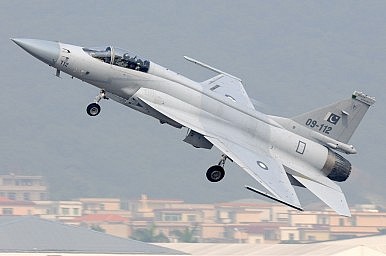
As Franz-Stefan Gady has reported for The Diplomat, the Sino-Pakistani JF-17 Thunder (known in China as the FC-1 Xiaolong) is also trying to compete in this crowded field. Developed as a joint venture between China’s Chengdu Aircraft Industry Group (CAC) and Pakistan Aeronautical Complex (PAC), the JF-17 is supposed to be a low-cost multirole alternative to the more expensive fighters currently on the market. According to the Defense Industry Daily, the aircraft isn’t a top-tier competitor, but does represent a clear step up from Pakistan’s Chinese MiG-19/21 derivatives and French Mirage III/V fighters. This positioning addresses a budget-conscious, “good enough” performance market segment that western companies once dominated, but have since nearly abandoned in recent decades.
First deployed in an operational capacity, the JF-17 Thunder has a conventional aerodynamic layout. The aircraft is fitted with Russian Klimov RD-93 turbofan engine with afterburner capabilities. It is a derivative of the RD-33, used on the MiG-29. In 2007, a contract was signed to supply 150 RD-93 engines for the JF-17, exported to Pakistan. China is also developing an indigenous turbofan engine, which is a copy of the RD-93, but has some modifications. It is designated as the WS-13 (Tianshan-21). The Thunder multi-role fighters delivered to Pakistan are fitted with Italian Grifo S-7 multi-track, multi-mode pulse Doppler radar. It has look-down, shoot-down capability.
What’s Saudi Arabia’s New Islamic Coalition Really Up To?
Saudi Arabia’s nebulous announcement that it is forming a 34-country Islamic alliance to battle terrorism has raised speculation about the group’s true mission.
The clearest aspect of the Dec. 15 announcement was that it was sorely lacking in details. Prince Mohammed bin Salman, the country’s deputy crown prince and defense minister, merely noted that Riyadh is creating the Islamic Military Alliance to fight terrorism in the Muslim world.
While no countries led by Shiite parties — such as Iran, Iraq or Syria — appeared on the list of member states, Salman stressed that the alliance is open to all Islamic countries. That sentiment was reiterated Dec. 19 by Egyptian Foreign Minister Sameh Shoukry in remarks made to the press during the international conference on Syria in New York.
Gen. Anwar Majid Ashqi, head of the Middle East Center for Strategic and Legal Studies in Riyadh, said during a Dec. 15 phone call to Al-Ghad al-Araby channel that Iran is welcome in the alliance if it proves it does not support terrorist organizations. Ashqi said the precondition is necessary “because Western states accuse [Iran] of financing terror.” However, the general neglected to comment on the memberships of Turkey, Qatar and Sudan, despite numerous allegations that they support terrorism.
Most notable among those accusations is the one made by Russian President Vladimir Putin, who explicitly accused Turkey of supporting the Islamic State (IS) by buying Iraqi oil through the organization. On Dec. 2,Russia’s Defense Ministry also claimed Ankara is providing weapons to IS in exchange for oil. Thus, accusations of supporting terror are not confined to Iran alone and have been directed at some states that are actually members of the new Saudi alliance. This could indicate that the sectarian and political disputes between Saudi Arabia and Iran played a role in the alliance’s formation.
How To Stop Islamic State’s Escalation Dominance
By James Kitfield on December 23, 2015
While President Barack Obama’s declared both that the U.S. is hitting the Islamic State of Iraq and Syria “harder than ever” and that progress in the campaign to degrade and defeat the group “needs to keep coming faster,” he revealed clearly that the administration is in a race against time. American officials believed that their anti-ISIL strategy and military campaign of the last year-and-a-half had achieved a stalemate: The momentum of the ISIL juggernaut that captured large swaths of Syria and Iraq was largely checked, but U.S.-backed proxies have struggled to roll back the terrorist group’s vast territorial gains.
In fact, ISIL (which we’ll refer to as Daesh from now on) has, in fact, recaptured “escalation dominance” outside of Syria with a series of deadly terrorist attacks in Egypt, Lebanon, France, and the United States, even as its reach and influence continues to grow through increased pledges of allegiance from far-flung extremist groups. Meanwhile, the Syrian civil war that fuels its rise has produced the largest refugee crisis in Europe since World War II; shifted the political dynamic in Western countries far to the right, with unpredictable long-term implications; and provoked open fighting between a NATO ally and Moscow when Turkey downed a Russian warplane.
That steep escalation curve has prompted some of the leading experts in the country to implore the Obama Administration to adjust its strategy and contemplate more aggressive measures against Daesh, ranging from enforcing no-fly zones and safe sanctuaries inside Syria, to reintroducing U.S. ground forces to break Daesh’s hold on major population centers. Each of those options carries great risk. But so does the current trajectory towards a regional meltdown coupled with expanding terrorist attacks that are drawing major powers into the Syrian vortex.
The Absence of Global Leadership Will Shape a Tumultuous 2016
As bombing in Syria intensifies, a debate about the rules of engagement
By Karen DeYoung and Missy Ryan December 22
President Obama’s order to intensify air attacks in Syria has led to new internal debate over whether to loosen tight restrictions on strikes against Islamic State targets that risk civilian casualties, according to senior administration officials.
But so far, at least, the White House has resisted proposals to change the rules of engagement for the bombing. Each strike, whether against a pre-planned target or one chosen on a “dynamic” basis by patrolling aircraft, is weighed against likely collateral damage and must be individually approved by top officers at the coalition operations center in Baghdad.
“We are trying to develop intelligence to get targets, to leverage opportunities . . . to create strikes that have a strategic effect,” a U.S. military official said. “But we’re going to keep doing those the same way we have done. We will not willy-nilly go after a target because it’s right there, right now.”
That caution has drawn sharp criticism from some Republican opponents of Obama’s strategy, with calls to “carpet-bomb” the Islamic State and place a lower priority on avoiding civilian deaths.
President Obama admitted to the legitimacy behind the criticism of his strategy to combat the Islamic State, saying they need to share more information with the public. "Part of our goal here is to make sure that people are informed about all the actions that we're taking," he said. (AP)
Who Wants What in the Syria Negotiations
From the U.S and Russia to Saudi Arabia, it seems like everyone has a stake in Syria's civil war.
Andrew J. Bowen, December 22, 2015
On Friday, John Kerry convened a high-level session of UN Security Council member states’ foreign ministers to build on the diplomatic momentum that came from the October and November Syria talks in Vienna. Late afternoon Friday, Kerry, Russia’s Sergei Lavrov, France’s Laurent Fabius and the UK’s Philip Hammond reached agreement on a draft Security Council resolution, recognizing the Geneva II communiquรฉ as the guiding principles of a possible settlement, and endorsed the timeline for such a process agreed upon in Vienna last month.
While upon initial glance the resolution text is more a canonization of the status quo than any substantive change, there’s more than meets the eye. First, in a sign of unanimity, the Security Council reaffirmed both the understanding reached at Geneva II (a secular representative democratic Syria) and the timeline for reaching a political settlement (elections within eighteen months and a transition government agreed in six months). Despite pressure by Tehran to void critical components of Geneva II, Iran's efforts to push for a national unity government headed by Bashar al-Assad instead of a transition along the Geneva communiquรฉ were foiled.
Second, the resolution recognized Saudi Arabia’s steps in organizing the opposition for the expected January Vienna talks between the opposition and President Assad’s government. While differences remain, namely between Iran, Turkey, Russia and Saudi Arabia over who constitutes the legitimate opposition, recognition of the Kingdom’s efforts to build unity amongst the political and armed opposition is a positive step. While the Kremlin may have its objections, Moscow didn’t seek to invalidate the Saudi process in the resolution text. Their recognition of Jordan’s role in defining which groups should be defined as a terrorist group, instead of as an opposition group, is important as well.
Wikistrat’s Predictions for 2016
Flexibility from Participating Nations – Key to TAPI’s Success
Sanket Sudhir Kulkarni, December 23, 2015
In the last one month, two significant developments have brought the TAPI project back into the lime light. Reportedly, Dragon Oil evinced interest in participating in the TAPI project’s pipeline construction1. This is a major breakthrough for this ambitious, multilateral project that was facing the prospect of a silent burial a few months ago due to the absence of any leader for the consortium. But with Dragon Oil’s participation, construction of the proposed project can be expected to move ahead with full speed2. Following closely on the heels of this development, the four nations who have invested in the project participated in a ground-breaking ceremony in Ashgabat to commence pipeline construction3. But, despite the progress made in the last few weeks, the project still faces certain commercial constraints that have the potential to stall the pipeline construction. Foremost among these revolves around gas pricing concerns, primarily of India and Pakistan. As per recent reports in The Economic Times on November 9, 2015, India apparently is not happy about the unit price of gas quoted by Turkmenistan and is hoping to re-negotiate the issue4. Couple of years ago, similar concerns associated with gas prices for TAPI pipeline project were echoed by the Sustainable Development Policy Institute, an Islamabad based think tank5. It will be interesting to see how the Turkmen government responds to this fresh Indian move on gas price negotiations. For the continued sustenance of this project, it would be imperative for the Turkmen government to show some degree of flexibility on gas pricing. If that does not happen, it will perhaps force India to reconsider its participation in the project.
The reasons are quite simple. Recent geo-political developments in India’s neighbourhood have come as a blessing in disguise for its energy diplomacy. Such improved circumstances in India’s neighbourhood imply that it has multiple alternatives to source its gas supplies6. It has been argued that as a result of US-Iran deal on nuclear issues, India should look towards Iran for satiating its natural gas demand from Iran through a deep sea pipeline7. Hence some of the stalled energy projects, whose fate seemed to have been sealed earlier, may receive renewed attention from policy planners in New Delhi. With India being relatively immune to external geopolitical pressure, the sole factor that might influence its decision making in joining natural gas projects will be commercial considerations. In the last one year quite a few energy options have opened up for India. For example, the LNG deal with Australia, opening of Iran’s energy sector and prospects of shale gas imports from United States are some options that have the potential to satisfy India’s gas demand in the coming years. What these options have essentially done is infuse an element of comfort into natural gas decision making in India, providing options that suit its commercial interests. This also means that certain projects which were signed earlier primarily based on geopolitical constraints and relatively limited natural gas supply sources globally may perhaps be re-visited. The current Indian effort to re-negotiate gas prices must therefore be seen in this context.
Social Movements Are The Next Big Weapon
December 22, 2015 By Micah White Quartz
Governments and non-state actors will increasingly foment citizen protests to topple terrorist states and influence regimes.
Could social movements replace conventional warfare?
The idea might sound far-fetched. But President Obama’s steadfast refusal to send occupation forces to fight the Islamic State in Syria may be evidence that the old methods of regime change—boots on the ground—are being rendered obsolete.
Going forward, governments will increasingly rely on catalyzing contagious social protests to topple terrorist states and influence autocratic regimes. Russian military theorists were the first to openly discuss this shift in the art of war—and to accuse America of pioneering techniques of fomenting viral protests abroad. Whether or not their accusations hold water, social movement warfare may well be the wave of the future.
Last year, defense ministers and high-ranking military personnel from several less-than-democratic societies, including Belarus, Iran, Egypt, Myanmar, Vietnam, Syria, the United Arab Emirates, and China, gathered in an opulent Stalinist-era hotel in Moscow to discuss a grave threat to their governments. The occasion was the third annual Moscow Conference on International Security (MCIS), an event hosted by the Russian Ministry of Defense. Unlike previous years, not a single military officer or official representative from a NATO member country participated in the two-day event.
The reason for the conspicuous absence of NATO representatives became apparent during the opening speech by Russia’s minister of defense, army general S. K. Shoygu. He announced that the focus of the gathering would be “on the problems of how so-called ‘color revolutions’ … affect global security.”
According To DARPA, This Is What The World Will Look Like In 2045
http://www.iflscience.com/ technology/world-2045- according-darpa
The U.S. military’s scientific and technological wing, the Defense Advanced Research Projects Agency (DARPA), is essentially tasked with constructing the future. Robotic soldiers and artificial intelligence (AI) have both been in development for some time, as have instantaneous language translation systems and advanced contact lenses. So it shouldn’t come as a surprise that DARPA has given its predictions for what the world will be like in 2045, as reported by Tech Insider.
In a video series entitled “Forward to the Future” released on YouTube, three DARPA researchers have explained how the technologies they are actively working on could transform the world in 30 years’ time.
The first of these predictions comes from Pam Melroy, an aerospace engineer, former astronaut, and deputy director of DARPA’s Tactical Technologies Office. This department, along with others, handles the development of drones.
Militarized drones are becoming increasingly spooky, with one DARPA project aiming to create “vampire drones,” those that sublimate into nothingness in direct sunlight, leaving no trace of their exploits.
Melroy takes this one step further. Instead of merely ordering drones and other machines around, advanced AI will “allow us to work as partners with machines and have them understand our intent for much more complex tasks.” Instead of having rudimentary voice recognition and keyboards, machines – drones, aircraft, and even spacecraft – will respond to our commands dynamically and control multiple systems simultaneously.
DARPA is currently developing an empathetic system that will even allow robots on the battlefield to detect and analyze our emotional and physical state in real-time; this will permit them to predict our needs before we even need them. Even before this system is operational, a quarter of combat soldiers will be robots by just 2030, according to one U.S. general.
Stefanie Tompkins, a geologist and director of DARPA’s Defense Sciences Office, believes the world of 2045 will be dominated by nanotechnology. Our ability to manipulate materials at the atomic level already means we can produce incredible materials, including prosthetic limbs that have the ability to “feel” and night vision contact lenses only a few atoms thick.
10 reasons that explain why you should oppose Facebook's Free Basics campaign
Newsweek Has Just Published a “Declassified” Special Edition
The Special Newsweek Edition “DECLASSIFIED” - Declassified Even Further
December 23, 2015 - Newsweek’s Special Edition, “Declassified,” is on
news stands now. To commemorate this extraordinary release, which features a
curated list of the most noteworthy documents declassified in 2015,
contributing editor and Archive FOIA project director Nate Jones is
publishing a supplemental online posting for National Security Archive
followers on our blog, Unredacted.
Jones’s additional content is a fascinating read for document hounds, and
will compliment the Newsweek print edition, which, due to space constraints,
was forced to cut some of the background to these fascinating declassified
stories. Readers can also now click the links and access the entire featured
documents themselves, as well as see how they were initially presented by
the “dedicated patriots” who actually filed the FOIAs and brought these
government secrets into the public domain.
Enjoy!