The Profession of Arms: A Guide for Young Army Officers
It takes courage, especially for a young officer, to check a man met on the road for not saluting properly or for slovenly appearance, but, every time he does, it adds to his stock of moral courage, and whatever the soldier may say, he has respect for the officer who does pull him up.
Read Document →The Dragon's Teeth: Assessing China's Military Modernization
PLA has focused on modernising its capabilities across all warfare domains to achieve these goals. This includes land, air, and maritime operations, nuclear, space, counter-space, electronic warfare and cyberspace operations, aiming to become a fully integrated joint force.
Read Document →Transforming the PLA: A Decade of reorganisation from SSF to ISF
PRC has engaged in a sustained and broad effort to transform the PLA from an infantry-heavy, low-technology, ground forces-centric military into a high-technology, networked force with an increasing emphasis on joint operations and naval and air power projection.
Read Document →Eyes without Borders: Exploring the World of Open Source Intelligence (OSINT) in the Digital Age
Open Source Intelligence (OSINT) is gaining prominence with the rise of social media, the digital society and the vast growth of publicly and commercially available information (PAI and CAI).
Read Document →
The PLA’s Developing Cyber Warfare Capabilities and India's Options
Informationised warfare blurs the lines between peacetime and wartime. A nation in the information age cannot wait for the hostilities to break out to collect intelligence, carryout influence operations, develop antisatellite systems or design computer software weapons.
Read Document →
Galwan and After
Why did China did this when he is under tremendous pressure in all fronts, is this China's salami slice tactics being progressed rigorously, what will be new Rules of Engagement, what will be escalatory control mechanism, who has taken this decision, will there be some pressure put by China in India's North-East through insurgency.
Read Document →
India’s Joint Doctrine for Cyberspace Operations: A Critical Review
Chief of Defence Staff (CDS) General Anil Chauhan and Secretary, Department of Military Affairs, formally released declassified versions of the Joint Doctrines for Cyberspace Operations during the Chiefs of Staff Committee meeting in New Delhi.
Read Document →
Know your Enemy General(now Field Marshal) Syed Aseem Munir
Gen SA Munir's position in the hierarchy of Pakistan was not very comfortable. The state of economy, insurgency in Pakhtoonistan and Balochistan, attack on the Jaffar Express, constant protests by supporters of Imran Khan's supporters inside and outside of parliament.
Read Document →
Decoding Operation SINDOOR: Key Aspects and Implications
Precision strikes were carried out on nine sites—four in Pakistan and five in PoK—linked to anti-India terrorist groups such as the LeT, JeM and the Hizbul Mujahideen. The targeted sites included Muridke (LeT headquarters) and Bahawalpur (JeM headquarters).
Read Document →
Chinese Cyber Exploitation in India's Power Grid - Is There a linkage to Mumbai Power Outage?
The New York Times (NYT), based on analysis by a U.S. based private intelligence firm Recorded Future, reported that a Chinese entity penetrated India’s power grid at multiple load dispatch points. Chinese malware intruded into the control systems that manage electric supply across India, along with a high-voltage transmission substation and a coal-fired power plant
Read Document →19 December 2017
President Trump's New National Security Strategy
India, China likely to suggest new steps to boost border peace
For India and China, Southeast Asia Is a Battleground
While focus is on North Korea, China continues South China Sea military buildup: think tank
The Great Leap Forward: China’s Pursuit of a Strategic Breakthrough
On February 25, 1956, in a closed session of the 20th Congress of the Communist Party of the Soviet Union, Soviet Premier Nikita Khrushchev gave his “Secret Speech” denouncing Stalin and his cult of personality. The political tremors from this questioning of Communist doctrine traveled across the border to Beijing where Chinese-leader Mao Zedong initially responded with an invitation for criticism (“Let a thousand flowers bloom”), only to double down on his relentless pursuit of internal enemies and continuous revolution. In search of a strategic breakthrough, Mao embarked on the Great Leap Forward, a sweeping, terrifying and, ultimately, catastrophic economic program designed to surpass the achievements of Western industrialization in an accelerated timeframe (in one “big bang”).Joining the Quad: Fear Versus Greed
The administration of U.S. President Donald J Trump has re-raised the decade-old geopolitical concept of the “Indo-Pacific region.” Within this framework, it is proposing and pushing for a so-called “Quad” — a potential security arrangement among the four large democracies of India, Australia, Japan, and the United States. The proposed Quad is widely perceived as a part of the U.S. China containment strategy. U.S. pressure, both public and private, is forcing each prospective member, as well as other players like Singapore, to face some very tough decisions regarding their future relations with China. To the chagrin of the United States, their decisions are neither easy nor clear cut.Why China Plans to Invade Taiwan
Is China's Era of Cheap Labor Really Over?
Cheap labor has long been considered the main factor behind the Chinese economic miracle, propelling the country to the status of the world’s factory, shifting global supply chains, and igniting debates in other countries about companies moving their plants to China, the consequences of job outsourcing for domestic industries and workers, and unfair competitive advantages associated with the poor labor conditions of Chinese factory workers.Following the developing Iranian cyberthreat
Iran is one of the leading cyberspace adversaries of the United States. It emerged as a cyberthreat a few years later than Russia and China and has so far demonstrated less skill. Nevertheless, it has conducted several highly damaging cyberattacks and become a major threat that will only get worse. Like Russia and China, the history of Iran’s cyberspace operations begins with its hackers. But unlike these other countries, Iran openly encourages its hackers to launch cyberattacks against its enemies. The government not only recruits hackers into its cyberforces but supports their independent operations.US national security adviser: Qatar and Turkey are new sponsors of radical ideology
US national security adviser HR McMaster condemned Qatar and Turkey for taking on a “new role” as the main sponsors and sources of funding for extremist Islamist ideology that targets western interests. “Radical Islamist ideology is a grave threat to all civilised people,” Gen McMaster said. The US national security adviser said this threat has been identified “myopically” in the past. “We didn’t pay enough attention to how it’s [radical Islamist ideology] being advanced through charities, madrassas and other social organisations."U.S. Third Offset (Part 2)
Putin's Plan for Syria
SPECULATORS AREN'T THE ONLY ONES CHEERING THE RUNAWAY BITCOIN BOOM -- NORTH KOREAN LEADER KIM JONG UN MAY ALSO BE CELEBRATING A WINDFALL.
Russia Sharply Expanding Nuclear Arsenal, Upgrading Underground Facilities
White House pushes back on cyber strategy demand
President Donald Trump signed the 2018 defense authorization bill into law on Dec. 12, but he had a few choice words for a section designed to pressure the White House into delivering a cybersecurity strategy to Congress. In a signing statement, Trump said he strongly objected a provision that limits funding for the White House Communications Agency "contingent upon the submission of a report on a national policy for cyberspace, cybersecurity, and cyberwarfare." Trump called the measure "unprecedented and dangerous." The item, section 1633 in the National Defense Authorization Act, is near and dear to Sen. John McCain (R-Ariz.), the chairman of the Senate Armed Services Committee.A Key Shift of Eurasian Alliances Boosts Russia
MAKING SENSE OF UKRAINE'S UGLY FALL
THE BILLION DOLLAR QUESTION How Oligarchs Are Taking Over the World
Read Online The Russian Way of Warfare
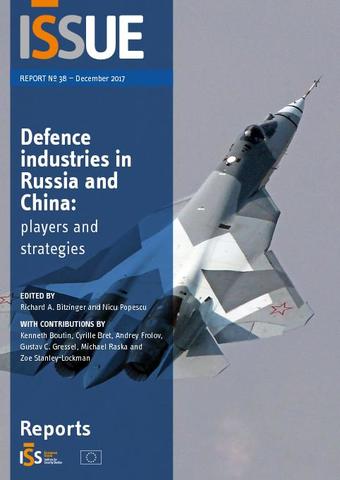
Defence industries in Russia and China: players and strategies
This Report turns the spotlight on two major players in the global defence industry: Russia and China. It examines how both countries, however different in their trajectory and ambition, have in recent years narrowed the industrial and technological gap with the European armaments sector and are now openly challenging the West’s traditional superiority in this domain. The loss of this military-technological edge could severely undermine the West’s ability to counter direct Russian or Chinese military threats, while also entailing greater competition for European defence industries, thus reshaping the global arms trade – with repercussions for security relationships around the world.Drones in Counterterrorism: The Primacy of Politics Over Technology
Pentagon Delays Deadline For Military Suppliers to Meet Cybersecurity Rules
The Pentagon will delay a Jan. 1 deadline for all of its suppliers to meet a set of new regulations largely designed to better protect sensitive military data and weapon blueprints. By year’s end, companies must instead merely show that they have a plan in place to meet the regulations, Ellen Lord, the defense undersecretary for acquisition, technology and logistics told the Senate Armed Services Committee.A ‘World Without Mind’: Big Tech’s Dangerous Influence
IRANIAN CYBER ARMY
Army’s first directly-commissioned cyber officers could be on duty by next May
Next-Gen Drones: Making War Easier for Dictators & Terrorists
The introduction of armed unmanned aerial vehicles (UAVs) permanently altered the modern battlefield. New technological advances in drone technology could do it again: from advanced materials that allow drones to fly, roll, run or swim in less forgiving environments, to thinking software than makes them more independent, to stealth technology that renders them even less visible. On the positive side, the intelligence that drones provide helps focus lethality on the intended target and limit the risk of civilian casualties and friendly fire incidents. But drone advances also will get cheaper to copy, so non-state actors will be able to employ them as well, giving insurgents or terrorists an outsized advantage.The Pentagon wants big-data analytics in every rucksack
In the (near) future, troops on the ground will check their kit to make sure everything is accounted for as they head into battle, and the most critical tool will be data access. That is, at least, what some future-focused tech officials at the Pentagon say, pointing to the growing importance of cloud capabilities and access to data at the tactical edge. To take on the increasing appetite for data, officials are pursuing pilot programs and working diligently on tools like much-needed algorithms that make intelligence products from the volumes of data pouring in from sources like unmanned aerial systems’ video feeds.