September 18, 2014
Prime Minister Narendra Modi has bent over backwards to befriend China. Yet Chinese President Xi Jinping’s India visit has been marred by border incursions, including one that ranks, in terms of the number of intruding troops, as the worst in many years. Modi coined his “inch toward miles” slogan to underscore how India-China collaboration could positively transform Asia. But the slogan more aptly describes the salami-slice strategy of the People’s Liberation Army (PLA) to use stealthy incursions to incrementally change facts on the ground.
The PLA is taking advantage of its rising political clout at home to escalate border incursions. It has been undeterred even by Xi’s visit. After all, in the run-up to Premier Li Keqiang’s New Delhi visit last year, the PLA staged a deep, three-week-long intrusion into Indian territory.
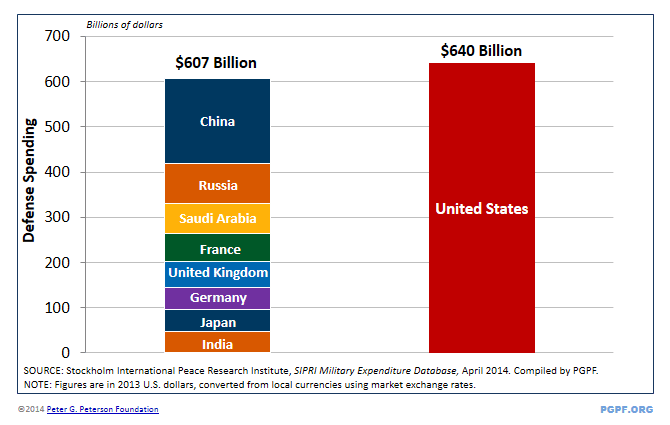
Enjoying increasing autonomy and soaring budgets, the PLA of late appears ready to upstage even the Communist Party of China. Ideologically adrift, the party is becoming dependent on the PLA for its political legitimacy and to ensure domestic order. The PLA sees itself as the power behind the throne, encouraging it to assert its primacy.
China’s expanding ‘core interests’ and its willingness to take on several neighbours simultaneously point to how the PLA is calling the shots. With the PLA gaining political muscle and boasting financial assets and enterprises across the nation, it is seizing opportunities to nibble at neighbouring countries’ territories, besides driving an increasingly muscular foreign policy.
The more powerful the PLA has become at the expense of the civilian collective leadership, the more China has presented itself as a tiger on the prowl by discarding Deng Xiaoping’s dictum ‘tao guang yang hui’ (keep a low profile and not bare your capabilities). It is as if China has decided that its moment has finally arrived.
This structural transformation parallels the one that occurred in Imperial Japan, which rose dramatically as a world power in one generation after the 1868 Meiji Restoration. Boosted by war victories against Manchu-ruled China and Tsarist Russia, the Japanese military gradually went on to dictate terms to the civilian government, opening the path to aggression and conquest.
The PLA’s increasing clout has led China to resurrect territorial and maritime disputes and assert new sovereignty claims. Such assertiveness also helps the party to turn nationalism into the legitimating credo of its monopoly on power. But as the latest Ladakh intrusions show, the PLA is ready to strike even at the risk of drawing attention to the wrong issues during a Chinese presidential visit.
Whereas the Indian military continues to be shut out from the policymaking loop in a way unmatched in any other established democracy, the PLA has repeatedly blindsided government leaders with military actions, weapon displays or hawkish statements, prompting US defence secretary Robert Gates in 2011 to warn of “a disconnect between the military and the civilian leadership” in China. The recent rise of a new Chinese dynasty of ‘princelings’ or sons of revolutionary heroes who have close contacts in the military has narrowed that disconnect.
 The process of giving up on hubris has left America neither feared nor loved.
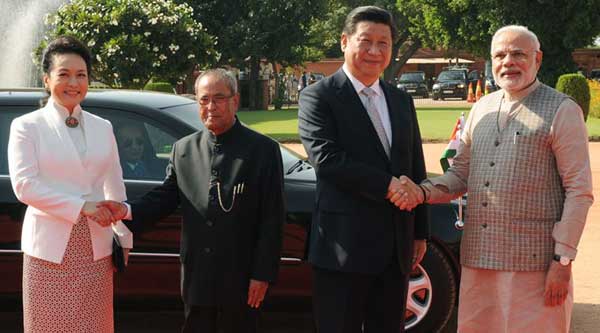
 Prime Minister Narendra Modi, Chinese President Xi Jinping and his wife Peng Liyuan.




 Gen. Martin Dempsey, chairman of the Joint Chiefs of Staff, testifies before the Senate Armed Services Committee on Capitol Hill on Sept. 16, 2014 in Washington.