The Profession of Arms: A Guide for Young Army Officers
It takes courage, especially for a young officer, to check a man met on the road for not saluting properly or for slovenly appearance, but, every time he does, it adds to his stock of moral courage, and whatever the soldier may say, he has respect for the officer who does pull him up.
Read Document →The Dragon's Teeth: Assessing China's Military Modernization
PLA has focused on modernising its capabilities across all warfare domains to achieve these goals. This includes land, air, and maritime operations, nuclear, space, counter-space, electronic warfare and cyberspace operations, aiming to become a fully integrated joint force.
Read Document →Transforming the PLA: A Decade of reorganisation from SSF to ISF
PRC has engaged in a sustained and broad effort to transform the PLA from an infantry-heavy, low-technology, ground forces-centric military into a high-technology, networked force with an increasing emphasis on joint operations and naval and air power projection.
Read Document →Eyes without Borders: Exploring the World of Open Source Intelligence (OSINT) in the Digital Age
Open Source Intelligence (OSINT) is gaining prominence with the rise of social media, the digital society and the vast growth of publicly and commercially available information (PAI and CAI).
Read Document →
The PLA’s Developing Cyber Warfare Capabilities and India's Options
Informationised warfare blurs the lines between peacetime and wartime. A nation in the information age cannot wait for the hostilities to break out to collect intelligence, carryout influence operations, develop antisatellite systems or design computer software weapons.
Read Document →
Galwan and After
Why did China did this when he is under tremendous pressure in all fronts, is this China's salami slice tactics being progressed rigorously, what will be new Rules of Engagement, what will be escalatory control mechanism, who has taken this decision, will there be some pressure put by China in India's North-East through insurgency.
Read Document →
India’s Joint Doctrine for Cyberspace Operations: A Critical Review
Chief of Defence Staff (CDS) General Anil Chauhan and Secretary, Department of Military Affairs, formally released declassified versions of the Joint Doctrines for Cyberspace Operations during the Chiefs of Staff Committee meeting in New Delhi.
Read Document →
Know your Enemy General(now Field Marshal) Syed Aseem Munir
Gen SA Munir's position in the hierarchy of Pakistan was not very comfortable. The state of economy, insurgency in Pakhtoonistan and Balochistan, attack on the Jaffar Express, constant protests by supporters of Imran Khan's supporters inside and outside of parliament.
Read Document →
Decoding Operation SINDOOR: Key Aspects and Implications
Precision strikes were carried out on nine sites—four in Pakistan and five in PoK—linked to anti-India terrorist groups such as the LeT, JeM and the Hizbul Mujahideen. The targeted sites included Muridke (LeT headquarters) and Bahawalpur (JeM headquarters).
Read Document →
Chinese Cyber Exploitation in India's Power Grid - Is There a linkage to Mumbai Power Outage?
The New York Times (NYT), based on analysis by a U.S. based private intelligence firm Recorded Future, reported that a Chinese entity penetrated India’s power grid at multiple load dispatch points. Chinese malware intruded into the control systems that manage electric supply across India, along with a high-voltage transmission substation and a coal-fired power plant
Read Document →15 September 2014
Arab states mull air strikes on ISIS
***** It’s Not Airpower Vs. Boots On Ground Any More
**** Reflections on the Modern Battlefield: A Discussion with General Anthony Zinni
PM gives clarity to security, writes Anil Chait
September 11, 2014
Some of the responses of the government to security related developments provide a clear glimpse of how it seeks to secure India and Indians and the message it conveys to our nation's adversaries. Prime Minister Narendra Modi's address to military personnel at Ladakh on August 12 was the occasion he used to spell out the first, notable policy shift. This was followed by the Government's support to the 'tough' posturing in dealing with ceasefire violations and later, the decision to put off the Foreign Secretary talks, after the Pakistan High Commissioner arranged meetings with Kashmiri separatist leaders, changed the status quo in quick time. While departing for Japan on Aug 31 he cautioned Islamabad, to keep the environment free of terrorism and violence and assured Japan, that there will be no change to India's nuclear doctrine, while he seeks to build security and trade pacts with them.
Finally recommending 'vichar' instead of 'vistar' to those possessing the 18th Century expansionist mindset, he decided to sit with Japan as he stands up to China's President Mr Xi Jinping.
Tolerance
Indian soldiers patrolling the LoC.The contours of the new approach towards national security should emerge from an examination of the measured words and actions in each case. Take first, the address to troops. Delivered at Kargil, a militarily significant location, the Prime Minister spelled out his assessment that Pakistan now had no strength to fight an open conventional war, which is why it has taken recourse to a proxy (terror) war against India. In strategic terms, this meant the 'conventional' warfare route by a belligerent neighbour has been abandoned in favour of the 'sub conventional', and 'asymmetrical' warfare route to deal with India. Coming from the Prime Minister, this is an observation of immense significance.
The lowering of the tolerance threshold for indiscriminate firing across the IB and LoC was another index of change. Message out to Pakistan is clear, that India is no more a soft state and that the costs of bleeding it, would have to be borne by blood. The Forces have also been asked to give a befitting reply. While Pakistan daily, Jung, reports heavy losses on the Pakistani side, cautionary messages in content are unambiguous - "escalating tension is not good; Pakistan should mend its ways because if it does not then it will not be good for them; environment is not conducive for talks", etc. The decision to call off Secretary level talks with Pakistan follows the caveat 'either talk to us or to separatists'. Reversing Pakistan's perception of India being defensive, soft and conceding, political parties in J&K such as National Conference and PDP stood isolated on the eve of state elections whatever be their stand for the political remedy of the Kashmir dispute.
Service before self: Army camps submerged as soldiers save Kashmir
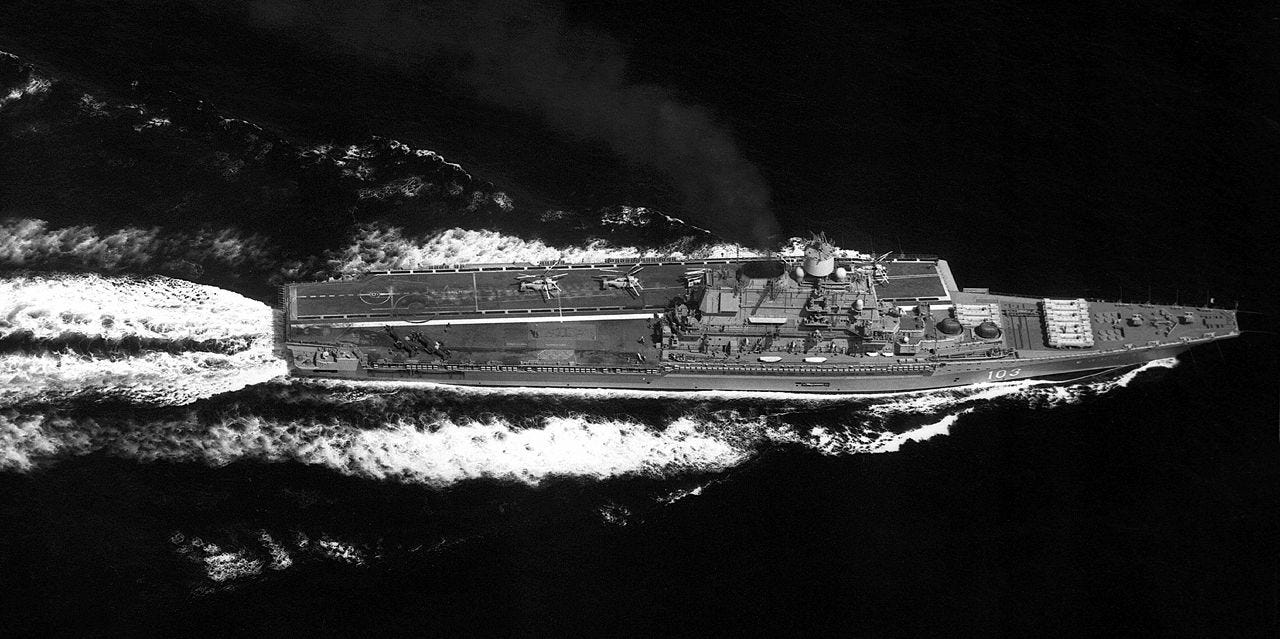
Whatever You Do, Don’t Buy Your Aircraft Carrier From Russia India learned the hard way with INS ‘Vikramaditya’
Soviet helicopter carrier Baku, pre-makeover. Note missile armament, guns. Photo via WikipediaA Negotiable Nuclear Deal
Taliban Fighters Have Returned in Force to Sangin In Helmand Province
Emma Graham Harrison
Royal Marines launching an attack in 2007 to remove Taliban insurgents from Sangin, Afghanistan. Photograph: Corporal Adrian Harlen/PA
The gains from Britain’s bloodiest battles in Afghanistan are now at risk afterTaliban fighters swarmed into Sangin and nearby parts of northern Helmand, taking control of villages, overrunning checkpoints and threatening the dusty towns that serve as the only government outposts in the area.
Hundreds of civilians have been killed or injured and thousands have fled their homes because of the fierce fighting, less than a year after David Cameron declared “mission accomplished”. The military setback in an area that became symbolic of the wider battle for Afghanistan raises uncomfortable questions about Helmand’s future and the British sacrifices meant to secure it from insurgent fighters.
"These attacks have been going on for around three months now," said Sulaiman Shah, Sangin district governor, after reluctantly agreeing to a telephone interview. He had been ordered not to speak to journalists. "There are some places which are under Taliban control," he said, naming several villages and warning that the situation was deteriorating. "We have had security problems over the last two or three years, but now it is much worse – the Taliban are getting stronger."
Sangin became a death trap for foreign forces from the moment they arrived in 2006. The first unit in the area endured the most intense ground fighting British soldiers had seen since the Korean war.
Nearly a quarter of the 453 British soldiers who lost their lives in Afghanistan died in Sangin or from injuries inflicted during fighting there, and when American troops replaced UK forces in late summer 2010 they initially had an even higher casualty rate.
By the time the last US marines left in the late spring of this year, the road north to a major dam had been cleared and the government was in control of the entire area. It was a shaky security, though, based on soldiers who had already tried to strike non-aggression deals with the Taliban, and police who were ill-prepared to protect themselves against battle-hardened insurgents.
The ceasefire holds uneasily, but tension in eastern Ukraine will still trouble the governments in both Kiev and Moscow
"Cargo 200": Russian Government Trying to Suppress Information About Deaths of Russian Soldiers in Combat in the Ukraine
How Good Is the Evidence That Russian Troops Took Part in the Fighting in the Eastern Ukraine
Who won the Russia-Ukraine war?
http://euobserver.com/opinion/125547