In late December, China’s hosting of a trilateral meeting with the foreign ministers of Afghanistan and Pakistan drew headlines. “China Steps Up to Broker Peace in Afghan-Pakistan Conflict,” Bloomberg reported; “China can help bring peace to Afghanistan,” the South China Morning Post declared. Reuters highlighted China’s announcement that Afghanistan would be included into the China-Pakistan Economic Corridor (CPEC). Fewer took note of the subsequent meeting between Chinese State Councilor and Defense Minister Chang Wanquan and Afghan Minister of Defense Tariq Shah Bahrami. Bahrami also met with the Vice Chairman of China’s Central Military Commission Xu Qilian. The Diplomat’s Ankit Panda covered the meeting, noting that it “underlined the increasingly close military-to-military ties between the two countries.”The Profession of Arms: A Guide for Young Army Officers
It takes courage, especially for a young officer, to check a man met on the road for not saluting properly or for slovenly appearance, but, every time he does, it adds to his stock of moral courage, and whatever the soldier may say, he has respect for the officer who does pull him up.
Read Document →The Dragon's Teeth: Assessing China's Military Modernization
PLA has focused on modernising its capabilities across all warfare domains to achieve these goals. This includes land, air, and maritime operations, nuclear, space, counter-space, electronic warfare and cyberspace operations, aiming to become a fully integrated joint force.
Read Document →Transforming the PLA: A Decade of reorganisation from SSF to ISF
PRC has engaged in a sustained and broad effort to transform the PLA from an infantry-heavy, low-technology, ground forces-centric military into a high-technology, networked force with an increasing emphasis on joint operations and naval and air power projection.
Read Document →Eyes without Borders: Exploring the World of Open Source Intelligence (OSINT) in the Digital Age
Open Source Intelligence (OSINT) is gaining prominence with the rise of social media, the digital society and the vast growth of publicly and commercially available information (PAI and CAI).
Read Document →
The PLA’s Developing Cyber Warfare Capabilities and India's Options
Informationised warfare blurs the lines between peacetime and wartime. A nation in the information age cannot wait for the hostilities to break out to collect intelligence, carryout influence operations, develop antisatellite systems or design computer software weapons.
Read Document →
Galwan and After
Why did China did this when he is under tremendous pressure in all fronts, is this China's salami slice tactics being progressed rigorously, what will be new Rules of Engagement, what will be escalatory control mechanism, who has taken this decision, will there be some pressure put by China in India's North-East through insurgency.
Read Document →
India’s Joint Doctrine for Cyberspace Operations: A Critical Review
Chief of Defence Staff (CDS) General Anil Chauhan and Secretary, Department of Military Affairs, formally released declassified versions of the Joint Doctrines for Cyberspace Operations during the Chiefs of Staff Committee meeting in New Delhi.
Read Document →
Know your Enemy General(now Field Marshal) Syed Aseem Munir
Gen SA Munir's position in the hierarchy of Pakistan was not very comfortable. The state of economy, insurgency in Pakhtoonistan and Balochistan, attack on the Jaffar Express, constant protests by supporters of Imran Khan's supporters inside and outside of parliament.
Read Document →
Decoding Operation SINDOOR: Key Aspects and Implications
Precision strikes were carried out on nine sites—four in Pakistan and five in PoK—linked to anti-India terrorist groups such as the LeT, JeM and the Hizbul Mujahideen. The targeted sites included Muridke (LeT headquarters) and Bahawalpur (JeM headquarters).
Read Document →
Chinese Cyber Exploitation in India's Power Grid - Is There a linkage to Mumbai Power Outage?
The New York Times (NYT), based on analysis by a U.S. based private intelligence firm Recorded Future, reported that a Chinese entity penetrated India’s power grid at multiple load dispatch points. Chinese malware intruded into the control systems that manage electric supply across India, along with a high-voltage transmission substation and a coal-fired power plant
Read Document →7 January 2018
Why Would China Help Build an Afghan Military Base in Badakhshan?
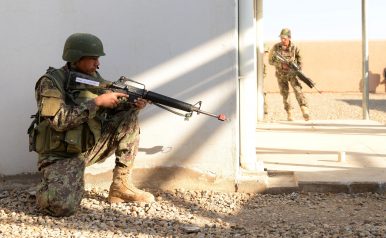
In late December, China’s hosting of a trilateral meeting with the foreign ministers of Afghanistan and Pakistan drew headlines. “China Steps Up to Broker Peace in Afghan-Pakistan Conflict,” Bloomberg reported; “China can help bring peace to Afghanistan,” the South China Morning Post declared. Reuters highlighted China’s announcement that Afghanistan would be included into the China-Pakistan Economic Corridor (CPEC). Fewer took note of the subsequent meeting between Chinese State Councilor and Defense Minister Chang Wanquan and Afghan Minister of Defense Tariq Shah Bahrami. Bahrami also met with the Vice Chairman of China’s Central Military Commission Xu Qilian. The Diplomat’s Ankit Panda covered the meeting, noting that it “underlined the increasingly close military-to-military ties between the two countries.”Trump, Citing Pakistan as a ‘Safe Haven’ for Terrorists, Freezes Aid
Pakistan Loses Importance In US Strategic Calculus 2018 – Analysis
Trump’s Belligerence Toward Pakistan Isn’t Unreasonable
On Tuesday, Trump administration officials joined the president to criticize Pakistan’s commitment to Afghanistan’s stability, accusing Islamabad of playing “a double game for years.” The comments by Nikki Haley, the U.S. ambassador to the United Nations, H.R. McMaster, the national-security-adviser, and Sarah Huckabee Sanders, the White House spokesperson, are likely to increase the pressure on Pakistan, which is still smarting over the president’s first tweet of the year:China’s Soft and Sharp Power
IF WAR WITH THE U.S. COMES, WHAT ARE THE CHINESE MILITARY'S STRONGEST WEAPONS?
Forget North Korea or Russia: The Real Threat to America Is China
Coming to Grips With a Rising China
Backgrounder: China’s Continuing Attempts to Increase Its Influence Around the World
CHINA'S NEW HYPERSONIC MISSILES COULD HIT ANYWHERE IN THE U.S. IN UNDER AN HOUR: CHINESE EXPERTS
China’s ‘Long Arm’ Scholars and political leaders describe increasing concerns about Chinese government influence over teaching and research in the U.S. and Australia.
Two times in Kevin Carrico’s six years of teaching he’s been approached by students from China who told him that things they said in his classroom about sensitive subjects somehow made their way to their parents back home.Turkey: Learning From the Ottomans’ Mistakes
Why nuclear war with North Korea is less likely than you think
On Tuesday night, in response to North Korean leader Kim Jong Un’s claim to have a nuclear button on his desk, President Trump tweeted, “I too have a Nuclear Button, but it is a much bigger & more powerful one than his, and my Button works!” THE CUTTING-EDGE ISRAELI MILITARY UNIT REVOLUTIONIZING FIELD INTELLIGENCE
The ‘Nuclear Button’ Explained: For Starters, There’s No Button
The image of a leader with a finger on a button — a trigger capable of launching a world-ending strike — has for decades symbolized the speed with which a nuclear weapon could be launched, and the unchecked power of the person doing the pushing. There is only one problem: There is no button. A military aide traveling with President Trump in December carried the so-called nuclear football as he walked toward Marine One, the president’s helicopter. CreditMark Wilson/Getty ImagesWhere The Uranium Comes From
Global Trends to 2035: Geo-politics and International Power
The case for optimism in 2018 My first assumption for the year is there will not be a war on the Korean peninsula
Intelligence: Mossad Milks Facebook
The Smoldering Hot Spots of Latin American Political Instability
Transitions of political power in Latin America have become generally peaceful over the past three decades. But in Bolivia, Cuba, and Honduras — where deeply entrenched governments will dispute control against political challengers — domestic politics will become more unstable over the coming years.Bolivian President Evo Morales' weakening hold over domestic politics will be the main driver of instability in that country in coming years.In Cuba, the eventual lifting of the U.S. economic embargo will bring with it more money, leaving political leaders to jockey for influence and greater access to revenue from trade and tourism.In Honduras, political unrest will persist over the next few years as the country's opposition tries to resist unpopular government moves.