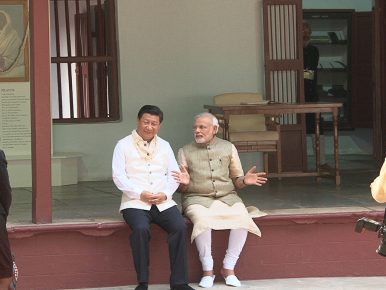
Indian Prime Minister Narendra Modi will meet Chinese President Xi Jinping for an unofficial bilateral summit on April 27 and 28, the two countries announced on Sunday. The meeting will take place in Wuhan, in China’s Hubei province. The sudden announcement of this kind of an unprecedented meeting between the leaders of these two countries was announced after a trip by Indian External Affairs Minister Sushma Swaraj to China to meet with her Chinese counterpart Wang Yi. A Modi trip to China had long been rumored amid reports of Indian attempts to “reset” bilateral relations with China, but the announcement for an end-April summit is especially quick. The Indian prime minister will also travel to China in June, for the Shanghai Cooperation Organization’s security summit.The Profession of Arms: A Guide for Young Army Officers
It takes courage, especially for a young officer, to check a man met on the road for not saluting properly or for slovenly appearance, but, every time he does, it adds to his stock of moral courage, and whatever the soldier may say, he has respect for the officer who does pull him up.
Read Document →The Dragon's Teeth: Assessing China's Military Modernization
PLA has focused on modernising its capabilities across all warfare domains to achieve these goals. This includes land, air, and maritime operations, nuclear, space, counter-space, electronic warfare and cyberspace operations, aiming to become a fully integrated joint force.
Read Document →Transforming the PLA: A Decade of reorganisation from SSF to ISF
PRC has engaged in a sustained and broad effort to transform the PLA from an infantry-heavy, low-technology, ground forces-centric military into a high-technology, networked force with an increasing emphasis on joint operations and naval and air power projection.
Read Document →Eyes without Borders: Exploring the World of Open Source Intelligence (OSINT) in the Digital Age
Open Source Intelligence (OSINT) is gaining prominence with the rise of social media, the digital society and the vast growth of publicly and commercially available information (PAI and CAI).
Read Document →
The PLA’s Developing Cyber Warfare Capabilities and India's Options
Informationised warfare blurs the lines between peacetime and wartime. A nation in the information age cannot wait for the hostilities to break out to collect intelligence, carryout influence operations, develop antisatellite systems or design computer software weapons.
Read Document →
Galwan and After
Why did China did this when he is under tremendous pressure in all fronts, is this China's salami slice tactics being progressed rigorously, what will be new Rules of Engagement, what will be escalatory control mechanism, who has taken this decision, will there be some pressure put by China in India's North-East through insurgency.
Read Document →
India’s Joint Doctrine for Cyberspace Operations: A Critical Review
Chief of Defence Staff (CDS) General Anil Chauhan and Secretary, Department of Military Affairs, formally released declassified versions of the Joint Doctrines for Cyberspace Operations during the Chiefs of Staff Committee meeting in New Delhi.
Read Document →
Know your Enemy General(now Field Marshal) Syed Aseem Munir
Gen SA Munir's position in the hierarchy of Pakistan was not very comfortable. The state of economy, insurgency in Pakhtoonistan and Balochistan, attack on the Jaffar Express, constant protests by supporters of Imran Khan's supporters inside and outside of parliament.
Read Document →
Decoding Operation SINDOOR: Key Aspects and Implications
Precision strikes were carried out on nine sites—four in Pakistan and five in PoK—linked to anti-India terrorist groups such as the LeT, JeM and the Hizbul Mujahideen. The targeted sites included Muridke (LeT headquarters) and Bahawalpur (JeM headquarters).
Read Document →
Chinese Cyber Exploitation in India's Power Grid - Is There a linkage to Mumbai Power Outage?
The New York Times (NYT), based on analysis by a U.S. based private intelligence firm Recorded Future, reported that a Chinese entity penetrated India’s power grid at multiple load dispatch points. Chinese malware intruded into the control systems that manage electric supply across India, along with a high-voltage transmission substation and a coal-fired power plant
Read Document →27 April 2018
Modi Will Meet Xi For an Informal Summit: What's on the Agenda?
Indian Prime Minister Narendra Modi will meet Chinese President Xi Jinping for an unofficial bilateral summit on April 27 and 28, the two countries announced on Sunday. The meeting will take place in Wuhan, in China’s Hubei province. The sudden announcement of this kind of an unprecedented meeting between the leaders of these two countries was announced after a trip by Indian External Affairs Minister Sushma Swaraj to China to meet with her Chinese counterpart Wang Yi. A Modi trip to China had long been rumored amid reports of Indian attempts to “reset” bilateral relations with China, but the announcement for an end-April summit is especially quick. The Indian prime minister will also travel to China in June, for the Shanghai Cooperation Organization’s security summit.Trade war
How Walmart’s Purchase Of Flipkart Will Change The Rules Of Online Game
Uzbekistan Agrees to ‘Take Part’ in TAPI
Uzbekistan has reportedly agreed to participate in the massive Turkmenistan-Afghanistan-Pakistan-India (TAPI) pipeline. The news comes as Turkmen President Gurbanguly Berdimuhamedov paid a visit to Tashkent on Monday. As the visit began, RFE/RL reported that sources had indicated TAPI was on the agenda, followed by Reutersreporting that Uzbek President Shavkat Mirziyoyev had told journalists after meeting with the Turkmen president, “We have agreed that Uzbekistan will also take part in this project.”Bangladesh Set to Reach Economic Par With India
The United Nations Committee for Development Policy announced in March that Bangladesh had successfully met the criteria to graduate from a “least developed country” (LDC) to a “developing country” (DC). That sounds like a lot of bureaucratese. But it isn’t. The UN’s low-key proclamation has led to celebration in Bangladesh and for good reason. This once famously impoverished nation – regularly crushed by famine and floods – will soon have the same economic status as Mexico, Turkey, and its neighbor India. And it achieved that ranking fast; Bangladesh has been an independent nation for just 47 years.Zuckerberg Was Called Out Over Myanmar Violence. Here’s His Apology.
Rohingya refugees arriving in Bangladesh last year from Myanmar, where advocacy groups have criticized Facebook’s approach to hate speech. In an email, Mark Zuckerberg, Facebook’s chief executive, told the groups: “I apologize for not being sufficiently clear about the important role that your organizations play in helping us understand and respond to Myanmar-related issues.” Last week, after frustrated activists from Myanmar sent an open letter to Mark Zuckerberg, the chief executive of Facebook, they got something unexpected: a reply. The activists, representing six civil society organizations, harshly criticized Mr. Zuckerberg in the letter, saying he had mischaracterized Facebook’s response to violence-inciting messages in Myanmar and had not devoted sufficient resources to enforcing its hate speech rules in the violence-stricken country. Mr. Zuckerberg wrote back to the group the next day from his personal email address, apologizing for misspeaking and outlining steps that Facebook was taking to increase its moderation efforts.How America can win its tech war with China
A new Cold War with the US and China as bitter rivals would be a grievous mistake
In the 17 years since the 9/11 attacks, the United States has made combating terrorism worldwide its number one national security priority. The shift away from its Cold War and immediate post-Cold War stance was the biggest it had made since the end of the Second World War and resulted in trillions of dollars of expenditures, two major wars and constant US military engagement in the Middle East for nearly two decades.HOW DOES CHINA'S NAVY COMPARE TO AMERICA'S?
How China Is Buying Its Way Into Europe
Tibet can be in China: Dalai Lama
Caliphate - Islamic State & The Fall of Mosul Chapter Two: Why Would Anyone Join ISIS?
Can Macron and Trump Bring Stability to the Indo-Pacific Region?
New USAF African Drone Base Being Constructed Outside Agadez in Niger
North Korea’s Nuclear Weapons: The Unfinished Arsenal
Why Isn't Russia an Aircraft Carrier Superpower?
Like Vietnam, it is Time to Cut Our Loses in Afghanistan
Where U.S. Trade Policy and Grand Strategy Intersect
History shows how trade policy can be a potent tool in the U.S. strategic arsenal, especially when containing peer competitors. Trade policy was a matter of intense debate for the Founding Fathers, but it took a massive shock in the form of the Great Depression for the United States to restructure and position itself to wield trade policy as a tool of grand strategy. U.S. President Donald Trump's economic assault on U.S. trading partners is a reaction to decades of pent-up economic discontent and a nebulous era in the global arena in which the United States lacked a well-defined adversary. But great power competition is back, and with it will come a more strategic approach toward trade and a focus on containing China.Will robots and AI take your job? The economic and political consequences of automation
Syria in 2018 is not Iraq in 2003
Last Saturday, when the United States, the UK and France launched strikes on three chemical facilities in Syria, the move was met with disapproval in some quarters. The pre-announced spectacle blew up three buildings and took no lives, but some pronounced it a "dangerous escalation". Some spoke of its "illegality". All complained about its disregard for the OPCW investigation. The action, which lasted less than an hour, was an escalation only if everything that preceded it was normal. By this reckoning, Syria has now returned to its status quo of genocide by the Assad regime.Israel celebrates but is war with Iran looming?
Israelis enjoyed a lavish party last week to mark the nation’s seven eventful decades, but the threat to its existence could hardly have been greater An RAF Hercules takes part in an air show that was part of Israel’s independence celebrations last week. There were fireworks, concerts, torch processions and parties throughout the country. In Jerusalem the night sky was illuminated by 300 drones that coalesced to form images of favourite Israeli symbols,such as the national flag and a dove with an olive branch in its mouth. The celebrations included a live, televised retelling of Jewish history dating to biblical times. In one scene children with yellow stars pinned to their clothes fled marching Nazi soldiers. Another showed pioneers building the fledgling Jewish state.