The Profession of Arms: A Guide for Young Army Officers
It takes courage, especially for a young officer, to check a man met on the road for not saluting properly or for slovenly appearance, but, every time he does, it adds to his stock of moral courage, and whatever the soldier may say, he has respect for the officer who does pull him up.
Read Document →The Dragon's Teeth: Assessing China's Military Modernization
PLA has focused on modernising its capabilities across all warfare domains to achieve these goals. This includes land, air, and maritime operations, nuclear, space, counter-space, electronic warfare and cyberspace operations, aiming to become a fully integrated joint force.
Read Document →Transforming the PLA: A Decade of reorganisation from SSF to ISF
PRC has engaged in a sustained and broad effort to transform the PLA from an infantry-heavy, low-technology, ground forces-centric military into a high-technology, networked force with an increasing emphasis on joint operations and naval and air power projection.
Read Document →Eyes without Borders: Exploring the World of Open Source Intelligence (OSINT) in the Digital Age
Open Source Intelligence (OSINT) is gaining prominence with the rise of social media, the digital society and the vast growth of publicly and commercially available information (PAI and CAI).
Read Document →
The PLA’s Developing Cyber Warfare Capabilities and India's Options
Informationised warfare blurs the lines between peacetime and wartime. A nation in the information age cannot wait for the hostilities to break out to collect intelligence, carryout influence operations, develop antisatellite systems or design computer software weapons.
Read Document →
Galwan and After
Why did China did this when he is under tremendous pressure in all fronts, is this China's salami slice tactics being progressed rigorously, what will be new Rules of Engagement, what will be escalatory control mechanism, who has taken this decision, will there be some pressure put by China in India's North-East through insurgency.
Read Document →
India’s Joint Doctrine for Cyberspace Operations: A Critical Review
Chief of Defence Staff (CDS) General Anil Chauhan and Secretary, Department of Military Affairs, formally released declassified versions of the Joint Doctrines for Cyberspace Operations during the Chiefs of Staff Committee meeting in New Delhi.
Read Document →
Know your Enemy General(now Field Marshal) Syed Aseem Munir
Gen SA Munir's position in the hierarchy of Pakistan was not very comfortable. The state of economy, insurgency in Pakhtoonistan and Balochistan, attack on the Jaffar Express, constant protests by supporters of Imran Khan's supporters inside and outside of parliament.
Read Document →
Decoding Operation SINDOOR: Key Aspects and Implications
Precision strikes were carried out on nine sites—four in Pakistan and five in PoK—linked to anti-India terrorist groups such as the LeT, JeM and the Hizbul Mujahideen. The targeted sites included Muridke (LeT headquarters) and Bahawalpur (JeM headquarters).
Read Document →
Chinese Cyber Exploitation in India's Power Grid - Is There a linkage to Mumbai Power Outage?
The New York Times (NYT), based on analysis by a U.S. based private intelligence firm Recorded Future, reported that a Chinese entity penetrated India’s power grid at multiple load dispatch points. Chinese malware intruded into the control systems that manage electric supply across India, along with a high-voltage transmission substation and a coal-fired power plant
Read Document →26 December 2015
Pretty Violence
Christmas 2015: Will Syria & Iraq Become Washington’s Stalingrad?
22.12.2015 , By Ronald Holland
73 years ago on Christmas Eve 1942 German troops sang Silent Night on a European wide radio Christmas program from the distant battlefields of Nazi conquest outside Leningrad in the North and from surrounded Stalingrad on the southern Eastern Front to the Middle East. Also all across Nazi occupied Europe, from Italy and Norway to the Atlantic coastlines of Fortress Europe the soldiers sang to their families and listeners back home starting to question the promises of Nazi victory propaganda.
The Dangers of Empire Overreach in 1942 & 2016
Yes Germany excelled at propaganda, as does the establishment cable and print news media in the United States today. Although the radio show had the intended propaganda effect of temporarily raising civilian morale, Germany and their fair weather allies were already stretched way too thin around the expansive parameter of Nazi conquered and occupied territory.
Print version
Now on Christmas 2015 there is a Washington military effort also stretched too far among our many distant conquests, peacekeeping missions, occupations and attempts to secure oil resources and pipelines. Our foreign policy is designed to perpetuate the failing petrodollar system. Like the Germans 70 plus years ago, our allies and local populations generally hate us and our attempts to go after local resistance groups only results in the growth of more anti-American groups we describe as terrorists.
In America Today Political Correctness Is Just Fascism By Another Name
NSA advisory sparks concern of secret advance ushering in cryptoapocalypse
Once elliptic curve crypto was viewed as a savior. Now its future looks doomed.
by Dan Goodin - Oct 23, 2015
112
National Nuclear Security Administration In August, National Security Agency officials advised US agencies and businesses to prepare for a not-too-distant time when the cryptography protecting virtually all sensitive government and business communications is rendered obsolete by quantum computing. The advisory recommended backing away from plans to deploy elliptic curve cryptography, a form of public key cryptography that the NSA spent the previous 20 years promoting as more secure than the older RSA cryptosystem.
Quantum computing threatens crypto as we know it. The NSA is taking notice. Almost immediately, the dramatic about-face generated questions and anxiety. Why would the NSA abruptly abandon a series of ECC specifications it had championed for so long? Why were officials issuing the advice now when a working quantum computer was 10 to 50 years away, and why would they back away from ECC before recommending a suite of quantum-resistant alternatives? The fact that the NSA was continuing to endorse use of RSA, which is also vulnerable to quantum computing, led some observers to speculate there was a secret motivation that had nothing to do with quantum computing. On Tuesday, researchers Neal Koblitz and Alfred J. Menezes published a paper titled A Riddle Wrapped in an Enigma that compiles some of the competing theories behind the August advisory. The researchers stressed that that their paper isn't academic and at times relies on unsourced facts and opinions. And sure enough, some of the theories sound almost conspiratorial. Still, the paper does a good job of evaluating the strengths and weaknesses of the NSA's highly unexpected abandonment of ECC in a post quantum crypto (PQC) world.
"The PQC announcement suggests that NSA has no interest in this topic because it now views ECC as only a stopgap solution," the researchers wrote. "This caught many people by surprise, since it is widely believed that ECC will continue to be used extensively for at least another decade or two."
Did RBI Just Hint That Indian Corporates Have Reached Ponzi Stage Of Finance?
The latest Financial Stability Report of the RBI indicates that many corporates are not in a position to even pay interest on their loans.
Vivek Kaul,Vivek Kaul is the author of the 'Easy Money' trilogy. He tweets @kaul_vivek
24 Dec, 2015
The Reserve Bank of India (RBI) releases the Financial Stability Report twice a year. The second report for this year was released yesterday (i.e. December 23, 2015). Buried in this report is a very interesting box titled ‘In Search of Some Old Wisdom;. In this box, the RBI has resurrected the economist Hyman Minsky. Minsky has been rediscovered by the financial world in the years that have followed the financial crisis which started with the investment bank Lehman Brothers going bust in September 2008.
So what does the RBI say in this box?
“When current wisdom does not offer solutions to extant problems, old wisdom can sometimes be helpful. For instance, the global financial crisis compelled us to take a look at the Minsky’s financial stability hypothesis which posited the debt accumulation by non-government sector as the key to economic crisis.”
And what is Minsky’s financial stability hypothesis? Actually Minsky put forward the financial instability hypothesis and not the financial stability hypothesis as the RBI points out. I know I am nit-picking here but one expects the country’s central bank to get the name of an economic theory right. I guess given that the name of the report is the Financial Stability Report, someone mixed the words “stability” and “instability”.
The basic premise of this hypothesis is that when times are good, there is a greater appetite for risk and banks are willing to extend riskier loans than usual. Businessmen and entrepreneurs want to expand their businesses, which leads to increased investment and corporate profits.
All that was discussed at Dhordo
December 23, 2015
The conference in Kutch was a landmark, where there was a frank exchange of views between the Prime Minister and State DGPs on how to bring the police closer to the people. There is an acute need to divorce politics from policing
As a three-term Chief Minister of Gujarat, Prime Minister Narendra Modi may rightly be expected to know a thing or two about policing, both in urban and rural India. Without pampering the force — as many Chief Ministers do for winning their loyalties — I understand he gave the Gujarat Police the tools and the incentives it very much needed. He had many admirers as also a few detractors for the unique style of administration that he brought to the State. Every officer knew that the Chief Minister was meticulous and a hands-on-machine man, who preferred to hear how a problem could be solved, rather than why it could not. Anybody who sulked was given marching orders.
This is the style he has now brought to the corridors of administration in the nation’s capital, much to the chagrin of many senior civil servants who were content with just pushing pens. This was also perhaps the message that he wanted to send down the police ranks in the country by opting to hold the customary annual meeting of State Directors General of Police (DGP) outside the miasmic, and therefore stultifying, ambience of the national capital.
The venue was Dhordo, against the enchanting backdrop of the Rann of Kutch in rural Gujarat. He may be accused of being chauvinistic in deciding to meet the police chiefs in his native State. But he has to be lauded for the unconventional shift in locale, made with a view to ensuring that the participants were not inhibited or stifled in any way giving feedback to the country’s CEO as to where the shoe pinched.
** Afghanistan a Year After "Transition": Losing the War at Every Level
By Anthony H. Cordesman, DEC 22, 2015
It has now been almost exactly a year since U.S. and International Security Assistance Force (ISAF) combat forces formally left Afghanistan. So far, the Afghan government and Afghan forces are losing at every level: Politics, governance, economics, security, and popular support. This becomes brutally clear from the metrics available on the war, as well as from virtually all media reporting.
It is also clear from the fact that the Obama administration is steadily having to revise its plans for Afghanistan, extending the military training and assist mission from a planned end in 2016 to 2017 and beyond, and gradually adapting its size and scale to the fact that the threat is steadily gaining both in military terms and in the far more important area of regional presence, control, and influence.
These trends are complex, and they go far beyond the tactical issues that are the focus of many studies and reports. It is also impossible to put them all in proper context, list all of the areas where metrics are not available, or list all of the uncertainties involved. Work from a wide range of think tanks, the United Nations and other international institutions, media sources, and U.S. and other country government reports do, however, provide a range of data that make these trends all too clear.
These data are summarized in a report available on the CSIS website entitled Afghanistan a Year After “Transition”: Losing the War at Every Level, which is available athttps://csis.org/files/publication/151222_year_after_transition_presentation.pdf.
There Is No Meaningful U.S. Strategy for Afghanistan
Afghanistan After America's War
How to Win in Afghanistan The situation is far from hopeless, but our strategy still isn't right. Here's what we must do now.
Read more: http://www.politico.com/magazine/story/2015/12/afghanistan-explosion-obama-strategy-213456#ixzz3vELG0hMO
Barack Obama is almost certain to end up as the only two-term president in American history to have waged a single war—in Afghanistan—through his entire time in office. And no end is even in sight: Recent days have brought yet more troubling news. The Taliban killed 50 civilians near Kandahar Air Base on December 9, then struck again in Kabul, causing Spanish and Afghan losses. Most recently, they killed six Americans on patrol near Bagram Air Base on December 21. Afghan President Ashraf Ghani went to Pakistan in mid-December in the hope that Islamabad would rein in the Taliban, but instead all he got was the resignation of his top intelligence officer, who felt that Ghani was becoming a supplicant to the enemy.
All this happened even as the Islamic State has been establishing a foothold in the country, adding to the witches’ brew of extremist groups already there and continuing a nightmarish cycle by which violent radicals from Iraq have sent both their ideology and their fighters to Afghanistan, and vice versa. Given such a backdrop, some Americans may wonder why President Barack Obama recently decided to retain a significant U.S. troop presence in Afghanistan of 5,500 GIs to hand off to his successor, rather than to cut his losses and leave (as previously planned).
In fact, Obama is right to keep at it. Afghanistan remains very important to American security, largely because of the presence of those very groups that are causing the mayhem. Nonetheless, for all his commendable resolve, the president is still making mistakes in his Afghan policy. He is trying so hard to minimize the U.S. role and wean Afghans from international help that he runs unnecessary risks of losing America’s longest war in the short term. None of Obama’s thinking is reckless. But it pushes too far and too fast for an Afghan people and government who are still making several huge transitions, in political and economic as well as security terms, that leave their situation very fraught and fragile.
Power Struggle Inside the Taliban Making U.S. Mission in Afghanistan Far More Difficult
The conflict in Afghanistan is entering a new, even more chaotic chapter. On Monday, the six U.S. service members were killed in an apparent suicide attack in Bagram province. Meanwhile, the Islamic State has a growing presence in the country. And a dangerous power struggle has emerged within the Taliban.
Early this month, rumors of the demise of the Taliban Supreme Leader, Mullah Akhtar Mohammad Mansour, sent shockwaves through the region. Mansour was supposedly injured in a shooting between rival factions of Taliban at a meeting in Quetta, Pakistan, dampening the prospect of peace talks between the central government in Kabul and the Taliban.
A supposed audio message from Mansour was distributed days later, an attempt to allay concerns among Taliban supporters of Mansour. But the rumor of his death or injury continues to precipitate among key members of the Afghan government, including chief executive Abdullah Abdullah, who on December 7, reiterated that the Taliban leader was indeed injured in a shootout.
Whatever the truth, the Taliban is becoming more fractured, which could lead it to become more violent and unstable—right as the Obama administration is trying to adjust its course in the planned withdrawal of American forces from Afghanistan.
The top U.S. commander in Afghanistan, General John F. Campbell, stated before a Senate hearing in October that the United States needs a new plan for Afghanistan, and he stressed that the political and strategic dynamics within the country have changed within the last year, including the rise of ISIS and the death of Taliban leader Mullah Omar that halted peace talks this summer. A recent US government report foundthe security situation in Afghanistan has deteriorated from June 2015 through November 2015.
U.S. Intelligence Gaps Are Once Again the Norm in Afghanistan As Taliban and ISIS Are On the Rise
KABUL—Fourteen years after the U.S. and its allies routed most al Qaeda militants from Afghanistan, the country is again becoming a haven for extremist groups, the result, in part, of inadequate surveillance of its far-flung territory, Afghan and Western officials say.
At the height of their presence five years ago, the U.S. military and its allies operated 852 bases and outposts across Afghanistan, many with their own informants, drones and surveillance balloons to monitor even remote areas of the vast and rugged country.
Today, these spy assets are largely gone. As of September, all but about 20 of the installations that anchored the extensive intelligence-gathering network have been closed, bulldozed or handed off to the Afghan government. With large stretches of Afghanistan now regularly unmonitored, Afghan and Western officials fear that more extremists from Islamic State, al Qaeda and other militant groups could find sanctuary inside the country’s borders.
“We lost a lot of eyes and ears,” said an official with U.S.-led forces in Afghanistan. “Reporting from the provinces dried up.”
In a sign that militants are able to grow and operate undetected outside Afghanistan’s main urban centers, the U.S. military in October discovered a 30-square-mile al Qaeda training camp in a remote and sparsely populated area of the southern province of Kandahar.
U.S. special-operations forces razed the encampment, which officials described as probably the largest al Qaeda installation in Afghanistan since the U.S. invasion of the country in 2001.
India Walks The Talk In Afghanistan How India has shown that it is prepared to walk the talk towards a sovereign, stable and peaceful Afghanistan.
Khyber Sarban, Khyber Sarban is a policy commentator in Afghanistan and has been an adviser in Afghanistan's Independent Directorate of Local Governance.
25 Dec, 2015
Finally the much-awaited gift, the new Afghan Parliament, was unveiled during Indian Prime Minister Narendra Modi’s visit to Afghanistan. It is a symbolic gesture from India, the world’s largest democracy, to Afghanistan, a resilient country with the tradition of ‘Jirga’.
It is a known fact that India and Afghanistan are bound by geographic and civilizational ties. In modern times, these go back to the resistance against the British in the Indian subcontinent and part of Afghan land; the establishment of the provisional government of India in Kabul in 1915, the cooperation between Mahatma Gandhi and Khan Abdul Ghaffar Khan, and Subhas Chandra Bose’s journey to Soviet Union via Afghanistan. The India-Afghanistan political relationship for the past century has been cordial and cooperative with the exception of the Taliban period when Pakistan’s practice of ‘strategic depth’ led to shrinking Indian presence and closure of the Indian embassy in Kabul in 1996.
Luckily, the post 9/11 period restored the state-to-state and people-to-people ties and elevated them to new heights. The comeback stands out for its remarkable achievements varying from building infrastructure to capacity building in education, health, energy, telecommunication and many more.
Despite the momentum built during the past decade, the year 2015 has been a year of ups and downs for both Afghanistan and India-Afghanistan relations. India, a key regional-and-traditional ally of Afghanistan, upset by Ashraf Ghani’s overtures to Pakistan, shunned frequent requests by the Afghan government to restart the ‘strategic dialogue’. The Indian consortium led by the Steel Authority of India (SAIL) backed off from its earlier commitment to invest 10.8 billion $ in an iron ore project in Afghanistan.
For the First Time, Chinese UAVs Are Flying and Fighting in the Middle East
Although not as good as their American counterparts, they can be purchased quicker and with fewer strings.
By Kyle Mizokami, Dec 22, 2015
Chinese drones are being used on two fronts in the Middle East, the first time modern, high-tech weaponry by the People's Republic has been used on the battlefield. The Predator-type drones will likely bolster demand for Chinese weapons, which have previously had a reputation for being unsophisticated and unreliable.
After the success of American Predator and Reaper drones post-9/11, China quickly jumped on the unmanned aerial vehicle bandwagon. One result is the CH (Cai Hong, or Rainbow)-4, a medium-altitude, long endurance armed drone. The CH-4 entered service with the People's Liberation Army Air Force in 2014.
Looking very much like a MQ-9 Reaper drone, the CH-4 has similar characteristics. Built for intelligence, surveillance, target acquisition, and reconnaissance, it is also armed to permit precision-guided air strikes. With maximum payload and fuel, it can remain aloft for up to 14 hours.
For armament, the CH-4 can carry 4-6 AR-1 laser guided anti-tank missiles, each capable of penetrating up to 1,000 millimeters of armored plate and hitting targets at ranges of up to 8 kilometers. The CH-4 can also carry 100 pound laser-guided bombs.
China Tests New ICBM From Railroad Car
U.S. intelligence agencies recently monitored a Chinese test of a new rail car-based long-range missile capable of hitting targets throughout the United States.
The canister ejection test of a DF-41 missile from a rail-mobile launcher was detected on Dec. 5 in western China, said defense officials familiar with reports of the test.
Few details were available on the DF-41 launcher ejection test.
However, Chinese rail-based missile development has been carried out in the past at the Wuzhai missile test center, also known as the Taiyuan satellite launch center since 1982, according to declassified CIA documents. The launch site is located in China’s central Shanxi Province.
The test this month marks a significant milestone for Chinese strategic weapons developers and demonstrates that Beijing is moving ahead with building and deploying the DF-41 on difficult-to-locate rail cars, in addition to previously-known road-mobile launchers, the officials said.
Pentagon spokesman Cmdr. Bill Urban declined to comment. “We do not comment on PRC weapons tests, but we do monitor Chinese military modernization carefully,” he said.
Chinese Military Using Blinding Laser Weapons
Laser gun violates arms control accord
BY: Bill Gertz, December 22, 2015
China’s military has equipped its forces with blinding laser weapons in apparent violation of an international agreement signed by Beijing.
“China has been updating its home-made blinding laser weapons in recent years to meet the needs of different combat operations,” the official military newspaper PLA Daily reported Dec. 9.
“Blinding laser weapons are primarily used to blind … targets with laser[s] in [the] short distance, or interfere [with] and damage … laser and night vision equipment,” the brief photo report stated.
A State Department official expressed concerns that the weapons appear to violate a provision of the United Nations 1980 Convention on Certain Conventional Weapons. The convention includes a 1998 Protocol on Blinding Laser Weapons banning their use in combat.
Time to Focus on the Wars Within the War Against the Islamic State
Michael Knights, December 21, 2015
Contrary to many assertions, defeating the self-proclaimed Islamic State may not be particularly complex in the parts of Iraq, Syria, Libya and other countries where the group has sought to hold terrain. If local armed forces get organized and receive air support, they will defeat the Islamic State on the battlefield, and in doing so they will tarnish the group’s reputation for success and limit its recruitment potential. But there is one thing standing in the way of this victory: the lack of unity and motivation of its opponents.
In the absence of a major international ground force deployment, the pace of the war will continue to be driven by local actors — meaning the fight will run on their timeline rather than ours. While defeating the Islamic State may be Washington’s top concern, it is not the over-riding priority of most local actors arrayed against the group on the ground. The reality is that there is no cohesive team of allies fighting against the Islamic State and this war is only one of a number of wars being fought or prepared for across the region. In many cases actors are fighting the Islamic State purely to better positon themselves for these other conflicts.
Useful as this goal might be for building a coalition of outsiders, the local players in Iraq, Syria, and other theaters where the Islamic State is flourishing (such as Libya, Afghanistan, and Yemen) have always allowed themselves to take in the full strategic landscape of the region. All of our allies and rivals have far more complex goals than degrading and defeating the Islamic State. For them, the current battle is really a game of positioning for the truly decisive action that will begin as soon as the Islamic State is defeated.
In Ramadi battle, a potential model for rolling back ISIS
By Howard LaFranchi, Staff writer December 23, 2015
Washington — If the Iraqi forces now advancing toward the heart of Ramadi are able to wrest the strategic and psychologically important city from Islamic State, the impact could be significant both in the Iraqi Security Forces and within Iraq’s Sunni community.
It could also provide evidence that the Obama administration’s strategy for defeating the Islamic State in Iraq and Syria – which Defense Secretary Ashton Carter defined as “Raqqa, Ramadi, and raids” – is starting to work.
Iraqi Army commanders said Wednesday their forces have cleared large swaths of Ramadi, are fighting street-by-street, and could fully recapture the city within days. The fight for Ramadi is advancing with significant United States air support and with special counterterrorism units trained by US forces deployed in Iraq.
Depending on how Ramadi is taken back and then secured, the victory could provide a big morale boost to Iraqi forces that were pushed out of the city by Islamic State fighters in May. At the same time, it could provide reassurances to Iraq’s Sunni population about the aims of the country’s Shiite majority.
Bernie Sanders: The Quiet Revolt
Simon Head
Though he continues to receive far less attention in the national media than Hillary Clinton or Donald Trump, Sanders is posing a powerful challenge not only to the Democratic establishment aligned with Hillary Clinton, but also the school of thought that assumes that the Democrats need an establishment candidate like Clinton to run a viable campaign for president. Why this should be happening right now is a mystery for historians to unravel. It could be the delayed effect of the Great Recession of 2007-2008, or of economists Thomas Piketty and Emmanuel Saez’s unmasking of the vast concentration of wealth among the top 1 percent and the 0.1 percent of Americans, or just the cumulative effect of years of disappointment for many American workers.
Such mass progressive awakenings have happened before. I remember taking part in antiwar demonstrations on the East and West coasts in the Fall and Winter of 1967–1968. I noticed that significant numbers of solid middle-class citizens were joining in, sometimes with strollers, children, and dogs in tow. I felt at the time that this was the writing on the wall for Lyndon Johnson, as indeed it turned out to be. We may yet see such a shift away from Hillary Clinton, despite her strong performance in the recent debates and her recent recovery in the polls.
If it happens, it will owe in large part to Sanders’s unusual, if not unique, political identity. Consider the mix of political labels being attached to him, some by Sanders himself: liberal, left-liberal, progressive, pragmatist, radical, independent, socialist, and democratic socialist. Sanders’s straight talk about the growing inequalities of income and wealth in America has been much written about, notably in a long profile of him in The New Yorker in October. But most of this writing has been of the campaign trail genre, and has not gotten very far in sorting out the strands of radicalism that have come together in Sanders’s run for the presidency and that have attracted large numbers of Americans dissatisfied with their deteriorating economic circumstances and with the politics that has helped create them.
The Seven Deadly Sins of Russia Analysis
Michael Kofman, December 23, 2015
One analyst's reflection on the common analytical sins and questionable assumptions that bedevil the field of Russia analysis.
As the clock counts down to the end of another tumultuous and difficult year of dealing with Russia, the natural instinct is to look back on the battles and surprises of 2015 with an eye to making predictions for the coming year. There is material aplenty: the battle of Debaltseve, Moscow’s operations in Syria, a crisis with Turkey that still burns bright. A new year offers new opportunities for prognostication: Where will Russia strike next? What is Putin thinking? What are the likely flashpoints of 2016? Instead of this traditional exercise, Russia experts should reflect on a year of discussions, briefings, round tables, merciless PowerPoint decks about hybrid war, and occasional spats in the virtual pages of outlets like War on the Rocks. What are the nagging questions, questionable assumptions, and unknowns that beset the analytical and policymaking community?
Experts and policymakers who deal with Russia are living in a high-tempo environment, keeping pace with military interventions, crises, and the frequent twists in bilateral relations. However, in any such endeavor, it is possible to learn lessons that are not true. This is my own attempt at presenting a list of questionable bits of analysis and assumptions that exist within the community. In doing so, I hope to push people to critically examine how they look at Russia. Why do we say some of these things, and more importantly why do we think them?
1. The Russian Government is Brittle. Or is it?
Presenting Vladimir Putin’s regime as brittle is often analytical shorthand for arguing that his regime is dangerous in the near term, but equally likely to implode in short order, with Russia descending into turmoil and instability. Indeed, Moscow has accumulated so many domestic and foreign policy problems that it would make this a logical assessment were it not for the poor track record of such predictions. With each new outbreak in what has become an almost routine series of political, economic, or foreign policy crises, a segment of the Russia-watcher community invariably begins to make predictions of Putin’s imminent demise. Unfortunately, the science of predicting regime change seems to lag significantly behind astrology. We should remember that few predicted the Soviet Union’s rapid demise, the start of the Arab Spring, or anticipated the rapid fall of Victor Yanukovich in Ukraine following the start of the Maidan.
What the Newly Declassified 1959 Nuclear Targeting List Tells Us
WASHINGTON — Target category No. 275 from the nuclear target list for 1959 may be the most chilling. It is called simply “Population.”
For the first time, the National Archives and Records Administration has released a detailed list of the United States’ potential targets for atomic bombers in the event of war with the Soviet Union, showing the number and the variety of targets on its territory, as well as in Eastern Europe and China.
It lists many targets for “systematic destruction” in major cities, including 179 in Moscow (like “Agricultural Equipment” and “Transformers, Heavy”), 145 in Leningrad and 91 in East Berlin. The targets are referred to as DGZs or “designated ground zeros.” While many are industrial facilities, government buildings and the like, one for each city is simply designated “Population.”
“It’s disturbing, for sure, to see the population centers targeted,” said William Burr, a senior analyst at the National Security Archive, a research group at George Washington University that obtained the target list in response to a request first made in 2006. Mr. Burr, who specializes in nuclear history, said he believed it was the most detailed target list the Air Force had ever made public.
The targets are identified only generically, with code numbers that correspond to specific locations. The exact addresses and names of facilities from that period are in a still-classified “Bombing Encyclopedia,” which Mr. Burr said he was trying to get declassified.
** NSA HELPED BRITISH SPIES FIND SECURITY HOLES IN JUNIPER FIREWALLS
What Has Become of the US Intel Community’s Cyber Threat Intelligence Integration Center?
Sean Lyngaas, fcw.org, December 22,2015
The White House’s plan for fusing cyber intelligence after the massive hack of Sony Pictures Entertainment got off to a rocky start. The Obama administration reportedly gave the House Permanent Select Committee on Intelligence little to no notice before announcing the Cyber Threat Intelligence Integration Center in February, irking lawmakers and possibly contributing to an inter-branch disagreement over the fiscal 2016 intelligence authorization bill.
Several months later, the agency turf battles that appeared ready to unfold have been quieted, and there is agreement on Capitol Hill on the need for CTIIC, according to an administration official involved in standing up the agency.
President Barack Obama ordered CTIIC to be housed at the Office of the Director of National Intelligence, with a goal of having the center fully running by the end of fiscal 2016. The initial plan was to give CTIIC a staff of about 50, drawn from personnel from the CIA, Department of Homeland Security, FBI and National Security Agency, among other agencies.
While there may have been some initial skepticism about CTIIC from DHS officials who run their own cyber threat center, any such skepticism has dissipated, according to the administration official, who spoke on the condition of anonymity.
“I think we’ve turned the corner with [DHS] where they feel like they’re one of the key customers now,” the official said.
DHS officials were initially worried by the announcement of CTIIC “because they were afraid it would replace or supplant” DHS’ National Cybersecurity and Communications Integration Center, said James Lewis, a senior fellow at the Center for Strategic and International Studies who speaks regularly with administration officials on cybersecurity. A former DHS official who is in touch with staff from that agency’s National Protection and Programs Directorate echoed that same concern. CTIIC, however, is meant to be wholly different from NCCIC. The former is an inward-facing intelligence mechanism, while the latter is charged with disseminating cyberthreat information to the private sector. The omnibus package that Obama signed into law last week includes cybersecurity legislation that solidifies NCCIC’s lead role in the public-private exchange of cyberthreat data. Meanwhile, administration officials say there is a clear need for a new clearinghouse for cyberthreat intelligence, a point made painfully clear by the Sony Pictures hack and its aftermath.
U.S. Power Grid Has Been ‘Attacked At Least 12 Times By Foreign Hackers — Stole Plans So Detailed, They Could Knock Out Electricity To Millions Of American Homes
www.fortunascorner.com
The Associated Press (AP), reported December 21, 2015, that “foreign hackers have broken into networks running the U.S. power grid; and, have stolen passwords and engineering drawings for a number of U.S. power plants.” The publication notes that [cyber security] “researcher Brian Wallace was on the trail of hackers who had snatched a California university’s housing files, when he stumbled on [into] a larger nightmare. Cyber hackers had opened a pathway into the networks running the U.S. power grid. Digital clues [Persian writing] pointed to Iranian hackers.” Though it should be noted that a clever adversary could also disguise their true origin by using denial and deception, and use a language or leave clues that lead investigators to blame the wrong culprit. That said, the AP notes, “Wallace found they [the Iranian hackers] had already taken passwords, as well as engineering drawings of dozens of power plants, at least one with the title “Mission Critical.” The drawings were so detailed experts told the AP, that skilled hackers could have used them, along with other tools and malicious code, to knock out electricity to millions of [American] homes.” One of the power companies successfully hacked was Calpine, a power producer with 82 plants operating in 18 states and Canada.
According to the AP investigation, hackers got:
— User names and passwords that could be used to connect remotely to Calpine’s network, which were being maintained by a data security company. Even if some of the information was outdated, skilled hackers could have found a way to update the passwords, and slip past firewalls to get into the [critical] operations network.Eventually, [cyber] intruders could [remotely] shut down generating stations, foul communications networks; and, possibly cause a blackout near the plants’;
— Detailed engineering drawings of networks and power stations from New York to California — 71 in all — showing the precise location of devices that communicate with with gas turbines, boilers, and other crucial equipment attackers would need to hack specific plants;
— Additional diagrams showing how those local plants transmit information back to the company’s virtual cloud, knowledge attackers could use to mask their activity.
Social media screening for terrorism needs multiple lenses
Since the recent tragic terrorist attack in San Bernardino, California—where a radicalized Muslim couple gunned down 14 people at a holiday office party—much attention has been focused on the wife, Tashfeen Malik, a Pakistani national. She was allowed into the US in 2014 on a type of visa for people who plan to marry American citizens.
Malik passed two background checks before she was admitted to the United States and a third one in the summer of 2015, when she was given a green card. In the intensive post-attack analysis, federal investigators initially concluded that she had discussed violent jihad on social media prior to her visa approval. Subsequently, FBI Director James B. Comey noted that a further review indicated
Malik’s jhadist messages were direct, private ones rather than communicated through social media. Mr. Comey also spoke more broadly about the role social media played in the recruitment of extremists.
What to Watch in 2016
December 22, 2015 By Molly O'Toole Patrick Tucker Marcus Weisgerber
Keep an eye on these nine story lines in warfighting, industry, politics, and technology.
2016
Here are some of the story lines we’ll be watching in the new year:
Molly O'Toole is the politics reporter for Defense One. O'Toole previously worked as a news editor at The Huffington Post. She has covered national and international politics for Reuters, The Nation, the Associated Press and Newsweek International, among others, from Washington, New York, Mexico ... Full Bio
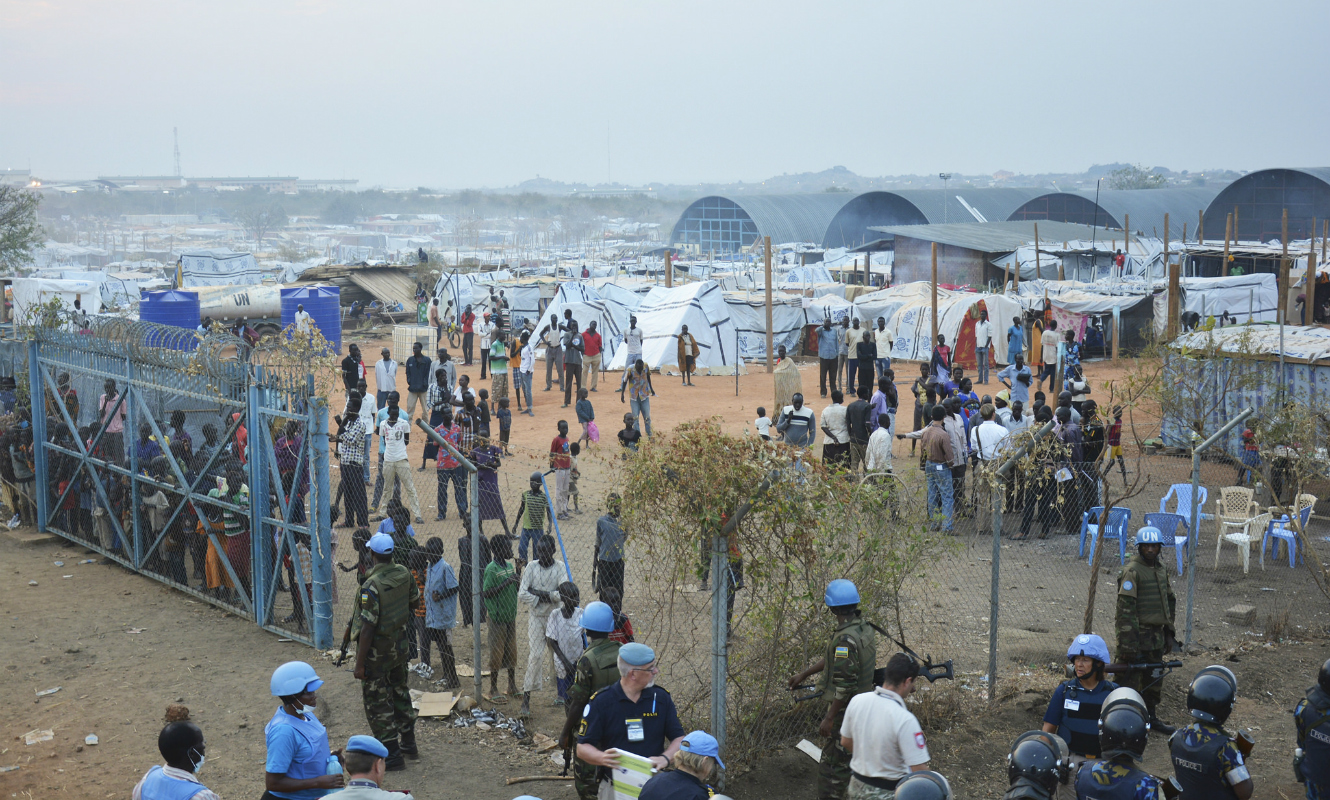
CAN PEACEKEEPING WORK? THE ENORMITY OF THE CHALLENGE IN SOUTH SUDAN
An executive’s guide to machine learning
It’s no longer the preserve of artificial-intelligence researchers and born-digital companies like Amazon, Google, and Netflix.
June 2015 | byDorian Pyle and Cristina San Jose
Machine learning is based on algorithms that can learn from data without relying on rules-based programming. It came into its own as a scientific discipline in the late 1990s as steady advances in digitization and cheap computing power enabled data scientists to stop building finished models and instead train computers to do so. The unmanageable volume and complexity of the big data that the world is now swimming in have increased the potential of machine learning—and the need for it.
In 2007 Fei-Fei Li, the head of Stanford’s Artificial Intelligence Lab, gave up trying to program computers to recognize objects and began labeling the millions of raw images that a child might encounter by age three and feeding them to computers. By being shown thousands and thousands of labeled data sets with instances of, say, a cat, the machine could shape its own rules for deciding whether a particular set of digital pixels was, in fact, a cat.1 Last November, Li’s team unveiled a program that identifies the visual elements of any picture with a high degree of accuracy. IBM’s Watson machine relied on a similar self-generated scoring system among hundreds of potential answers to crush the world’s best Jeopardy! players in 2011.
Dazzling as such feats are, machine learning is nothing like learning in the human sense (yet). But what it already does extraordinarily well—and will get better at—is relentlessly chewing through any amount of data and every combination of variables. Because machine learning’s emergence as a mainstream management tool is relatively recent, it often raises questions. In this article, we’ve posed some that we often hear and answered them in a way we hope will be useful for any executive. Now is the time to grapple with these issues, because the competitive significance of business models turbocharged by machine learning is poised to surge. Indeed, management author Ram Charan suggests that “any organization that is not a math house now or is unable to become one soon is already a legacy company.2
1. How are traditional industries using machine learning to gather fresh business insights?
A look at the 5th Gen-enabled Air Combat Force Airpower & the Hybrid Threat
BY ROBBIN LAIRD, © 2015 FrontLine Defence (Vol 12, No 6)
Counter-insurgency (COIN) warfare has been the dominant template in U.S. military engagements for more than a decade. Joint warfare has been largely defined in terms of the air and naval services supporting the ground forces doing COIN.
COIN has become so dominate that the key elements of a fighting force have been crafted in its image with slow motion warfare, hierarchical C2, implementation of the OOLDA (Observe, Orient, Legally Review, Decide, and Act) loop which adds a review component to the previous quick-action OODA, K-Mart type of logistics support capabilities, significant numbers of Forward Operating Bases in the battlespace, and uncontested and uncontestable air space.
Sept 2015 – U.S. Air Force F-22 Raptor takes off from Spangdahlem Air Base, Germany, on a training sortie. The USAF has deployed four F-22 Raptors, one C-17 Globemaster III, some 60 Airmen, and associated equipment. The F-22s will also forward deploy from Germany to maximize training opportunities while demonstrating its commitment to NATO allies and to the security of Europe. (U.S. Air Force photo by Tech Sgt Jason Robertson)
In a recent commentary by Francis Tusa, the age of COIN has been decisively replaced by the demands of what he refers to as hybrid warfare. “How much more hybrid can you get than the current situation over Syria?” he wrote. “The ‘traditional’ view of hybrid warfare is an enemy who exhibits elements of different parts of the conflict spectrum – some cyber, some conventional, some guerrilla,” he explained.
“But look at what US/French (and soon British…?) forces face over Syria today: a low level insurgent threat, which can exhibit some higher level capabilities, and then a very high intensity threat from Russian SAMs and combat aircraft. Not a hybrid threat from one foe, but made up of different enemies. That really is hybrid!”
Airpower in this context needs to seamlessly operate in all airspace – uncontested, contestable and contested. For the USAF, the coming of age of the F-22 provides a very flexible capability that enables the air combat force to operate in the quick turn quality of modern warfare.