Perhaps Walmart’s $16 billion acquisition of India’s online shopping leader Flipkart this summer was the last straw. Soon after the massive deal was signed, journalists got a look at a draft proposal for a new e-commerce policy from the central government. Suddenly India seemed prepared to follow China’s playbook: Measures that appeared to be copied straight from Beijing included closing loopholes permitting foreign ownership and requiring firms to store Indian consumer data in country and make it accessible to the government. All this and more, the proposal asserted, is needed to “level the playing field,” “encourage domestic innovation,” and give India’s tech companies an opportunity to flourish.The Profession of Arms: A Guide for Young Army Officers
It takes courage, especially for a young officer, to check a man met on the road for not saluting properly or for slovenly appearance, but, every time he does, it adds to his stock of moral courage, and whatever the soldier may say, he has respect for the officer who does pull him up.
Read Document →The Dragon's Teeth: Assessing China's Military Modernization
PLA has focused on modernising its capabilities across all warfare domains to achieve these goals. This includes land, air, and maritime operations, nuclear, space, counter-space, electronic warfare and cyberspace operations, aiming to become a fully integrated joint force.
Read Document →Transforming the PLA: A Decade of reorganisation from SSF to ISF
PRC has engaged in a sustained and broad effort to transform the PLA from an infantry-heavy, low-technology, ground forces-centric military into a high-technology, networked force with an increasing emphasis on joint operations and naval and air power projection.
Read Document →Eyes without Borders: Exploring the World of Open Source Intelligence (OSINT) in the Digital Age
Open Source Intelligence (OSINT) is gaining prominence with the rise of social media, the digital society and the vast growth of publicly and commercially available information (PAI and CAI).
Read Document →
The PLA’s Developing Cyber Warfare Capabilities and India's Options
Informationised warfare blurs the lines between peacetime and wartime. A nation in the information age cannot wait for the hostilities to break out to collect intelligence, carryout influence operations, develop antisatellite systems or design computer software weapons.
Read Document →
Galwan and After
Why did China did this when he is under tremendous pressure in all fronts, is this China's salami slice tactics being progressed rigorously, what will be new Rules of Engagement, what will be escalatory control mechanism, who has taken this decision, will there be some pressure put by China in India's North-East through insurgency.
Read Document →
India’s Joint Doctrine for Cyberspace Operations: A Critical Review
Chief of Defence Staff (CDS) General Anil Chauhan and Secretary, Department of Military Affairs, formally released declassified versions of the Joint Doctrines for Cyberspace Operations during the Chiefs of Staff Committee meeting in New Delhi.
Read Document →
Know your Enemy General(now Field Marshal) Syed Aseem Munir
Gen SA Munir's position in the hierarchy of Pakistan was not very comfortable. The state of economy, insurgency in Pakhtoonistan and Balochistan, attack on the Jaffar Express, constant protests by supporters of Imran Khan's supporters inside and outside of parliament.
Read Document →
Decoding Operation SINDOOR: Key Aspects and Implications
Precision strikes were carried out on nine sites—four in Pakistan and five in PoK—linked to anti-India terrorist groups such as the LeT, JeM and the Hizbul Mujahideen. The targeted sites included Muridke (LeT headquarters) and Bahawalpur (JeM headquarters).
Read Document →
Chinese Cyber Exploitation in India's Power Grid - Is There a linkage to Mumbai Power Outage?
The New York Times (NYT), based on analysis by a U.S. based private intelligence firm Recorded Future, reported that a Chinese entity penetrated India’s power grid at multiple load dispatch points. Chinese malware intruded into the control systems that manage electric supply across India, along with a high-voltage transmission substation and a coal-fired power plant
Read Document →23 October 2018
India’s Sleeping Tech Giants Are About to Awaken
Perhaps Walmart’s $16 billion acquisition of India’s online shopping leader Flipkart this summer was the last straw. Soon after the massive deal was signed, journalists got a look at a draft proposal for a new e-commerce policy from the central government. Suddenly India seemed prepared to follow China’s playbook: Measures that appeared to be copied straight from Beijing included closing loopholes permitting foreign ownership and requiring firms to store Indian consumer data in country and make it accessible to the government. All this and more, the proposal asserted, is needed to “level the playing field,” “encourage domestic innovation,” and give India’s tech companies an opportunity to flourish.Opinion | A new process for peace in central India
In his Nobel Memorial Prize lecture, entitled ‘War and Peace’, game theorist Robert Aumann emphasizes that characterizations of war as irrational may only serve to prolong conflict. Violent conflict has to be understood as a rational, albeit painful, response to certain incentives. He also demonstrates that peace can emerge, even with selfish parties involved, through a process of long-term interaction, provided the parties have a sufficiently low discount rate—they do not inordinately prioritize present gains over future benefits. He memorably writes, “If you want peace now, you may well never get peace. But if you have time—if you can wait … then you may get peace now.”Infosys Built Its Global Machine With Indian Workers. Can It Adjust to Trump’s ‘Hire American’?
When Infosys, a big Indian technology outsourcing company, opened a new office in Indianapolis this year, executives hailed it as a step along a new path. Infosys built itself into a global giant by running the digital engine rooms of American corporations with armies of engineers in India. But the new technology center — a sprawling open-plan space in a downtown office tower — is in the epicenter of the American Midwest. And its recruits are people like Keith Smith Jr., a graduate of Indiana University, who previously held a variety of jobs before Infosys trained him as a software engineer. Ravi Kumar, a president of Infosys, described the office as “a manifestation of what the future is going to look like.”Saudi Investment in Pakistan Could Yield Global Returns
SOUTH ASIA INTELLIGENCE REVIEW [SAIR]
A Sting Operation Lifts the Lid on Chinese Espionage
China and others, such as Russia, will continue their attempts to acquire intelligence as they strive to achieve technological parity with the West. Because it is faster and cheaper to steal technology than develop it from scratch, Western companies, universities and other organizations will remain prime targets. Although the Chinese operative at the center of the latest case has been captured, the high stakes involved mean that the arrest will do little to curb the persistent threat of industrial espionage.China Risks a Backlash to Secure a Western Buffer
In recent years, China has intensified its security crackdown on Uighur Muslims and other minority groups in Xinjiang as part of its efforts to control the strategic region, but the move has drawn international criticism. Now, the United States is weighing whether to impose human right sanctions as part of its campaign against China. International criticism is growing against China over its crackdown on Uighur Muslims and other minority groups in the western province of Xinjiang — and now there are rumblings that Washington could impose targeted sanctions against Beijing as peer competition grows. The White House reportedly is considering all its options to increase pressure on China, including sanctions on human rights grounds that could cause wider international ramifications.Chinese Anti-Submarine Warfare: Aviation Platforms, Strategy, and Doctrine
This is the second piece in a two part article evaluating the anti-submarine warfare (ASW) capabilities of the Chinese People’s Liberation Army Navy (PLAN). The first piece documented the PLAN’s significant recent growth in capable ASW surface combatants, with many of those warships equipped with capable organic ASW sensor suites including variable depth sonar (VDS) and towed array sonar systems (TASS). Frigates (FFGs) and destroyers (DDGs) also have organic ASW weapons, such as vertically launched missile/rocket launched torpedo systems. This piece will consider the rotary and fixed wing ASW capabilities the PLAN currently has and their trajectory, as well as briefly describing some of the other specialized ASW assets that the PLAN is developing. Finally, all of the aforementioned systems and platforms will be brought together to consider what an overall PLAN ASW strategy may look like.How China’s AI Technology Exports Are Seeding Surveillance Societies Globally
A First: China, EU Launch New Combined Military Exercise
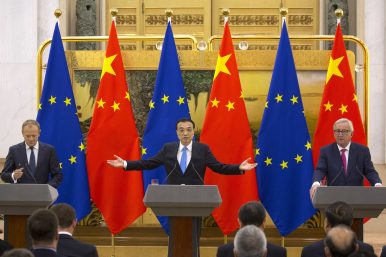
For the first time, as announced on October 16, European Union military forces have completed a combined exercise with the People’s Liberation Army Navy (PLAN). While European Union Naval Force (EU NAVFOR) interactions with the PLAN in the Gulf of Aden are not entirely new, this exercise indicates an unprecedented level of coordination between European and Chinese naval forces. Set in the current geopolitical context, this new development merits attention for activity not only in the Gulf of Aden, but also in the Mediterranean Sea.DoD knows future terror groups will seek to copy ISIS, turn social media into a weapon
#AllEyesOnISIS became a viral propaganda machine that inspired followers, generated bots and is credited in part with driving enough fear to lead thousands of U.S.-trained and equipped Iraqi forces to abandon their posts. The organization fed that fear and gained followers by broadcasting terrifying orange suit-black hood beheadings, terror attacks or the obscene cruelties awaiting anyone in their path.How a Journalist's Disappearance Could Affect U.S.-Saudi Ties
Crossing Borders: How the Migration Crisis Transformed Europe’s External Policy
AMERICA DOESN’T NEED ALLIES WHO TORTURE AND MURDER JOURNALISTS | OPINION
How to Save Globalization
What Does Mattis’ Visit Reveal About US-Vietnam Defense Ties Under Trump?
This week, U.S. Defense Secretary Jim Mattis embarked on a visit to Vietnam. Though the headlines focused on the development itself, its significance should be understood in the broader context of U.S.-Vietnam defense ties, which have continued to deepen during the Trump administration despite lingering concerns.What Concerns Japan in the Pacific?
On a visit to New Zealand this week Japan’s foreign minister, Taro Kono, expressed his concerns — alongside New Zealand Foreign Minister Winston Peters — about the high levels of debt being accumulated by some Pacific Island states. While being careful not to mention China, Kono’s comments were clearly aimed at Beijing’s lending practices in the region. The fear is that some Pacific states are accumulating unsustainable debt burdens to China, which could make them beholden to Chinese interests. The 99-year lease that China now has on Sri Lanka’s Hambantota Port is seen as an example of what may be the consequences of these debts owed to Beijing. This is of obvious concern to Australia and New Zealand, which are in the process of adapting their Pacific strategies to accommodate increased regional engagement from China. But is also of significant interest to Japan, a country that remains a highly active actor in the region, and is wary of the shifts in the international order occurring due to China’s rise.Europe’s Migration Maelstrom & Its Political Tides
Rebuilding Strategic Thinking
Differences Between AI and Machine Learning and Why it Matters
This past week, while exploring the most recent press on artificial intelligence, I stumbled upon an organization that professed to utilize “AI and machine learning” to gather and examine thousands of users’ data to enhance the user experience in versatile mobile applications. Around the same time, I read about another organization that anticipated customer behavior using “a blend of machine learning and AI” along “AI-powered forecasting analytics.” (I will abstain from naming the organizations in order to not disgrace them, since I somewhat “trust” their SaaS may tackle genuine issues, regardless of whether they are advertising their products deceptively.)Eisenhower On ‘Leading From Within’ And The Art Of Collaborative Leadership
“NEEDED–AN EMP MANHATTAN PROJECT” GRAHAM-PRY ARTICLE
Here’s when industry can expect to hear more on the Army’s tactical cloud
Source Link
The Army plans to respond to more than 70 proposals from industry on how to best take advantage of the tactical cloud before the end of the year. As part of the service’s efforts to modernize its tactical communications and network, the program office and the network cross functional team hosted an industry day in August in Raleigh, North Carolina. Army leaders discussed how to tell industry about the service’s goals and to learn more about what industry can offer. The Army is setting its sights on tactical cloud computing as it continues to modernize its network.
Army officials described the industry day as market research, noting that contracts might not come out of it.
‘A Perfect Harmony Of Intense Violence’: Army Chief Milley On Future War
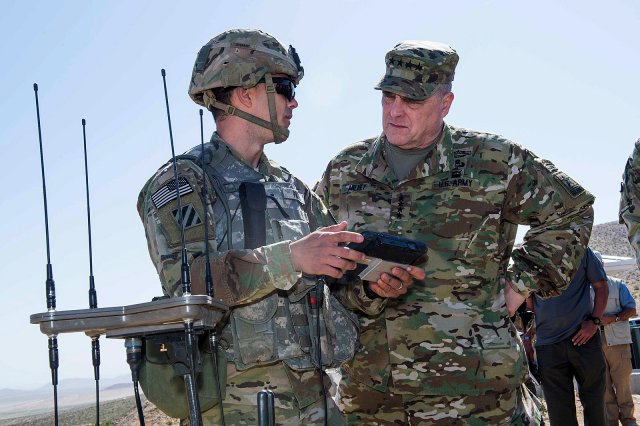
AUSA: How will the US fight the next war? Today, the Army’s top general declared that the military means “to shift from battles of attrition to battles of cognition, where we think, direct, and act at speeds the enemy cannot match in order to achieve a perfect harmony of intense violence.” The goal is to combine US forces on land, sea, air, space, and cyberspace in a seamless multi-domain operation, assailing the enemy from all sides at once until they’re overwhelmed.The Weaponization of Airspace
On September 25, 2018, U.S. President Donald J. Trump addressed the 73rd session of the United Nations General Assembly. Standing before arguably the world’s most representative international body, Trump rejected the “ideology of globalism” and offered the alternative “doctrine of patriotism” wherein “responsible nations” must defend against “threats to sovereignty” from “global governance” and other “new forms of coercion and domination.” Despite laughter from world leaders, Trump spoke without irony. In fact, the president’s call for a muscular nationalism – drawing on the “powerful love for your nation” and “intense loyalty to your homeland” – has found an audience. The argument for individualized homelands has a long history, of course. But Trump’s sovereignty mission goes even further, demanding the fencing-off of international relations and a devolution of global politics. In this regard, the United States is becoming the first among equals in revisionist powers.